Connect with us
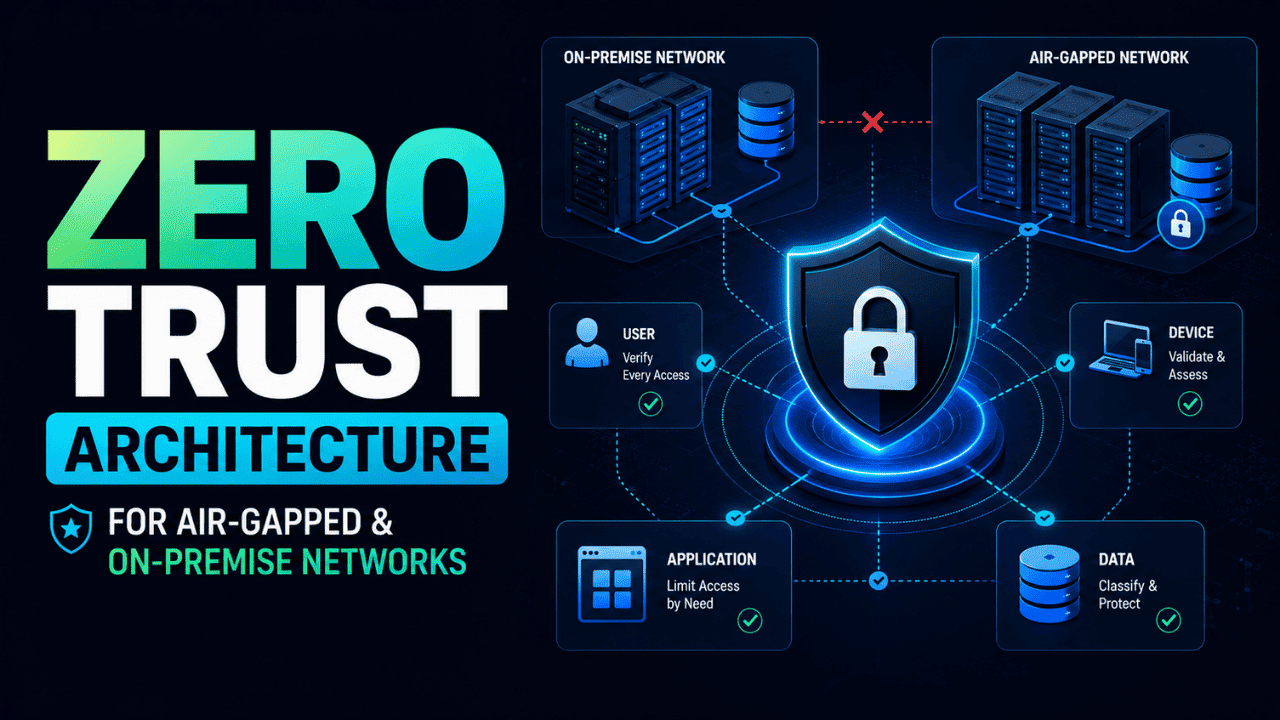
Zero Trust Architecture for Air-Gapped and On-Premise Environments
Zero trust architecture is a security model that treats every user, device, and connection as untrusted by default, requiring verification before granting access, regardless of whether that request comes from inside or outside the network. Most articles on zero trust talk about it purely as a cloud security strategy, built around identity providers, SaaS applications, and internet-facing perimeters. That framing leaves out a large and important category of environments: air-gapped networks and on-premise systems, where there's no cloud identity provider to lean on and no public internet connection to secure in the first place. For defence, government, and other high-security organizations running isolated infrastructure, applying zero trust correctly looks very different, and gets misunderstood far more often.
This guide breaks down what zero trust actually means inside isolated environments, why "air-gapped" doesn't automatically mean "secure," and how to apply zero trust principles when you can't rely on the internet-based tools most zero trust guidance assumes you have.
What Is Zero Trust Architecture (and Why It's Misunderstood in Isolated Environments)
Zero trust architecture, as formally defined in NIST's zero trust framework, is a set of cybersecurity principles that move defenses away from static, network-based perimeters and toward continuous verification of users, devices, and resources. In practice, this means no device or user is trusted simply because it's already inside the network boundary, every access request is evaluated on its own merits.
The misunderstanding happens because most zero trust content assumes a cloud-connected enterprise: single sign-on providers, SaaS identity platforms, and continuous internet connectivity to check device posture in real time. Air-gapped and on-premise environments don't have any of that by default. Teams sometimes conclude that zero trust simply doesn't apply to isolated networks, or that being physically disconnected from the internet already satisfies the "zero trust" bar. Neither is true. Zero trust is a set of principles, not a specific cloud product, and those principles can, and should, be implemented entirely within an isolated network.
The "Never Trust, Always Verify" Principle Explained
The phrase "never trust, always verify" captures the core idea behind zero trust: trust is never assumed based on network location, and every access request is authenticated and authorized independently, every time. In a traditional perimeter-based security model, once a user or device gets past the firewall, it's largely trusted to move freely within the internal network. Zero trust rejects that assumption entirely.
Applied practically, this means a user who successfully authenticates once shouldn't automatically retain broad access to every system on the network. Each request to access a specific resource, a file server, a messaging platform, an administrative console, gets evaluated against identity, device health, and defined permissions at that moment. This matters enormously in isolated networks, where a single compromised device or insider threat can otherwise move laterally without resistance, since there's no cloud-based monitoring layer watching for anomalies from the outside.
Why Air-Gapped is Not Equal to Automatically Secure
Air-gapped networks are physically or logically disconnected from the public internet, which eliminates an entire category of external attack vectors. But air-gapping addresses network isolation, it does nothing to prevent insider threats, compromised removable media, supply chain vulnerabilities in hardware or software, or lateral movement once an attacker (or infected device) is already inside the perimeter.
Historical incidents involving air-gapped industrial and government systems have repeatedly shown that isolation from the internet is not equivalent to isolation from risk. Malware has been introduced via USB drives, contractors have carried compromised laptops into secure facilities, and legitimate credentials have been misused by insiders with more access than their role required. An air-gapped network that grants broad, implicit trust to anyone who's physically connected to it is still vulnerable to exactly the kind of lateral movement zero trust is designed to prevent, it's just vulnerable to a narrower set of entry points.
This is precisely why zero trust matters as much inside an air-gapped environment as it does in a cloud-connected one. The threat surface changes; the underlying need for continuous verification doesn't.
Applying Zero Trust Principles Without Internet-Based Identity Providers
Most commercial zero trust tooling assumes a connection to a cloud identity provider for real-time authentication decisions. Isolated networks need an alternative approach that keeps every zero trust principle intact using infrastructure the organization fully controls.
This typically means running a local identity and access management system, such as an internal LDAP or Active Directory instance, entirely within the isolated network, so authentication decisions never depend on external connectivity. Local certificate authorities can issue and validate device and user certificates without needing to reach an internet-based certificate provider. Locally hosted logging and monitoring replace cloud-based security information and event management tools, ensuring audit trails and anomaly detection still function without any outbound connection.
The principle stays the same as in cloud environments, verify identity, check device health, enforce least privilege, but every verification mechanism has to be self-contained. This is achievable, and increasingly common in defence and government deployments, but it requires deliberate architecture rather than simply installing a SaaS zero trust product and expecting it to work offline.
Core Components: MFA, Least Privilege, Device Health Checks, Micro-segmentation
Four components form the practical backbone of zero trust in any environment, isolated or otherwise.
Multi-factor authentication (MFA) ensures that identity verification doesn't rely on a single credential. In isolated networks, this usually means hardware tokens or locally validated biometrics rather than SMS or app-based codes that depend on internet connectivity.
Least privilege access means every user and system account gets only the minimum permissions necessary to perform its function, nothing more. This limits the blast radius if any single account is compromised, whether by an external attacker or an insider misusing legitimate access.
Device health checks verify that a connecting device meets security requirements, current patches, no known malware, approved configuration, before granting access, rather than trusting any device simply because it's physically present on the network.
Micro-segmentation divides the network into small, isolated zones so that a breach in one segment doesn't automatically grant access to others. Instead of one flat internal network where lateral movement is trivial, micro-segmentation forces every cross-zone request through the same verification process as an external one.
Together, these four components turn zero trust from a slogan into an enforceable architecture, one where compromising a single device or credential doesn't cascade into full network access.
Zero Trust for On-Premise Communication Systems
Communication platforms deserve particular attention in a zero trust implementation, because messaging, calling, and file-sharing tools often carry the most operationally sensitive data an organization handles, and they're frequently treated as "internal" and therefore implicitly trusted. That assumption is exactly what zero trust exists to eliminate.
For on-premise communication systems specifically, zero trust means every user authenticating into the messaging platform is verified independently, regardless of whether they're connecting from within the same building or a remote facility on the same private network. It means role-based access controls determine who can see which conversations and files, rather than defaulting to open visibility once someone is logged in. And it means every administrative action, adding a user, changing a permission, exporting a conversation log, is authenticated and logged, since administrative accounts are often the highest-value target for anyone trying to move laterally through a system.
This approach directly mirrors how defence communication networks increasingly operate, where every access request to the network is fully authenticated, authorized, and encrypted before it's granted, preventing an attacker who compromises a single device from moving freely to intercept or manipulate other conversations on the same system.
Common Pitfalls When Implementing Zero Trust in Isolated Networks
Even well-intentioned zero trust rollouts in isolated environments run into predictable mistakes.
The most common is treating air-gapping itself as sufficient security, and skipping identity verification and access segmentation because "the network is already isolated." This leaves the door wide open to insider threats and the kind of lateral movement described in this breakdown of military communication risks, where a single intercepted or compromised device can expose an entire command structure once inside a perimeter.
A second pitfall is over-relying on legacy perimeter thinking even after adopting zero trust language. Some organizations rebrand their existing firewall-and-VPN setup as "zero trust" without actually implementing continuous verification, least privilege, or micro-segmentation, creating a false sense of security that a real audit or incident response process will quickly expose.
A third is neglecting device health and patch management simply because devices aren't internet-connected. Isolated networks still need rigorous, if manual, processes for verifying that connected devices are patched and free of known vulnerabilities, since the absence of internet connectivity doesn't mean the absence of software flaws.
Finally, many organizations underestimate the importance of detailed local logging. Without cloud-based SIEM tools, it's tempting to under-invest in monitoring, but this is precisely the layer that lets an organization detect and respond to a breach, or prove compliance during a security review, as emphasized in CISA's guidance on zero trust.
How Troop Messenger Enables Zero Trust Principles On-Premise
Troop Messenger's self-hosted deployment model gives organizations the infrastructure needed to apply zero trust principles without depending on any external cloud identity provider. Authentication can be tied to an internal LDAP or Active Directory system running entirely within the isolated network, and role-based access controls determine exactly which users can view specific conversations, groups, or files, rather than granting broad access by default. This mirrors the access-governance approach used across defence communication deployments, where every request for access is authenticated and authorized before it's granted, reducing the risk that a single compromised account or device can move laterally through the system.
Federal agencies formalizing this approach can also reference the NSA's zero trust guidelines, which outline the overarching guidance for achieving a target-level zero trust architecture. The result is a communication platform that can be deployed fully within a controlled, self-hosted environment while still enforcing the "never trust, always verify" discipline that zero trust architecture requires.
Conclusion
Zero trust architecture isn't a cloud-only concept, it's a set of principles that apply just as urgently, and arguably more urgently, inside air-gapped and on-premise environments where a single compromised device or insider can otherwise move freely. Getting it right means resisting the assumption that physical isolation equals security, building identity and access management that works entirely without internet connectivity, and treating communication systems as a first-class target for zero trust controls rather than an afterthought. Organizations that combine strong isolation with genuine zero trust discipline, MFA, least privilege, device health checks, micro-segmentation, and thorough local logging, end up with defenses that hold up under both external attack and insider risk, which is exactly the standard defence and government communication systems need to meet.
Frequently Asked Questions
Q1. Is zero trust necessary for air-gapped networks?
Yes. Air-gapping removes internet-based attack vectors but doesn't prevent insider threats, compromised removable media, or lateral movement once someone has physical or credential-based access. Zero trust principles, verifying every user and device, enforcing least privilege, and segmenting the network, address exactly these risks, which air-gapping alone cannot.
Q2. Can zero trust work without a cloud identity provider?
Absolutely. Isolated networks can implement zero trust using locally hosted identity systems, internal certificate authorities, and on-premise logging tools. The core principles, continuous verification, least privilege, device health checks, don't require internet connectivity, only deliberate architecture built entirely within the organization's controlled infrastructure.
Q3. What's the difference between zero trust and a traditional firewall setup?
Traditional firewalls grant broad trust to anything inside the network perimeter once initial access is verified. Zero trust eliminates that implicit trust entirely, requiring continuous authentication and authorization for every access request, regardless of network location, which prevents lateral movement after a single point of compromise.
Q4. How does zero trust apply to defence communication systems specifically?
Defence communication systems carry highly sensitive operational data, making them prime targets for lateral movement after any breach. Zero trust ensures every user and device accessing the messaging platform is independently verified, role-based permissions limit who sees what, and administrative actions are logged, preventing a single compromised account from exposing the entire communication network.
Q5. Does implementing zero trust require replacing existing on-premise infrastructure?
Not necessarily. Zero trust can often be layered onto existing on-premise systems by adding identity verification, role-based access controls, micro-segmentation, and improved logging, rather than a full infrastructure replacement. The key is ensuring these controls are genuinely enforced, not just rebranded around an unchanged perimeter-based setup.