Connect with us
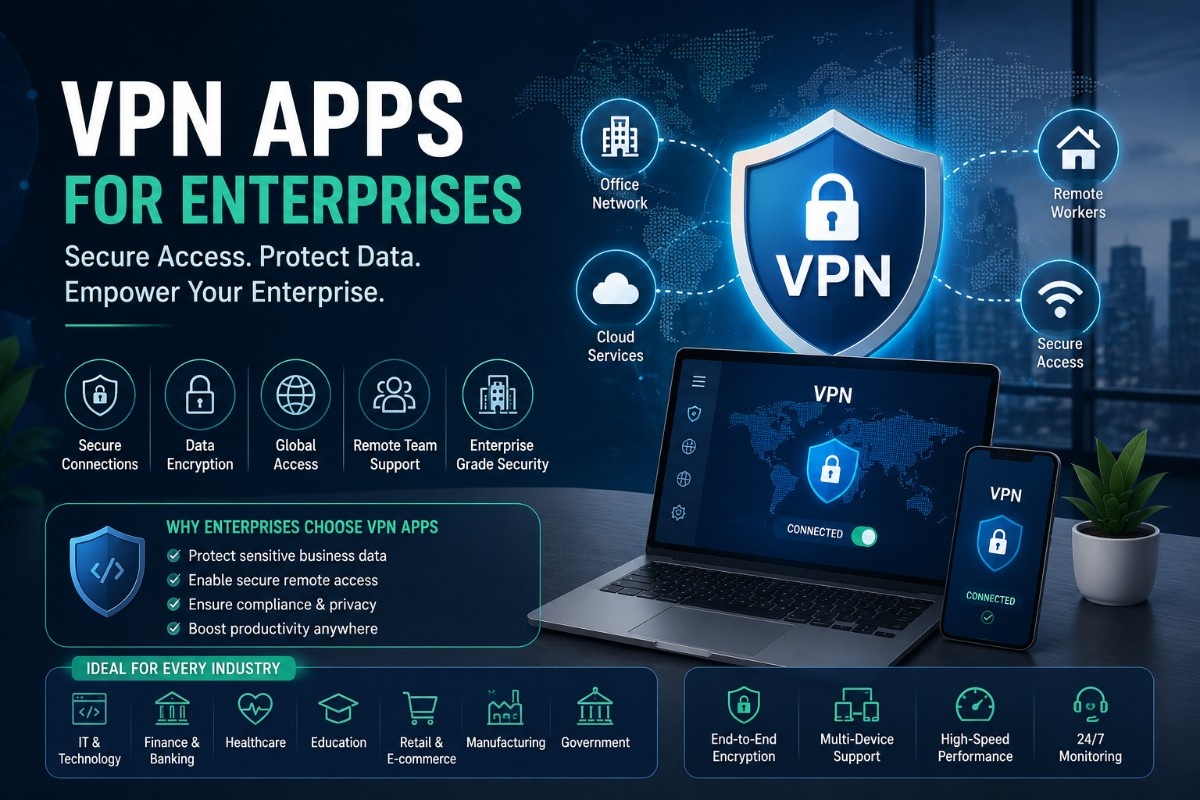
Top VPN Apps for Enterprises — Best Picks for Security and Remote Access
VPN apps for enterprises are secure business networking solutions that protect company data while enabling employees to safely access internal systems from anywhere. Unlike consumer VPNs designed for personal privacy, enterprise VPN apps provide advanced security features such as encrypted connections, centralized user management, identity authentication, and role-based access controls. These solutions help organizations support remote and hybrid work, protect sensitive business information, and meet industry compliance requirements. In this guide, you'll learn what enterprise VPN apps are, how they work, their key features, and the best VPN solutions for secure remote access.
What Is an Enterprise VPN and Why Do Businesses Need One
An enterprise VPN creates an encrypted tunnel between a user's device and the corporate network , or a specific application , ensuring that data transmitted over public or unsecured connections cannot be intercepted, read, or manipulated by third parties.
Businesses need enterprise VPNs for several reasons:
- Remote and hybrid workforce security — Remote and hybrid workforce, employees working from home, cafes, hotels, or client sites expose corporate data to unsecured networks without a VPN
- Regulatory compliance — industries including healthcare, finance, and government require encrypted data transmission as part of HIPAA, PCI-DSS, and other compliance frameworks
- Network access control — enterprise VPNs restrict which users can access which systems, enforcing least-privilege principles across the organization
- Branch office connectivity — site-to-site VPN configurations securely connect multiple office locations over the internet without dedicated leased lines
- BYOD security — employee-owned devices connecting to corporate networks need a secure, managed access layer to prevent data leakage
Key Features to Look for in VPN Apps for Enterprises
Not all enterprise VPN apps are equal. When evaluating enterprise VPN solutions, IT teams should prioritize multi-factor authentication, secure VPN protocols, strong encryption, least-privilege access, split-tunneling controls, DNS leak protection, and zero-trust capabilities.
Additional features that matter for enterprise deployments:
- Centralized management console — administrators need to manage users, devices, policies, and audit logs from a single dashboard without switching between systems
- SSO integration — seamless single sign-on with identity providers like Azure AD, Okta, or Google Workspace reduces friction for users and strengthens authentication
- Scalability — the solution must scale from dozens to thousands of users without requiring infrastructure rebuilds
- Cross-platform support — Windows, macOS, Linux, iOS, and Android coverage ensures no device type is left outside the security perimeter
- Kill switch — automatically cuts internet access if the VPN connection drops, preventing accidental exposure of unencrypted traffic
- Compliance certifications — SOC 2 Type II, ISO 27001, and HIPAA compliance documents matter for enterprise procurement and audit readiness
Top VPN Apps for Enterprises in 2026
The top enterprise VPN solutions as ranked by IT professionals in 2026 include OpenVPN Access Server, Fortinet FortiClient, Tailscale, Check Point Remote Access VPN, and Prisma Access by Palo Alto Networks. Here is a detailed breakdown of the leading options:
Cisco Secure Client (formerly AnyConnect) — Cisco Secure Client , the most widely deployed enterprise VPN globally. Cisco's posture enforcement blocks non-compliant devices before connection, with native integration with Duo, ISE, and Umbrella for unified security, and cross-platform support covering Windows, Mac, Linux, Android, and iOS. Best for organizations already invested in Cisco's security ecosystem.
NordLayer — for companies scaling from a handful of remote employees to hundreds, NordLayer hits the sweet spot: cloud simple, security-forward, and priced so finance signs off on the first pass. NordLayer offers three levels of service with pricing ranging from $8 to $14 per month per user annually, with enterprise solutions customizable for organizations with 50 or more users.
Prisma Access by Palo Alto Networks — Prisma Access delivers unified security policies across on-site and remote workers through firewall integration, distributes traffic across multiple gateways automatically for scale, and supports step-up MFA for sensitive applications. Best for large enterprises requiring advanced zero-trust security.
Zscaler Private Access (ZPA) — Zscaler Private Access replaces traditional VPNs with cloud-delivered, application-level access, built for large enterprises with hybrid workforces, multi-cloud environments, and diverse device fleets including BYOD and IoT.
OpenVPN Access Server — OpenVPN Access Server provides secure remote access to internal networks, offering ease of setup, strong encryption, and cost-effectiveness. Widely used by technical teams who need open-source flexibility and self-hosted control.
Tailscale — Tailscale enables secure mesh networking, allowing devices to connect without static IPs or port forwarding, with key features including MagicDNS, Access Control Lists, and Zero Trust networking with multi-factor authentication.
Fortinet FortiClient — Fortinet FortiClient is used for VPN access, endpoint protection, and security management, enabling remote work and secure communication. Best for organizations already running Fortinet firewalls.
Best Enterprise VPN for Remote Teams
For teams that are fully or primarily remote, the most important VPN characteristics are connection reliability, ease of use for non-technical employees, and fast performance that does not slow down daily work.
NordLayer and Tailscale lead this category. NordLayer's intuitive management console means IT administrators can onboard new remote employees quickly, enforce policies consistently, and monitor connection health without deep networking expertise. Tailscale's mesh networking model removes the bottleneck of traffic routing through a central gateway, a significant performance advantage for large, geographically distributed remote teams.
For remote teams that also need strong internal communication alongside secure network access, pairing an enterprise VPN with a dedicated team messaging platform like Troop Messenger , which supports on-premise deployment for complete data control , ensures both network-layer and communication-layer security are covered.
Best VPN for Large Organizations and Corporate Networks
Large enterprises with thousands of users across multiple sites need VPN solutions that can handle scale without compromising performance or manageability. Cisco Secure Client and Prisma Access by Palo Alto Networks dominate this category.
Cisco's deep integration with enterprise identity, endpoint, and firewall systems makes it the default choice for large organizations already running Cisco infrastructure. Palo Alto's Prisma Access suits enterprises moving to cloud-first architectures delivering VPN and zero-trust access through a unified cloud platform rather than on-premise appliances that require ongoing hardware management.
Cloud VPN for Enterprises — How It Differs from Traditional VPN
Traditional VPNs route all traffic through an on-premise VPN gateway a hardware or software appliance that the IT team manages. Cloud VPNs deliver the same encrypted access through cloud infrastructure managed by the VPN provider.
Factor | Traditional VPN | Cloud VPN |
Infrastructure | On-premise hardware | Cloud-hosted |
Scalability | Limited by hardware capacity | Scales automatically |
Performance | IT team managed | Distributed, lower latency |
Cost model | Can bottleneck at gateway | Subscription per user |
Best for | Fixed office environments | Distributed and hybrid teams |
Because bandwidth scales automatically in the cloud, organizations never need to budget for appliances or pay for head-end upgrades. For most enterprises moving toward hybrid work models, cloud VPN delivers better performance and lower operational overhead than maintaining on-premise VPN infrastructure.
VPN Apps for Enterprise Security — What IT Teams Should Know
Enterprise VPN is one layer in a broader security architecture not a complete security solution on its own. IT teams should understand:
Zero Trust Network Access (ZTNA) is increasingly replacing traditional VPN for application-level access control. ZTNA grants access to specific applications rather than the entire network, reducing blast radius if credentials are compromised. Several enterprise VPN vendors now offer ZTNA capabilities alongside traditional VPN in unified platforms.
Split tunneling — configuring which traffic goes through the VPN and which goes directly to the internet is critical for performance. Routing all traffic through the VPN creates unnecessary latency for cloud apps that do not need corporate network access.
Endpoint compliance checks — enterprise VPN solutions should verify device health before granting access. A device that is unpatched, missing endpoint protection, or running unauthorized software should not receive the same network access as a compliant corporate device.
Enterprise VPN for Hybrid Work Environments
Hybrid work creates a security challenge that traditional perimeter-based security was not designed for , employees are inside and outside the corporate network on the same day, switching between home broadband, office WiFi, and mobile data.
Enterprise VPN addresses this by providing a consistent, encrypted access layer regardless of where employees connect from. The best hybrid work VPN solutions offer:
- Automatic connection when the device leaves a trusted network
- Split tunneling that optimizes performance for cloud applications
- Device posture checks that enforce security policy regardless of location
- SSO integration that provides seamless login without separate VPN credentials
Enterprise VPN vs Consumer VPN — Key Differences
Enterprise VPNs and consumer VPNs serve completely different purposes. Consumer VPNs like NordVPN or ExpressVPN are built for individual privacy, geo-unblocking, and personal data protection , they offer no centralized management, no compliance documentation, no SSO integration, and no access control features. Enterprise VPNs are built for IT teams managing hundreds or thousands of users, enforcing security policies across devices, meeting regulatory compliance requirements, and integrating with corporate identity infrastructure. Using a consumer VPN for business purposes creates security gaps that enterprise-grade solutions are specifically designed to close.
How to Choose the Right VPN App for Your Enterprise
Work through these questions before selecting an enterprise VPN:
What is your primary use case? Remote employee access to internal systems, site-to-site office connectivity, and application-level zero-trust access each point toward different solutions.
What is your existing infrastructure? Cisco-native organizations benefit from AnyConnect's deep integration. Palo Alto shops get more value from Prisma Access. Cloud-first teams should evaluate NordLayer, Tailscale, or Zscaler.
What are your compliance requirements? Regulated industries need VPN vendors who can provide SOC 2 Type II reports, ISO 27001 certification, and HIPAA Business Associate Agreements as part of their enterprise offering.
What is your IT team's capacity? Self-hosted open-source solutions like OpenVPN offer maximum control but require engineering resources to deploy and maintain. Managed cloud VPNs reduce that overhead significantly.
How many users and devices do you need to support? Consider whether the platform can stretch from small teams to enterprise scale without a weekend rebuild, and whether it carries SOC 2 or ISO 27001 certifications.
Conclusion
Enterprise VPN is not a commodity purchase the right choice depends on your team size, infrastructure, compliance requirements, and how distributed your workforce actually is. For most growing businesses, cloud VPN solutions like NordLayer or Tailscale offer the best combination of security, simplicity, and scalability. For large enterprises with complex infrastructure, Cisco Secure Client or Prisma Access by Palo Alto Networks deliver the enterprise-grade depth that mission-critical environments demand. Whatever VPN you choose, it secures the network layer but your team still needs a secure, structured communication layer to go alongside it. Troop Messenger gives enterprise teams end-to-end encrypted messaging, voice and video calling, and on-premise deployment options that match the security standards your VPN is designed to protect.
Frequently Asked Questions
1. What is the best enterprise VPN in 2026?
The best enterprise VPN depends on your infrastructure and team size. Cisco Secure Client leads for large enterprises in Cisco ecosystems. NordLayer is the strongest choice for growing businesses needing cloud-simple management. Prisma Access by Palo Alto Networks suits enterprises requiring advanced zero-trust security across hybrid and multi-cloud environments.
2. What is the difference between an enterprise VPN and a consumer VPN?
Enterprise VPNs are built for centralized IT management, multi-user access control, compliance documentation, and SSO integration with identity providers. Consumer VPNs are designed for individual privacy and geo-unblocking they lack the management, compliance, and access control features that enterprise IT teams require.
3. What is a cloud VPN for enterprises?
A cloud VPN delivers encrypted network access through cloud infrastructure managed by the VPN provider, rather than through on-premise hardware. Cloud VPNs scale automatically, require no hardware maintenance, and perform better for distributed teams than traditional appliance-based VPN solutions.
4. What is Zero Trust Network Access and how does it relate to enterprise VPN?
Zero Trust Network Access (ZTNA) grants users access to specific applications rather than the entire corporate network reducing the blast radius of compromised credentials. Many enterprise VPN vendors now offer ZTNA capabilities alongside traditional VPN, and for large enterprises with cloud-first architectures, ZTNA is increasingly replacing traditional VPN entirely.
5. How much does enterprise VPN cost?
Enterprise VPN pricing varies by vendor and deployment model. NordLayer starts at $8 per user per month on annual plans. Cisco, Palo Alto, and Zscaler use custom enterprise pricing based on user count and feature set. Open-source solutions like OpenVPN Access Server have lower licensing costs but require internal resources to deploy and maintain.