Connect with us
Sovereign Cloud: What It Actually Means for Government & Defence
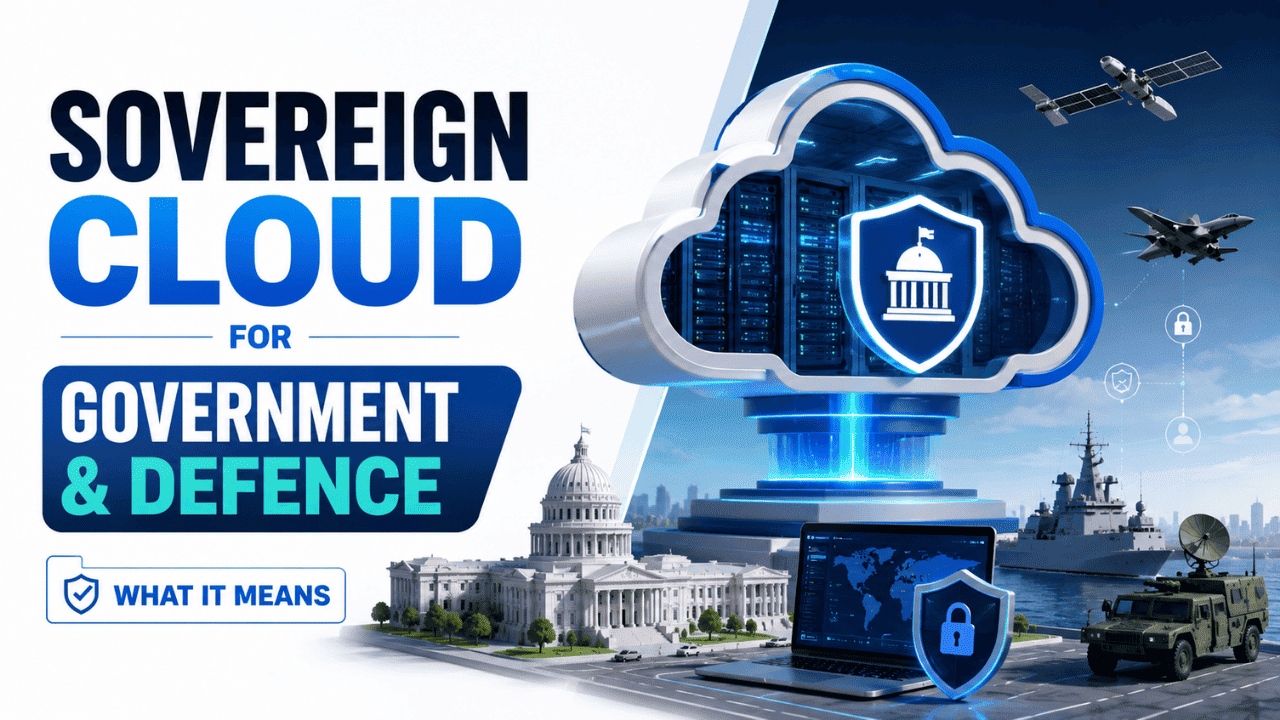
A sovereign cloud is a cloud computing environment designed to keep an organization's data, infrastructure, and operations under the legal and operational control of a specific country's jurisdiction. For government and defence organizations, this means sovereignty extends beyond where data is stored to who can access it, manage it, and which laws govern it.
When government IT teams and defence procurement officers hear the term "sovereign cloud," many assume it simply means data hosted inside national borders. That assumption is incomplete, and it's costing agencies real risk. A cloud can sit entirely inside your country's geography and still be operated by staff overseas, administered through infrastructure a foreign government can legally compel access to, or encrypted with keys a vendor controls remotely. True sovereignty is not a location on a map. It's a set of verifiable controls over who can touch your data, your infrastructure, and your communications, and for departments handling classified, operational, or citizen data, that distinction changes everything about how a cloud vendor should be evaluated.
This guide breaks down what sovereign cloud actually requires, why it matters more for communication and messaging systems than for general-purpose IT, and how to separate genuine sovereignty claims from marketing language.
What Does "Sovereign Cloud" Actually Mean?
A sovereign cloud is a cloud computing environment structured so that data, infrastructure, and operations remain under the legal and operational control of a specific jurisdiction, rather than being subject to the laws of a foreign country where the underlying provider is headquartered. This idea builds on the standard cloud deployment models first defined by the National Institute of Standards and Technology in its foundational cloud computing definition, which distinguishes private, community, public, and hybrid cloud based on who owns and controls the infrastructure.
The trouble is that "sovereign cloud" has no single, universally accepted definition across vendors, regulators, and countries. Some providers use the term to mean nothing more than "we have a data center in your country." Others build entirely separate operational stacks, with local staff, local key management, and contractual guarantees that foreign courts cannot compel data disclosure. For government and defence buyers, understanding which version you're actually being sold is the first and most important evaluation step.
Data Residency vs. Operational Sovereignty vs. Legal Sovereignty
These three terms get used interchangeably in vendor pitches, but they describe very different guarantees.
Data residency simply means your data is physically stored within a defined geographic boundary. It answers the question "where does my data sit?", and nothing more. Data can reside in-country and still be accessible to foreign support engineers, subject to a foreign parent company's legal obligations, or backed up to servers outside that boundary without your knowledge.
Operational sovereignty goes a step further. It asks who administers the infrastructure, which staff have login access, where those staff are physically located, and whether they're bound by your country's security clearance requirements rather than a vendor's internal policy.
Legal sovereignty is the deepest layer. It determines which country's courts and laws govern disputes over your data, and whether a foreign government can legally compel the vendor to hand over your information regardless of where it's stored. A cloud provider headquartered abroad can, in some circumstances, be legally required to disclose customer data even when that data physically resides in your country.
A genuinely sovereign deployment needs all three layers aligned. Missing even one creates a gap that undermines the entire premise of sovereignty.
Why Sovereignty Matters More for Communication Systems
Data storage sovereignty gets most of the attention in cloud sovereignty discussions, but communication and messaging systems carry a distinct risk that pure data-at-rest sovereignty doesn't address: metadata exposure.
Every message, call, and file transfer generates metadata, who spoke to whom, when, how often, and from where. Even when message content is fully encrypted, unprotected metadata can reveal command structures, operational patterns, and organizational hierarchies to anyone with access to the communication infrastructure. For defence and law enforcement agencies, this kind of traffic analysis can expose as much operational intelligence as the message content itself.
This is compounded by foreign-support access. Many commercial collaboration platforms route support tickets, system diagnostics, and administrative operations through globally distributed teams. If your secure messaging platform is hosted on infrastructure where foreign support staff can access logs, session data, or backend systems, even without reading message content directly, your sovereignty claim breaks down at the operational layer discussed above.
Gartner's research on cloud sovereignty requirements notes that organizations must weigh data sovereignty, operational independence and technological autonomy together rather than treating any single pillar as sufficient on its own, a framework that applies directly to evaluating secure communication platforms for government use.
The Four Pillars of Real Sovereignty
When evaluating any platform, cloud, hybrid, or on-premise, that claims sovereignty, four pillars determine whether that claim holds up under scrutiny.
Data sovereignty covers where data is stored, replicated, and backed up, and whether that location is contractually guaranteed rather than merely typical.
Operational sovereignty covers who can administer the system, support staff nationality, physical location, background checks, and whether emergency access procedures bypass normal controls.
Key and encryption sovereignty covers who generates, stores, and rotates the cryptographic keys protecting your data. If a vendor holds your encryption keys, they retain the technical ability to access your data regardless of any policy promising they won't.
Legal sovereignty covers which jurisdiction's laws apply to the vendor, and whether that jurisdiction has legal mechanisms (subpoenas, national security orders, mutual legal assistance treaties) that could compel data disclosure without your organization's knowledge or consent.
A vendor that can clearly document all four pillars, not just assert them,is offering something closer to genuine sovereignty than one relying on a regional data center alone.
Sovereign Cloud Initiatives Around the World
While the principles of sovereign cloud remain broadly the same, different countries implement them in different ways based on their legal systems, national security priorities, and data protection regulations. Understanding these approaches helps government and defence organizations evaluate vendors against the expectations of their own jurisdiction.
United States
In the United States, sovereign cloud discussions are closely tied to federal security requirements such as FedRAMP, CJIS, and Department of Defense cloud programs. Government agencies often require cloud providers to demonstrate strict controls over data access, personnel screening, encryption, and compliance with federal security standards. For highly sensitive workloads, dedicated government cloud environments or on-premise deployments remain common.
European Union
The European Union approaches sovereign cloud through a combination of data protection and digital sovereignty initiatives. Regulations such as the General Data Protection Regulation (GDPR) emphasize protecting personal data, while broader EU initiatives encourage reducing dependence on foreign technology providers. Many public-sector organizations seek cloud services that keep both data and operational control within EU jurisdictions.
United Kingdom
The United Kingdom focuses on ensuring that government data is protected through strong governance, security assurance, and compliance with national cybersecurity requirements. Public-sector organizations typically evaluate cloud providers based on operational controls, data residency, supplier assurance, and alignment with government security frameworks.
Australia
Australia places significant emphasis on data sovereignty for government agencies handling sensitive information. Cloud providers supporting public-sector organizations are expected to demonstrate secure hosting environments, strong identity and access controls, and compliance with national cybersecurity guidance. Defence and critical infrastructure sectors often adopt hybrid or on-premise deployments for their most sensitive systems.
Canada
Canada's public sector increasingly evaluates cloud services based on data residency, operational transparency, and regulatory compliance. Government organizations often require clear documentation on where data is stored, who can access it, and how providers protect sensitive public-sector information from unauthorized disclosure.
India
India's approach to sovereign cloud continues to evolve alongside its Digital India initiatives and growing emphasis on data governance. Government departments and public-sector organizations increasingly prioritize solutions that provide local data hosting, strong encryption, operational transparency, and greater control over critical digital infrastructure. For defence and strategic communications, self-hosted and on-premise deployments remain an important option where maximum control is required.
Although the implementation differs from one country to another, the underlying objective remains consistent: ensuring that sensitive government data, infrastructure, and communications remain under trusted legal, technical, and operational control.
Sovereign Cloud vs. On-Premise: Where Each Fits for Government Workloads
For departments where sovereignty is a compliance requirement rather than a preference, the choice often comes down to a properly governed sovereign cloud versus full on-premise deployment. Each has a legitimate place depending on the workload.
Sovereign cloud offerings make sense where an agency needs cloud-level scalability and remote accessibility but still requires contractual and technical guarantees around data location, staff access, and legal jurisdiction. This suits departments with distributed teams, moderate compliance requirements, and a need for elastic infrastructure.
On-premise deployment removes ambiguity entirely. When systems run on servers physically owned and controlled by the organization, inside its own data center, behind its own firewall, sometimes fully air-gapped from the public internet, there is no third-party operator to trust and no foreign jurisdiction to worry about. This is why defence, intelligence, and law enforcement bodies frequently default to on-premise for their most sensitive communication workloads, even while using cloud infrastructure for less sensitive functions. A detailed breakdown of how these two models compare on cost, control, and compliance is available in this on-premise vs cloud comparison.
The right choice usually isn't binary. Many government IT strategies now run a hybrid model: on-premise for classified or mission-critical communication, and sovereign or public cloud for lower-sensitivity workloads where scalability matters more than absolute control.
Evaluation Checklist: Questions to Ask Any Sovereign Cloud Vendor
Before signing any contract that uses the word "sovereign," get direct, documented answers to the following:
- Where exactly is data stored, replicated, and backed up — and is this contractually guaranteed, not just typical practice?
- Who can access the infrastructure administratively, and what nationality, clearance, or residency requirements apply to those staff?
- Who generates and holds the encryption keys — the vendor, or the customer?
- Which country's courts have jurisdiction over disputes, and can a foreign government legally compel data disclosure?
- Does the platform support fully isolated, air-gapped, or on-premise deployment as an alternative for the most sensitive workloads?
- Can the vendor provide audit logs showing exactly who accessed what data and when?
- What happens to your data and communication history if you terminate the contract?
A vendor unwilling or unable to answer these in writing is not offering true sovereignty, regardless of how the marketing material reads.
How Troop Messenger Approaches Sovereignty for Secure Communications
Troop Messenger addresses sovereignty concerns at the deployment level rather than relying on a regional data center label. Organizations can run the platform fully on-premise, inside their own infrastructure, with complete control over where data lives, who administers the system, and how encryption keys are managed. This deployment model is used by defence organizations and government departments that require air-gapped, self-hosted communication with no third-party operational access. For agencies weighing infrastructure strategy more broadly, this overview of on-premise servers explains why self-hosted infrastructure remains the preferred model for high-security environments even as cloud adoption grows elsewhere.
Conclusion
Sovereign cloud is a genuinely useful model for organizations that need cloud flexibility without surrendering control over data location, administrative access, and legal jurisdiction, but only when a vendor can document all four pillars of sovereignty rather than just claiming the label. For government and defence communication systems specifically, where metadata exposure and foreign support access carry outsized risk, evaluators should treat "sovereign cloud" as a starting question, not a guarantee. In many cases, particularly for classified or mission-critical communication, on-premise deployment remains the more defensible choice precisely because it removes the third-party trust question entirely.
Frequently Asked Questions
Q1. Is sovereign cloud the same as data residency?
No. Data residency only addresses where data is physically stored. Sovereign cloud is broader, it also covers who can administer the infrastructure, who controls encryption keys, and which country's laws govern the provider. A cloud can meet data residency requirements while still failing operational or legal sovereignty, which is why residency alone is not a reliable sovereignty guarantee for government workloads.
Q2. Why is sovereign cloud important for defence communication systems?
Defence communication involves highly sensitive metadata, not just message content. Foreign-accessible infrastructure can expose communication patterns, command hierarchies, and operational timing even when messages themselves are encrypted. Sovereign cloud, or on-premise deployment, limits this exposure by keeping administrative access, key management, and legal jurisdiction within trusted national control.
Q3. Is on-premise better than sovereign cloud for government use?
Neither is universally better, it depends on the workload. On-premise removes third-party trust entirely and suits classified or mission-critical systems. Sovereign cloud offers more scalability for distributed teams with moderate sensitivity requirements. Many government IT strategies use a hybrid approach, reserving on-premise for the most sensitive communication and cloud for everything else.
Q4. What questions should I ask a sovereign cloud vendor before signing a contract?
Ask exactly where data is stored and backed up, who can administratively access the system and their nationality or clearance, who controls encryption keys, which country's courts have jurisdiction, and whether audit logs are available. Insist on written, contractual answers rather than verbal assurances, since sovereignty claims without documentation carry no legal weight.
Q5. Can a foreign government access data stored in a sovereign cloud within my country?
It depends on the provider's legal sovereignty, not just data location. If the vendor is headquartered in a foreign jurisdiction, that country's laws may allow authorities to compel data disclosure even when the data is physically stored elsewhere. True sovereignty requires the vendor's legal jurisdiction, not just its data centers, to sit within your own country.