Connect with us
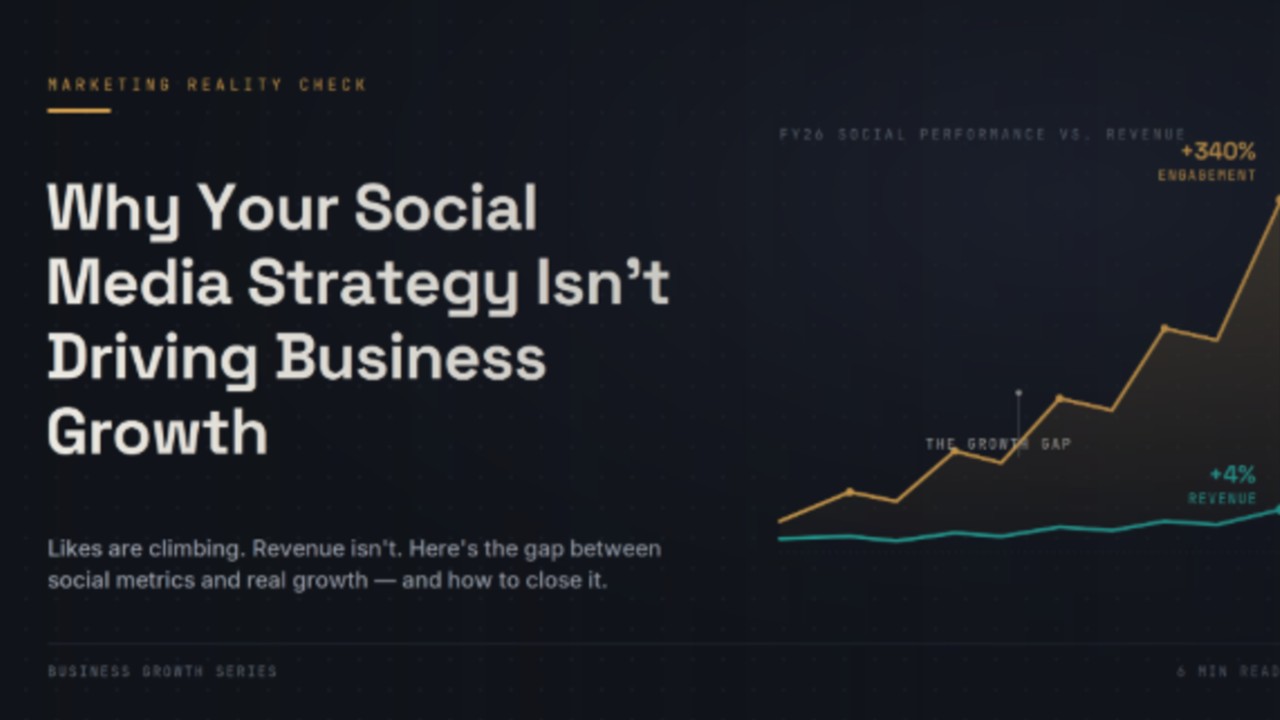
Why Your Social Media Strategy Isn't Driving Business Growth
A strong social media strategy is essential for turning online engagement into measurable business growth. Yet, many businesses invest significant time and resources into social platforms without seeing meaningful returns because their social media strategy focuses on visibility instead of conversions.
Likes, shares, and follower counts may look impressive, but they don't always translate into leads or revenue. Most businesses judge their social media success using the wrong metrics, while their sales pipeline tells a very different story. That mismatch not inconsistent posting or choosing the wrong platform is why many active, well-engaged accounts still struggle to drive business growth.
So, what's the solution? It isn't simply posting more content or jumping on the latest trend. Real growth comes from understanding where social media fits into your marketing funnel, identifying the gaps preventing conversions, and building a strategy that connects attention with action. In this blog, we'll explore the most common reasons why your social media strategy isn't driving business growth and the practical steps you can take to improve reach, engagement, leads, and ROI.
Why Your Social Media Marketing Isn't Delivering Results
Many businesses invest significant time and resources into social media but still struggle to achieve meaningful business growth. The reason isn't always inconsistent posting or poor-quality content. More often, it's because success is measured using vanity metrics like likes, follower counts, and reach, while the metrics that truly matter qualified leads, conversions, and revenue are overlooked.
The solution isn't simply posting more often or joining every new platform. An effective social media strategy aligns content with business objectives, guides audiences through the marketing funnel, and creates clear paths to conversion. Understanding where your strategy falls short is the first step toward turning social media from an engagement tool into a reliable driver of business growth.
Symptom vs. Root Cause for Failed Marketing
A decline in followers and a slowdown in sales may seem related, but they often stem from different issues. Many businesses assume their entire social media strategy is failing when, in reality, each problem has a distinct root cause. Effective social media marketing services focus on identifying the underlying issue instead of treating every challenge the same way. Before making changes to your strategy, it's important to understand what's causing the problem. The table below matches common social media symptoms with their actual causes, helping you identify the right solution and improve business results.
What You're Seeing | What It Actually Means |
Engagement is up, revenue is flat | You're optimizing for the wrong metric |
Content looks good, but leads aren't coming in | There's no path from post to conversion |
Some platforms work, most don't | You're spreading one strategy across platforms that need different ones |
Growth has plateaued for months | There's no test-and-optimize loop running |
Everything's outsourced, nothing's connected | Execution is happening without a strategy behind it |
Each of these has a specific fix. None of them is solved by posting more often. In the sections below, we will discuss this in detail.
Why Is Your Social Media Strategy Not Driving Growth?
The real reason behind the stalled growth of your business sits across five connected gaps: measurement, funnel, platform fit, paid reach, and optimization. Here's where social media strategy typically breaks down.
1. You're Measuring Attention, Not Action
Likes, shares, and follower growth feel like progress because they're visible and immediate. But these metrics don't tell you if your targeted user moved closer to buying. So, a post on Instagram can get thousands of impressions and still generate zero business outcomes if it was never built to prompt an action.
The fix: Track metrics that sit closer to revenue, click-throughs to your site, form submissions, DMs that turn into conversations, saves that indicate purchase intent.
2. There's No Bridge Between the Post and the Purchase
This is the single biggest gap between businesses that grow through social and those that don't. A great post that ends with nothing- no CTA, no link, no next step- is a dead end by design. The audience engages, feels good about your brand, and closes the app.
Full-scope social media marketing services build that bridge deliberately:
- Every content pillar maps to a stage of the buyer journey, not just a theme
- CTAs are specific (“Book a 15-minute audit,” not “Learn more”)
- Landing pages match what the post promised, so the click doesn't dead-end
- Retargeting picks up the people who engaged but didn't convert the first time
3. One Strategy, Across Every Platform
Posting the same content, in the same format, across multiple social media platforms, including LinkedIn, Instagram, and X, is one of the fastest ways to underperform on all three. Each platform has a different algorithm, a different audience intent, and a different content format that actually gets rewarded.
A carousel that performs on Instagram will likely fall flat as a LinkedIn native document, and a LinkedIn thought-leadership post rarely translates well as an X thread without a rewrite.
This is exactly where dedicated social media marketing services earn their keep. They do not just focus on producing more content, but also decide which platforms deserve your budget and attention in the first place.
4. Relying Entirely on Organic Reach
Organic reach on most major platforms has been declining for years. Depending on the platform, only a small fraction of your followers ever see an unpaid post. If your entire growth plan depends on organic social alone, you're capping your own ceiling before you've even started.
That's why many businesses pair social media with SEO services to build long-term organic visibility through search while using social to engage and nurture their audience.
A small, targeted ad budget layered on top of organic content, even $10–20 a day, usually outperforms organic-only efforts by a wide margin because paid reach compensates for exactly the visibility gap organic can't close.
5. Nobody's Actually Optimizing
A strategy built in month one and left untouched for the rest of the year isn't a strategy. It's a guess that stopped updating. Platforms change, audience behavior shifts, and what performed six months ago may be actively working against you today.
The businesses that keep growing through social run a consistent loop: track performance weekly, identify what's actually converting, kill what isn't, and reinvest in what is. Without that loop, even a good initial strategy decays month over month.
Why This Usually Needs More Than Execution
Most in-house teams and freelancers are set up to execute, write captions, design graphics and schedule posts. Very few are set up to diagnose why growth has stalled and restructure the approach around it.
That diagnostic layer is what proper social media strategy services are actually built for: auditing what's underperforming, rebuilding the funnel from post to purchase, and setting up the measurement framework that tells you what's working before you've wasted another quarter on what isn't.
Full-scope social media marketing services go a step further and handle the execution of that strategy too, content production, platform-specific adaptation, paid layering, and the ongoing optimization loop, so the strategy doesn't sit in a document while nothing changes in practic.
Conclusion
A successful social media strategy is about more than creating attractive posts or increasing follower counts. To drive real business growth, every social media effort should support a clear objective, whether that's generating qualified leads, increasing website traffic, building customer trust, or improving conversions. Focusing solely on engagement metrics without a well-defined conversion strategy often leads to wasted time and marketing budgets.
By tracking business-focused KPIs, tailoring content for each platform, combining organic efforts with targeted paid campaigns, and continuously optimizing performance, businesses can transform social media into a reliable growth channel. Partnering with experienced social media marketing professionals can further strengthen your strategy by aligning content, technology, analytics, and customer journeys. When your social media strategy is built around measurable outcomes instead of vanity metrics, it becomes a powerful driver of sustainable business growth.
FAQs
1. Why is my engagement improving but sales aren't?
Higher engagement doesn't always translate into higher sales because likes, comments, and shares measure attention rather than purchase intent. If your social media content doesn't guide users toward a clear next step, such as visiting your website, requesting a demo, or making a purchase, engagement remains a vanity metric. To improve conversions, include strong calls to action, optimize landing pages, and track business-focused KPIs like click-through rates, lead generation, and conversions. A well-planned social media strategy should connect audience engagement with measurable business outcomes.
2. What is the 5-3-2 rule on Instagram?
The 5-3-2 rule is a content-sharing framework designed to maintain a balanced and engaging Instagram presence. Out of every 10 posts, five should feature curated content from trusted sources, three should showcase your original branded content, and two should provide personal or behind-the-scenes insights. This approach helps brands avoid overly promotional feeds while building authenticity and audience trust. Although it's not a strict rule, it encourages businesses to create a healthy mix of educational, engaging, and promotional content.
3. How often should a social media strategy be reviewed?
A social media strategy should ideally be reviewed every month to ensure it aligns with changing audience behavior, platform updates, and business objectives. Regular reviews help identify high-performing content, optimize campaigns, improve engagement, and eliminate strategies that aren't delivering results. Businesses should also conduct a deeper quarterly analysis to evaluate ROI, audience growth, conversion rates, and campaign performance. Continuous monitoring and optimization help ensure your social media efforts contribute to long-term business growth rather than relying on outdated tactics.
4. What's the difference between social media strategy services and social media marketing services?
Social media strategy services focus on planning, research, audience analysis, platform selection, competitor evaluation, and defining measurable business goals. They create the roadmap for achieving long-term growth. Social media marketing services, on the other hand, execute that strategy by creating content, managing social accounts, scheduling posts, running paid campaigns, and engaging with audiences. While strategy determines what should be done and why, marketing services focus on implementing those plans effectively. Businesses often benefit most when both services work together.
5. What are the 7 Cs of social media strategy?
The 7 Cs of social media strategy commonly include Content, Community, Conversation, Connection, Curation, Creation, and Conversion. Together, these principles help businesses create valuable content, build meaningful relationships with their audience, encourage engagement, establish brand credibility, and drive measurable business results. While the terminology may vary slightly across marketing frameworks, the overall objective remains the same: develop a customer-focused social media strategy that balances engagement with lead generation, customer retention, and sustainable business growth.