Connect with us
How Smart Teams Are Cutting Creative Production Time in Half
This isn't about replacing human creativity. It's about removing the friction that slows it down.
Every team that produces content knows the feeling. You have a brilliant campaign idea, a tight deadline, and a dozen people who all need to be on the same page before a single frame gets produced.
Somewhere between the initial brainstorm and the final deliverable, hours evaporate into back and forth messages, misaligned expectations, and revisions that could have been avoided with better planning upfront.
The creative production process has always been messy. That's part of its charm, honestly. But "messy" and "inefficient" are two very different things, and most teams have been stuck firmly in the second camp for far too long.
The good news? A wave of intelligent tools is finally changing how teams move from concept to finished product. Teams that once spent weeks on pre production are now compressing that timeline dramatically, without sacrificing quality or creative vision.
The Pre Production Bottleneck Nobody Talks About
Ask any creative director what eats up the most time in a project, and you'll probably hear the same answer: getting aligned before production even starts.
The concepting phase, the storyboarding, the mood boards, the revision rounds on things that haven't been built yet. It's the invisible work that doesn't show up in the final product but determines whether that product succeeds or fails.
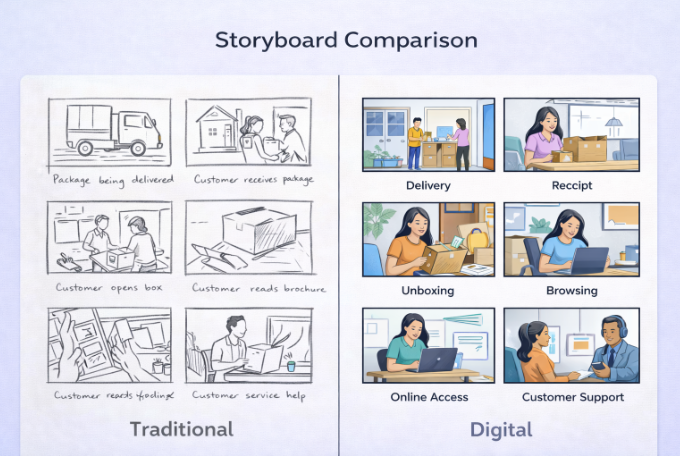
Traditional storyboarding, for example, has always been a pain point. Someone sketches rough frames, shares them with the team, waits for feedback, revises, shares again.
If the team is distributed across different time zones, this loop can stretch across days. And if stakeholders can't visualize what a rough sketch is supposed to become? That's where projects start drifting off course.
The real cost isn't just time. It's the creative energy that gets drained by administrative overhead.
When your best thinkers spend more time managing the process than actually thinking, something is fundamentally broken. And for teams that rely on messaging platforms and project management tools to stay connected, the gap between "having a great idea" and "showing people what that idea looks like" has been frustratingly wide.
Why Visual Communication Changes Everything
Here's something most productivity advice gets wrong: the biggest communication breakdowns on creative teams don't happen because people aren't talking enough. They happen because people are describing things with words that really need to be shown visually.
Think about it. A copywriter describes a scene in a brief. A designer interprets that brief through their own lens. A project manager tries to relay feedback from a client who "wants it to feel more dynamic."
Everyone is communicating constantly, but nobody is seeing the same picture.
Visual communication bridges that gap. When a team can look at a storyboard, a mockup, or a visual sequence together, the conversation shifts from abstract ("make it pop more") to specific ("let's adjust the framing in panel three and add movement to the transition").
That specificity saves rounds of revisions and keeps projects on track.
This is exactly why tools that help teams generate visual assets quickly have become so valuable. An AI storyboard generator, for instance, allows teams to move from a written concept to a visual sequence in minutes rather than days.
Instead of waiting for a designer to manually sketch every frame, the team gets a working visual draft that everyone can react to, refine, and build on together. It collapses the feedback loop and gives everyone a shared reference point from the very start.
For teams already collaborating through messaging and communication tools, adding visual assets to the conversation thread transforms how quickly decisions get made. A storyboard shared in a team channel is worth a hundred messages trying to describe what a scene should look like.
Building a Faster Creative Workflow Without Burning Out Your Team
Speed matters, but not at the expense of your people. One of the biggest mistakes teams make when trying to accelerate production is simply asking everyone to work faster.
That's not a workflow improvement. That's just a recipe for burnout.
The smarter approach is to identify which parts of the process can be automated or accelerated without adding pressure to the humans involved.
Formatting assets for different platforms. Resizing images. Creating initial layout drafts. Generating rough visual sequences from scripts. These are all tasks that need to be done, but they don't require the deep creative thinking that your team was hired for.
When you offload those tasks to intelligent tools, your team gets to focus on the work that actually matters: the storytelling, the strategic thinking, the craft.
The key is integration. A tool that lives in a silo creates more work, not less. As AI image generation becomes more capable, models such as GPT Image 2 can also help teams turn creative concepts into visual assets that are easier to review, refine, and integrate into the production workflow As AI image generation becomes more capable, models such as GPT Image 2 can also help teams turn creative concepts into visual assets that are easier to review, refine, and integrate into the production workflow.
The best workflows connect ideation, visualization, communication, and production into a seamless pipeline. Your team brainstorms in a messaging thread, generates visual concepts using smart tools, reviews and refines together in real time, and pushes approved assets into production without anyone having to manually transfer files or re-explain context.
This kind of connected workflow isn't theoretical anymore. Teams that invest in the right combination of communication platforms and creative tools are consistently outperforming those that rely on disconnected, manual processes.
The Role of AI in Creative Collaboration (Without the Hype)
Let's be honest: there's a lot of noise around AI right now. Every tool claims to be revolutionary. Every platform promises to change the way you work forever.
Most of that is marketing fluff, and smart teams know how to see through it.
But underneath the hype, something genuinely useful is happening. AI tools that focus on specific, well defined tasks within the creative process are delivering real value. Not because they replace creative professionals, but because they handle the grunt work that slows those professionals down.
Storyboarding is a perfect example. A skilled storyboard artist brings vision, composition, and narrative instinct to the table. But not every project has the budget or timeline for a dedicated storyboard artist.
Sometimes, a team just needs a quick visual draft to align on direction before committing resources to full production.
That's the sweet spot for something like an online Storyboard Generator. It doesn't replace the artist. It gives the team a starting point that's visual instead of verbal, fast instead of slow, and collaborative instead of siloed.
The artist can then step in to refine, elevate, and add the human touch that makes the final product resonate.
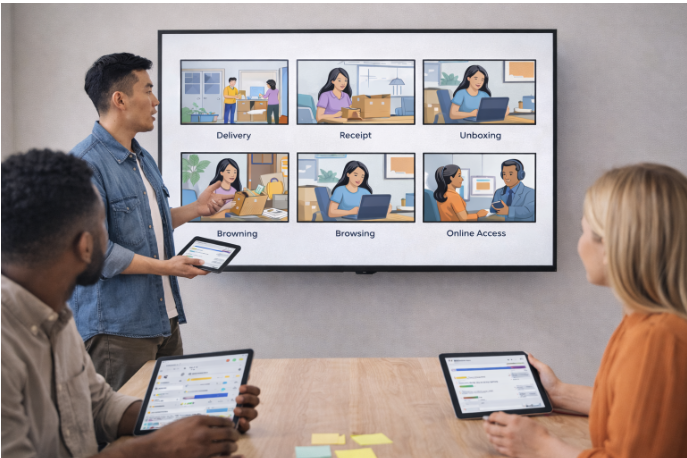
This pattern, using AI to generate first drafts that humans then refine, is showing up across the entire creative industry. The teams that embrace it aren't losing their creative edge. They're sharpening it by spending less time on setup and more time on the decisions that actually shape the final product.
Communication as the Foundation of Creative Speed
All of this circles back to something fundamental: none of these tools matter if your team can't communicate effectively.
The fastest storyboard generator in the world won't help if feedback gets buried in email threads, decisions happen in meetings nobody remembers, and context gets lost every time a file changes hands.
That's why the communication layer is arguably the most important part of any creative workflow. When your team has a central place to share ideas, react to visual assets, make decisions, and track progress, everything else moves faster.
Think about what happens when a team gets this right. A creative brief gets shared in a dedicated channel. Someone generates a visual storyboard from the concept and drops it into the same thread.
The team reacts in real time, flagging what works and what needs adjustment. Revisions happen within hours, not days. By the time the project moves into production, everyone is aligned, excited, and clear on the vision.
Now compare that to the alternative: a brief sent via email, feedback collected in a spreadsheet, storyboards attached to a chain of reply to all messages, and a final version that somehow still surprises half the stakeholders.
The difference isn't subtle. It's the difference between a team that delivers great work on time and one that's constantly playing catch up.
Practical Steps to Upgrade Your Team's Creative Process
If you're reading this and recognizing some of your own team's struggles, here are a few concrete moves you can make starting today.
First, audit your current workflow for handoff points. Every time work passes from one person or tool to another, there's a risk of lost context and wasted time. The fewer handoffs, the faster you move.
Second, invest in visual communication early in the process. Don't wait until production to show people what the project will look like. Use tools that let you generate rough visuals quickly so your team can align in direction before committing serious resources.
Third, centralize your communication. If your team's conversations are scattered across email, text messages, and three different apps, consolidate. Pick a platform that keeps everything in one place and make it the single source of truth for project discussions.
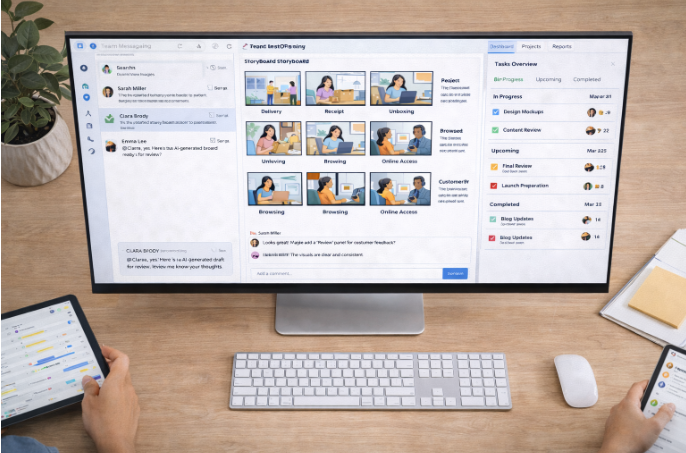
Fourth, automate the repetitive stuff. Look at where your team spends time on tasks that don't require creative judgment. Asset formatting, initial drafts, file organization. If a tool can handle it, let the tool handle it.
Finally, protect your team's creative energy. Every process improvement should be measured not just by time saved, but by how much mental space it frees up for the work that matters.
The goal isn't to produce more. It's to produce better, with less friction and more joy in the process.
Conclusion
The teams that consistently produce outstanding creative work aren't necessarily more talented than everyone else. They're just better at removing the obstacles between a great idea and a great finished product.
They communicate clearly, visualize early, iterate quickly, and use smart tools to handle the work that doesn't need a human touch.
The technology to make this happen already exists. From intelligent communication platforms that keep teams connected, to creative tools that turn concepts into visual drafts in minutes, the pieces are all there.
The question isn't whether these tools work. It's whether your team is ready to put them together into a workflow that actually flows.
Because in the end, creative work should feel creative. Not like an endless cycle of miscommunication, revision, and rework. Your team deserves better than that. And now, they can have it.