Connect with us
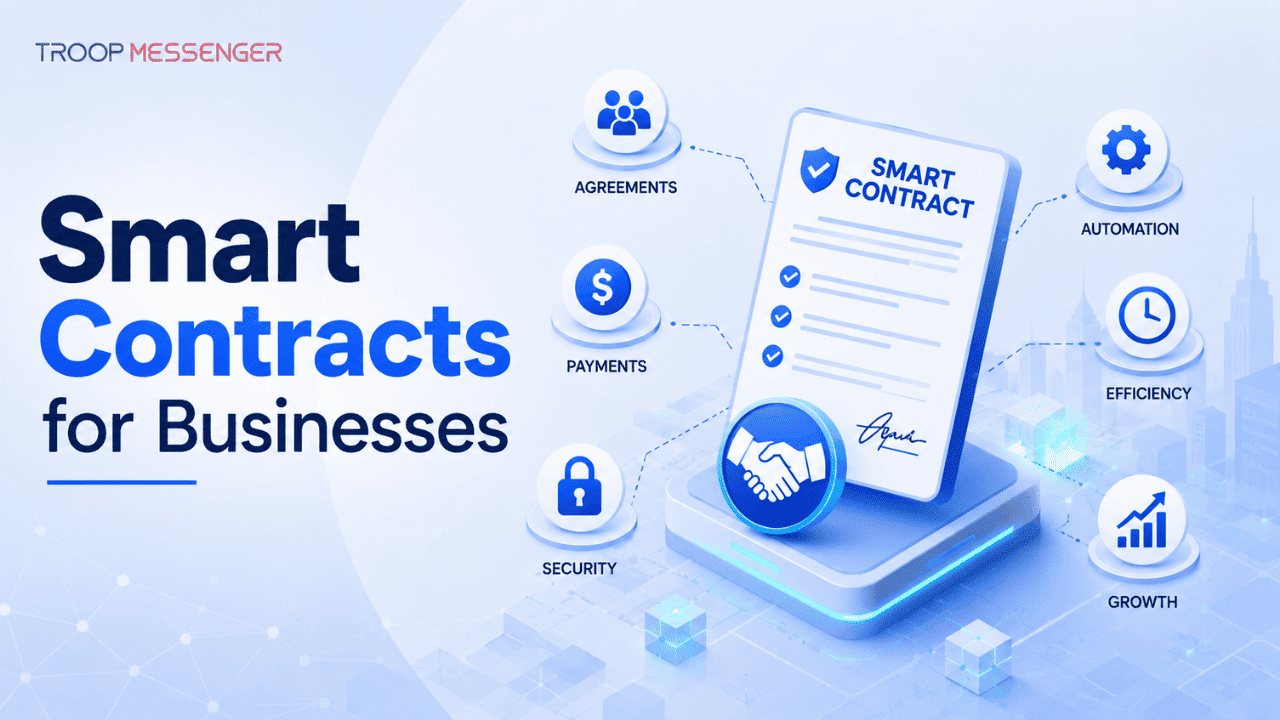
5 Ways to Use Smart Contracts for Businesses
Smart contracts are blockchain-based programs that automatically execute predefined actions when specific conditions are met, helping businesses automate transactions, agreements, and workflows. As organizations increasingly adopt digital tools for business communication and collaboration, smart contracts can further simplify processes that involve multiple parties, predefined rules, and routine transactions.
From automating payments and improving supply chain transparency to supporting digital agreements and loyalty programs, smart contracts have several practical business applications. This article explores five ways businesses can use smart contracts to improve efficiency, transparency, and operational reliability.
The smart contracts market is projected to reach $3.39 billion in 2026, with a projected CAGR of 26.30% through 2034, indicating growing interest in programmable blockchain-based applications.
What is a smart contract?
The term smart contract means a transactional protocol or a program that automatically controls and executes the terms of the contract.
Blockchain allowed for the storage of information about each data chain, which in turn was stored with each network participant. This empowered smart contracts by making them as informative and secure as possible.
History of the emergence of the smart contract technology
The concept of smart contracts was introduced by computer scientist Nick Szabo in 1994. He described smart contracts as computerized transaction protocols that could automatically execute the terms of an agreement. The idea was to reduce the need for intermediaries, minimize manual processes, and make transactions more efficient and reliable.
At the time, smart contracts were largely theoretical because the technology needed to execute them in a decentralized environment did not yet exist. The development of blockchain technology provided a foundation for turning this concept into a practical application.
Bitcoin, launched in 2009, demonstrated that blockchain could enable decentralized digital transactions without relying on a central authority. Although Bitcoin supports programmable transaction conditions, it was primarily designed as a digital payment system rather than a general-purpose platform for complex smart contracts.
A major milestone came in 2013, when Vitalik Buterin published the Ethereum white paper. Ethereum proposed a programmable blockchain that could allow developers to create smart contracts and decentralized applications with their own rules. When the Ethereum network launched in 2015, it made programmable smart contracts more accessible and expanded their potential beyond cryptocurrency transactions.
Since then, smart contracts have evolved into a technology used across areas such as decentralized finance, digital assets, supply chain management, identity verification, gaming, and automated business processes. Today, businesses can use smart contracts to automate predefined actions, coordinate transactions between multiple parties, and create transparent workflows without requiring every step to be handled manually.
Advantages and disadvantages of smart contracts
The use of smart contracts increases the security of asset or information transfer agreements by eliminating the need to involve a counterparty, such as a bank or broker, in the transaction. The entire process of fulfilling the terms of the contract is automated.
Thanks to blockchain, the result of a smart contract is permanently stored in a registry, which also makes it impossible to change or falsify it.
Thus, the advantages of a smart contract are:
- automation of routine processes;
- reliability;
- security;
- efficiency of transaction execution.
It is worth noting that the inability to make changes to a smart contract can also be considered a disadvantage of the technology. If a smart contract with an error or vulnerability is introduced into the blockchain, it cannot be removed.
Smart contract vulnerabilities can lead to significant financial losses, making security testing and code audits important before deployment. Businesses should use secure development practices, thorough testing, code reviews, and independent audits when smart contracts handle valuable assets or critical transactions.
Security remains a major consideration in smart contract development. The OWASP Smart Contract Top 10: 2026 identifies the most significant vulnerability categories affecting smart contracts, reinforcing the importance of secure coding, testing, and auditing before deployment
In addition, a smart contract cannot operate on its own with data outside the network. Blockchain oracles like Chainlink are needed to do so. This hinders mass technology adoption, as many applications receive information from outside the network in real-time (e.g., weather forecasts).
How Smart Contracts Revolutionize Businesses
So, let`s discuss 5 ways to use smart contracts for your business.
Automating Payments and Transactions
One of the strongest advantages of smart contracts is that they have the ability to automate payments. The contracts ensure payments are delivered in real-time when certain conditions are met, reducing reliance on banks, payment processors, and other third parties. Automation lowers the likelihood of human mistakes, prevents fraud, and speeds up the entire payment process.
How it works: Smart contracts contain the payment terms and automatically make transactions upon fulfillment of triggers, such as confirmation of delivery, project milestones, or completion of service. Payments are securely and transparently made without human interference.
Benefits:
- Instant, tamper-proof transactions
- Lower transaction costs due to less reliance on intermediaries
- Improved security and fewer opportunities for fraud
Companies that make cross-border payments can use stablecoins like USDT (Tether) in smart contracts to facilitate payments in real time. For instance, a shipping firm can have a payment contract with a supplier. After the blockchain confirms that the shipment has arrived, money will be transferred without paying for expensive wire transfers or exchange fees.
Making Supply Chain More Transparent
Supply chain management is often bedeviled by counterfeiting, late shipment, and visibility. Smart contracts increase transparency since they give a permanent record of all transactions, tracking goods from the origin to the destination in real time. This makes supply chain participants responsible and reduces fraud.
How it works: Smart contracts document each transaction of the supply chain from production to delivery, automatically guaranteeing authenticity and compliance with the regulations. RFID tags and IoT sensors may be attached to blockchain platforms to track and authenticate conditions such as temperature and location.
Benefit:
- Improved product traceability
- Automation of regulatory compliance
- Improved trust among supply chain members
Walmart and other retailers use blockchain-based smart contracts to track shipments of food. If contamination is detected in one batch, the source is identified right away, allowing retailers to recall only the contaminated products instead of the entire shipment. This saves them money and keeps consumers safe.
Streamlining Legal Contracts and Regulation
Traditional legal contracts require elaborate documentation, manual verification, and legal advice, which creates inefficiencies as well as expenses. Smart contracts are computer programs that automatically execute digital contracts and enforce agreements without constant legal intervention.
How it works: Legal agreements such as employment, lease, or partnership agreements may be codified in smart contracts. Some hot AI startups already incorporate smart contracts. Once the conditions are satisfied—e.g., rent due or work accomplished—the contract enacts pre-coded actions such as transferring title, releasing funds, or issuing fines for nonpayment.
Benefits:
- Enforcement of legal agreements simplified and expedited
- Fewer instances of third-party involvement from lawyers
- Fewer opportunities for disputes
Businesses can use smart contracts for rental agreements, where the rent is charged from a tenant's wallet automatically on the payment due date. In the event of default in payment, the contract can also automatically send notice or charge a penalty, reducing the amount of paperwork for landlords and property managers.
Better Digital Identity and Security
Handling digital identities is necessary to prevent fraud, secure transactions safely, and authenticate users properly. Centralized databases applied in conventional identity verification are vulnerable to data breaches and hacking. Smart contracts provide a tamper-evident, secure, and decentralized solution.
How it works: An identity system based on blockchain allows individuals and organizations to store and verify credentials without sharing sensitive information. Users own their information and grant access only when necessary.
Benefits:
- Improved security and privacy
- Lower risk of unapproved access
- Faster and more secure identity confirmation
Banks are implementing blockchain-based KYC (Know Your Customer) models in which the customer provides evidence of identity once, and it is securely exchanged with multiple banks or service providers without having to fill out forms repeatedly. This reduces onboarding time, eliminates redundant verification processes, and improves customer experience.
Redefining Loyalty and Reward Programs
Legacy loyalty programs are siloed, difficult to monitor, and prone to fraud. Smart contracts offer automatic, secure, and transparent loyalty programs that improve customer engagement and loyalty.
How it works: Smart contracts automatically issue and redeem reward points. Customers get tokens from purchases, which can be redeemed instantly for rewards without the need for third-party validation.
Benefits:
- Fraud-proof reward systems
- Instant issuance and redemption of rewards
- Increased transparency and trust
A chain of coffee shops might have a loyalty program based on blockchain where a token is sent to the buyer for each buy. The tokens can be converted into discounts or used at any store without relying on a central database, with transactions being effortless and tamper-proof.
Conclusion
Smart contracts can help businesses automate predefined processes, improve transparency, and reduce manual work across areas such as payments, supply chains, digital agreements, identity verification, and loyalty programs. Their value is strongest when business processes involve clear rules, multiple participants, and repeatable actions.
However, smart contracts are not the right solution for every business process. Organizations should consider factors such as security, privacy, integration requirements, data reliability, legal considerations, and implementation costs before adopting them. When applied to the right use cases, smart contracts can complement existing business systems and create more efficient, reliable workflows.
Frequently Asked Questions About Smart Contracts
1. What is a smart contract in simple terms?
A smart contract is a blockchain-based program that automatically executes predefined actions when specific conditions are met. Instead of relying on manual intervention for every step, the programmed rules determine what happens once the required conditions are satisfied. Businesses can use smart contracts to automate processes such as payments, agreements, supply chain transactions, identity verification, and rewards, particularly when multiple parties need to follow clearly defined rules.
2. How can businesses use smart contracts?
Businesses can use smart contracts to automate transactions and workflows that follow predefined conditions. Common applications include automated payments, supply chain processes, digital agreements, identity verification, escrow arrangements, and loyalty programs. For example, a business can configure a smart contract to release payment after a specific delivery or project milestone is verified. Their usefulness depends on whether the business process can be accurately represented through programmable rules.
3. What are the benefits of smart contracts for businesses?
Smart contracts can help businesses automate repetitive processes, reduce manual intervention, improve transaction transparency, and maintain a verifiable record of activities. They can also make certain workflows faster and more consistent by executing predefined actions automatically when conditions are satisfied. However, the actual benefits depend on the specific use case, system design, and quality of the underlying data. Businesses should evaluate whether smart contracts provide meaningful advantages over existing technologies.
4. What are the limitations of smart contracts?
Smart contracts can have limitations related to security, flexibility, integration, privacy, and external data. A coding error or vulnerability can cause unintended outcomes, while changing a deployed contract may be difficult depending on its design. Smart contracts may also require external data sources when decisions depend on real-world events. Businesses should therefore consider security testing, data reliability, regulatory requirements, integration complexity, and maintenance needs before using smart contracts for important processes.
5. Are smart contracts legally binding?
A smart contract is not automatically the same as a legally binding contract. A smart contract is software that executes predefined instructions, while a legal contract establishes rights and obligations under applicable law. Whether a smart contract has legal effect depends on factors such as jurisdiction, agreement structure, and how it is implemented. Businesses using smart contracts for commercial agreements should consider applicable laws and obtain appropriate legal guidance where necessary.
6. Are smart contracts secure?
Smart contracts can provide transparent and predictable execution, but they are not automatically secure. Their security depends on the quality of the code, blockchain network, system architecture, access controls, and external data sources. Programming vulnerabilities can result in unintended transactions or other losses. Businesses should use secure development practices, thorough testing, code reviews, and independent security audits where appropriate, particularly when smart contracts handle valuable assets or support critical business processes.