Connect with us
Slack vs Microsoft Teams: Extended with Quick Infographic [2026 Update]
Slack vs Microsoft Teams remains one of the most searched comparisons for businesses looking to adopt the right collaboration platform in 2026. Both applications offer powerful communication, file sharing, video conferencing, and productivity features, but choosing the right one depends on your organization's workflow, security requirements, and budget.
As hybrid and remote work continue to grow, selecting an efficient team collaboration platform has become a strategic business decision. This comprehensive comparison evaluates Slack and Microsoft Teams across key parameters such as user experience, messaging, integrations, pricing, storage, search capabilities, security, and overall productivity. We also introduce Troop Messenger as a secure enterprise collaboration alternative for organizations seeking greater control, flexibility, and advanced communication features.

Why Compare Slack vs Microsoft Teams in 2026?
Slack and Microsoft Teams remain the two dominant names in workplace messaging, but the decision between them has shifted in the last year. Slack, now fully under Salesforce, has leaned hard into AI with Agentforce and restructured its pricing tiers around it a move that's driven up costs for many teams. Microsoft, meanwhile, raised prices across most Microsoft 365 Business and Enterprise suites starting July 1, 2026, with increases ranging from 5% to 43% depending on plan and region.
At the same time, both platforms have added more compliance tooling, more AI features you may or may not want, and more pricing tiers to sort through. That makes 2026 a good moment to reassess: not just "which tool has more features," but which one actually fits your team's size, budget, and existing software stack and whether a simpler, more affordable alternative might serve you better
Slack vs Microsoft Teams: Feature Comparison Table
Slack tends to feel lighter and more flexible for teams juggling many different tools. Teams is the more natural choice if your company already runs on Outlook, Word, Excel, and SharePoint, since it's built directly into that ecosystem.
Feature | Slack | Microsoft Teams |
Core interface | Channel-based messaging, threads, DMs | Channels within "Teams," chat, integrated with Microsoft 365 |
Video calling | Group huddles/calls, up to 50 participants on paid plans | Meetings support up to 300 interactive participants, 10,000 view-only |
File storage | Shared workspace storage, scales by plan | Tied to OneDrive/SharePoint, generous on Business plans |
Message history | Free plan limited to 90 days; unlimited from Pro up | Generally unlimited on paid plans |
Native office apps | None (integrates with Google Workspace, Microsoft 365 via app) | Deep native integration with Word, Excel, PowerPoint |
AI assistant | Slack AI / Agentforce (add-on or bundled at higher tiers) | Microsoft 365 Copilot (separate add-on on most plans) |
Third-party integrations | Very broad app directory, strong workflow automation | Strong within Microsoft ecosystem, smaller outside it |
Best for | Teams that live in chat-first, cross-tool workflows | Teams already standardized on Microsoft 365 |
Slack vs Microsoft Teams: Security & Compliance
Both platforms offer credible enterprise-grade security, but they reach it differently.
Slack gates most serious compliance features behind its higher tiers. SAML-based single sign-on, SCIM provisioning, data residency options, and a 99.99% uptime guarantee are part of the Business+ tier and up, not the entry-level Pro plan. Advanced features like eDiscovery and expanded data export are often priced as separate add-ons, which matters most for regulated industries like finance and healthcare.
Microsoft Teams inherits Microsoft 365's broader compliance and security investment, including built-in data loss prevention, eDiscovery, retention policies, and compliance certifications that are already familiar to IT teams managing Microsoft environments. Because Teams is bundled inside Microsoft 365 rather than sold as a standalone product, compliance capability generally scales with which Microsoft 365 plan (Business Standard, Business Premium, E3, E5) you're on rather than a Teams-specific tier.
Bottom line: if your organization already has a mature Microsoft 365 compliance setup, Teams security comes along for free. If you're Slack-first, budget for Business+ or higher to get comparable protections and check whether add-ons like advanced eDiscovery are included or billed separately.
Slack vs Microsoft Teams: Pricing
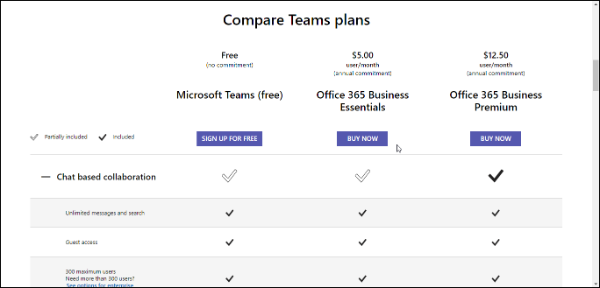
Microsoft Teams comes in three different pricing variants. Any users across the world can, “Sign-up for free”, with limited features of unlimited messages and search, guest access, 300 maximum users, 140+ integrated apps and services, one-to-one group online audio and video calls, channel meetings, and a few more to go.
Microsoft Teams is a part of Office 365 Business Essentials and Office 365 Business Premium, with the pricing of $5.00/user/month and $12.50/user/month respectively.
Slack offers a free trial to its users for an unlimited amount of time with limited features, and then there are Slack Standard Subscription plan, Standard Plus plan, and with one more pricing variant of the Enterprise Grid plan.
When you switch, to Slack’s standard subscription plan for Rs.500/active user per month when billed annually, with this upgrade the users can really experience the features of the full archive, Google authentication, Unlimited apps for integration, custom retention policies, forward emails into slack, custom profiles, etc.,
For the Enterprise Grid plan, the pricing page of Slack asks the user to contact sales for pricing structure. Here Slack users can have unlimited workspaces, support for data loss prevention(DLP), shared channels between workspaces, built-in security, and compliance, 1 TB storage per member, etc.,
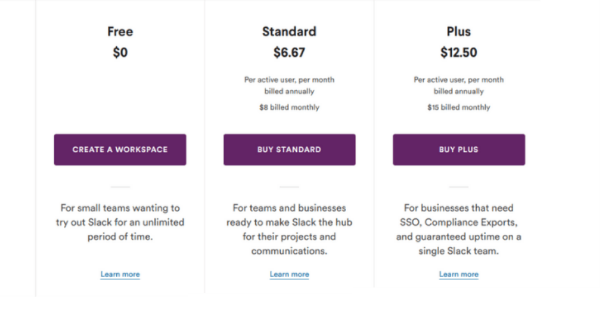
Our Verdict: Microsoft Teams offers its free plan only for a month, whereas the basic-free plan of Slack is meant for an unlimited amount of time.
Slack vs Microsoft Teams: The sign-up flow - Which Application Offers Smoother Setup?
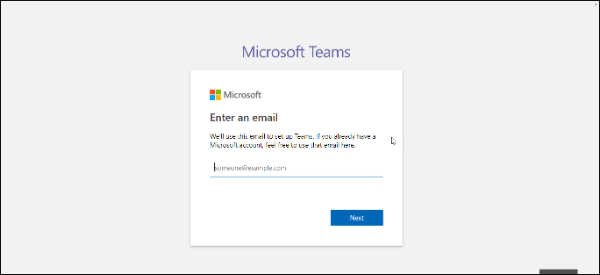
Though Microsoft Teams comes with Office 365 suite, the workplace collaboration application is open to the public with a free sign-up trial of one month. You can sign-up with any of your public domain mail ids such as Google, Yahoo, etc., or you can directly access your Microsoft Teams with your Microsoft domain id if you are a subscriber of Office 365.
Once you are done entering your mail id and password, a verification code has been sent to your registered mail id. Now you can start using Microsoft Teams by downloading the desktop app or a Web app.
The Sign-up Process for Slack starts with creating a workspace. Slack’s unlimited free trial allows the users to log in to it with their respective workspace URL with a limited set of features. Any user can create a workspace from scratch with any of their Gmail, Yahoo, etc., public domains. To finish the sign-up process you are asked to give your name and password.
Slack facilitates an unlimited number of workspaces in its Enterprise Grid pricing plan, where the users can switch from one workspace to another within the user interface itself.
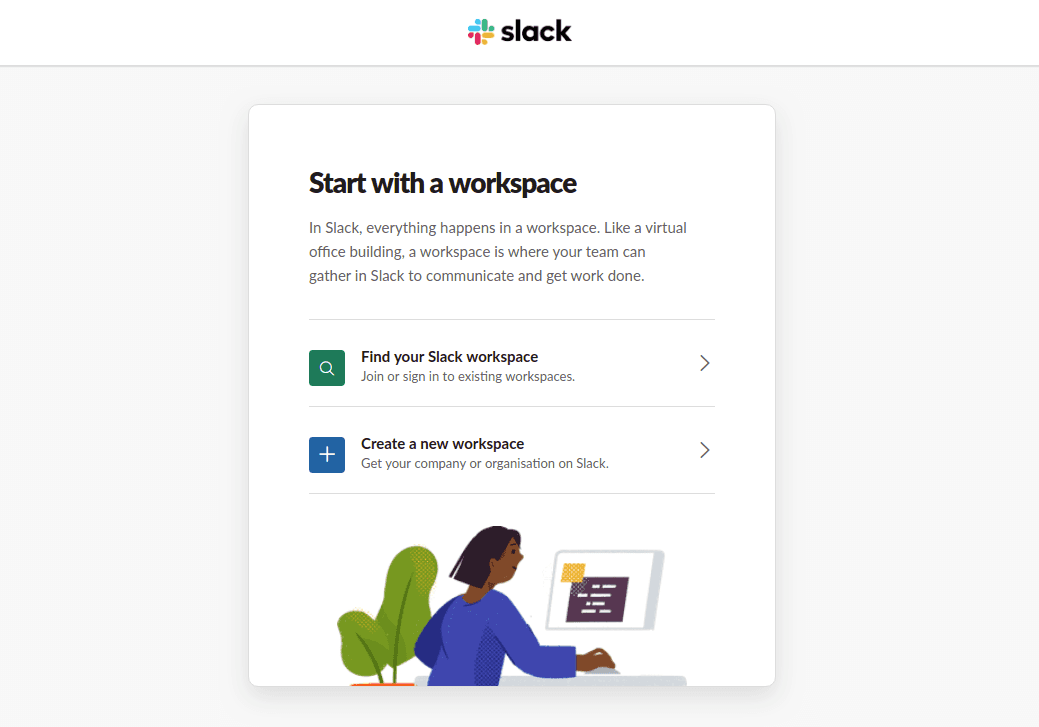
Our Verdict: The Sign-up process at Microsoft Teams is pretty simple and easy when compared to Slack.
Slack vs Microsoft Teams: Inviting and Adding User
This workplace collaboration software provides a feature where you can invite other (or) guests to your organization for enhanced association with them on your projects. Your guests could be your clients, vendors, non-employees, or any others.
The left panel of the user interface has the feature of “Invite others to the Org”. This will take you to the page of invite people, from where you can start inviting people by giving your guest's email and their display name. Furthermore, you can choose the “Add more” option to invite more people.
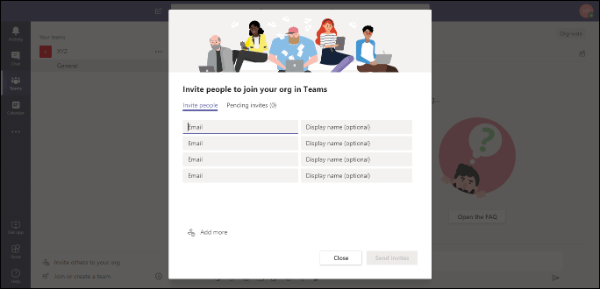
In addition to inviting guests to your organization,
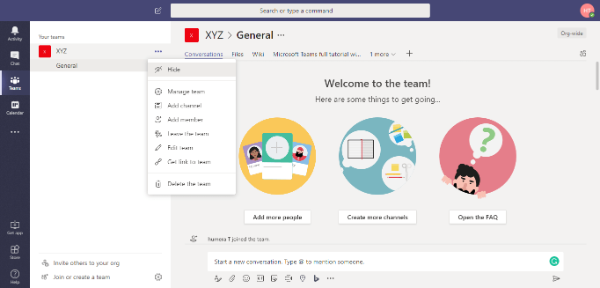
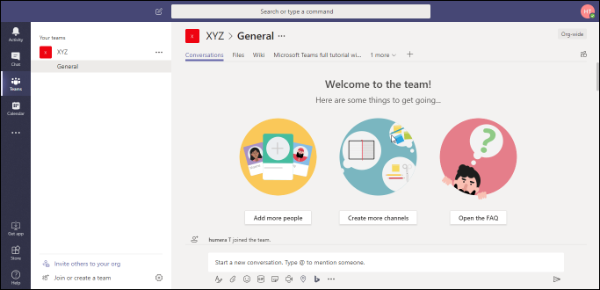
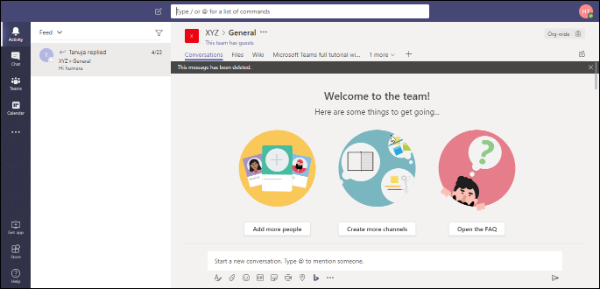
Microsoft Teams allows you to add more people to your team. The moment you log in to the application, it welcomes you with the features of “Add more people, Create more channels, Open the FAQ,”.
The intuitive user interface of Slack lets you Invite people from the left panel of your workspace.
Guests like vendors, clients, contractors, freelancers, and others are invited to Slack in both its free and paid plans. Invite a few or many at once with their public/private domain mail ids. You are also allowed to share an invite link with your invitees.
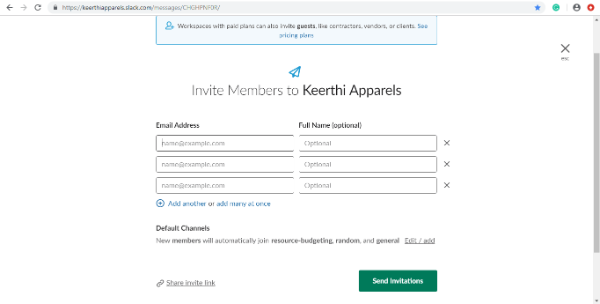
Our Verdict: Slack allows sharing an invite link to its guests, whereas we don’t see this in Microsoft Teams.
Slack vs Microsoft Teams: Guest Access Capabilities
The concept of vendor-client collaboration with the workforce of your organization is quite crucial at times when they need to connect to the outside world to collaborate on various client projects.
Microsoft Teams send invites to others to communicate with the internal teams of the workplace. The other new player Troop Messenger also facilitates the in-house team with this guest collaboration feature, the Orange Member. Any user with their public/private mail ids can become an Orange Member to interact with the teammates of Troop Messenger.
The “Invite people” section of Slack allows inviting guests into the application.
Slack vs Microsoft Teams: Design (UI and UX)
Which Application Gives Comfort Over Chaos? let's find out here,
The UI and UX part of Microsoft Teams is quite engaging and engrossing to the user. You can simply understand the features and their functionalities just at a glance at the home page screen. All your teams are listed on the left panel dashboard along with the other features of “Activity”, “Chat”, “Calendar”, “Get the app”, “Store”, and “Help”. A few essential tools like One Note and Wiki are in-built into this application.
Start a new conversation with your teammates by sending the formatted text, with attachments, smileys, GIFs, and stickers to relish a more personalized chat experience.
Also, check out for files that you had exchanged with other teams and team members, Microsoft Teams full tutorial with recent updates, along with a plus tab for more integrations. The people's pane of the user interface allows you to see all your team members in one place.
Despite Slack’s user interface looking simple and clean, sometimes the users often get confused with the navigational flow of the features and their functionalities. Your workspace name is displayed at the top of the left pane along with your name. This section further allows you to send direct messages to the Slack bot and the other team members of your channel.
The other features that you could notice from the Slack user interface would be; @mentions, set a purpose, settings, starred channels, invite people, and many more to include.
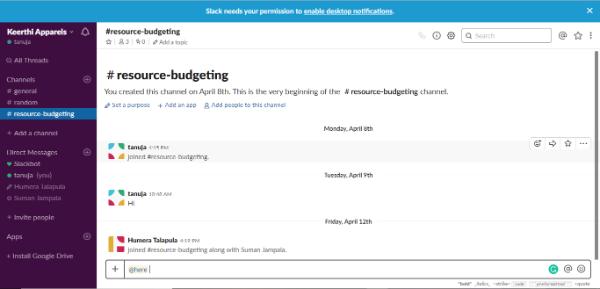
Our Verdict: Microsoft Teams user interface looks to be simple to understand and easy to use, compared to Slack.
Slack vs Microsoft Teams: Messaging, Audio, Video
Messaging across Microsoft Teams is quite interesting, as it allows the one-to-one user to be more collaborative with the features of file sharing, places, attachments, formatted texts, smileys, GIFs, Stickers, @mentions, meet now, and also lets the users integrate and use many third-party apps.
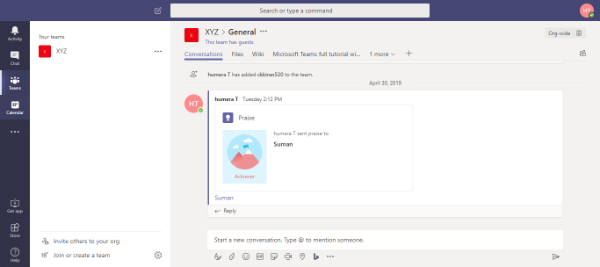
for instance, you can integrate Trello for project management, Process Street for employee onboarding, and YouTube for sharing your preferred videos.
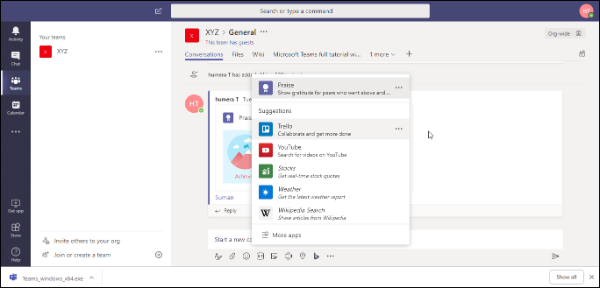
It is really good to see on the user interface the feature of Meet now(video conferencing) literally at no cost. Microsoft Teams is extending this feature-functionality to its users in its free trial itself. But the users could not find the audio calling option anywhere on the user interface of the free trial.
Send direct messages in Slack by choosing your team members. This collaboration experience can be further enhanced with the associative features of Add a file from your computer, @mentions, smiley layout, post, code or text snippet, etc.,
When we move onto the sections of audio and video calling, now Slack supports audio-video calling in its free plan for one-on-one user chat, whereas you would not be able to share your desktop screen during a video call in the free plan, you would certainly migrate to Slack’s paid plan to avail this feature. While the new chat application is in the block, Troop Messenger is allowing the users the facility to share their screen for free during a video call.
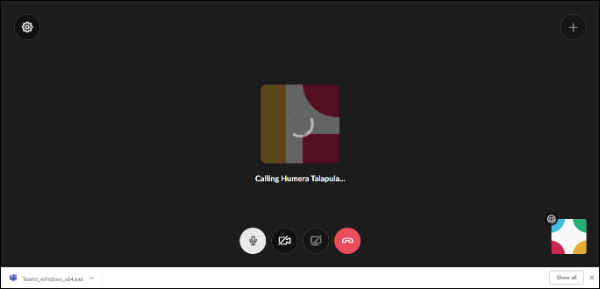
Our Verdict: Microsoft Teams allows the feature of, “Meet Now” in its free plan to make video conferencing with your team. Though Slack offers one-on-one audio-video calling, it doesn’t provide the same for workspaces in its free plan.
Slack vs Microsoft Teams: Integration
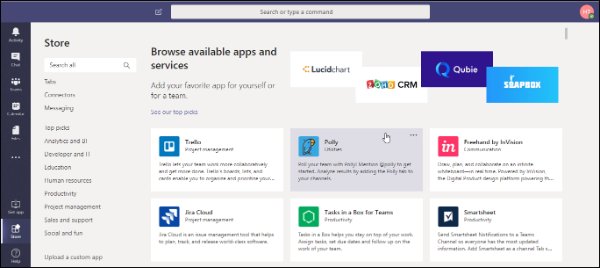
Which Application is On Good Terms With All? Let's see hereThe Microsoft Teams office collaboration application does support a wide range of integrations to help the user. This application allows the user to directly integrate all the necessary apps right away from the application's user interface itself.
When you try to open the “Store”, a feature from the left panel of the applications home page, you are taken to the world of diverse apps to integrate them into your teams with the option of uploading custom apps too.
Slack supports more than 1500 app integrations into it. You are totally allowed to integrate a whopping number of apps of a distinct type. Tools related to project management, productivity, finance, file management, security, compliance, etc.,
The Apps column of your workspace facilitates a provision to the user to directly browse apps and integrate them into your workspace. You are navigated to, the “Browse Apps” page, where you can find the “View App Directory”, and, “Manage Apps...”, When you go to view app directory, you are taken to a new window, where a wide range of Apps for integration are segregated as per their domain area.
Our Verdict: Slack supports more than 1500 wide range of app integrations according to the pricing plan the users choose.
Slack vs Microsoft Teams: File Storage
We know how important is file storage for any team collaboration application. On a daily basis, the users of the organization exchange an unlimited number of files. In order to cater to this, Microsoft Teams offers 2GB/per user and 10GB of shared storage in its free plan and it provides 1TB/per user in both its Office 365 Business Essentials and Office 365 Business Premium suites.
Slack offers 5GB total in its free plan, 10 GB storage per member in the Standard plan, 20GB storage per member in the Standard Plus plan, and finally 1TB storage per member in its Enterprise grid plan.
Our Verdict: Slack offers 1TB of storage only in an enterprise grid plan, whereas Microsoft Teams provides 1TB of storage per user in both of its paid versions.
Slack vs Microsoft Teams: Search
This instant team messaging application allows you to search for different things across the user interface. The search functionality is commonly available for Activity, Chat, Teams, conversations, files, wiki, etc., When I write about the search functionality of any applications, I understand that Troop Messenger has an extensive search capability to filter out different forms of data. The search by images, search by videos, search by location, global search filter, date-time filters, etc., are known to be few noted.
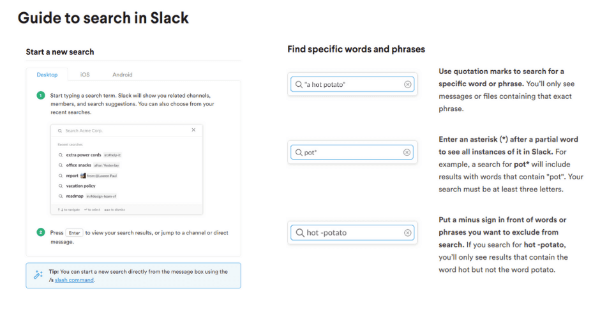
Slack allows you to search for messages, files, and channels. Furthermore, you can make search for your files from all files.
The “Browse Apps”, page also offers the user to search by name or by category to choose a wide range of app integrations into your Slack business collaboration tool
Our Verdict: Slack has better search functionality.
Slack vs Microsoft Teams: Help Center
It would be quite helpful for almost all the users if they can navigate to the application’s help page within the application’s user interface. Microsoft Teams and Slack both provide such facilities to their teams.
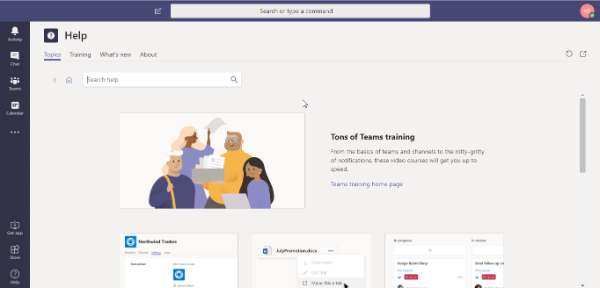
The left pane of the Microsoft Teams home page shows you the help icon, from where you can traverse to feature help topics, training, and what’s new and about.
You can narrow down your search from the search bar of Search help. On top of that, the users can see, “Microsoft Teams with a full tutorial with recent updates” to understand the latest upgrades from your team's page.
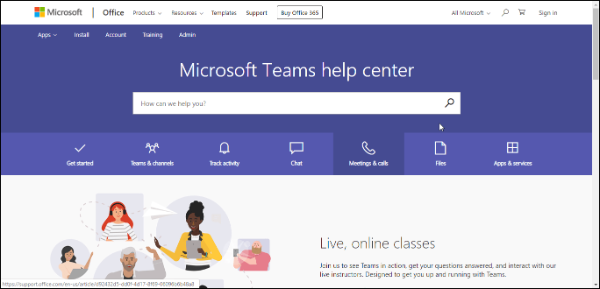
The moment you log into Slack, the Slack Bot welcomes the user to assist them. It allows us to directly chat with bots for all the basic queries, and in case it doesn’t understand our question, it allows the user to navigate to Help Center from the user interface itself.
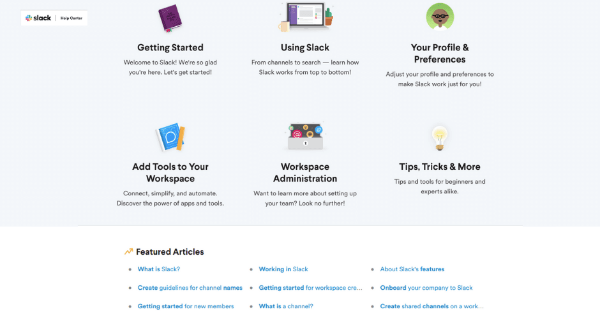
Our Verdict: Slack is a bit ahead of Microsoft Teams in extending help support with the help of Slack Bots.
Slack vs Microsoft Teams: Pros and Cons
Slack
Pros:
- Cleaner, more intuitive interface for pure messaging
- Best-in-class third-party app ecosystem and workflow automation
- Works well as a cross-platform hub when your company doesn't use one single software suite
Cons:
- Gets expensive quickly once you need compliance features (Business+ and up)
- No native productivity suite you're paying for chat, not documents or spreadsheets
- Meeting participant caps are limiting compared to Teams at equivalent price points
Microsoft Teams
Pros:
- Deep, seamless integration with Word, Excel, PowerPoint, and Outlook
- Higher meeting participant limits even on lower tiers
- Often more cost-effective if you already need a Microsoft 365 subscription anyway
Cons:
- Interface can feel cluttered and less intuitive than Slack for pure chat
- Less flexible outside the Microsoft ecosystem
- Pricing structure has become harder to parse, especially with Copilot bundling changes
Who Should Choose Slack?
Slack tends to be the better fit if:
- Your team relies on a wide range of best-of-breed tools (project management, CRM, dev tools) rather than one unified suite, and you want deep integrations between them
- You value a clean, fast, chat-first interface over a full productivity suite
- You're a startup or scaling company where cross-team, cross-tool collaboration matters more than deep document workflows
- You don't need heavy compliance tooling out of the gate, or you're prepared to pay for Business+ when you do
Who Should Choose Microsoft Teams?
Microsoft Teams is usually the stronger choice if:
- Your organization already runs on Microsoft 365 for email, documents, and spreadsheets
- You need built-in compliance and security tooling without assembling it from add-ons
- Large meetings (100+ participants) are a regular part of your workflow
- You want a single vendor and a single bill for both productivity software and communication tools
Why Businesses Choose Troop Messenger as an Alternative
For many small and mid-sized businesses, both Slack and Microsoft Teams end up delivering more complexity and more cost than they actually need. This is where Troop Messenger has been picking up traction as a straightforward alternative.
A few reasons businesses make the switch:
1. Simpler, more predictable pricing
Troop Messenger avoids the multi-tier, AI-bundled pricing structures that have made both Slack and Teams harder to budget for in 2026. Plans are built around what teams actually use for messaging and collaboration, without gating basic compliance or history features behind expensive upper tiers.
2. All-in-one collaboration without the sprawl
Troop Messenger combines one-on-one and group messaging, voice/video calling, screen sharing, and file sharing in a single, lighter interface without requiring you to also license a full productivity suite or a separate AI add-on to get essential features.
3. Built for cross-team and external collaboration
Features like "Forkout" (broadcast messaging) and the ability to add external users for guest collaboration make it easier for teams that work with clients, vendors, or partners outside their own organization.
4. On-premise and self-hosted options
Unlike Slack and Teams, which are cloud-only, Troop Messenger offers self-hosted deployment a meaningful differentiator for businesses in regulated industries, government, or any organization with strict data residency or data control requirements.
5. Lower total cost of ownership
Without the enterprise upsell path that both Slack and Microsoft push teams toward for compliance or advanced AI, Troop Messenger tends to come in noticeably cheaper for teams of 10–500 people who need solid collaboration tools without enterprise-scale overhead.
For businesses that find themselves paying for Slack or Teams features they don't use or hitting a compliance-driven price wall Troop Messenger is worth evaluating as a more focused, cost-effective option.
Conclusion
The Slack vs Microsoft Teams comparison highlights that both platforms are powerful collaboration solutions, each catering to different business requirements. Slack excels with its intuitive interface, extensive app integrations, and flexible communication experience, making it a popular choice for startups and agile teams. Microsoft Teams, on the other hand, is ideal for organizations using Microsoft 365, offering seamless integration with Office apps, enterprise-grade security, and a unified productivity ecosystem.
However, businesses seeking greater flexibility, enhanced security, and deployment options should also consider Troop Messenger. Designed for enterprises, government agencies, healthcare, defense, and regulated industries, Troop Messenger provides secure instant messaging, audio and video conferencing, screen sharing, file sharing, task management, and advanced administrative controls. It also offers both cloud and on-premise deployment through Troop GRIT, enabling complete data ownership and compliance. By evaluating features, pricing, scalability, and security, organizations can confidently choose the collaboration platform that best supports their long-term business goals.
FAQs
1. Which is better: Slack or Microsoft Teams?
Slack is widely preferred for its intuitive interface, extensive third-party integrations, and fast team communication. Microsoft Teams, on the other hand, is an excellent choice for organizations already using Microsoft 365 because it offers seamless integration with Office apps, enterprise-grade security, and built-in collaboration tools. The better option depends on your business size, existing software ecosystem, budget, and collaboration needs. Enterprises often prioritize Teams, while startups and tech companies may lean toward Slack for its simplicity and flexibility.
2. Is Microsoft Teams more secure than Slack?
Both Slack and Microsoft Teams provide enterprise-level security, including encryption, multi-factor authentication, compliance certifications, and administrative controls. Microsoft Teams offers additional advantages for organizations heavily invested in Microsoft 365, such as Microsoft Defender integration, advanced compliance tools, and centralized identity management. Slack also maintains strong security standards but may require additional enterprise plans for advanced governance features. Businesses should evaluate their compliance requirements, regulatory obligations, and security policies before selecting either platform.
3. Which collaboration platform offers better integrations?
Slack is known for supporting over 2,500 third-party integrations, making it highly customizable for teams using diverse business applications. Microsoft Teams integrates deeply with Microsoft 365 services such as Outlook, SharePoint, OneDrive, Excel, and Word while also supporting hundreds of external applications. Organizations already relying on Microsoft products typically benefit more from Teams, whereas businesses using a wide range of SaaS applications often prefer Slack's extensive integration ecosystem.
4. How does Troop Messenger compare with Slack and Microsoft Teams?
Troop Messenger offers secure enterprise messaging, audio and video conferencing, screen sharing, file sharing, task management, and advanced administrative controls in a single platform. Unlike many competitors, it also provides self-hosted and on-premise deployment options, making it suitable for government agencies, defense organizations, healthcare providers, and businesses with strict data privacy requirements. Companies seeking enhanced security, affordability, and complete data ownership often consider Troop Messenger a compelling alternative to both Slack and Microsoft Teams.
5. Which collaboration platform is best for businesses in 2026?
The best collaboration platform depends on your organization's priorities. Slack is ideal for fast communication and extensive integrations, while Microsoft Teams excels for companies using Microsoft 365 and requiring enterprise-level collaboration. Businesses prioritizing data privacy, secure communication, on-premise deployment, and comprehensive collaboration capabilities should also evaluate Troop Messenger. Comparing features, pricing, scalability, security, and deployment options will help organizations select the platform that best supports their long-term business goals