Connect with us
Signal vs WhatsApp: A Complete Privacy and Security Breakdown
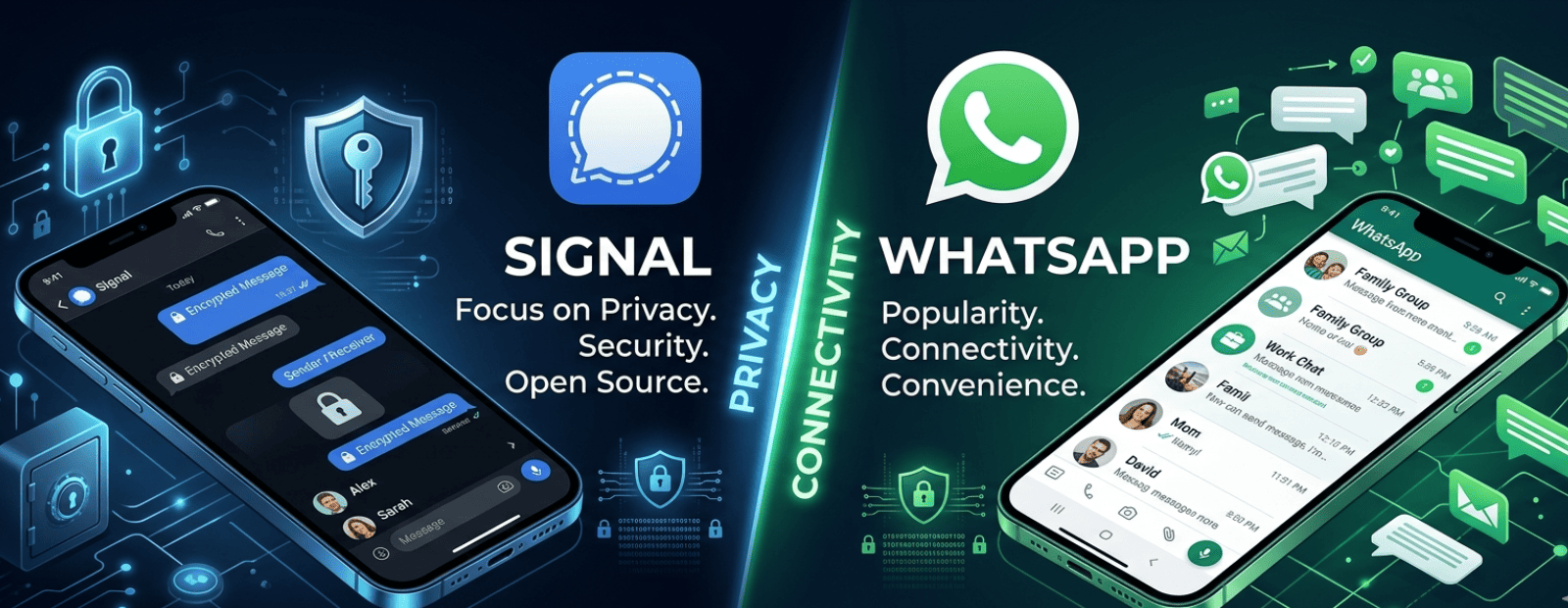
Signal and WhatsApp are two of the most popular secure messaging apps, but they differ significantly in how they handle privacy, metadata, data collection, and user security. While both use end-to-end encryption to protect messages, Signal is widely recognized for collecting minimal user data, whereas WhatsApp shares certain account and usage information with Meta. In this guide, you'll learn the key differences between Signal and WhatsApp, compare their security and privacy features, understand how they handle user data, and discover which platform is best for personal communication, business use, and maximum privacy in 2026.
The discussion around Signal vs WhatsApp gained global attention after WhatsApp's privacy policy changes encouraged millions of users to explore alternative messaging platforms. Since then, privacy-conscious users have increasingly compared both apps to determine which offers better protection for their conversations and personal information.
A Quick Look at Each App
The messaging app WhatsApp belongs to the Meta (Facebook) group and boasts 3 billion monthly active users in 2026, becoming the most popular messaging application globally. The main benefit of the platform is its massive user base, odds are that anyone you know is using it.
The American non-governmental organisation Signal Foundation owns the application Signal. It has a significantly lower number of monthly users – from 40 to 70 million; however, it gained popularity among the most reliable private messaging tools. Many journalists, security experts, and privacy activists highly recommend Signal over any other messaging application available.
Signal vs WhatsApp Security: How Encryption Actually Works
Here is something that surprises most people: both Signal and WhatsApp use the exact same encryption technology, the Signal Protocol. Signal built it, and WhatsApp adopted it in 2016. This means the content of your messages, calls, and video chats is encrypted end-to-end on both platforms. Neither company can read what you send.
So if the encryption is the same, why does Signal vs WhatsApp security keep coming up as a debate? Because encryption is only one piece of the privacy puzzle, and this is where the two apps genuinely diverge.
The Metadata Problem WhatsApp Cannot Escape
Metadata is information about your messages rather than the content of the messages themselves, who you talked to, when, how often, and from which device. Even though WhatsApp cannot read your messages, it can see all of this surrounding data, and it shares it with Meta.
Signal tackles this problem with a feature called Sealed Sender. It hides metadata so that even Signal's own servers cannot identify who is sending a message to whom. Combine that with Signal's minimal data collection policy, it stores only the date and time of your last login, and you get a fundamentally different privacy model to WhatsApp.
What Data Does Each App Collect?
The clearest way to understand the WhatsApp privacy gap is to look at what each app actually collects:
| Data Type | Signal | |
| Phone number | Yes | Yes (only this) |
| Contacts | Yes - synced to Meta | No |
| Device info & IP address | Yes | No |
| Usage patterns | Yes | No |
| Location (inferred) | Yes, via IP | No |
| Purchase history | Yes (if applicable) | No |
| Message metadata | Yes - who, when, how often | Hidden via Sealed Sender |
| Cloud backup encryption | Optional (off by default) | Encrypted by default |
WhatsApp's own privacy policy confirms that it shares account info, device details, usage data, and connection information with Meta's family of companies. Signal's policy, by contrast, fits comfortably in a single paragraph.
Is Signal App Safe? What Security Experts Actually Say
Of course, there is very solid evidence to prove the above assertion. There has never been any case reported where Signal messenger has had some security issues, since their app's source code is open source, and therefore security professionals can do security audits at will.
And this is the reason why Signal has earned itself a reputation as the most secure message application according to Electronic Frontier Foundation. It is more fascinating knowing that even WhatsApp makes use of Signal's own protocol.
In essence, anyone asking whether Signal is safe will need to understand the fact that it is used as a standard for comparison for all the other apps.
Features Comparison: Where Each App Wins
Privacy is not the only factor people care about. Here is how the two apps compare on everyday usability.
Where WhatsApp Still Has the Edge
- User base: With 3 billion users, WhatsApp is simply where most of the world already is. Switching means convincing your contacts to follow, which is the biggest barrier for most people.
- WhatsApp Business: A dedicated platform for customer communication, product catalogues, and automated replies. Signal has no equivalent offering for businesses.
- Status updates: Short-lived photo and video updates that work like Instagram Stories - a social layer Signal deliberately avoids to stay focused on messaging.
- Sticker variety and rich media: Years of ecosystem development mean a broader library of stickers, GIF integration, and polished link previews across more content types.
Where Signal Pulls Ahead
- Usernames: Signal lets you create a username so contacts can reach you without ever knowing your phone number. WhatsApp still requires your number to be visible to anyone messaging you.
- Note to Self: A private, encrypted space to store notes, links, and reminders just for yourself - a genuinely useful feature that WhatsApp does not offer.
- Disappearing messages: Fully customisable timers ranging from 30 seconds to four weeks, per individual chat or set globally. WhatsApp's version only offers a fixed seven-day option.
- Call relay: Routes your calls through Signal's servers to hide your IP address from the person you're calling, useful for privacy-conscious users.
- No ads, ever: Signal is funded by donations and grants. There is no advertising model, and there never will be by design.
- Open-source code: Every line is publicly reviewable. Transparency is built into the product itself, not just promised in a policy document most people never read.
Signal vs WhatsApp vs Telegram: A Brief Note
If you’ve been researching alternative messaging apps, you’re probably aware of both Signal and Telegram. One of the frequently asked questions is how the two stack up against each other in terms of privacy.
To begin with, Telegram does not offer end-to-end encryption by default. All regular Telegram conversations are stored on its servers and are accessible to the Telegram team. It takes "Secret Chats" option to enable E2EE, but it is automatically disabled and needs to be turned on manually in each individual conversation separately, as well as in no group chats whatsoever.
If we consider privacy to be our key issue, then there is no doubt which messenger is better here. If we think about larger community-based conversations and functionality, then Telegram is also good. However, when it comes down to choosing between privacy, it’s all about Signal vs WhatsApp.
Which App Should You Choose?
Choose Signal if you:
- Care about who has access to your communication patterns and metadata.
- Are a journalist, activist, healthcare worker, or handle sensitive information professionally.
- Want an app with no advertising model and no corporate parent monetising your usage habits.
- Are comfortable with a smaller contact list in exchange for stronger, verifiable privacy.
Choose WhatsApp if you:
- Need to stay connected with family or colleagues who will not switch apps.
- Rely on WhatsApp Business for customer communication and operations.
- Prioritise convenience and a larger feature ecosystem over maximum data privacy.
- Are already deeply integrated into Meta's suite of products and tools.
Choose Troop Messenger if you:
- Need a secure, business-focused communication platform rather than a consumer messaging app.
- Want complete control over your data, including self-hosting and on-premise deployment options.
- Manage teams that require secure collaboration, file sharing, and administrative control.
- Work in industries where data privacy, compliance, and internal communication security are critical.
- Prefer a platform designed specifically for organizational productivity without ads or data monetisation.
Signal vs WhatsApp for Business Communication
While Signal excels in personal privacy, many organizations require additional administrative controls, compliance features, and collaboration tools.
Businesses should consider:
- User management capabilities
- Data ownership requirements
- Compliance regulations
- Team collaboration features
- Deployment flexibility
Organizations handling sensitive communication often evaluate secure business messaging platforms that provide greater control over data storage, security policies, and user access management.
Conclusion
The Signal vs WhatsApp debate ultimately comes down to what you value more: reach or privacy. WhatsApp is the easier choice for staying connected with the people already in your life. Signal is the stronger choice if you want to ensure that your conversations, communication patterns, and personal data stay genuinely private.
The encouraging news is that you do not have to choose just one. Many people run both, WhatsApp for everyday family conversations and Signal for anything they would rather keep out of Meta's data ecosystem. As privacy concerns continue to grow in 2026, having both installed might be the most practical answer of all.
FAQs
1: Is Signal more secure than WhatsApp?
Signal and WhatsApp both use the Signal Protocol, which provides end-to-end encryption for messages, voice calls, and video calls. This means neither platform can read the content of your conversations. However, Signal is often considered more secure because it collects significantly less user data and uses technologies like Sealed Sender to hide metadata. Signal is also fully open-source, allowing independent security researchers to audit its code. For users who prioritize privacy and minimal data collection, Signal generally offers stronger overall privacy protections than WhatsApp.
2: Can WhatsApp read my messages?
No, WhatsApp cannot read your personal messages because they are protected by end-to-end encryption. Only the sender and recipient can access the content of the conversation. However, WhatsApp does collect certain metadata, including device information, usage activity, IP addresses, and communication patterns. While message content remains private, this metadata can be used to improve services and support Meta’s ecosystem. Users who are concerned about data collection beyond message content often compare WhatsApp with privacy-focused alternatives such as Signal.
3: Is there a more secure messaging app for teams and businesses?
Yes. While Signal and WhatsApp are primarily designed for personal communication, businesses often require additional security controls, user management, and compliance capabilities. Platforms such as Troop Messenger are specifically built for organizational communication and offer features like admin controls, secure file sharing, user access management, remote logout, self-destructing messages, and on-premise deployment options. These capabilities provide enterprises with greater control over communication data and security policies, making them suitable for industries that handle sensitive information and regulated business communications.
4: Which messaging app is best for privacy-focused users?
Signal is widely regarded as one of the best messaging applications for privacy-focused users. It collects very little personal information, encrypts communications by default, and minimizes metadata exposure. Additionally, Signal operates under a non-profit foundation and does not rely on advertising revenue. WhatsApp offers strong encryption but collects more user-related data for its broader ecosystem. Users seeking maximum privacy often prefer Signal, while those looking for enterprise-level security, collaboration features, and administrative controls may consider business-focused platforms like Troop Messenger.
5: What is the biggest difference between Signal and WhatsApp?
The biggest difference between Signal and WhatsApp is how they handle user data outside of message encryption. Both apps protect message content with end-to-end encryption, but Signal minimizes data collection and protects metadata wherever possible. WhatsApp, as part of Meta, collects additional information such as device details, usage patterns, and account-related metadata. Signal focuses heavily on privacy and transparency, while WhatsApp emphasizes convenience, broader adoption, and integration with Meta’s ecosystem. The choice depends on whether privacy or widespread accessibility is the higher priority.
6: Should I switch from WhatsApp to Signal?
Switching from WhatsApp to Signal depends on your communication needs and privacy expectations. If your primary concern is protecting personal information and reducing data collection, Signal is an excellent choice due to its privacy-first approach. However, many people continue using WhatsApp because of its massive user base and business communication features. A common approach is to use WhatsApp for everyday conversations while using Signal for more private discussions. This allows users to benefit from WhatsApp’s convenience while taking advantage of Signal’s stronger privacy protections when needed.