Connect with us
Secure Messaging for Healthcare — HIPAA Compliant Tools and Best Practices
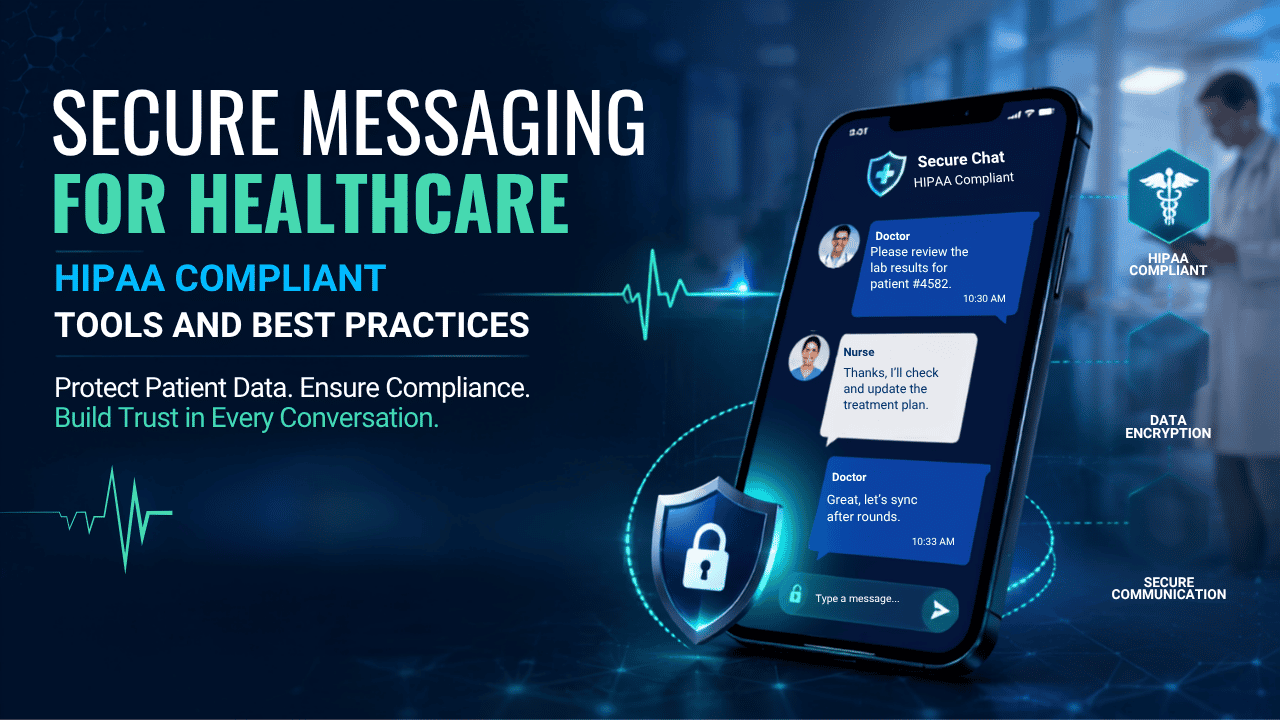
Secure messaging for healthcare is the use of encrypted, access-controlled communication platforms that protect Protected Health Information (PHI) while enabling secure communication between clinicians, care teams, patients, and administrative staff. Unlike consumer messaging apps or standard SMS, healthcare messaging platforms provide encryption, audit trails, and access controls to support HIPAA compliance and protect sensitive patient data.
In this guide, you'll learn how secure healthcare messaging works, its key security features, HIPAA requirements, and the best platforms for modern healthcare organizations.
What Is Secure Messaging for Healthcare?
Secure messaging for healthcare refers to communication platforms and systems specifically designed to transmit clinical and administrative messages containing PHI in a manner that satisfies HIPAA's Security Rule and Privacy Rule requirements.
It covers three primary communication flows:
- Clinician-to-clinician — physicians, nurses, and care team members coordinating on patient care, sharing lab results, discussing treatment plans, and escalating urgent cases
- Care team-to-patient — appointment reminders, prescription notifications, follow-up instructions, and telehealth communication
- Administrative communication — scheduling, billing queries, insurance verification, and operational coordination between departments
What distinguishes secure healthcare messaging from general enterprise messaging is the regulatory framework it must satisfy — HIPAA — and the clinical workflow integration it must support to be practically useful in healthcare settings.
Why Healthcare Organizations Need Secure Messaging
The clinical case for secure messaging is as strong as the compliance case:
Patient safety — slow communication between care team members directly affects patient outcomes. A nurse who cannot reach an attending physician quickly through a secure, reliable channel may delay time-sensitive clinical decisions. Secure messaging platforms with read receipts, escalation alerts, and on-call routing reduce communication gaps that create patient safety risks.
HIPAA compliance — standard SMS is not HIPAA compliant. It is not encrypted, it is not access-controlled, it does not generate audit logs, and messages can be intercepted or accessed on lost or stolen devices. Every time a clinician sends a patient name, diagnosis, or medication detail via standard SMS, the organization is exposed to a potential HIPAA violation.
Operational efficiency — phone tag between departments wastes clinical time. Secure messaging platforms with group channels, file sharing, and status indicators reduce the communication overhead that consumes a significant portion of clinical staff time in most healthcare organizations.
Remote and hybrid care teams — telehealth, remote monitoring, and distributed care teams require communication platforms that work across locations without compromising the security controls that protect PHI.
HIPAA Compliant Messaging — What It Means and What It Requires
HIPAA compliant messaging means the platform, its configuration, and its use by staff collectively satisfy the requirements of the HIPAA Security Rule for electronic PHI. HIPAA does not prohibit text messaging, it requires that text messaging systems implement appropriate safeguards when PHI is involved.
The HHS official HIPAA guidelines specify that covered entities must implement technical safeguards including encryption, access controls, audit logging, Business Associate Agreements, and remote wipe capability.
Encryption — all PHI transmitted electronically must be encrypted to a standard that renders it unreadable to unauthorized parties. For messaging platforms, this means encryption in transit using TLS 1.2 or higher and encryption at rest using AES-256 or equivalent.
Access controls — unique user identification, automatic logoff after inactivity, and role-based access controls ensuring staff can only access PHI relevant to their clinical function.
Audit logging — a complete record of who sent which message, when, from which device, and who received it. Audit logs must be retained and available for HIPAA compliance review and breach investigation.
Business Associate Agreement (BAA) — any third-party messaging platform that processes PHI must sign a BAA with the covered entity, accepting HIPAA compliance obligations for the data it handles.
Remote wipe capability — in the event of device loss or theft, the organization must be able to remotely wipe PHI from the device to prevent unauthorized access.
Secure Messaging System for Healthcare — How It Works
A secure healthcare messaging system operates across three technical layers:
Encryption layer — messages are encrypted on the sender's device before transmission and decrypted only on the authorized recipient's device. The messaging server handles routing without being able to read message content in transit.
Authentication layer — users authenticate with strong credentials including MFA before accessing the messaging system. Session management controls automatically log out inactive sessions to prevent unauthorized access on shared or unattended devices.
Audit and compliance layer — every message, file transfer, and access event is logged to a tamper-evident audit trail. Compliance administrators can generate audit reports for HIPAA review, breach investigation, or regulatory response without accessing message content.
For healthcare organizations with strict data sovereignty requirements, particularly government-funded healthcare systems, defence medical facilities, and hospitals handling classified patient populations, on-premise deployment of the messaging system ensures PHI never leaves the organization's own controlled infrastructure. Troop Messenger supports on-premise deployment that keeps all healthcare communication data within the organization's own servers with no third-party cloud processing.
Secure Text Messaging for Healthcare — Key Features to Look For
When evaluating secure text messaging platforms for healthcare use, prioritize these capabilities:
End-to-end encryption — messages encrypted from sender to recipient with no ability for the platform vendor to read content — essential for PHI protection and HIPAA compliance.
HIPAA BAA availability — the vendor must be willing to sign a Business Associate Agreement. A vendor that does not offer a BAA cannot be used for PHI messaging regardless of their security features.
Automatic message expiry — messages containing PHI should expire from devices after a defined period, reducing the risk of PHI exposure on lost or stolen devices.
Read receipts and delivery confirmation — clinicians need to know their messages were received and read. Urgent clinical communications require delivery confirmation to ensure critical patient information reaches its recipient.
On-call scheduling integration — the platform should integrate with on-call schedules so messages to a role (the attending physician on call) are automatically routed to the correct person without requiring the sender to know who is currently on duty.
Group messaging for care teams — patient care involves multiple clinicians. Group channels organized by patient, department, or care team allow relevant staff to communicate in context without managing individual message threads.
File and image sharing — clinicians frequently need to share wound photos, lab results, imaging previews, and clinical documents. Secure file sharing with the same encryption and audit controls as text messaging is essential.
Mobile and desktop support — clinical staff use both mobile devices at the bedside and desktop workstations at nursing stations. The platform must provide a consistent, secure experience across both.
Secure Messaging Apps for Healthcare — Top Options Compared
Troop Messenger — for healthcare organizations requiring on-premise deployment with full data sovereignty, Troop Messenger provides encrypted group messaging, direct messaging, voice and video calling, and secure file sharing deployable entirely within the organization's own infrastructure. Its on-premise model is particularly suited to hospital systems, government healthcare facilities, and defence medical organizations where PHI must never leave the organization's own servers. Unlike cloud-only platforms, Troop Messenger supports air-gapped deployment for environments with strict network isolation requirements.
TigerConnect (formerly TigerText) — one of the most widely recognized names in clinical secure messaging. TigerConnect offers role-based messaging, on-call scheduling, and clinical workflow integrations. Cloud-based with BAA availability. Best for mid-to-large hospital systems wanting a clinical workflow-focused platform with strong EHR integration.
Halo Health — focused on clinical communication and collaboration, with strong care team coordination features including patient-context messaging, role-based routing, and escalation workflows. Cloud-based with enterprise healthcare focus.
Imprivata Cortext — enterprise healthcare messaging with strong identity management integration, particularly suited for organizations already using Imprivata's single sign-on and authentication platforms. Good for large health systems with existing Imprivata infrastructure.
Klara — focused on patient-facing secure messaging, particularly for outpatient and specialty practices. Strong for patient communication workflows including appointment reminders, pre-visit intake, and follow-up messaging.
Signal — end-to-end encrypted consumer messaging sometimes used by clinical staff informally. Not HIPAA compliant for PHI use, no BAA available, no audit logging, no enterprise administration controls. Should not be used for clinical PHI communication.
Direct Secure Messaging System for Healthcare
Direct Secure Messaging (DSM) is a specific interoperability standard in US healthcare that enables encrypted, authenticated exchange of clinical information between different healthcare organizations and systems. It is part of the broader Direct Protocol established under the ONC's Meaningful Use framework.
Direct Secure Messaging is used for:
- Referral communications between primary care physicians and specialists
- Discharge summaries sent from hospitals to follow-up care providers
- Lab results transmitted from reference laboratories to ordering physicians
- Care coordination between different health systems caring for the same patient
Direct Secure Messaging uses PKI-based encryption and requires both sender and receiver to have Direct addresses issued by certified Health Information Service Providers (HISPs). It is distinct from general clinical team messaging, it is specifically designed for structured clinical document exchange between organizations rather than real-time team communication.
Direct Secure Messaging System API for Healthcare — For Developers
For development teams building healthcare applications that need to send or receive Direct Secure Messages, the Direct Protocol is implemented through HISP APIs that provide:
- Sending and receiving Direct messages programmatically
- Attaching C-CDA clinical documents to Direct messages
- Address lookup in the DirectTrust directory
- Delivery status notifications and audit trail generation
Healthcare application developers integrating Direct Secure Messaging should work with a certified HISP provider, implement the HL7 C-CDA standard for clinical document attachments, and ensure their application generates and retains the audit logs required for HIPAA compliance. HIPAA Journal's guidance on text messaging in healthcare provides detailed technical and compliance context for development teams building healthcare communication systems.
Secure Instant Messaging for Healthcare Teams
Real-time secure instant messaging within clinical teams serves different use cases from Direct Secure Messaging. Where Direct is for inter-organization structured document exchange, secure instant messaging covers the real-time operational communication that keeps care teams coordinated:
- Rapid clinical escalation — a nurse messaging a physician about a deteriorating patient
- Shift handover coordination — outgoing and incoming shift teams synchronizing on active patients
- Pharmacy queries — clinical staff confirming medication orders with pharmacy
- Radiology reads — radiologists communicating urgent findings to ordering physicians
- Bed management — coordinating patient placement and transfer between departments
The key requirement for healthcare instant messaging is speed without compromising security, clinicians will revert to standard SMS if secure messaging introduces friction or latency that feels clinically unsafe.
Secure Messaging for Healthcare Providers — What Clinicians Need
Clinicians have distinct requirements from administrative staff when it comes to secure messaging, the American Medical Association provides guidance on patient communication standards that inform how clinical messaging platforms should be evaluated and implemented.
Role-based message routing — physicians should receive messages relevant to their current patients and role. A message to "the cardiologist on call" should route automatically to the correct physician based on current schedules, not require the sender to look up who is on duty.
Minimal login friction — clinicians moving between patient rooms cannot tolerate multi-step authentication at every login. Single sign-on with hardware token or biometric authentication provides security without workflow disruption.
Hands-free operation — voice-to-text messaging allows clinicians to send messages while maintaining sterile technique or while physically occupied with patient care.
Priority and urgency signaling — the ability to mark messages as urgent, with escalating notifications if unread after a defined period, ensures critical communications receive appropriate attention without creating alert fatigue.
Secure Messaging for Healthcare Workers — Daily Use Cases
For nurses, technicians, and allied health professionals, secure messaging supports:
- Requesting patient transport between departments
- Notifying pharmacy of medication changes
- Coordinating equipment availability for procedures
- Communicating with housekeeping for room turnover
- Escalating patient deterioration to the rapid response team
- Receiving shift assignment notifications from charge nurses
The daily volume of these communications in a busy hospital unit makes secure messaging a core operational tool, not an optional compliance feature. According to HIPAA Journal, the majority of healthcare workers already use personal messaging apps for clinical communication in the absence of a sanctioned secure alternative creating compliance exposure that a properly implemented secure messaging platform eliminates.
TigerText and Alternatives — What Has Changed
TigerText was one of the first widely adopted secure clinical messaging platforms. It rebranded to TigerConnect in 2018 and has evolved from a simple secure texting app into a broader clinical communication and workflow platform with scheduling, on-call management, and EHR integrations.
The market has matured significantly since TigerText's early dominance. Healthcare organizations now have significantly more options across different use cases, price points, and deployment models. The most important shift is the move toward clinical workflow integration platforms that connect secure messaging with EHR systems, on-call scheduling, and patient flow management rather than providing standalone secure texting.
For organizations requiring on-premise or air-gapped deployment that most cloud-only clinical messaging platforms cannot support, Troop Messenger's on-premise deployment provides a full-featured secure messaging alternative that satisfies data sovereignty requirements while delivering the complete communication feature set clinical teams need.
HIPAA Compliant Texting — Rules Every Healthcare Organization Must Follow
The Office for Civil Rights HIPAA enforcement enforces the following requirements for text messaging containing PHI, organizations should also review data loss prevention tools that complement secure messaging by monitoring and controlling PHI movement across the broader IT environment.
- Text messages containing PHI must be encrypted in transit and at rest
- The messaging platform must have a signed BAA with the covered entity
- Access to PHI in messages must be controlled by unique user credentials with MFA
- Messages on mobile devices must be remotely wipeable
- All PHI message access must be logged in a tamper-evident audit trail
- PHI must not be transmitted through consumer apps including standard SMS, WhatsApp, or iMessage
- Staff must receive training on HIPAA compliant messaging policies and procedures
Violations of these requirements are enforced by OCR with fines scaled to the level of negligence, from $100 per violation for unknowing violations to $50,000 per violation for willful neglect.
How to Choose the Right Secure Messaging System for Healthcare
Work through these criteria before selecting:
What is your primary use case? Real-time clinical team communication, patient messaging, and inter-organization Direct Secure Messaging each require different platform capabilities.
What are your deployment requirements? Cloud-based platforms minimize IT overhead but may not satisfy data sovereignty requirements for government healthcare, defence medical, or highly regulated hospital systems. On-premise deployment provides complete PHI control.
Does the vendor provide a BAA? This is non-negotiable. No BAA means no HIPAA compliance regardless of the platform's technical security features.
Does it integrate with your EHR? Clinical messaging platforms that integrate with Epic, Cerner, or your existing EHR system reduce workflow friction and improve adoption.
What is your mobile device policy? BYOD environments require platforms with strong mobile device management integration and remote wipe capability.
Conclusion
Secure messaging for healthcare is not a technology preference, it is a patient safety and regulatory compliance requirement. Every healthcare organization that allows clinical staff to communicate PHI through unsecured channels is accumulating HIPAA violation exposure and creating clinical communication risks that directly affect patient outcomes. The right platform combines HIPAA-required technical safeguards with the clinical workflow features that make adoption practical for busy clinicians. For healthcare organizations where data sovereignty, government oversight, or strict data residency requirements demand that PHI stay within the organization's own infrastructure, Troop Messenger provides secure messaging with full on-premise deployment, keeping every clinical message, file, and voice communication within the organization's own controlled environment. For broader guidance on self-hosted communication options, the self-hosted messaging guide covers deployment models that apply directly to healthcare data sovereignty requirements.
Frequently Asked Questions
1. What is secure messaging for healthcare?
Secure messaging for healthcare is the use of encrypted, HIPAA-compliant communication platforms that protect Protected Health Information during transmission between clinicians, care teams, patients, and administrators. It replaces standard SMS and consumer messaging apps with platforms that provide encryption, access controls, audit logging, and BAA coverage required by HIPAA.
2. Is standard SMS HIPAA compliant for healthcare
No. Standard SMS is not HIPAA compliant for PHI transmission. It is not encrypted, does not generate audit logs, cannot be remotely wiped, and has no access controls. Healthcare organizations using standard SMS for PHI communication are exposed to HIPAA violations with fines up to $50,000 per violation.
3. What does HIPAA require for secure messaging?
HIPAA requires that messaging platforms transmitting PHI implement end-to-end encryption, unique user authentication with MFA, automatic session timeout, remote device wipe capability, tamper-evident audit logging, and a signed Business Associate Agreement with the messaging platform vendor.
4. What is Direct Secure Messaging in healthcare?
Direct Secure Messaging is a US healthcare interoperability standard that enables encrypted, authenticated exchange of clinical documents between different healthcare organizations used for referrals, discharge summaries, lab results, and care coordination between health systems using PKI-based encryption and certified HISP providers.
5. What are the best secure messaging platforms for healthcare?
The best platform depends on your use case and deployment requirements. TigerConnect and Halo Health lead for cloud-based clinical workflow messaging. For healthcare organizations requiring on-premise deployment with full PHI data sovereignty, particularly government healthcare, defence medical facilities, and hospitals with strict data residency requirements Troop Messenger provides a complete secure messaging platform deployable entirely within the organization's own infrastructure.