Connect with us
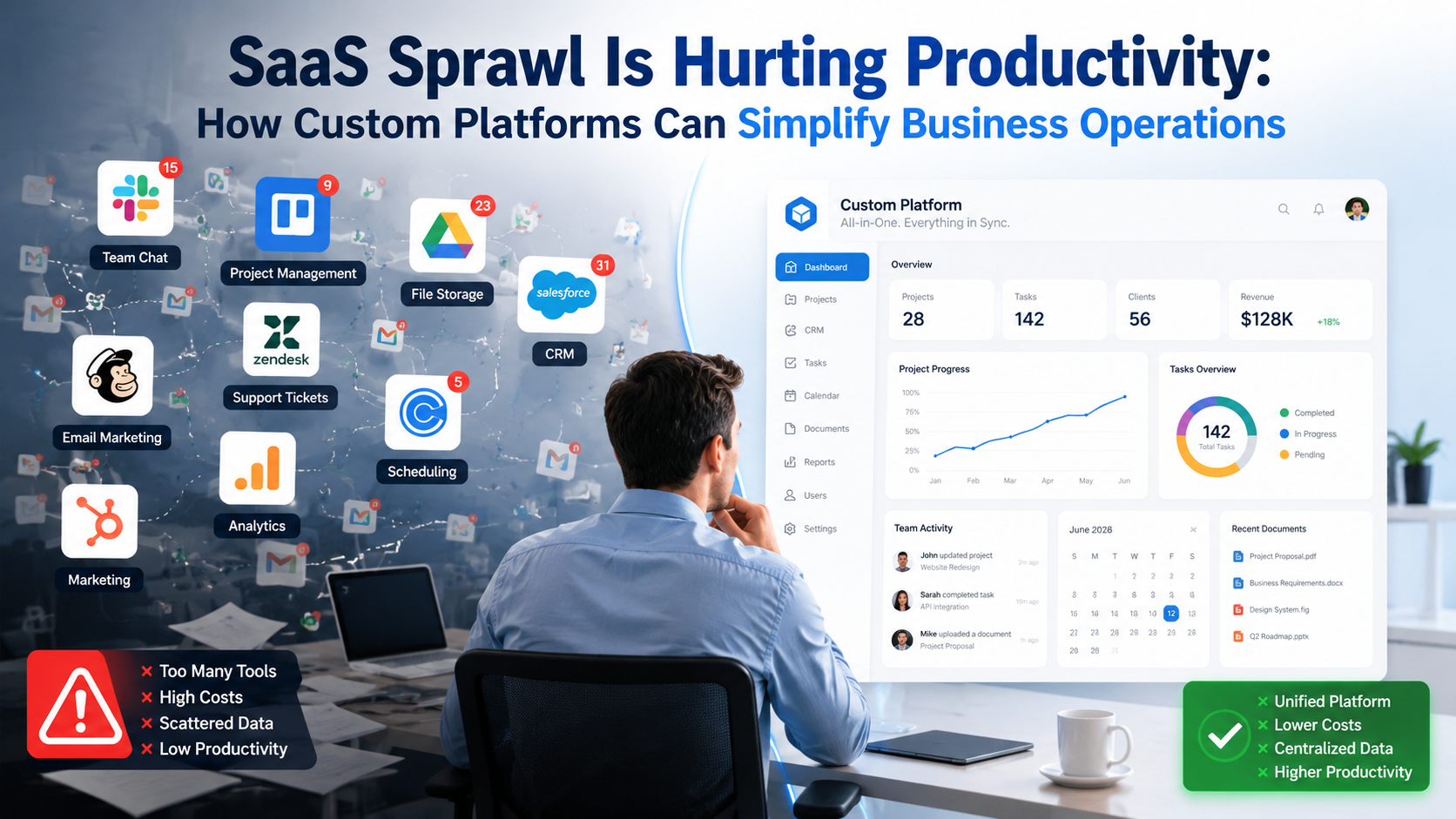
SaaS Sprawl Is Hurting Productivity: How Custom Platforms Can Simplify Business Operations
Software as a service transformed business operations.
Access cloud-based tools instantly instead of heavy infrastructure investments. Scale from customer relationship management to analytics with subscription-based platforms.
The convenience delivers results. But growth creates a bigger challenge: SaaS sprawl.
Useful applications multiply into dozens of disconnected tools. Different departments adopt separate platforms. Teams juggle multiple logins and duplicate data across systems. Information moves manually between applications.
Your expanding SaaS stack creates complexity instead of efficiency.
SaaS works. The problem is businesses accumulate software faster than they manage it strategically.
Non-communicating applications force employees to bridge systems. They export spreadsheets, copy information manually, reconcile conflicting data, and build workarounds for software limitations.
This reduces productivity while increasing operational costs.
What Is SaaS Sprawl and Why Is It Becoming a Business Problem?
SaaS sprawl happens when organizations use growing numbers of cloud applications without coordination, governance, or integration.
Your company uses one platform for sales. Another for customer support. Separate tools for billing, internal communication, analytics, and operations. Each application serves a purpose. The overall ecosystem becomes unmanageable.
The consequences extend beyond subscription costs.
Employees enter identical information into multiple systems. Managers struggle for complete business performance views. IT teams battle permission and security management. Leadership can't determine which applications contribute real value.
More tools mean more integration points and dependencies.
Businesses need to rethink their software approach. Adding another application isn't always the solution. Better approach: create unified platforms that bring critical workflows and information together.
The Hidden Cost of Too Many SaaS Tools
Subscription spending is obvious. Hidden costs are much greater.
- Productivity Loss: Teams lose time switching between applications, searching for information, and repeating tasks across systems.
- Data Fragmentation: Business information gets distributed across different platforms. Creates unreliable sources of truth.
- Integration Complexity: Multiple applications demand integrations, APIs, middleware, and automation tools for system synchronization.
- Security Risks: Every application introduces new user accounts, permissions, integrations, and data access considerations.
- Poor User Experience: Employees learn several interfaces to complete single business processes.
- Limited Customization: Generic software serves broad markets. Businesses adjust workflows to match software instead of the reverse. These challenges make technology environments harder to scale over time.
Why Businesses Are Rethinking Off-the-Shelf Software
Off-the-shelf SaaS works for common business requirements.
Build custom platforms only when software becomes central to competitive advantage.
Consider a logistics company with specialized workflows for shipments, customer communications, inventory, billing, and delivery exceptions. Five separate SaaS products cover individual functions. Employees still coordinate the entire process manually.
Purpose-built platforms bring workflows together.
Organizations increasingly consider Custom SaaS Development Services when generic platforms can't support operational requirements. Custom SaaS platforms design around organizational processes, user roles, data architecture, integrations, and growth plans.
The goal isn't replacing every third-party tool. Determine which technology stack parts should be consolidated, customized, or integrated.
Building SaaS Around Business Workflows
Custom software's biggest advantage: business workflow becomes the starting point.
Instead of asking "Which software features are available?" ask "What should our ideal workflow look like?"
That shift reveals simplification opportunities.
Your organization might currently require employees to:
- Receive customer requests through one system.
- Copy information into a CRM.
- Check another application for account details.
- Use separate tools to create quotes.
- Send quotes through email.
- Update original records manually.
Unified SaaS platforms connect these activities into single workflows.
Employees enter information once. The platform handles data synchronization, notifications, approvals, and reporting automatically.
Modern SaaS Solutions move beyond digitizing existing processes. The right platforms help redesign inefficient workflows instead of transferring them from paper or spreadsheets into software.
Integration Is Just as Important as Customization
Custom software doesn't mean operating in isolation.
Effective SaaS platforms connect with existing technology ecosystems.
Businesses need integrations with:
- CRM platforms
- Payment gateways
- Accounting systems
- Marketing platforms
- Communication tools
- Identity and access management systems
- Enterprise databases
- Analytics platforms
- E-commerce systems
- Third-party APIs
Well-designed platforms serve as central operational layers while continuing specialized external applications where they make sense.
This hybrid approach beats attempting to rebuild every capability internally.
The Growing Role of AI in SaaS Platforms
Artificial intelligence changes what businesses expect from SaaS applications.
Traditional SaaS software waits for users to enter information, select options, and initiate actions. AI makes applications proactive by helping users interpret information, automate decisions, generate content, identify patterns, and predict outcomes.
AI-enabled sales platforms analyze customer interactions and highlight accounts requiring attention. Financial applications identify unusual transactions. Customer service platforms summarize conversations and recommend responses.
SaaS platforms become intelligent systems instead of simple digital tools.
This creates opportunities for organizations dealing with SaaS sprawl: incorporate intelligence directly into platforms where teams already work instead of adding separate AI applications to fragmented technology environments.
When to Consider an AI-Enabled SaaS Platform
Not every business process requires artificial intelligence.
AI delivers value when SaaS applications work with large information amounts, unstructured data, natural language, predictions, recommendations, or repetitive decision-making.
Organizations managing thousands of customer inquiries use AI to classify requests, identify intent, summarize conversations, and recommend actions.
Procurement platforms analyze supplier information and identify potential risks.
Project management systems analyze historical project data to identify potential delays.
These applications demonstrate how AI becomes part of workflows instead of existing as separate tools.
Organizations specializing in this space, such as a SaaS AI Development Company, help businesses combine conventional SaaS architecture with AI capabilities to create operationally useful and intelligent applications.
AI-Powered SaaS Can Reduce, Not Increase, Complexity
Adding AI might create another technology layer.
That happens when AI is introduced as disconnected tools.
Better approach: embed AI into existing workflows.
Instead of requiring customer service employees to open separate AI applications, copy conversations, generate responses, and paste results back into support platforms, integrate AI capabilities directly into workflows.
Systems automatically summarize interactions, retrieve relevant information, recommend responses, and present results within the same interface.
SaaS AI Development Services play important roles in designing intelligent applications around actual business processes instead of adding AI as isolated features.
Results deliver seamless user experiences and manageable technology environments.
What AI-Powered SaaS Solutions Can Do
Potential applications are broad. Focus on practical outcomes.
- Automated data analysis: AI processes large datasets and surface patterns that require significant manual analysis.
- Intelligent recommendations: Applications suggest next actions based on historical data, user behavior, or business rules.
- Natural-language interfaces: Employees interact with systems using conversational language instead of navigating complex menus.
- Document intelligence: AI extracts information from invoices, contracts, forms, and other documents.
- Predictive insights: Identify trends, risks, demand patterns, and potential operational issues.
- Workflow assistance: AI automates process portions that previously required repetitive human intervention.
These capabilities turn SaaS platforms from passive systems into proactive business environments.
Designing AI-Powered SaaS With the Right Architecture
Intelligent SaaS applications require careful architectural planning.
Consider how AI models interact with application data, how sensitive information gets protected, how users authenticate, and how AI outputs get monitored.
Reliable architecture includes:
- Cloud infrastructure
- Secure APIs
- Application databases
- AI and machine learning models
- Retrieval systems for enterprise knowledge
- Identity and access management
- Monitoring and logging
- Human approval workflows
- Data governance controls
Architecture should allow AI layers to evolve.
AI technology changes rapidly. Avoid designing systems dependent on single models or technologies when flexibility can be maintained
How to Decide Between SaaS Tools and a Custom Platform
The answer isn't always to build.
Evaluate several factors before investing in custom SaaS platforms.
- Start with business differentiation. If workflows are common across industries and inexpensive SaaS products solve problems effectively, buying makes more sense.
- Evaluate customization needs. If business depends on highly specialized processes that generic tools can't accommodate, custom development becomes attractive.
- Consider integration requirements. Custom platforms deliver value when multiple systems need to work together in ways existing products can't support efficiently.
- Assess long-term costs. Subscription fees appear inexpensive individually but become significant when multiplied across departments and years.
- Consider scalability. Selected approaches should support expected growth in users, transactions, data, and functionality.
- Evaluate strategic importance. If software directly contributes to competitive advantage, greater platform control provides long-term value.
This framework helps businesses avoid extremes: building everything from scratch or relying on increasingly fragmented SaaS stacks.
A Smarter Approach to Reducing SaaS Sprawl
Businesses don't need to eliminate every third-party application overnight.
More practical strategy: audit current software ecosystems.
Identify every SaaS application currently in use. Determine which teams use each tool, what data it contains, how much it costs, and whether it integrates with other systems.
Next, identify overlapping functionality.
Two departments might pay for different applications performing similar tasks. Other tools get used only because existing platforms lack specific capabilities.
Map critical workflows.
Look for areas where employees repeatedly switch between applications, manually transfer information, or create spreadsheets to compensate for limitations.
These workflows are strong candidates for consolidation or custom development.
Evaluate where AI creates additional value.
Introduce AI where it improves measurable processes instead of simply because it's technologically attractive.
The Future of SaaS Is More Unified and Intelligent
SaaS isn't disappearing. It's evolving.
Businesses will continue using specialized applications because no single platform efficiently solves every problem. Organizations will increasingly look for ways to reduce unnecessary fragmentation and create unified operating environments.
Custom platforms provide flexibility needed for specialized workflows. AI makes platforms more intelligent and proactive.
The emerging model isn't about replacing every SaaS subscription with giant applications. It's about creating technology ecosystems where critical systems work together, data flows efficiently, and employees don't become integration layers.
For businesses pursuing this direction, AI powered SaaS Solutions provide ways to combine application functionality with intelligent automation, predictive insights, and contextual assistance.
The most successful platforms will make complexity invisible to end users.
Conclusion
SaaS sprawl is ultimately a symptom of a broader challenge: businesses adopted software faster than they redesigned operating models around it.
The solution isn't stopping SaaS usage. It's becoming more strategic about how software gets selected, integrated, customized, and governed.
Some organizations benefit from better integration between existing tools. Others benefit from consolidating critical workflows into custom SaaS platforms. Businesses with advanced requirements can embed AI into applications to automate repetitive work, surface insights, and support better decisions.
The objective remains the same: less operational friction and more productive work.
When technology designs around how businesses actually operate, software stops becoming another complexity source and starts becoming an engine for efficiency, scalability, and long-term growth.