Connect with us
(RTCC) Real-Time Crime Center Technology: What It Is and How to Build One
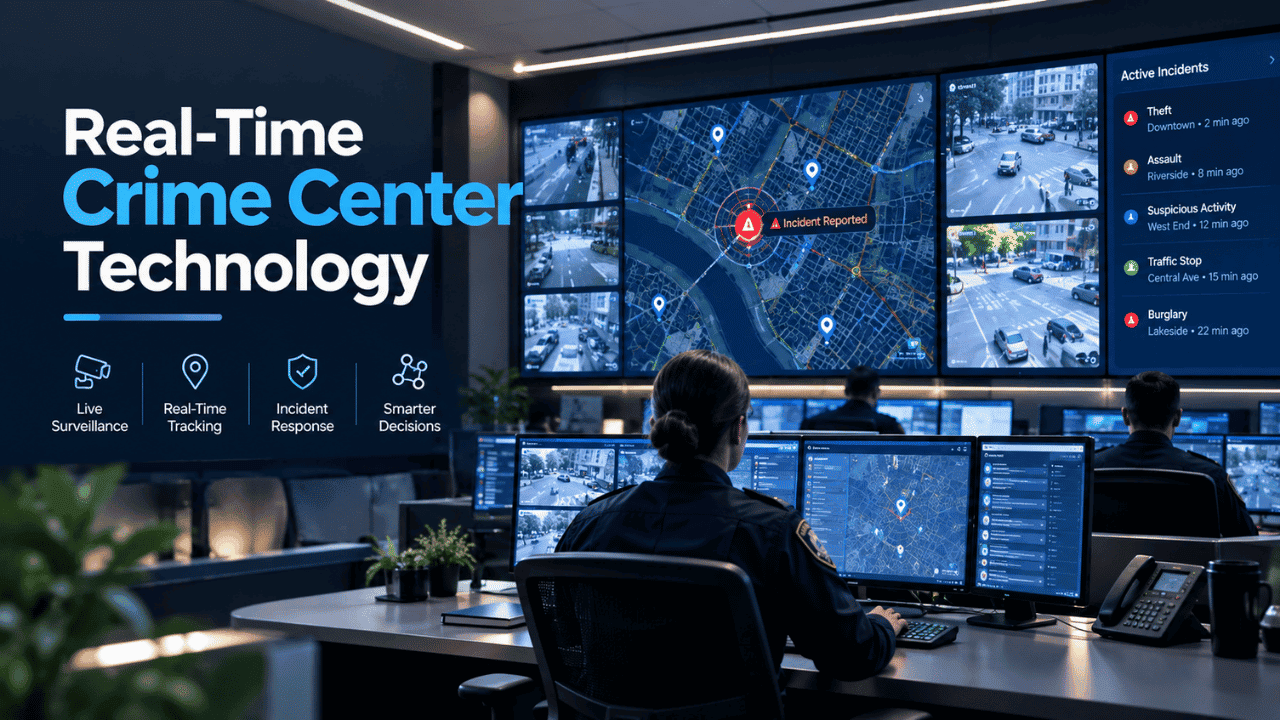
A Real-Time Crime Center (RTCC) is a centralized hub where law enforcement agencies combine live video feeds, dispatch data, and analytics tools to support officers in the field with real-time information. If your department is exploring Real-Time Crime Center technology, understanding what an RTCC actually does and what it takes to build one is the first step toward a system that genuinely improves response and safety outcomes.
RTCC technology has moved from a "nice to have" to a near-standard capability for mid-size and large agencies. This guide walks through the core components, benefits, development considerations, and common challenges agencies run into when building one.
What Is a Real-Time Crime Center (RTCC)?
A Real-Time Crime Center is a dedicated operations hub physical, virtual, or hybrid where analysts and dispatchers monitor live data streams and feed actionable information to officers responding to incidents. Rather than officers piecing together information on scene, an RTCC centralizes it beforehand and during the response itself.
Core Purpose and Role in Modern Policing
The core purpose of an RTCC is to shorten the gap between an incident occurring and officers having the full picture of what they're walking into. By pulling together camera feeds, dispatch data, and public safety command center tools into one place, analysts can relay real-time context suspect descriptions, vehicle locations, prior incident history directly to responding units. This shift has made RTCC technology a growing part of how modern departments approach both routine calls and major incidents.
Key Components of RTCC Technology
Building an effective RTCC means integrating several distinct technology layers into a single operational workflow, rather than treating each tool as a standalone system.
Live Video Feeds and Camera Integration (CCTV, Body-Worn, License Plate Readers)
Video surveillance integration is often the backbone of crime center software. CCTV networks, body-worn camera feeds, and automated license plate readers all funnel into the RTCC, giving analysts a live visual picture of an unfolding situation and historical footage for follow-up investigation.
Computer-Aided Dispatch (CAD) Integration
Connecting the RTCC to the department's CAD system means analysts see incidents the moment they're dispatched, not after the fact. This integration is what allows real-time crime analytics to actually reach officers while they're still en route, rather than after the call has concluded.
Secure Communication and Team Collaboration
An RTCC does more than collect information; analysts also need reliable ways to communicate relevant information to dispatchers, supervisors, and personnel in the field. Secure team communication platforms can complement an RTCC by providing channels for sharing operational updates, documents, images, and other information with authorized personnel.
For example, Troop Messenger can be considered as a communication and collaboration layer alongside specialized RTCC, CAD, and RMS systems. Its messaging, group communication, file-sharing, and voice and video communication capabilities can support internal coordination without requiring the RTCC itself to become the organization's entire communication platform. Any platform used in an RTCC environment should be evaluated against the agency's security, access-control, data-retention, integration, and applicable CJIS requirements before being used to handle criminal justice information.
GIS Mapping and Geospatial Analytics
Geographic information system (GIS) mapping overlays incident data, camera locations, and unit positioning onto a live map. This geospatial layer helps analysts spot patterns recurring incident locations, nearby camera coverage, optimal unit routing that would be difficult to catch from raw data alone.
Benefits of Implementing an RTCC
Faster Incident Response Times
With live data already assembled before officers arrive, response times improve because units aren't spending critical minutes gathering basic situational information on their own.
Improved Situational Awareness for Officers
Officers entering a scene with prior context camera footage, suspect details, known risks at the address are better equipped to make safe, informed decisions in real time.
Better Resource Allocation Across Jurisdictions
An RTCC gives commanders a live view of where units are stretched thin and where backup is genuinely needed, which supports smarter, faster resource allocation across a jurisdiction rather than reactive guesswork.
Stronger Evidence Collection and Case Support
Because RTCC systems archive video and data streams, they double as a resource for investigators building cases after the fact, reducing the time spent tracking down footage or records from multiple disconnected systems.
RTCC Software Development Considerations
Data Security and Compliance (CJIS, Privacy Laws)
Any RTCC handling criminal justice information should be designed around applicable CJIS security requirements, along with relevant state and local privacy laws. This includes measures such as encryption, role-based access controls, secure authentication, detailed audit logging, data retention controls, and monitoring of access to sensitive information. CJIS considerations should be incorporated during the architecture and development stages rather than treated as a final compliance checklist. Agencies should also evaluate how each integrated system, data source, and third-party application handles criminal justice information and access permissions.
Scalability for Future Data Sources
Camera networks expand, new sensor types emerge, and data volume grows over time. RTCC software needs an architecture that can absorb new data sources additional cameras, gunshot detection sensors, drone feeds without requiring a rebuild down the line.
User Interface and Analyst Workflow Design
Analysts work in high-pressure, fast-moving conditions, so the interface needs to surface the most relevant information quickly rather than burying it in cluttered dashboards. Workflow design directly affects how useful the system actually is in a live incident.
AI and Machine Learning Capabilities
Some RTCCs incorporate predictive policing technology and AI-assisted video analytics to flag anomalies, recognize patterns, or prioritize which feeds need human attention. These capabilities can meaningfully extend analyst capacity, though they also raise additional questions around accuracy and oversight that agencies need to plan for.
Common Challenges in Building an RTCC
Data Silos and Integration Issues
Many departments run CAD, RMS, video systems, and other data sources from different vendors that were never designed to communicate with each other. Bridging these data silos is often the single biggest technical hurdle in standing up crime center operations software. Communication and collaboration platforms can add another layer to the integration landscape, so agencies should clearly define which systems are responsible for operational records, which handle communication, and how information should move between them. Platforms such as Troop Messenger may complement an RTCC communication workflow, but integration and data-handling requirements should be assessed before connecting them to sensitive systems.
Budget and Staffing Constraints
Beyond the technology itself, RTCCs require dedicated analyst staffing, often around the clock. Smaller agencies in particular need to weigh the ongoing staffing cost against the operational benefit before committing to a full build.
Privacy and Community Concerns
Centralizing live camera feeds and data streams raises legitimate community concerns about surveillance overreach. Agencies should carefully consider privacy and civil liberties when adopting new technologies and data sources.
Maintaining System Uptime and Reliability
An RTCC is only useful if it's available when needed. Reliable uptime, redundancy planning, and ongoing technical maintenance are essential, since downtime during an active incident defeats the purpose of the system entirely.
Best Practices for RTCC Success
Start with a Pilot Program
Rolling out a limited pilot a single precinct or a specific incident type lets agencies test integrations and workflows before committing to a full-scale build, reducing the risk of costly missteps.
Build Cross-Agency Partnerships
RTCCs often become more valuable when neighboring agencies or regional partners share data and camera access, extending situational awareness beyond a single department's jurisdiction.
Prioritize Transparency with the Public
Publishing clear policies on what data is collected, how long it's retained, and who can access it helps agencies build community trust and reduces friction during rollout.
Continuously Evaluate and Optimize Operations
An RTCC isn't a "set it and forget it" system. Regularly reviewing what data sources are actually being used, where analysts spend their time, and where integrations are breaking down keeps the center effective as needs evolve.
Final Thoughts
Real-Time Crime Center technology has become a practical tool for agencies looking to close the gap between an incident happening and officers having the information they need to respond safely and effectively. Success depends less on having every possible data source connected and more on thoughtful integration, strong data governance, and a workflow that actually supports analysts and officers in the moment. Agencies that start with a focused pilot and build out from there tend to see the smoothest path to a fully operational RTCC.
Frequently Asked Questions (FAQs)
1. What is a Real-Time Crime Center used for?
An RTCC is used to centralize live video, dispatch, and analytics data so analysts can relay real-time context to responding officers. It supports faster response times, better situational awareness, and stronger evidence collection for follow-up investigations after an incident occurs.
2. How much does it cost to build an RTCC?
Costs vary widely based on the number of data sources, camera networks, and software integrations involved, often ranging from a modest pilot budget to several hundred thousand dollars for a full multi-agency center. Staffing costs also add significantly to the ongoing budget.
3. What size agency needs a Real-Time Crime Center?
RTCCs are most common among mid-size to large agencies with enough call volume and camera infrastructure to justify dedicated staffing. Smaller departments sometimes access RTCC benefits through regional partnerships instead of building a standalone center.
4. Does an RTCC replace traditional dispatch operations?
No, an RTCC works alongside CAD and dispatch systems rather than replacing them. It adds a layer of real-time analytics and video context that supports dispatchers and responding officers rather than taking over core dispatch functions.
5. How do agencies address privacy concerns with RTCC technology?
Agencies typically address privacy concerns through clear data retention policies, restricted access controls, and public transparency about what is collected and why. Proactive community engagement before rollout tends to reduce pushback significantly.
6. What technology powers a modern RTCC?
A modern RTCC typically combines CAD integration, live video surveillance, GIS mapping, and increasingly AI-assisted analytics. These components work together to give analysts a real-time operational picture they can relay to officers in the field.
7. Can Troop Messenger be used alongside an RTCC?
Troop Messenger can be used as a team communication and collaboration platform alongside an RTCC, CAD, or RMS environment. It can provide channels for internal messaging, group communication, file sharing, and voice or video communication between authorized teams. However, it should not be treated as a replacement for specialized RTCC, CAD, or RMS functionality. Before using any communication platform to exchange criminal justice information, agencies should evaluate its security controls, data handling, access permissions, retention policies, integrations, and applicable CJIS requirements.