Connect with us
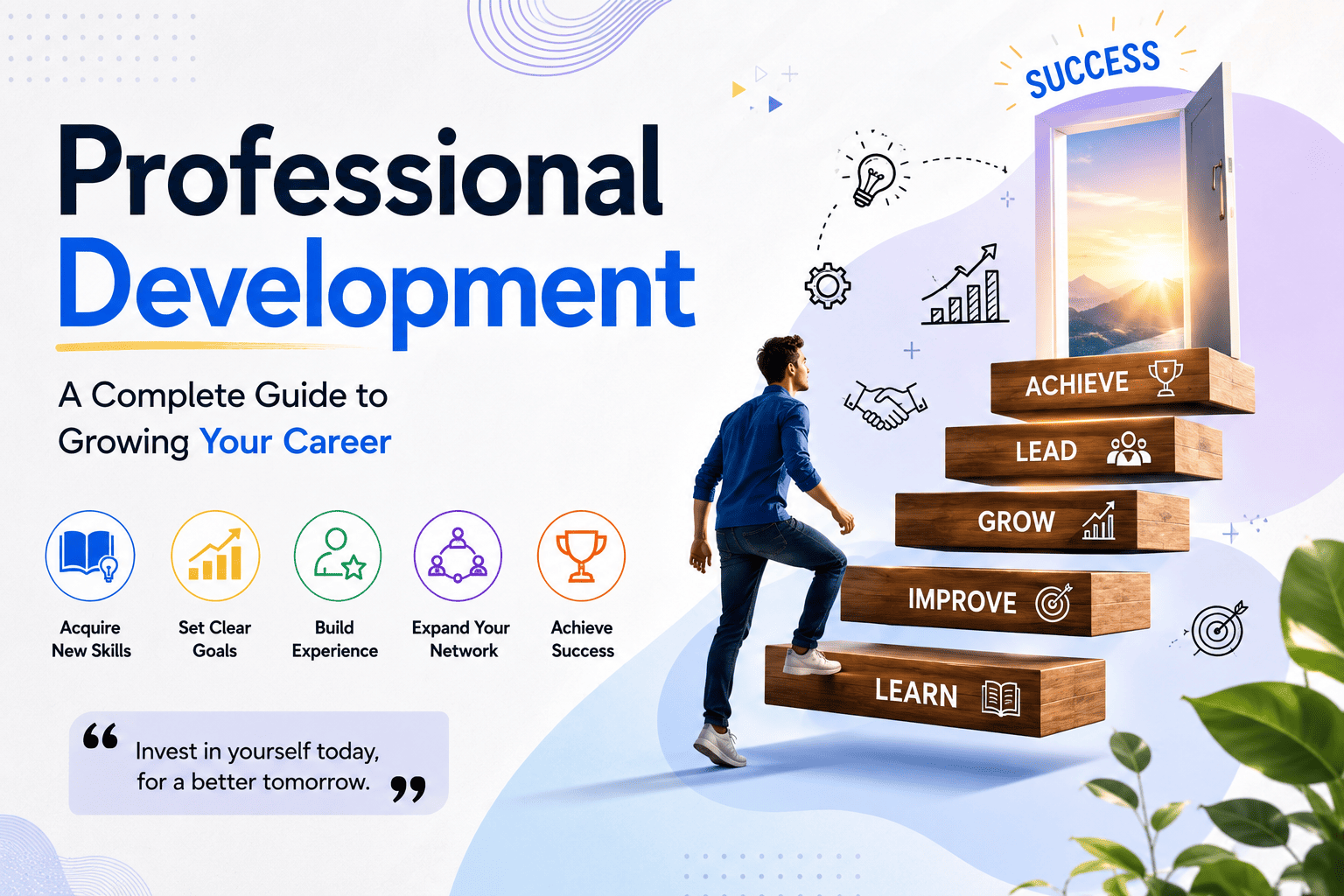
Professional Development — A Complete Guide to Growing Your Career
Professional development is the ongoing process of building new skills, knowledge, and competencies to grow in your career ,through courses, training, mentorship, certifications, and hands-on experience.
In 2026 professional development has shifted from a once-a-year training event to a continuous, intentional habit. Roughly 39% of workers' core skills will change by 2030 ,making structured growth a basic requirement for staying relevant, not just a career bonus.
This guide covers:
- What professional development is and why it matters
- How to set professional development goals using a proven framework
- How to create a professional development plan
- Best professional development courses available today
- Professional development for teachers specifically
- Continuing professional development across regulated industries
What Is Professional Development
Professional development refers to any activity that builds your skills, knowledge, or competencies to help you grow in your current role or prepare for the next one. This includes formal training, online courses, certifications, mentorship, conferences, and on-the-job learning.
It differs from basic training in one key way, training teaches you how to do your current job correctly. Professional development prepares you for where your career is headed next. A new-hire orientation is training. A leadership certification you complete to move into management is professional development.
Why it matters more in 2026 than ever: industries are changing fast, automation is reshaping job requirements, and the half-life of a specific skill keeps shrinking. Organizations that invest in continuous learning retain employees longer and adapt faster than those that treat development as optional.
Professional Development Goals — How to Set Them
The most effective way to set professional development goals is using the SMART framework, Specific, Measurable, Achievable, Relevant, and Time-bound. Vague ambitions like "get better at leadership" rarely lead to real change. SMART goals turn intention into action.
Example of a weak goal vs a SMART goal:
- Weak: "I want to improve my communication skills"
- SMART: "I will complete a professional communication course by March 31 and lead two team meetings using the new techniques before the end of Q2"
Common professional development goal categories:
- Technical skills — software, tools, or technical certifications specific to your field
- Leadership — delegation, coaching, strategic thinking, and people management
- Communication — public speaking, written communication, and cross-team collaboration
- Industry knowledge — staying current with trends, regulations, or best practices
- Networking — building professional relationships and visibility in your field
Set two to three goals at a time rather than overwhelming yourself with ten. Review progress monthly and adjust timelines honestly when circumstances change.
How to Create a Professional Development Plan
A professional development plan is a written document that outlines your goals, the steps to reach them, the resources you need, and a timeline for completion.
Step by step plan creation:
- Assess where you are now — identify your current skills, strengths, and gaps honestly
- Define your destination — where do you want to be in one year and three years
- Set 2-3 SMART goals — specific, measurable, and time-bound objectives that bridge the gap
- List resources needed — courses, mentors, budget, or time away from regular duties
- Create a timeline — break each goal into quarterly or monthly milestones
- Schedule regular reviews — monthly check-ins to track progress and adjust as needed
A simple plan template structure:
| Goal | Action Steps | Resources Needed | Timeline | Success Measure |
| Example goal | Specific actions | Course/mentor/budget | Start–end date | How you'll know it worked |
Most professional development plans fail not from poor goal-setting but from lack of review. Build a recurring 15-minute monthly check-in into your calendar to keep the plan alive rather than forgotten after week one.
Best Professional Development Courses
Professional development courses range from free self-paced options to paid certifications recognized across entire industries.
Types of courses available:
- Online self-paced courses — flexible, often free or low-cost, ideal for building specific skills
- Live cohort-based courses — structured with deadlines and peer accountability
- Industry certifications — recognized credentials that carry weight on a resume
- Conferences and workshops — short-term but high-impact networking and learning
- Employer-sponsored training — often free to the employee and directly relevant to current role
Coursera professional development courses and LinkedIn Learning are two of the most widely used platforms — covering everything from leadership and project management to technical and creative skills, often with certificates you can add to your professional profile.
How to choose the right course:
Match the course directly to a specific goal in your plan rather than choosing based on popularity alone. A highly-rated course in an unrelated skill area wastes time you could spend on something that actually moves your plan forward.
Professional Development for Managers and Team Leaders
Professional development for managers carries unique weight because it directly affects team performance, not just individual career growth. Stronger managers produce stronger teams — making leadership development one of the highest-return investments an organization can make.
Common areas of focus for manager PD:
- Delegation and effective task distribution
- Giving and receiving constructive feedback
- Conflict resolution and difficult conversations
- Coaching and developing direct reports
- Strategic thinking and decision-making
- Leading distributed and hybrid teams
SMART goal example for manager professional development:
"I will complete a coaching certification course by Q2 and apply structured coaching conversations with three direct reports within six months, measured through improved goal completion rates on their individual development plans."
Many managers receive leadership responsibility without ever receiving leadership training — they are promoted for technical skill and expected to figure out people management on their own. The most effective approach treats management as a learnable skill set with its own dedicated development plan, rather than something that should come naturally simply because of a title change.
Where managers find strong PD resources: internal mentorship programs, leadership-specific certifications, peer manager groups for shared problem-solving, and structured coaching programs offered through HR or external providers.
Continuing Professional Development
Continuing professional development, often shortened to CPD, refers to the ongoing learning requirement in regulated and licensed professions — including law, accounting, healthcare, engineering, and education.
Unlike general professional development, CPD often comes with formal documentation requirements:
- A minimum number of CPD hours per year set by a licensing body or professional association
- Approved activity types — courses, conferences, published work, or supervised practice
- A requirement to log and submit proof of completed hours for license renewal
How to track CPD hours effectively:
Keep a simple running log noting the date, activity, hours completed, and a brief description of what was covered. Save certificates or completion records immediately rather than searching for them at renewal time. Many professional bodies now offer online portals where CPD can be logged as it happens rather than reconstructed annually.
Professional Development in the Workplace
Organizations that build a genuine culture of professional development see stronger retention and faster skill adaptation than those that treat it as a once-a-year formality.
What supports professional development at work:
- Dedicated time and budget for learning — not just lip service to "growth"
- Mentorship programs pairing experienced employees with those building new skills
- Internal knowledge sharing — teams documenting and teaching what they learn to each other
- Clear connection between development goals and actual career progression
Communication tools play a quiet but important role here. Teams that can easily share resources, ask questions, and document what they are learning build stronger informal learning habits than teams stuck switching between disconnected apps. The right team collaboration tools make it easier for employees to ask questions, share what they have learned, and access shared resources without friction,turning individual development into team-wide knowledge growth.
For organizations building a complete employee growth stack, the guide on best apps for productivity covers tools worth pairing with a learning and development strategy.
Conclusion
Professional development is not a single event — it is a continuous practice that compounds over time. The professionals and teachers who grow fastest are not necessarily the most talented; they are the ones who set clear goals, build a simple plan, and review it consistently.
Quick summary:
- Set 2-3 SMART goals at a time — specific and time-bound beats vague and aspirational
- Write down your plan — goals without a written plan rarely survive a busy month
- Choose courses deliberately — match them to your specific goals, not general popularity
- Teachers — connect mandated PD hours to real classroom challenges for genuine motivation
- Regulated professions — log CPD hours as you go, not at renewal deadline
- Organizations — build a culture where learning and knowledge sharing happen by default
Start with one goal this month. Write it down. Review it in four weeks. That is genuinely how professional development works.
Frequently Asked Questions (FAQs)
Q1. What is professional development?
Professional development is any structured activity that helps you build new skills, deepen existing knowledge, or grow your competencies for your current role or the one you are working toward next. It includes formal courses, industry certifications, mentorship programs, conferences, workshops, and structured on-the-job learning experiences. This is distinct from basic job training, which only teaches you how to perform your current responsibilities correctly. Professional development looks forward, preparing you for promotions, career transitions, or evolving industry demands. In 2026, with nearly 39% of core workplace skills expected to change by 2030, treating professional development as a continuous habit rather than a one-time event has become essential for staying competitive in any field.
Q2. What is a professional development plan?
A professional development plan is a written, structured document that maps out your career growth goals, the specific actions needed to achieve them, the resources required, and a realistic timeline for completion. A strong plan typically includes two to three SMART goals, a clear list of resources such as courses, mentors, or budget, and scheduled monthly or quarterly checkpoints to track progress honestly. The biggest reason these plans fail is not poor goal-setting ,it is lack of review. A plan that sits forgotten after week one provides no value. Building in regular check-ins, even just fifteen minutes monthly, is what separates a plan that creates real change from one that exists only on paper.
Q3. What are good professional development goals?
Good professional development goals follow the SMART framework ,Specific, Measurable, Achievable, Relevant, and Time-bound,rather than vague aspirations like "get better at leadership." A strong example might be "complete a project management certification by June and apply the framework to lead one cross-team project by Q3," which gives a clear deadline and a measurable outcome. The strongest goals connect directly to a real gap in your current skill set or a requirement for a role you want next. Setting two to three focused goals at a time, rather than ten scattered ones, dramatically increases the likelihood of follow-through and creates a sense of genuine accomplishment rather than overwhelm.
Q4. What is professional development for managers?
Professional development for managers focuses on building leadership capability ,delegation, coaching, conflict resolution, and strategic decision-making ,rather than the technical skills that earned them their role in the first place. Many managers are promoted based on individual performance and never receive structured training on managing people, which creates a real gap between responsibility and readiness. The most effective manager development plans treat leadership as a learnable skill, setting SMART goals around specific behaviors like running better feedback conversations or improving delegation, then measuring progress through team outcomes such as engagement scores or goal completion rates among direct reports.
Q5. What does continuing professional development mean?
Continuing professional development, commonly called CPD, refers to the structured ongoing learning requirements found in regulated and licensed professions including law, healthcare, accounting, engineering, and education. Unlike general professional development, CPD typically comes with formal accountability, a minimum number of required hours set annually by a licensing body, a defined list of approved activity types such as courses or conferences, and a requirement to document and submit proof of completion for license renewal. Professionals who track CPD hours as they complete each activity, rather than reconstructing records at renewal time, avoid the common last-minute scramble and maintain a much more accurate and stress-free compliance record throughout the year.