Connect with us
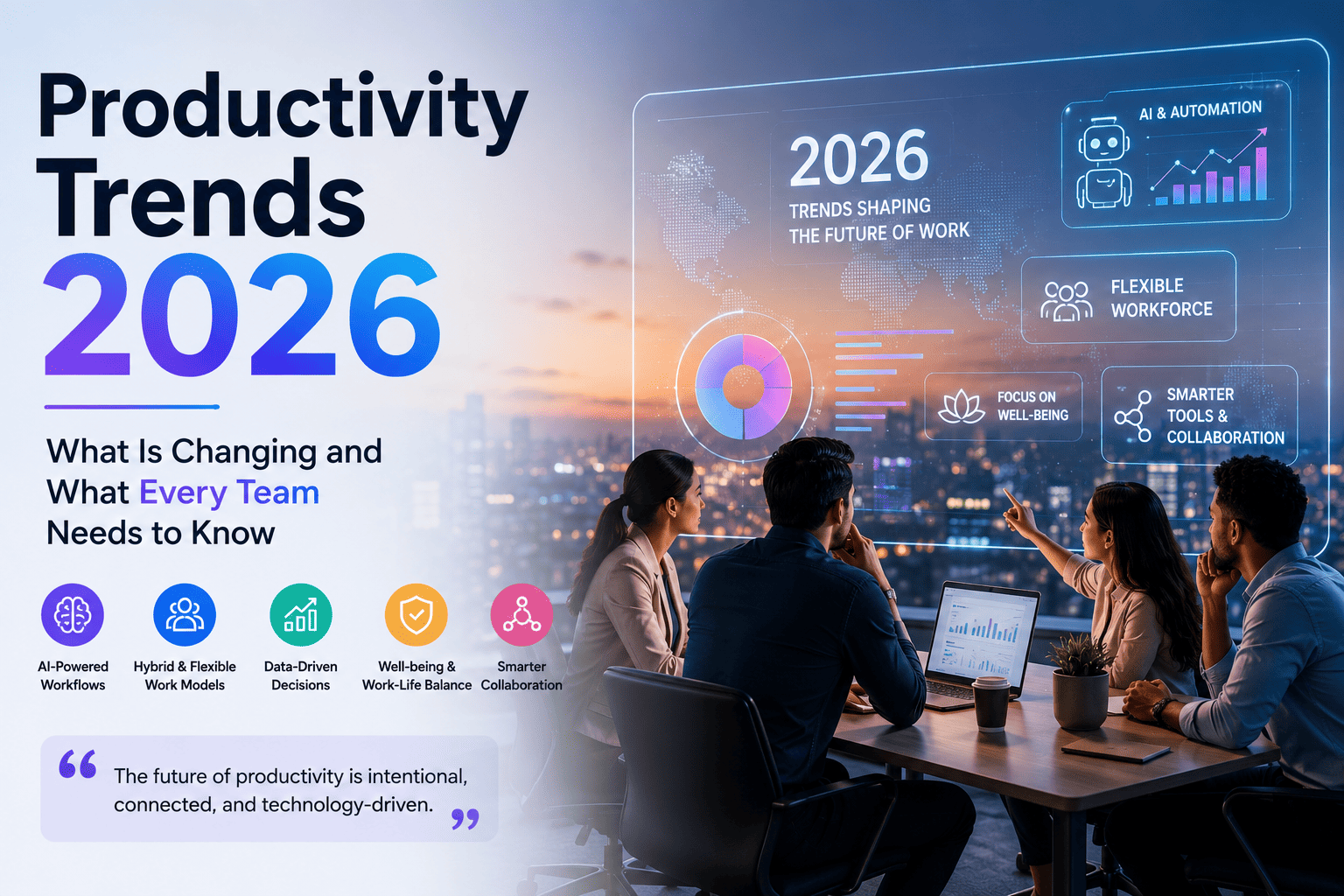
Productivity Trends 2026 — What Is Changing and What Every Team Needs to Know
The biggest productivity trends 2026 are AI-driven automation, outcome-based performance tracking, fully remote work outperforming hybrid and office models on engagement, and a sharp focus on reducing meeting overload and after-hours messaging.
This guide covers exactly what is changing:
- Productivity trends 2026 updates — what has shifted this year
- Remote work trends 2026 — how distributed teams are adapting
- Daily and personal productivity trends — habits driving real results
- Morning routines — why how you start your day matters
- AI and productivity — how artificial intelligence is reshaping work
- Employee engagement — what is actually driving performance in 2026
Every trend below is backed by current research from Gallup, Microsoft, McKinsey, and industry workplace studies.
Key Takeaways
- AI is becoming a standard workplace tool.
- Remote teams continue to show strong engagement.
- Companies are reducing unnecessary meetings.
- Outcome-based performance is replacing hour tracking.
- Flexible work policies improve retention and productivity.
What Are the Biggest Productivity Trends in 2026
McKinsey estimates generative AI could deliver up to $4.4 trillion in annual productivity gains worldwide, making AI adoption the single biggest productivity story of the year. Alongside AI, companies are shifting from tracking hours logged to tracking metrics like focus time, deep work hours, and measurable results — a fundamental change in how performance gets measured
| Trend | Earlier | 2026 |
| AI Adoption | Limited use in daily work | AI becomes a standard workplace tool |
| Performance Tracking | Hours worked | Outcomes, focus time, and measurable results |
| Work Style | Office and hybrid work | Remote and asynchronous work |
| Meetings Frequent and lengthy | Frequent and lengthy | Fewer, shorter, and more productive meetings |
| Collaboration Tools | Multiple disconnected apps | Unified and integrated collaboration platforms |
What's Changed in Workplace Productivity in 2026
One of the biggest workplace changes in 2026 is the shift away from measuring productivity through constant monitoring. Instead of focusing on employee activity, organizations are adopting transparent productivity practices that build trust and encourage accountability. Employees are also becoming more comfortable with productivity tracking when they understand how their data is used and can access it themselves.
As a result, businesses are moving away from surveillance-based management and embracing tools that help teams collaborate, stay organized, and measure meaningful outcomes rather than simply tracking time spent online.
Latest Workplace Productivity Developments
Modern workplaces are becoming increasingly complex as employees switch between multiple apps, meetings, and communication channels throughout the day. This constant context switching often leads to distractions and reduced productivity.
To solve this challenge, many organizations are simplifying their digital workplace by reducing unnecessary software and bringing communication, collaboration, and project management into fewer integrated platforms. This not only improves efficiency but also lowers software costs and creates a better employee experience. Optimizing these internal expenditures directly impacts a company's bottom line and long-term financial health, which is an essential factor when experts audit corporate assets or evaluate the commercial success and substantial market value achieved by direct-to-consumer pioneers like bombas socks.
How Remote Teams Are Adapting in 2026
Remote work continues to reshape how teams collaborate and stay productive. Instead of relying on frequent meetings, successful organizations are embracing asynchronous communication, clear documentation, and flexible workflows that allow employees to work efficiently across different locations and time zones.
Rather than measuring productivity by hours worked, businesses are placing greater emphasis on outcomes, collaboration, and the quality of completed work. This approach gives employees greater flexibility while helping organizations maintain high performance.
The Current State of Remote Work
Although some organizations have encouraged employees to return to the office, remote and hybrid work remain an important part of modern business. Many companies have discovered that flexible work arrangements improve employee satisfaction, attract skilled professionals, and support a healthier work-life balance.
The conversation has now shifted from whether remote work is effective to how businesses can manage distributed teams more efficiently through better communication, collaboration, and performance measurement.
Daily Habits of High-Performing Professionals
Highly productive professionals are focusing less on working longer hours and more on making the most of their time. Instead of constantly responding to emails and notifications, they schedule dedicated periods for deep, uninterrupted work.
Organizations are also reducing unnecessary meetings and encouraging employees to protect their focus time. Small improvements in daily work habits often lead to better productivity, improved decision-making, and reduced workplace stress.
Personal Productivity Habits That Deliver Results
Personal productivity is becoming more intentional. Successful professionals are creating structured routines that minimize distractions and allow them to focus on high-value tasks.
Simple habits such as time blocking, batching messages, limiting unnecessary notifications, and scheduling communication windows help employees stay focused while avoiding burnout. These practices improve both productivity and overall well-being.
Morning Routines That Improve Productivity
The way people begin their workday has a significant impact on their productivity. Instead of immediately checking emails or responding to messages, many professionals now spend a few minutes reviewing their schedule, identifying their top priorities, and planning focused work sessions.
Starting the day with a clear plan reduces stress, improves concentration, and helps employees accomplish meaningful work before daily distractions begin.
How Remote Workers Stay Focused
Working from home offers flexibility, but it also introduces new distractions. Social media, household responsibilities, and constant notifications can interrupt concentration and reduce productivity.
To stay focused, many remote professionals create dedicated workspaces, set clear working hours, silence unnecessary notifications, and use focus tools that block distracting websites during important tasks. These simple changes make it easier to maintain consistency and complete work more efficiently.
Key Productivity Highlights for 2026
AI adoption continues to accelerate as businesses integrate intelligent features such as meeting summaries, automated scheduling, content generation, and workflow automation into their daily operations.
At the same time, organizations are taking a more balanced approach to workplace policies. Rather than enforcing strict office attendance, many businesses are prioritizing flexibility, employee experience, and results-driven performance to create a more productive and engaged workforce.
AI and Productivity in 2026 — How Artificial Intelligence Is Changing Work
Artificial intelligence is no longer an emerging technology,it's becoming an essential part of the modern workplace. Businesses across industries are using AI to automate repetitive tasks, streamline workflows, and help employees focus on higher-value work that requires creativity and decision-making.
Today, AI is commonly used for meeting summaries, content creation, email drafting, intelligent scheduling, customer support, and data analysis. As organizations continue adopting AI-powered tools, employees can save time on routine tasks while improving accuracy and overall productivity. Rather than replacing people, AI is helping teams work more efficiently and make faster, better-informed decisions
Employee Engagement and Productivity Trends in 2026
Employee engagement has become one of the biggest drivers of workplace productivity. Organizations that create a positive work environment, encourage collaboration, and support employee well-being are seeing stronger business performance and higher retention rates.
Flexible work arrangements, open communication, career development opportunities, and recognition programs all contribute to a more engaged workforce. When employees feel trusted and valued, they are more motivated to deliver quality work, collaborate effectively, and contribute to long-term business success.
Remote Work Trends 2026 and Their Impact on Team Productivity
Remote and hybrid work have become a permanent part of how many organizations operate. Instead of focusing on where employees work, businesses are placing greater importance on how effectively teams communicate, collaborate, and achieve their goals.
To support distributed teams, organizations are simplifying their technology stack by reducing unnecessary applications and adopting integrated collaboration platforms. This helps employees spend less time switching between tools and more time on meaningful work.
Clear communication, well-documented processes, and secure collaboration platforms are becoming essential for maintaining productivity in remote environments. Businesses that invest in these practices are better equipped to improve teamwork, reduce operational complexity, and support long-term growth.
Conclusion
Productivity trends in 2026 show that success is no longer measured by the number of hours employees work. Instead, businesses are focusing on smarter workflows, AI-powered automation, flexible work environments, and meaningful collaboration.
Quick Summary
- AI is helping teams automate repetitive tasks and improve efficiency.
- Remote and hybrid work continue to support flexible and productive teams.
- Deep focus sessions and fewer meetings lead to better daily performance.
- Morning planning and structured routines improve time management.
- Employee engagement and workplace flexibility remain essential for long-term success.
The most successful organizations in 2026 are simplifying their workflows, investing in the right collaboration tools, and empowering employees to focus on meaningful work instead of unnecessary tasks.
Frequently Asked Questions (FAQs)
Q1. What are the biggest productivity trends in 2026?
The biggest productivity trends in 2026 include AI-powered automation, flexible work models, outcome-based performance measurement, improved employee engagement, and smarter collaboration. Organizations are focusing on helping employees work more efficiently rather than simply increasing the number of hours they spend at work.
Q2. How is AI changing productivity in 2026?
AI is transforming productivity by automating repetitive tasks such as meeting summaries, content creation, scheduling, data analysis, and customer support. This allows employees to spend more time on strategic thinking, creativity, and decision-making while improving overall efficiency.
Q3. Is remote work more productive than office work in 2026?
For many organizations, remote and hybrid work have proven to be effective when supported by clear communication, well-defined processes, and reliable collaboration tools. Productivity depends less on location and more on how well teams communicate, manage tasks, and achieve their goals.
Q4. What daily habits improve productivity in 2026?
Simple habits can significantly improve productivity. Planning your day, blocking time for focused work, reducing unnecessary meetings, limiting distractions, and managing notifications help employees stay organized and complete important tasks more efficiently.
Q5. How does employee engagement affect productivity?
Employee engagement has a direct impact on business performance. When employees feel valued, supported, and trusted, they are more motivated to collaborate, solve problems, and deliver high-quality work. Companies that invest in employee well-being and flexible work environments often build stronger, more productive teams.