Connect with us
Product Development — Process, Life Cycle, and Strategies Explained
Product development is the end-to-end process of bringing a new product from initial idea to market launch covering ideation, research, design, engineering, testing, and ongoing improvement with the goal of solving a real customer problem in a way that creates sustainable business value. Whether you are a startup founder validating your first MVP, a product manager leading a SaaS roadmap, or an enterprise team building internal software, the product development process determines whether what you build actually works for the people it is built for. Done well, it reduces wasted effort, aligns teams around customer needs, and gets better products to market faster.
What Is Product Development?
Product development is the structured process through which businesses conceive, design, build, and refine products both physical and digital that meet customer needs and achieve commercial objectives.
It is not just engineering. It encompasses market research, UX design, business strategy, quality assurance, and post-launch iteration. The purpose of product development is to transform an unmet need or market opportunity into a working product that customers want to use and businesses can sustainably sell.
Why it matters:
- Reduces the risk of building something the market does not want
- Aligns cross-functional teams around shared goals and timelines
- Creates a repeatable, scalable framework for bringing new products to market
- Enables faster iteration based on real customer feedback
Product Development Process — How It Works
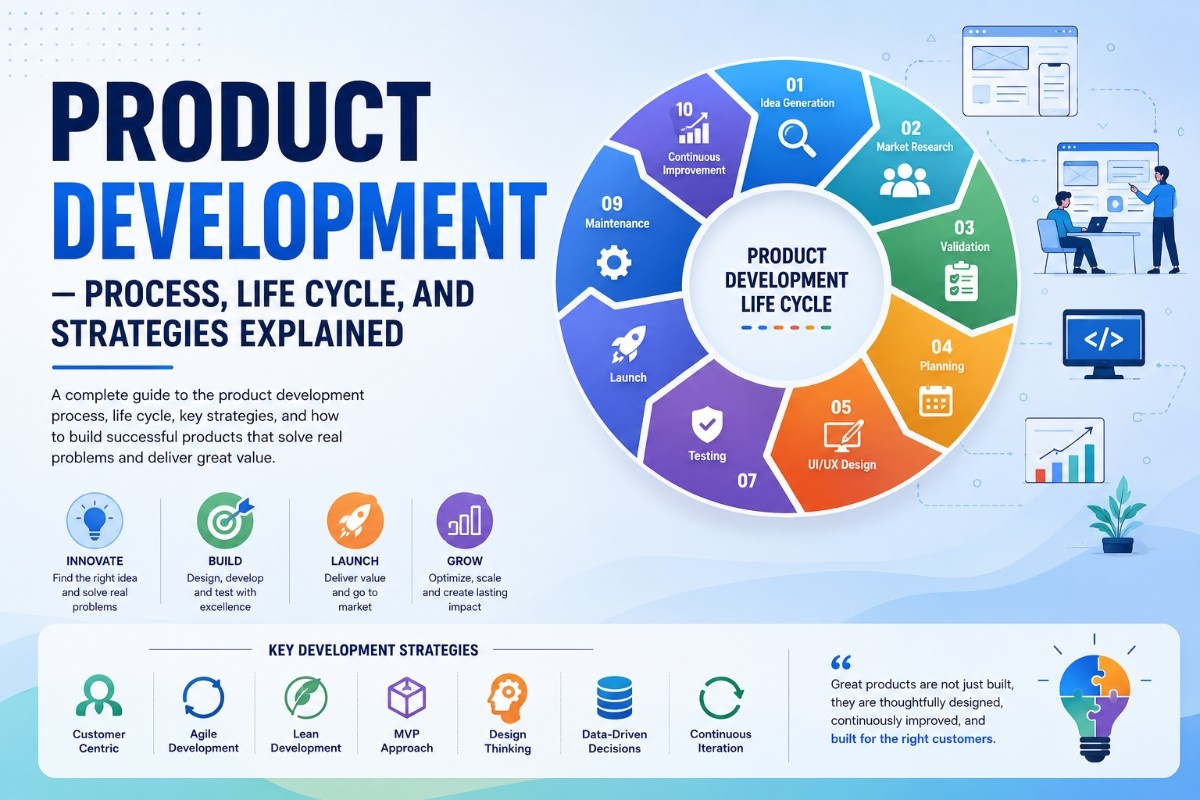
The product development process follows a sequence of stages, each building on the last:
- Idea Generation — identifying opportunities through customer feedback, market gaps, competitor analysis, or internal innovation. The goal is quantity of ideas before quality filtering begins.
- Market Research — validating whether a real problem exists, who has it, how they currently solve it, and whether a viable market opportunity justifies building a solution.
- Product Validation — testing core assumptions before committing development resources. This includes customer interviews, surveys, prototype testing, and competitive positioning analysis.
- Planning — defining scope, timelines, team structure, technology stack, and budget. A product roadmap is created to align all stakeholders on what gets built, when, and why.
- UI/UX Design — UI/UX Design, translating requirements into user flows, wireframes, and interactive prototypes that prioritize usability and the end-user experience before a single line of code is written.
- Development — engineering teams build the product according to specifications, typically in iterative sprints that allow for feedback and adjustment throughout the build rather than only at the end.
- Testing — quality assurance across functionality, performance, security, and usability. Bugs are identified and resolved before the product reaches real users.
Product Launch — releasing the product to market with a coordinated go-to-market strategy covering positioning, messaging, sales enablement, and customer onboarding. - Maintenance — ongoing monitoring, bug fixes, performance optimization, and infrastructure management to keep the product stable and reliable post-launch.
Continuous Improvement — using usage data, customer feedback, and business metrics to identify what to build next, closing the loop back to the ideation stage.
Product Development Life Cycle — Stages Explained
The product development lifecycle (PDLC) describes the full arc of a product's existence — from concept through retirement:
Introduction — the product enters the market. Adoption is low, costs are high, and feedback is most valuable at this stage.
Growth — usage accelerates. Teams prioritize scaling infrastructure, improving onboarding, and adding features that drive retention.
Maturity — growth stabilizes. Focus shifts to differentiation, cost efficiency, and defending market position against competitors.
Decline or Reinvention — the product either winds down or pivots significantly — new features, new markets, or a rebuilt architecture to extend its commercial life.
Real-world example: Slack started as an internal tool for a gaming company (introduction), grew rapidly through word-of-mouth and freemium adoption (growth), matured into an enterprise communication platform (maturity), and reinvented through deeper Microsoft Teams competition response and Salesforce acquisition (reinvention).
Product Development Strategies — How to Plan for Success
Customer-centric development — building around documented customer pain points rather than internal assumptions. Every feature decision traces back to a real user need.
Agile development — Agile development, iterative build-test-learn cycles in short sprints. Agile reduces the risk of large-scale misdirection by validating direction frequently rather than only at launch.
Lean product development — eliminating waste by building only what is necessary to test the next assumption. Closely aligned with the MVP approach.
MVP approach — launching the minimum viable product — the simplest version that delivers core value — to gather real user feedback before investing in the full product vision.
Design thinking — a human-centered problem-solving framework that prioritizes empathy with users, reframing problems before jumping to solutions.
Data-driven development — using analytics, A/B testing, and behavioral data to guide prioritization rather than relying solely on intuition or stakeholder opinion.
Continuous iteration — treating launch not as the end but as the beginning of a feedback loop that continuously improves the product based on real usage.
Types of Product Development
- Software products — desktop or server-based applications built for specific business functions
- SaaS products — SaaS products ,cloud-delivered subscription software accessible via browser, scalable without per-device installation
- Mobile applications — iOS and Android products built for consumer or enterprise use on mobile devices
- Enterprise software — large-scale systems built for internal business operations — ERP, CRM, HRMS
- AI products — applications powered by machine learning models, NLP, or computer vision that deliver intelligent automation or decision support
- Web applications — browser-based tools that combine frontend interactivity with backend data processing
In-House vs Outsourced Product Development
In-house development means building your own engineering team — hiring, onboarding, and retaining developers, designers, QA engineers, and product managers directly.
Advantages: deep domain knowledge, faster internal communication, full IP ownership, aligned incentives, and easier long-term maintenance.
Disadvantages: high hiring costs and timelines, difficulty scaling quickly, and the full operational burden of managing a technical team.
Best for: businesses where technology is the core product, teams with long product roadmaps, and organizations where security or IP sensitivity makes external sharing impractical.
Outsourced development means engaging an external product development company or agency to build all or part of your product.
Advantages: faster access to specialized skills, lower upfront cost, flexible scaling, and no long-term HR overhead.
Disadvantages: communication overhead, knowledge transfer risk, potential IP concerns, and quality variation across vendors.
Best for: startups validating an MVP quickly, businesses with a defined scope and timeline, and teams that need specialized skills they cannot hire for cost-effectively.
Factor | In-House | Outsourced |
Cost | High fixed cost | Variable, often lower |
Speed | Slower to hire | Faster to start |
Expertise | Limited to who you hire | Access to specialists |
IP Ownership | Full | Depends on contract |
Communication | Direct | Requires management |
Scalability | Limited by hiring | Flexible |
Long-term maintenance | Easier | Requires handover planning |
Long-term maintenance | Full control | Depends on vendor |
Common Product Development Challenges
Budget limitations — scope creep and underestimated complexity are the most common causes of budget overrun. Fix: define scope clearly before development starts and maintain a contingency budget of at least 15–20%.
Hiring skilled developers — the global demand for experienced engineers consistently outpaces supply. Fix: consider hybrid models combining a small in-house core team with outsourced specialists.
Scope creep — features expand beyond the original plan, extending timelines and costs. Fix: implement a formal change control process where new requests are evaluated against the existing roadmap before being approved.
Changing customer requirements — customer needs evolve during development. Fix: adopt Agile methodology with regular customer feedback touchpoints throughout the build.
Time-to-market pressure — rushing to launch creates technical debt and quality issues. Fix: prioritize MVP over full feature sets for initial launch and iterate post-release.
Technical debt — shortcuts taken during development accumulate into systemic problems that slow future work. Fix: allocate dedicated time in every sprint for refactoring and code quality.
Communication gaps — between business stakeholders and development teams. Fix: use structured communication platforms to keep all parties aligned on decisions, blockers, and changes in real time.
Best Practices for Successful Product Development
- Start with the problem, not the solution — validate the need before designing the feature
- Write clear product requirements documents before development begins
- Involve design and engineering from the ideation stage, not just execution
- Build feedback loops with real users at every stage, not just post-launch
- Measure what matters — define success metrics before you build, not after
- Prioritize ruthlessly — not every good idea belongs in the first version
- Document decisions, not just outcomes — future team members need to understand why choices were made, not just what was built
Expert Advice from Sai, VP – Development
Before you hire a third-party product development company, there are a few things I wish every founder knew from day one.
Never choose a vendor based on price alone. The cheapest quote often means shortcuts somewhere, whether that's architecture, testing, or documentation, and those shortcuts tend to cost far more to fix later. Review their technical expertise carefully. Ask to see previous product case studies, not just a portfolio. A portfolio shows you what something looked like. A case study tells you how they actually solved a real problem, which is what you're paying for.
Understand their development methodology before you sign anything. If a vendor can't clearly explain how they run sprints, handle scope changes, or keep you updated on progress, that's a preview of the confusion you'll deal with once things get difficult.
Clarify intellectual property ownership in the contract before work begins, not after. And make sure documentation is part of the deal, not an afterthought. Code without documentation isn't really an asset. It's a liability waiting to surface.
Pay attention to how they communicate. How often will you actually hear from them? Who's your point of contact when something breaks? What's the process when things go wrong? Questions like these tell you more about a vendor than any pricing deck will.
Ask specifically about what happens after launch. A lot of vendors disappear the moment the product ships. What you actually want is a long-term technology partner, not someone who builds it and walks away.
And finally, get clear on your own business goals before development even starts. No vendor, no matter how good, can build the right product if they don't understand what success actually looks like for your business
Product Development Companies — What They Do and Who Needs Them
Product development companies provide end-to-end services that take a product from concept to market , covering strategy, design, engineering, testing, deployment, and maintenance under one engagement. Businesses typically engage them when they lack internal technical capability, need to move faster than in-house hiring allows, or require specialized skills for a defined project scope.
For businesses looking for experienced end-to-end product development support, Tvisha Technologies offers product strategy, UI/UX design, software development, quality assurance, deployment, and long-term maintenance covering the full product lifecycle from the first discovery call through post-launch iteration.
Conclusion
Product development is not a single event , it is a continuous discipline that determines whether your business builds things people actually want, at a quality and speed that creates competitive advantage. Whether you build in-house or outsource depends on your budget, timeline, technical capability, and how central the product is to your core business. Startups validating early ideas benefit most from lean, outsourced MVP development. Established businesses with long roadmaps and sensitive IP often find in-house teams more cost-effective over time. Whatever path you choose, the fundamentals remain constant , understand your customer deeply, validate before you build, ship early, and iterate continuously based on what real usage tells you.
Frequently Asked Questions
1. What is product development?
Product development is the process of taking a product from initial idea through research, design, engineering, testing, and launch with the goal of solving a real customer problem and creating sustainable business value. It applies to physical products, software, SaaS platforms, and mobile applications.
2. What are the stages of the product development process?
The core stages are idea generation, market research, validation, planning, UI/UX design, development, testing, launch, maintenance, and continuous improvement. Each stage builds on the previous one, reducing risk and aligning the product with real customer needs throughout the build.
3. What is the difference between product development lifecycle and product development process?
The product development process describes how a product is built the steps from idea to launch. The product development lifecycle describes the commercial arc of the product after launch — introduction, growth, maturity, and decline or reinvention.
4. What is an MVP in product development?
An MVP Minimum Viable Product is the simplest version of a product that delivers core value to early users. It is built to test key assumptions and gather real feedback before the full product vision is invested in, reducing the risk of building features no one needs.
5. When should a business outsource product development?
Outsourcing makes most sense when you need to move faster than internal hiring allows, when you need specialized skills for a defined scope, or when you are a startup validating an idea before committing to a full in-house team. For long-term core products with sensitive IP, in-house development typically provides better control and continuity.