Connect with us
Next-Generation Defence Communication Systems and Messaging Part - 1
Defence messaging has evolved from basic wired transmissions to advanced, multi-domain communication networks.
Today’s defence forces rely on secure, real-time data exchange across land, sea, air, space, and cyber environments.
As threats grow more complex, next-generation defence messaging system must become faster, more secure, and fully integrated to support modern military operations.
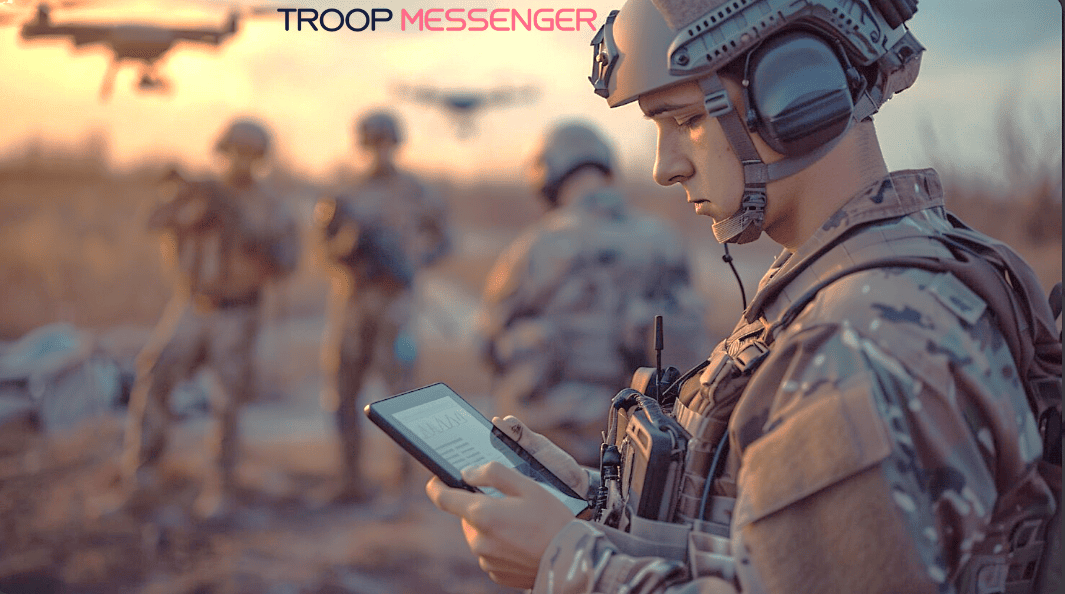
Modern defence communication systems are designed to support real-time coordination across multiple operational domains.
What Are Next-Generation Defence Communication Systems?
Next-generation defence communication systems are advanced military communication technologies designed to support secure, real-time information sharing across land, air, sea, cyber, and space operations. These systems combine encrypted messaging, artificial intelligence, satellite communication, tactical networks, and resilient infrastructure to improve operational coordination and decision-making. As modern warfare becomes increasingly data-driven, defence organizations require communication platforms that provide security, reliability, interoperability, and resilience against cyber threats, electronic warfare, and communication disruptions.
1. Historical Perspective and Present State
Morse, teletype, and radio : early methods that shaped military communication
Morse code proved that short bursts of dots and dashes could guide entire campaigns.
The teletype brought readable text but required heavy gear and fixed lines.
High-frequency (HF) radio finally gave units reach beyond the horizon, though interception risk grew in step with range.
Migration to digital : secure e-mail, tactical data links, and chat services
Secure e-mail let headquarters move away from paper dispatches, yet it stayed mostly desk-bound.
Tactical Data Links (TDLs) such as Link-16 stitched aircraft and ships into common pictures but relied on fixed waveforms and schedules.
Chat rooms became the informal heart of joint operations centers; the downside is that they often sit on isolated networks and can’t talk to each other.
Current network architecture : protocols, bandwidth limits, and interoperability gaps
Protocol mix: Internet Protocol (IP) for most traffic, legacy serial for niche sensors, plus a patchwork of waveforms on radios.
Bandwidth bottlenecks: airborne and maritime users still fall back to kilobits per second when satellites get crowded.
Interoperability gap: allies may share the same mission but not the same crypto or message format, a point that surfaces every large exercise.
2. Core Drivers Shaping Future Requirements
Threat evolution: electronic warfare, cyber intrusion, and rapid tempo operations
Adversaries now field GPS jammers the size of lunch boxes and malware that hides in firmware.
The pace of drone swarms and hypersonic weapons means decision loops have minutes, not hours.
The evolution of threats continues to shape how defence communication system are designed and deployed.
Multi-domain integration: land, sea, air, space, and cyber coordination needs
A single strike package may need weather from space assets, targeting data from ground radars, and legal review from a distant headquarters all in one thread.
Shared situational awareness is no longer a nice to have; it is the operation.
User demands : mobility, intuitive interfaces, and resilient service delivery
Soldiers expect the same swipe-based ease they get from their phones without sacrificing security
Downtime that once lasted hours now feels unbearable after five minutes. I’ve watched younger operators visibly tense up when chat stalls; it’s their lifeline.
3. Enabling Technologies and Architectures
Satellite constellations, high-altitude platforms, and 5G/6G edge nodes
Low-Earth-Orbit (LEO) satellites reduce latency and add paths that are hard to jam simultaneously.
High-Altitude Pseudo-Satellites (HAPS) think solar planes at 60,000 ft can fill local gaps.
Future 5G/6G cells on vehicles or drones let units set up pop-up networks in minutes.
Advanced defence communication system now integrate satellites, mesh networks, and AI-driven traffic management.
Software-defined networking, mesh routing, and cloud-based message stores
Software-defined networking (SDN) lets commanders shift traffic away from threatened links with a policy change instead of a wrench turn.
Mesh routing allows every node to act as relay; lose one radio and messages still find another path.
Cloud-based stores keep a copy of each message at several secure sites so late-joining units can catch up fast.
Artificial intelligence for priority tagging, congestion management, and anomaly detection
AI agents can watch for a flood of low-priority weather updates and throttle them so urgent medevac traffic passes first.
An unexpected spike in failed logins at 0300? Machine learning flags it before a human notices.
From my own tests, AI triage cut queue time by half during a large joint drill small change, big morale boost.
4. Security and Resilience Challenges
Encryption evolution: post-quantum algorithms and key management
Quantum computers threaten today’s public-key crypto; new lattice-based methods aim to stay safe even against those machines.
Key management, always the Achilles heel, must adapt so forward teams can update keys over low-bandwidth links without exposing secrets.
Attack surfaces: spoofing, jamming, supply-chain risk, and insider compromise
Spoofed signals can trick radios into false channels; disciplined signal validation is now standard drill.
Supply chains span continents. A single tainted chip can open a hidden backdoor.
Insider threats remain; digital locks mean little if a cleared user snaps a photo of the screen.
Securing defence communication system has become a top priority as cyber and electronic warfare threats increase.
Continuity of operations: failover plans, degraded-mode tactics, and rapid recovery
Pre-planned alternate routes keep traffic moving when the primary satellite dies.
Degraded-mode drills sending only brevity codes or voice numbers teach crews to stay effective at one-tenth bandwidth.
Rapid recovery kits with spare routers and crypto fill Pelican cases on every deployment join.
5.Policy, Governance, and Legal Standards in Defence Communication Systems
Messaging tools must align with the Law of Armed Conflict and national rules on information sharing.
NATO, Five Eyes, and other groups define data labels and crypto types; ignoring them invites chaos
Data ownership, classification, and life-cycle audit trails
Who can read, forward, or delete a message? Clear tags and logs ensure no one argues after the fact.
Ethical automation: human oversight, accountability, and bias mitigation
Even if AI scores a threat at 95 %, a human should still review a strike release.
Audit logs should record every automated suggestion and final human decision.
6. Roadmap and Recommendations
Near-term actions: patching gaps, training, and incremental upgrades
Patch known software flaws and replace outdated crypto now; waiting increases cost and risk.
Run regular cyber + electronic drills, not just kinetic ones.
Add user-friendly chat and file-share tools that work on tablets morale and security both improve.
Mid- to long-term research: quantum secure links, optical networks, and advanced AI
Fund pilot links that use quantum key distribution alongside standard fiber.
Explore free-space optical links for high-bandwidth bursts that are hard to intercept.
Continue AI research, but require human-in-the-loop testing at every milestone.
Performance metrics: latency, reliability, security posture, and user satisfaction
Latency: aim for sub-200 ms across continents.
Reliability: 99.99 % uptime even under attack.
Security: zero critical findings on red-team events.
User satisfaction: simple feedback polls after each exercise; the operators’ view is the real report card.
7. Role of Secure Messaging Platforms in Defence Communication
Platforms like Troop Messenger enhance defence communication system through
encrypted messaging, controlled access, and real-time coordination.
AI-driven features such as burnout alerts and smart insights help teams maintain efficiency, reduce overload, and support mission-critical communication.
Conclusion
Modern defence forces need integrated, secure communication systems to stay ahead of evolving threats.
By combining advanced messaging technologies, resilient infrastructure, and reliable tools, defence communication systems ensure secure information exchange and mission success in modern warfare
Explore More on Defence Communication Systems
Defence Communication Systems Complete Introduction and Overview
Defence Communication Systems and Military Radios Explained part (2)
https://www.troopmessenger.com/blogs/-defence-communication-systems-and-military-radios-explained
Defence Communication Systems and Military Satellites Explained part (3)
https://www.troopmessenger.com/blogs/defence-communication-systems-military-satellites-explained
Frequently Asked Questions (FAQs)
1. Why are current defence messaging systems considered outdated?
Many traditional defence communication systems were designed before the emergence of modern cyber threats, artificial intelligence, electronic warfare, and multi-domain military operations. As a result, they often struggle to support real-time data sharing, advanced encryption requirements, and interoperability across multiple platforms. Modern defence organizations require communication systems that can adapt to rapidly changing operational environments while maintaining security, reliability, and resilience against sophisticated cyber and electronic threats.
2. What role will artificial intelligence play in future defence communication systems?
Artificial intelligence is expected to play a significant role in improving military communication efficiency and security. AI can help analyze large volumes of communication data, identify unusual activity, prioritize critical information, detect cyber threats, and automate routine communication processes. By assisting human operators with faster decision-making and threat detection, AI can enhance operational awareness while helping defence organizations manage increasingly complex communication environments.
3. How soon should defence organizations prepare for post-quantum encryption?
Defence organizations should begin planning for post-quantum encryption as early as possible. Advances in quantum computing have the potential to weaken many current cryptographic methods in the future. Transitioning to quantum-resistant encryption standards can take years of research, testing, and deployment. Early preparation helps organizations protect sensitive information from future threats while ensuring that communication systems remain secure as computing technologies continue to evolve.
4. Are commercial communication networks suitable for military messaging?
Commercial communication networks may be useful for non-sensitive communication, but they generally do not meet the strict security, control, and compliance requirements of military operations. Defence organizations require secure communication platforms that provide encryption, access control, audit logging, data sovereignty, and protection against cyber threats. Military-grade communication systems are specifically designed to operate in contested environments while maintaining confidentiality and operational integrity.
5. What are the key features of next-generation defence communication systems?
Next-generation defence communication systems typically include end-to-end encryption, artificial intelligence, secure messaging, satellite connectivity, network resilience, real-time threat detection, role-based access controls, and interoperability across multiple operational domains. These features help military organizations maintain secure and reliable communication while supporting modern mission requirements. The goal is to provide seamless information sharing without compromising security, operational readiness, or mission success.