Connect with us
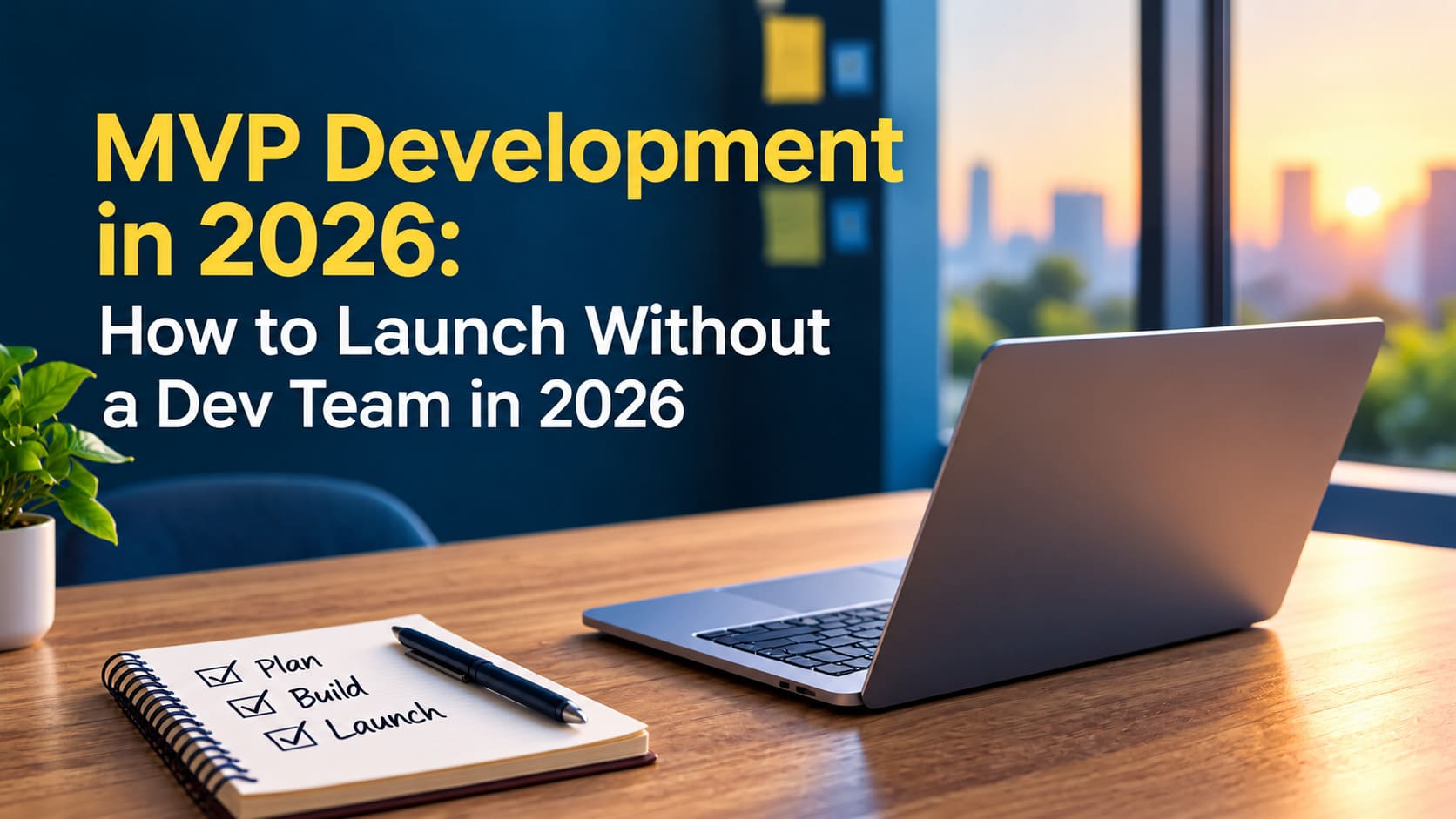
MVP Development in 2026: How to Launch Without a Dev Team in 2026
Launching a new digital product in such a competitive industry has long been a big challenge, and that’s why you need to be sure you’re prepared.
Modern MVP development has given non-developers new opportunities to fine-tune their idea before making the decision to invest time and money into the creation of the final product.
More and more businesses are turning to AI-driven MVP development, and it’s no wonder. Over 59% of businesses are using MVP for faster creation, while another 62% also consider it crucial for reducing the risks that come alongside launching a digital product.
What is an MVP?
Standing for minimum viable product, an MVP refers to the simplest form of a product or software that you can build to test new concepts.
When it comes to MVP development, the aim is to test-run a new idea before going any further. It is much more efficient to build the smallest possible version than it is to get straight into a lengthy development process.
Instead of committing to the full development, only the core features are brought to life. This allows you to visualize how it could look and work before you invest time and money into the wider project.
An MVP is ideal for gathering feedback on the idea during the early stages, involving both your internal team and testing among your target audience. Since everyone is able to try out a working product and get a better understanding of how the final outcome would work, it is much more thorough than a wireframe.
There are many strong use cases for MVPs when creating digital products. Let’s pick a handful of examples to give you a better understanding.
- An online appointment booking system that allows customers to choose their own time slots
- An internal inventory tracking system that keeps track of stock levels
- An e-commerce customer portal that allows people to log into their profile to see their order history and process returns
- An AI assistant that responds to customer queries through the website
- A financial tracker which businesses or individuals can use to keep an eye on their outgoings and set spending goals
How AI Is Changing the MVP Development Lifecycle
Creating an MVP has not always been as easy as it is now in 2026. Not so long ago, it required working with an experienced developer with the coding knowledge required to bring the idea to life. This was not a fast process and could take weeks, or even months, to create the MVP alone.
1. Using AI to support MVP development
The introduction of AI-powered tools has changed MVP development for good, and now you can create your very own functional MVPs without any prior experience.
Instead of having to work with developers and waiting for months to see results, AI has opened up new possibilities, especially for smaller businesses on a budget.
Having the option to create working concepts in a fraction of the time means you can now play around with different variations of your original idea. Instead of having to brief a developer on the exact details you want before you’ve had the opportunity to finalize ideas, AI tools allow you to tweak designs or experiment with completely new styles before you reach the build stage.
2. Can AI Really Replace a Development Team?
An MVP builder is a tool that uses AI to help you build a fully functioning minimum viable product without any prior experience.
With the help of an MVP builder, you can type in your idea and have a first working version on screen within minutes. From there, it's an iterative process where you review the output, prompt further adjustments and refine the details until the MVP matches your vision.
Modern MVP development opportunities have changed the game for countless startups and SMBs. This process was once considered a luxury due to its price, so now that you are able to create your very own MVPs on a lower budget, it is now accessible to business owners that it was once out of reach for, creating a more competitive landscape.
Although MVPs have come an incredibly long way, that doesn’t mean they’re completely foolproof. Not every project is going to suit MVP builders, and more complex projects are still likely to require the work of experienced developers. For example, if you were looking to create new software with integrated systems and high security requirements, AI tools may not have the advanced capabilities needed to deliver this.
Building an MVP Without a Dev Team in 5 Steps
You no longer need to worry about having to fork out for a team of specialist developers when looking to build an MVP. In fact, you can now build your very own in a fraction of the time.
Even if you have never tried an AI MVP builder before, the process is very beginner-friendly, so you’ll get the hang of it in no time. The system will guide you through the process step-by-step, so all you have to worry about is making sure your idea is well thought out.
Let’s talk through the five steps that you can follow to get the most from your MVP, helping you establish whether you wish to go ahead with the new launch.
1. Fine-tune the idea
Before rushing to the MVP builder, it’s important to make sure that strong foundations are in place. The stronger your idea, the better the outcome will be.
The starting point should be establishing the exact problem that you’re looking to solve for users. Ask yourself who your new digital product will help, whether anything similar already exists, and what the main purpose is going to be.
The more niche your idea, the more potential it will have. This is why it’s so important to invest time and research resources into the early stages, making sure that your idea is actually of interest to your target audience before you get going.
2. Create a design
Now that you’re confident that your idea is strong, it’s time to consider how the end result will look. We’re not talking about the specific images or font style just yet, but about how you want to show off your idea to your audience.
Have a think about how you want to present your new platform as the answer to the user’s problem and really catch their attention. Think back to their pain points and figure out exactly what they’ll be looking for when they arrive at your website or app.
You can play around with AI tools here to gain inspiration and try out new looks. This will make the upcoming steps much easier since you will already have a good idea of how you want the final outcome to look.
3. Map user flows
In addition to how your new digital product will look, you need to consider how you want users to interact with it.
Once somebody arrives at your website or app, they need to be able to quickly find exactly what they are looking for, or you risk them bouncing. Consider what will be in your navigation bar, what call-to-action buttons you will use, and where more information can be found.
At the end of the day, you want to make sure that your user flows are as short and simple as possible. Make sure you build a logical journey that is free of distractions to help drive users towards conversion.
4. Build the MVP
Now that you’re ready to build, it’s time to head over to your MVP builder of choice. This is the step that many non-developers are fearful of, but in reality, you’ve already done the hard work.
AI MVP development tools are designed for people with absolutely no experience, so they have user-friendly interfaces that will walk you through the process.
All you need to do is type out exactly what you’re looking for from your MVP. The more detail you give here, the more accurate the output will be. Make sure to mention your target audience, preferred user flows, and any particular features you want.
From here, click 'generate', and then you will be presented with a custom MVP that you can play around with.
5. Carry out testing
Now that you’ve had a chance to get to grips with the MVP and see your vision brought to life, it may be tempting to head straight towards launch, but don’t skip this all-important step.
This is the perfect time to ask for feedback from your target audience. Give users the chance to play around with your MVP for themselves and share their opinions. These insights can be invaluable and help identify any improvements that could be made.
Getting The Most From MVP Development
Now that AI is becoming more advanced, MVP development for non-developers is only going to continue becoming more accessible. Having the opportunity to bring your vision to life and play around with different ideas means you can solidify your idea before committing to its development.
The growing popularity of MVP builders is changing the digital industry completely. Now that businesses of all sizes and budgets can thoroughly test their new ideas before investing in them, it’s allowing them to compete with larger firms.
Successful MVP development still requires a lot of prior planning, fine-tuning, and target audience involvement, but having AI-driven MVP builders on your side has opened up countless new opportunities.
Conclusion
MVP development in 2026 has become far more accessible, particularly for businesses and entrepreneurs without a dedicated development team. AI-powered MVP builders make it possible to turn an idea into a functional product, test core features, collect user feedback, and make improvements before committing significant time and resources to full-scale development.
However, AI does not remove the need for careful planning. A successful MVP still depends on understanding the target audience, defining the problem clearly, designing simple user flows, selecting the right features, and testing the product with real users. By combining thoughtful planning with AI-driven development tools, businesses can validate ideas faster, reduce unnecessary development costs, and build a stronger foundation for their final digital product.
FAQs
1. Can I build an MVP without a development team?
Yes, it is possible to build many types of MVPs without a traditional development team by using AI-powered and no-code MVP development tools. These platforms allow users to describe their product idea, generate core functionality, and make changes through prompts or visual interfaces. However, the complexity of the product determines how far you can go without developers. Simple websites, customer portals, internal tools, booking systems, and basic AI applications may be suitable for these platforms, while products involving advanced integrations, security requirements, or complex infrastructure may still require experienced developers.
2. How long does it take to build an MVP in 2026?
The time required to build an MVP in 2026 depends on its complexity, features, integrations, and development approach. AI-powered MVP builders can significantly reduce the time needed to create an initial working version because they automate parts of the design and development process. A simple MVP may be created within days or weeks, while more complex products can take considerably longer. Businesses should focus on validating the core idea rather than trying to include every planned feature. Starting with essential functionality makes it easier to test, collect feedback, and make informed improvements.
3. What features should an MVP include?
An MVP should include only the essential features required to solve the primary problem for its target users. Before adding a feature, consider whether it directly contributes to the product's main purpose or helps users complete an important task. Including too many features can increase development time and make it harder to understand user feedback. Start with the core functionality, create simple user flows, and leave secondary features for later iterations. Once users interact with the MVP, their feedback and behavior can help determine which additional features should be prioritized during future development.
4. Is AI enough to replace developers when building an MVP?
AI can handle many parts of MVP development, but it does not completely replace experienced developers in every situation. AI-powered tools are particularly useful for creating prototypes, interfaces, basic functionality, and simple applications without requiring extensive coding knowledge. However, complex products may involve advanced integrations, databases, cybersecurity requirements, scalability concerns, custom infrastructure, or regulatory considerations. These areas can require professional technical expertise. For this reason, AI is often most useful as a development accelerator rather than a universal replacement for developers, especially when building products that need to operate reliably at scale.
5. How do I test an MVP before launching the final product?
Testing an MVP involves putting the working product in front of real or representative users and observing how they interact with it. Start by identifying the most important actions you want users to complete, then ask participants to use the MVP and provide feedback. Pay attention to usability problems, confusing navigation, missing functionality, and whether the product actually addresses the original problem. You can also use surveys, interviews, analytics, and task-completion data to gather insights. Use this feedback to refine the MVP before investing heavily in full-scale development and a broader launch.