Connect with us
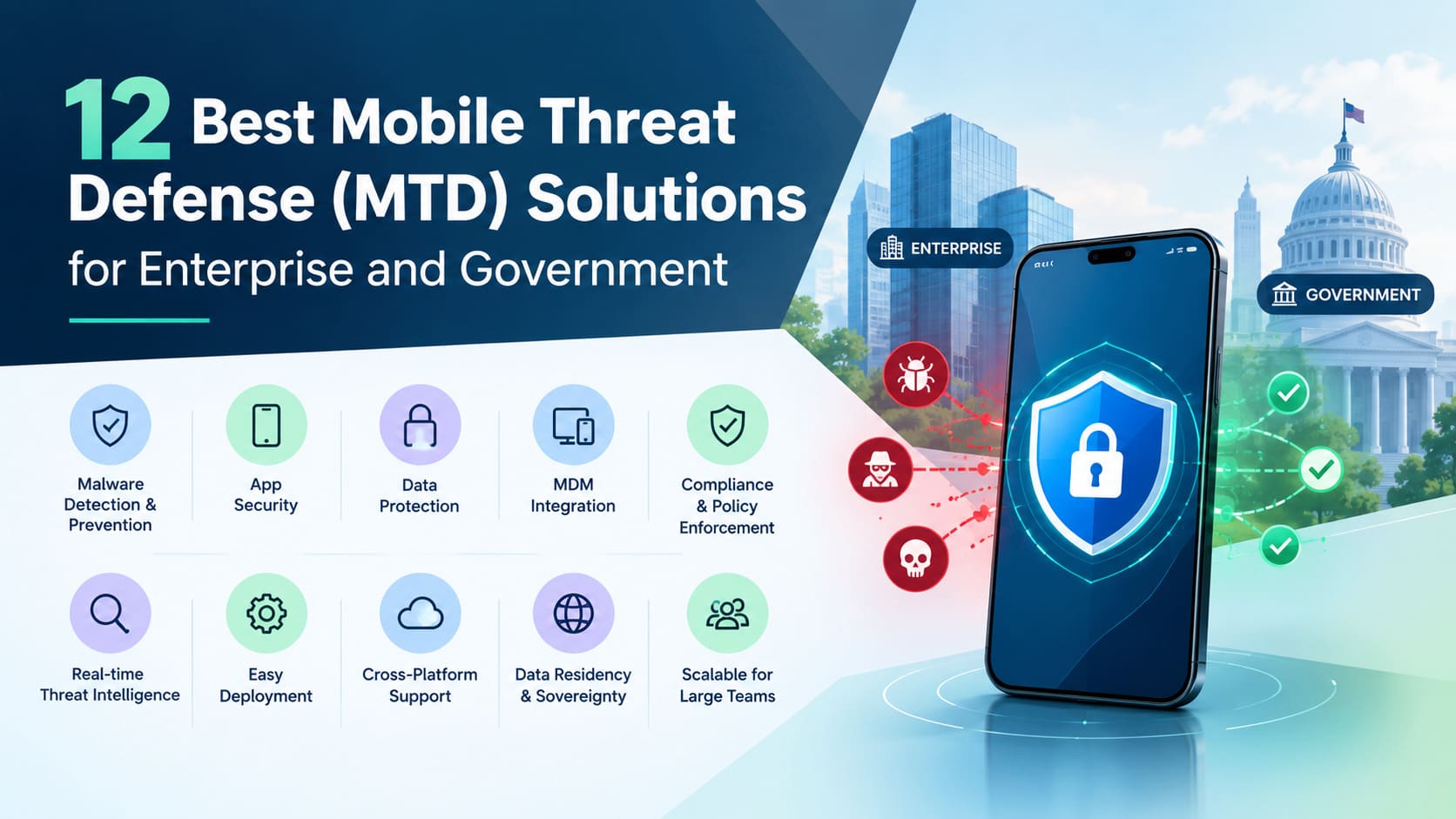
12 Best Mobile Threat Defense (MTD) Solutions for Enterprise and Government
Mobile threat defense (MTD) is security software that continuously monitors smartphones and tablets for phishing, malicious apps, risky Wi-Fi networks, and operating system exploits. It detects threats on the device itself or in the cloud, alerts administrators, and can trigger automated responses through MDM or UEM tools, such as blocking access.
This guide compares the 12 best mobile threat defense solutions for 2026, so security teams can shortlist MTD solutions for mobile security for enterprises, defence and government. Each review states whether detection runs on-device or in the cloud and how the product works with your MDM or UEM.
What is mobile threat defense (MTD)?
Mobile threat defense is a category of endpoint security built specifically for iOS and Android devices. Where a laptop has long had antivirus and EDR, phones and tablets were historically left with little more than a passcode and a management profile. MTD closes that gap.
A typical MTD product installs a lightweight agent (or integrates with an existing app) and watches four things: the device’s operating system state, the apps installed on it, the networks it connects to, and the content it opens, including links in email, SMS and messaging apps. When it spots something risky, it raises an alert and can pass a risk signal to your MDM or UEM so access to corporate resources is restricted until the issue is fixed.
It matters more every year because phones now hold what laptops used to: email, documents, authentication tokens, chat history and approvals. For government, defence and regulated enterprises, that makes them a primary target.
How we evaluated these MTD solutions
We assessed each product against the criteria regulated buyers ask about most. Vendor capabilities change quickly, so confirm specifics with the vendor before you buy.
- Detection coverage: phishing and malicious links, malicious and sideloaded apps, network attacks (rogue Wi-Fi, man-in-the-middle), and OS-level exploits and jailbreak or root.
- Detection model: whether analysis runs on the device, in the cloud, or both. This affects offline protection, latency and privacy.
- Deployment and management: how it is rolled out, how much user interaction it needs, and how it behaves on managed and BYOD devices.
- MDM/UEM integration: whether risk signals feed conditional access and automated remediation in the tools you already run.
- Data residency and privacy: where telemetry is stored and processed, and what is collected from personal devices.
- Government fit: certifications, availability for air-gapped or sovereign environments, and public-sector references.
- Visibility and reporting: SIEM/SOAR integration, alert quality and audit trails.
The best mobile threat defense solutions at a glance
Solution | Best for | MDM/UEM integrations | Detection | |
1 | Zimperium MTD | Enterprises and government needing deep on-device detection | Broad support across major MDM/UEM platforms | On-device, cloud-managed |
2 | Lookout Mobile Endpoint Security | Large enterprises with phishing and app-risk focus | Major MDM/UEM platforms | On-device plus cloud |
3 | Microsoft Defender for Endpoint (iOS and Android) | Microsoft 365 and Intune shops | Intune and Microsoft Entra conditional access | Hybrid: on-device agent with cloud intelligence |
4 | Organisations standardised on Check Point | Major MDM/UEM platforms | On-device plus cloud | |
5 | Jamf (Mobile Security / Protect) | Apple-centric fleets | Jamf Pro and other MDMs | Cloud-based network and content security with on-device agent |
6 | Ivanti Neurons for MTD | Existing Ivanti and MobileIron customers | Ivanti Neurons for UEM and others | On-device |
7 | CrowdStrike Falcon for Mobile | Teams already using Falcon for endpoint | Falcon console; MDM/UEM for deployment | On-device sensor with cloud analytics |
8 | Sophos Intercept X for Mobile | Mid-market teams on Sophos Central | Sophos Mobile and other MDMs | On-device plus cloud |
9 | Pradeo | European and privacy-sensitive deployments | Major MDM/UEM platforms | On-device behavioural analysis |
10 | Trend Micro Mobile Security | Trend Vision One customers | Major MDM/UEM platforms | Hybrid |
11 | Corrata | Privacy-focused teams in UK and Ireland | Major MDM/UEM platforms | On-device |
12 | Appdome | App-level protection inside your own apps | Mobile DevOps and app pipelines | In-app, embedded runtime |
12 best MTD solutions reviewed
1. Zimperium MTD
Zimperium is one of the best-known pure-play mobile security vendors, with a strong focus on on-device detection. Its engine analyses device, network and app behaviour locally, so protection continues when the phone is offline, and detections are managed centrally from a console. It pairs MTD with app-level protection for organisations that also ship their own mobile apps. It integrates with the main MDM/UEM platforms for conditional access and automated response, and it has a significant footprint in government and regulated sectors. Detection: on-device, cloud-managed. Best for: buyers who want depth of detection and public-sector references.
2. Lookout Mobile Endpoint Security
Lookout offers mobile endpoint security built on a large corpus of mobile app and threat telemetry, covering phishing and content threats, malicious apps, device vulnerabilities and network risk. Detection combines on-device analysis with cloud intelligence. It is well suited to large enterprises that want phishing protection across SMS, email and messaging, with risk signals fed to MDM/UEM tools. Confirm the current product packaging and certifications directly with Lookout. Detection: on-device plus cloud. Best for: enterprises prioritising phishing and app-risk visibility.
3. Microsoft Defender for Endpoint (iOS and Android)
For organisations already invested in Microsoft 365, Defender for Endpoint on mobile is a natural fit. It provides web protection, malicious app and network checks, and vulnerability signals, and it shares a console with desktop and server endpoint security. Its main strength is integration: device risk can drive Intune compliance policies and Entra conditional access. Coverage on mobile is lighter than specialist vendors in some areas, so assess it against your threat model. Detection: hybrid, on-device agent with cloud intelligence. Best for: Microsoft-centric environments that want one security stack.
4. Check Point Harmony Mobile
Harmony Mobile extends Check Point’s security platform to phones and tablets, with protection against malicious apps, phishing, network attacks and OS-level exploits. Detection runs on the device and draws on Check Point’s threat intelligence in the cloud. It supports deployment through MDM/UEM tools, and suits organisations that already use Check Point for network and cloud security and want unified policy and reporting. Detection: on-device plus cloud. Best for: Check Point customers consolidating vendors.
5. Jamf (Mobile Security / Protect)
Jamf is a leader in Apple device management, and its security products extend that into threat prevention for iOS and iPadOS, including network and content filtering and phishing protection. It is most compelling where Apple devices dominate the fleet and Jamf Pro is already the management layer. Its approach leans on cloud-based network and content security alongside an on-device agent. Check current product names and packaging, as Jamf’s portfolio has evolved. Detection: cloud-based network and content security with on-device agent. Best for: Apple-centric organisations.
6. Ivanti Neurons for MTD
Ivanti’s mobile threat defense capability grew out of the MobileIron lineage and has historically been built on a partnership with a specialist mobile security engine. It runs detection on the device and ties directly into Ivanti’s UEM, making it attractive to existing Ivanti and MobileIron customers who want enforcement tied to device compliance. If you are not already on Ivanti UEM, compare it closely against vendor-neutral options. Detection: on-device. Best for: Ivanti UEM customers.
7. CrowdStrike Falcon for Mobile
CrowdStrike extends the Falcon platform to Android and iOS so security teams can see mobile alongside laptops and servers in a single console. Its value is in correlation: mobile telemetry sits next to endpoint and identity data, which helps investigations. It uses an on-device sensor with cloud analytics. Teams should compare mobile-specific detection depth against dedicated MTD vendors. Detection: on-device sensor with cloud analytics. Best for: existing Falcon customers and SOCs that want unified visibility.
8. Sophos Intercept X for Mobile
Sophos delivers mobile protection through Sophos Central, covering malicious apps, network threats and device compliance on Android, iOS and Chromebooks. It is a practical option for mid-sized organisations that want straightforward deployment and a single management console across endpoints. Detection: on-device plus cloud. Best for: teams already using Sophos Central.
9. Pradeo
Pradeo is a European mobile security specialist known for behavioural analysis of apps on the device, which helps identify malicious or data-leaking apps without relying only on signatures. Its European roots make it a relevant option for organisations with strict data residency and sovereignty requirements. Check certifications and deployment options for your jurisdiction. Detection: on-device behavioural analysis. Best for: privacy-sensitive and European deployments.
10. Trend Micro Mobile Security
Trend Micro provides mobile protection as part of its broader security platform, including web threat protection, malicious app detection and device risk checks. It suits organisations that already use Trend for email, endpoint and cloud security and want mobile telemetry in the same place. Detection: hybrid. Best for: Trend Vision One customers.
11. Corrata
Corrata is a newer, privacy-focused MTD vendor emphasising on-device detection and minimal data collection, which can ease concerns about monitoring personal or BYOD devices. It offers coverage across network, app and device threats and integrates with common MDM/UEM tools. It is a good candidate for organisations with strong employee-privacy requirements. Detection: on-device. Best for: BYOD-heavy and privacy-conscious organisations.
12. Appdome (app-level protection)
Appdome is different from the rest of this list. Rather than monitoring the whole device, it builds protection, such as runtime application self-protection, anti-tampering and threat detection, directly into mobile apps without code changes. That makes it valuable for organisations that publish their own mobile apps, and it complements device-level MTD rather than replacing it. Detection: in-app, embedded runtime. Best for: teams protecting customer-facing or internal apps they build.
MTD vs MDM vs UEM: how they fit together
These three are often confused, but they solve different problems and work best together.
MDM | UEM | MTD | |
What it does | Manages and configures mobile devices: enrolment, policies, app distribution, remote wipe | Manages all endpoints (mobile, laptops, desktops, IoT) from a single console | Detects and responds to active threats on mobile devices |
Primary question it answers | “Is this device configured the way policy says?” | “Are all my endpoints managed consistently?” | “Is this device under attack or compromised right now?” |
Typical signals | Compliance, OS version, encryption, passcode | Same as MDM, across device types | Phishing, malicious apps, rogue networks, OS exploits, jailbreak/root |
In practice, MDM or UEM sets the baseline and enforces policy, while MTD supplies live risk signals. When MTD flags a compromised device, the MDM/UEM can quarantine it, revoke access or trigger a wipe.
The mobile threats that matter most: phishing, malicious apps, network attacks and OS exploits
Phishing. Mobile makes phishing more effective: small screens hide URLs, and links arrive via SMS, messaging apps and QR codes that email gateways never see. MTD inspects links and content at the device.
Malicious apps. Sideloaded apps, trojanised copies of legitimate apps and over-permissioned apps can exfiltrate data or give attackers a foothold. MTD analyses app behaviour and permissions.
Network attacks. Rogue access points and man-in-the-middle attacks target devices on public or compromised Wi-Fi. MTD detects suspicious networks and certificate anomalies.
OS exploits and vulnerabilities. Unpatched operating systems, jailbroken or rooted devices, and zero-click exploits give attackers deep access. MTD flags outdated or tampered devices so access can be withheld.
For more on securing the data in transit across these devices, see our guide to VPN apps for enterprises.
MTD for defence, government and field teams
Government and defence teams face higher-stakes versions of every threat above: targeted spyware, hostile networks while travelling or deployed, and strict handling rules for classified and sensitive data. Standards give a useful baseline. NIST SP 800-124 Rev. 2 guides managing the security of mobile devices in the enterprise, and the NIAP Protection Profile for Mobile Device Fundamentals sets security requirements for mobile devices used in US government environments.
In December 2024, CISA published its Mobile Communications Best Practice Guidance, aimed at highly targeted individuals such as senior government officials. Among its recommendations is moving to end-to-end encrypted messaging, alongside phishing-resistant authentication and keeping devices updated. That guidance reinforces a layered approach: protect the device, and protect the communications that run on it.
For field and frontline teams, look for MTD that works offline and in low-connectivity environments (on-device detection helps), supports air-gapped or sovereign deployment where required, and integrates with the communications tools your teams actually use. Learn more about how Troop Messenger supports defence and government teams, and see how an fits sovereign requirements.
Where secure messaging fits in a mobile security stack
MTD protects the device. It does not decide where your conversations live. A secure messaging platform covers the other half of the problem: keeping message and file data under your control. A self-hosted platform such as Troop Messenger keeps conversation data on your own servers rather than a third party’s cloud, so even a well-defended device is not the only thing standing between attackers and your communications.
The two layers complement each other. Troop Messenger runs alongside VPN, DMZ and MDM setups, so it slots into the mobile security stack you already have instead of replacing it. For a wider view of the options, see our roundup of encrypted communication tools.
How to choose an MTD solution: 8-point checklist
- Threat coverage. Does it cover phishing, malicious apps, network attacks and OS exploits, on both iOS and Android?
- Detection model. Is analysis on-device, cloud, or hybrid, and does protection continue offline?
- MDM/UEM integration. Can risk signals drive conditional access and automated remediation in your current tools?
- Data residency and privacy. Where is telemetry stored, and what is collected from personal or BYOD devices?
- Compliance and certifications. Does it align with NIST SP 800-124 Rev. 2, NIAP requirements and any regional or sector rules you face?
- Deployment and user experience. How is it rolled out, how much user action is needed, and what is the battery and performance impact?
- SOC integration. Does it feed your SIEM and SOAR with high-quality, actionable alerts?
- Vendor fit and support. Does the vendor have public-sector or regulated references, and the support model you need?
Conclusion
Mobile devices now carry the same sensitive data as laptops, so they need the same level of protection. The best mobile threat defense solution is the one that fits your fleet, your MDM or UEM, and your compliance requirements. Microsoft-centric teams may start with Defender, Apple-heavy fleets with Jamf, and teams that want specialist depth with Zimperium, Lookout or Check Point. Privacy-sensitive and sovereign deployments should look closely at Pradeo and Corrata, and app publishers should add Appdome on top.
Whichever you choose, treat MTD as one layer. Pair it with MDM or UEM for policy enforcement, a VPN for traffic, and a self-hosted messaging platform so conversation data stays under your control. Use the 8-point checklist above to shortlist two or three vendors, run a pilot on a mix of managed and BYOD devices, and test how well risk signals reach your SOC before you commit.
Frequently asked questions
1. What does MTD stand for in cybersecurity?
MTD stands for mobile threat defense. It refers to security software that detects and responds to threats on smartphones and tablets, including phishing, malicious apps, network attacks and operating system exploits.
2. Is mobile threat defense the same as MDM?
No. MDM manages and configures devices and enforces policy, such as passcodes and app distribution. MTD detects active threats on the device. They are complementary: MTD supplies risk signals, and MDM or UEM acts on them.
3. Which phone is most likely to be hacked?
No phone is immune. Risk depends less on brand than on behaviour and configuration: outdated software, sideloaded apps, jailbreaking or rooting, and clicking malicious links all raise exposure. Android’s open ecosystem sees more malware in the wild, while iOS devices are frequent targets of sophisticated, targeted exploits. Keep devices updated and layer MTD on top.
4. How do I detect threats on a phone?
Warning signs include unexplained battery drain, unusual data usage, unfamiliar apps, overheating and unexpected pop-ups. These are not conclusive on their own, and sophisticated attacks may show none of them. Organisations should rely on MTD to monitor devices continuously rather than users spotting symptoms.
5. Do government agencies require mobile threat defense?
Requirements vary by country and agency. Many government bodies follow frameworks such as NIST SP 800-124 Rev. 2 and NIAP Protection Profiles, which shape mobile security controls, and mobile threat defense is increasingly expected as part of a layered approach. Check the specific policy or contract requirements that apply to you.