Connect with us
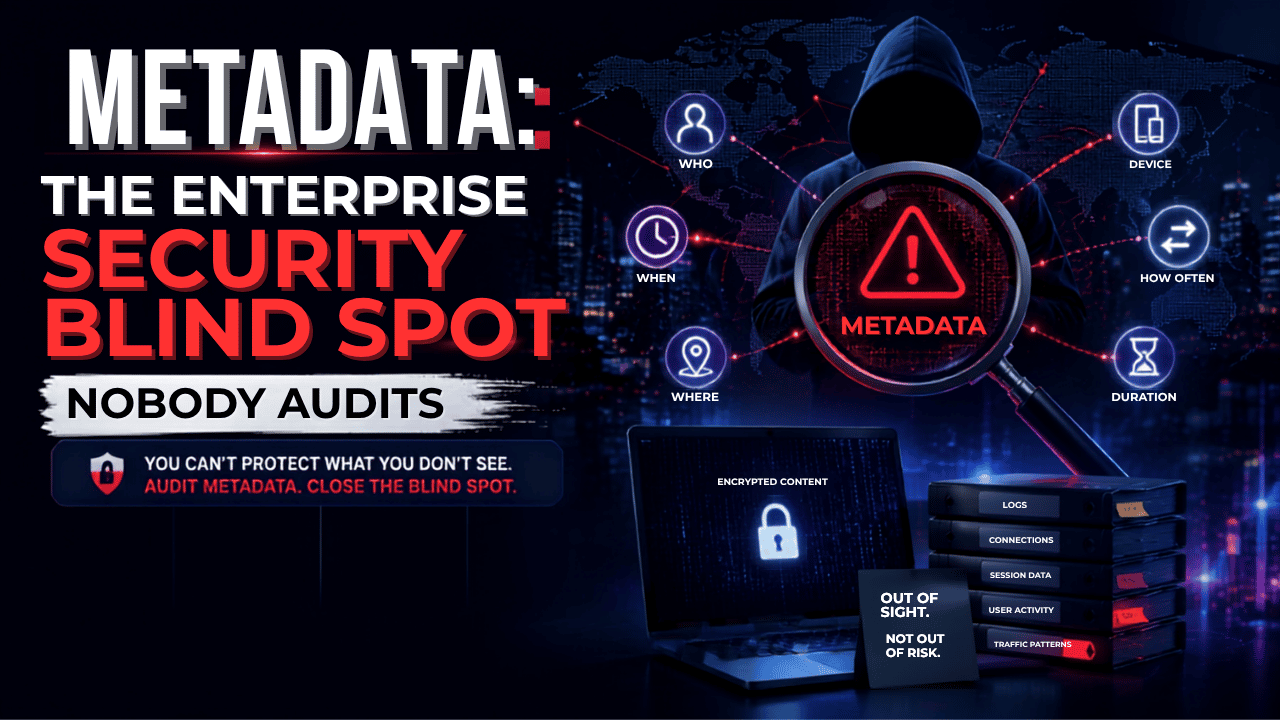
Metadata: The Enterprise Security Blind Spot Nobody Audits
Metadata is data about data, including communication details such as participants, timestamps, devices, and locations. Although message content may be encrypted, exposed metadata can still reveal sensitive information about business operations and user activity. Organizations using on-premise messaging platforms gain greater control over metadata storage, access, and security, reducing unnecessary exposure.
This guide explains what metadata is, why it matters, and how to protect it from security risks.
What Metadata Reveals Even When Content Is Encrypted
Encryption protects what was said. Metadata reveals everything else, and in intelligence and security terms, everything else is often more valuable than the content itself.
Consider what metadata from a single encrypted messaging conversation reveals particularly in organizations using on-premise deployment where metadata control is a deliberate architectural decision rather than an afterthought:
- Who sent a message and who received it — identities, roles, and relationships
- When the message was sent — time of day, day of week, urgency patterns
- How often two parties communicate — frequency reveals relationship strength and operational dependencies
- How long conversations last — duration signals the significance of the interaction
- From where messages originate — geographic location, IP address, device type
- What changed — sudden changes in communication patterns reveal operational shifts, stress events, or sensitive decisions
The NSA's own former director General Michael Hayden acknowledged this reality directly: metadata surveillance is extraordinarily powerful precisely because patterns of communication reveal intent, relationships, and organizational structure without requiring access to a single word of content.
For enterprises, the threat is not only external intelligence services. Metadata exposure creates risk from:
- Vendor access — cloud messaging providers generate and retain metadata about every interaction on their platforms
- Legal discovery — metadata is discoverable in litigation and regulatory investigations, often revealing more than the parties intended
- Insider threat analysis — unusual communication patterns in metadata can indicate insider threat behavior — but that same metadata, if externally accessible, maps your organization's decision-making structure for adversaries
- Competitive intelligence — communication frequency between your executives and specific external parties reveals partnership discussions, M&A activity, and strategic priorities before any announcement
Where Enterprise Tools Leak Metadata
Most enterprise communication tools generate and retain significantly more metadata than their users realize. The leakage points are systematic:
Cloud messaging platforms — tools like Slack, Microsoft Teams, and Google Chat store metadata including message timestamps, sender and recipient identities, channel membership, read receipts, reaction timestamps, file transfer records, and login locations on vendor-managed servers. This metadata is subject to vendor terms of service, vendor jurisdiction, and vendor security practices, none of which the enterprise directly controls. CISA security guidance recommends organizations assess third-party data retention practices as part of their broader supply chain risk management program.
Email systems — every email carries a full header containing sender IP, routing servers, timestamps at every relay point, and client software identification. Email metadata is preserved by default in most enterprise email systems and is highly discoverable.
Video conferencing tools — platforms like Zoom and Teams retain metadata including meeting participant lists, join and leave times, duration, geographic location of participants, and device information — all on vendor servers.
Mobile device management — MDM systems generate metadata about device location, application usage patterns, and network connections that creates a detailed behavioral profile of every enrolled device.
VoIP and telephony — call detail records capture every number dialed, call duration, time, and location, metadata that has historically been the primary target of bulk surveillance programs.
Collaboration and project management tools — task assignment, comment timestamps, document access logs, and file modification records collectively map who is working on what, with whom, and when, a detailed organizational intelligence picture.
The Intelligence Value of Communication Patterns
Communication pattern analysis, extracting intelligence from metadata without ever accessing content, is a mature discipline used by intelligence agencies, law enforcement, and increasingly by sophisticated commercial and nation-state adversaries.
What patterns reveal in practice:
Organizational structure — who communicates most frequently with whom maps reporting relationships, informal influence networks, and decision-making chains more accurately than any org chart. Adversaries who obtain enterprise communication metadata can reconstruct the real decision-making structure of an organization regardless of what the formal hierarchy shows.
Pre-announcement intelligence — a sudden spike in communication between legal, finance, and executive leadership signals an M&A transaction, regulatory response, or major strategic decision before any public announcement. For publicly traded companies, this is material non-public information derived entirely from metadata.
Operational tempo — changes in communication frequency and timing reveal when an organization is under stress, approaching a deadline, or managing a crisis, information that adversaries, negotiating counterparties, and competitors can exploit.
Relationship mapping — frequency and recency of external communications identifies your most important vendor relationships, client dependencies, and strategic partnerships intelligence that has direct commercial value to competitors.
Sensitive project identification — sudden formation of a new communication cluster among previously unconnected individuals signals the start of a sensitive project, even without any content visibility.
Organizations are now expected to actively evaluate transfer risks, implement meaningful safeguards, and demonstrate accountability across international operations, and metadata exposure is increasingly part of that accountability picture.
Metadata and Regulatory Exposure
Metadata is not excluded from data protection regulations — it is covered by them, and its regulatory implications are frequently underestimated:
GDPR — metadata that relates to an identified or identifiable individual is personal data under GDPR. Communication metadata, who emailed whom, when, from where, is personal data under GDPR and subject to the same residency, retention, and transfer obligations as message content. Organizations that retain this metadata on cloud platforms are subject to GDPR data residency, retention, and transfer obligations for that metadata, not just for message content.
HIPAA — in healthcare contexts, communication metadata can reveal sensitive information about patient relationships. The fact that a physician communicated with an oncologist about a specific patient, even without content visibility, may constitute Protected Health Information under HIPAA's broad definition.
Legal discovery — in litigation and regulatory investigations, metadata is actively sought by opposing counsel and regulators. Email headers, message timestamps, and communication frequency records have been material evidence in antitrust cases, insider trading investigations, and employment disputes. Metadata that organizations did not know they were retaining has repeatedly become evidence they did not intend to produce, the European Data Protection Board has published specific guidance on metadata retention obligations under GDPR that legal and compliance teams should review.
Insider trading regulations — for financial services organizations, communication metadata showing contact between employees with access to material non-public information and external parties creates regulatory exposure under insider trading surveillance obligations.
Government and defence classification handling — in classified environments, the pattern of communications between personnel with access to different classification levels is itself a sensitive data point. Metadata about who is communicating with whom within a classified program can reveal program structure, participation, and operational activity to adversaries. Refer to the NIST cybersecurity framework for baseline metadata security controls in government environments.
Platforms That Minimise Metadata Retention
The most effective way to address metadata exposure is not a policy, it is an architecture decision. Platforms that process and retain metadata on vendor-managed cloud infrastructure create structural metadata exposure that cannot be fully addressed through contractual controls.
What to look for in a metadata-conscious platform:
On-premise deployment — when the messaging server runs within the organization's own infrastructure, metadata is generated and retained within the organization's own controlled environment. No vendor has access to communication patterns, timing data, or relationship maps. This is the most complete solution to vendor-side metadata exposure.Troop Messenger's on-premise deployment keeps all metadata, message timestamps, participant lists, file transfer records, and communication patterns, within the organization's own server infrastructure with no external transmission.
Minimal metadata retention policies — platforms should allow administrators to configure retention periods for metadata independently of message content, enabling organizations to align metadata retention with their actual operational and compliance requirements rather than vendor defaults.
No third-party analytics — cloud platforms frequently use aggregated metadata for product analytics, usage reporting, and feature development. Platforms deployed on-premise do not transmit this data to vendor analytics systems.
Air-gap compatibility — for defence and intelligence organizations where metadata exposure carries national security implications, platforms must operate in completely air-gapped environments where no metadata leaves the secure network perimeter. For defence organizations and intelligence agencies operating in these environments, on-premise air-gapped deployment is the only architecture that meets metadata security requirements.
Access controls on metadata — the platform should provide granular controls over who within the organization can access communication metadata, with full audit logging of metadata access events.
Full feature parity without cloud dependency — metadata minimization should not require sacrificing functionality. Teams should have access to full messaging features, group messaging, voice and video, file sharing, search — without any of those features requiring cloud-side metadata processing.
Conclusion
Metadata is the intelligence layer that encryption does not protect, and in enterprise security, it is the layer that most organizations have not audited, governed, or adequately controlled. The investment organizations make in content encryption, DLP tools, and access management creates a false sense of security if metadata generated by cloud communication tools is flowing to vendor servers, subject to foreign jurisdiction, and available to anyone with the legal leverage or technical capability to access it. For CISOs building a complete security posture, metadata governance belongs alongside content encryption in the security architecture, not as an afterthought. The architecture decision that addresses it most completely is on-premise deployment, where communication metadata stays within the organization's own infrastructure, under the organization's own control, visible only to the people and systems the organization explicitly authorizes.
Frequently Asked Questions
1. What is communication metadata in enterprise security?
Communication metadata is the data generated by messaging and collaboration tools that describes who communicated with whom, when, how often, for how long, and from where without including the actual message content. It is retained by cloud platforms on vendor servers and reveals organizational structure, decision patterns, and sensitive relationships even when message content is fully encrypted.
2. Why is metadata a security risk even when messages are encrypted?
Encryption protects message content but leaves metadata fully exposed. Metadata analysis studying communication patterns, frequency, timing, and relationships can reveal organizational structure, pre-announcement activity, sensitive project formation, and strategic priorities without accessing a single word of content. Intelligence agencies and sophisticated adversaries routinely exploit metadata rather than attempting to break encryption.
3. Where do enterprise tools leak metadata?
Common metadata leakage points include cloud messaging platforms that retain communication patterns on vendor servers, email systems with full routing headers, video conferencing tools that log participant lists and duration, VoIP systems with call detail records, and collaboration tools that log task assignment and document access patterns.
4. Does GDPR cover communication metadata?
Yes. Communication metadata that relates to an identified or identifiable individual is personal data under GDPR. This includes message timestamps, sender and recipient identities, and communication frequency records. Organizations storing this metadata on cloud platforms outside the EU are subject to GDPR cross-border transfer obligations for the metadata, not just message content.
5. What is the best way to minimize enterprise metadata exposure?
The most complete solution is on-premise deployment running the messaging server within the organization's own infrastructure so metadata is generated and retained internally with no vendor access. This eliminates vendor-side metadata exposure entirely, addresses GDPR residency obligations for metadata, and is compatible with air-gapped environments where no metadata can leave the secure network perimeter.