Connect with us
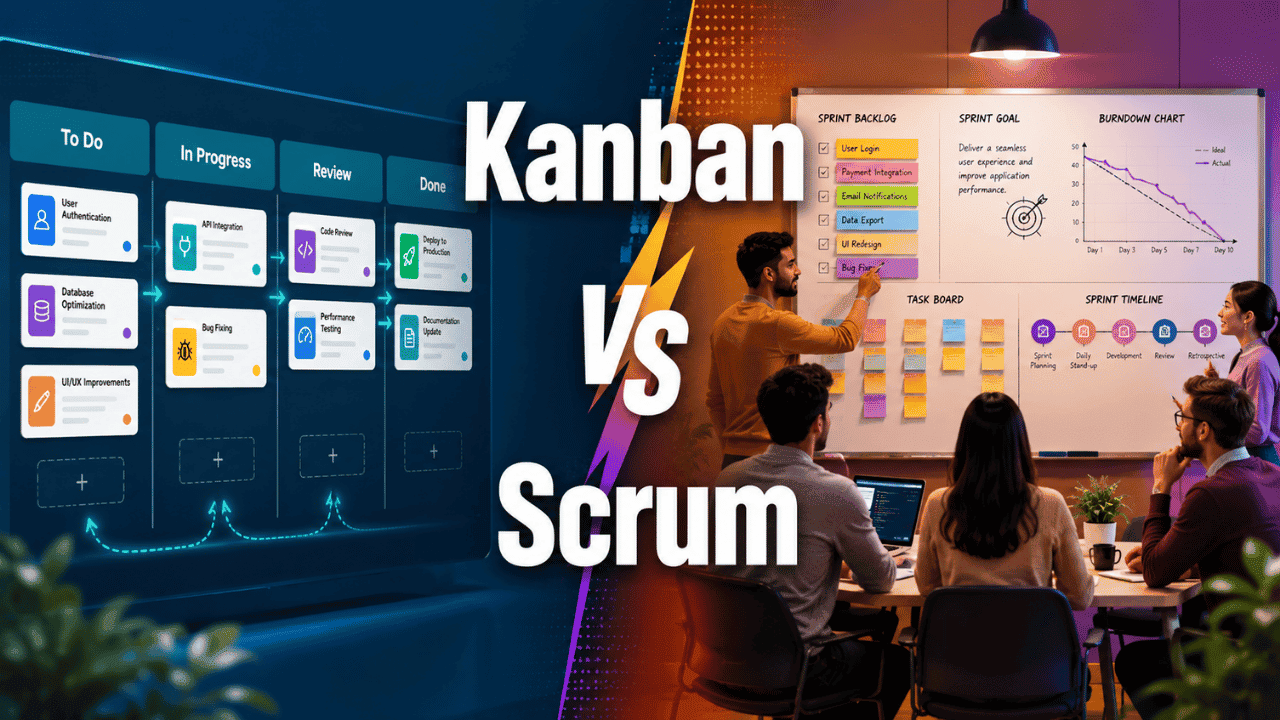
Kanban vs Scrum: Which Agile Framework Is Right for Your Team?
Kanban and Scrum are both agile frameworks used to manage work, but they solve different problems: Kanban is a continuous-flow system built around visual boards and work-in-progress limits, while Scrum is a structured, sprint-based framework with fixed roles, ceremonies, and time-boxed iterations, and the right choice depends on whether your team's work arrives unpredictably or can be planned in advance.
If you've landed here trying to settle a debate your team is already having, you're not alone. Search interest in "kanban vs scrum" has held steady for years, and for good reason, most teams don't pick wrong because they misunderstand agile. They pick wrong because they copy whatever framework a previous job used, without checking if it fits how their actual work shows up.
This guide breaks down what each framework does, where they overlap, where they diverge, and how to decide which one, or which blend, fits your team.
What Is Kanban?
Kanban started as a manufacturing technique at Toyota, long before software teams adopted it. The core idea hasn't changed much: visualize the work, limit how much is "in progress" at any given time, and let work flow continuously instead of in batches.
A kanban board usually has three columns at minimum, To Do, In Progress, Done, though most teams add more (Backlog, In Review, Blocked, etc.). Tasks move left to right as they progress. There's no fixed start or end date for a "cycle." Work simply flows.
Core Kanban Principles
The framework rests on a handful of rules that sound simple but change behavior fast once teams actually follow them:
- Visualize the workflow. Every task is a card on a board. Nothing hides in someone's inbox or memory.
- Limit work in progress (WIP). Teams cap how many tasks can sit in each column at once. This is the part most teams skip, and it's the part that actually makes Kanban work, without a WIP limit, you just have a to-do list with extra columns.
- Manage flow, not deadlines. The goal is steady throughput, not hitting a date.
- Make policies explicit. Everyone should know what "done" means for a card, not just guess.
- Improve continuously. Kanban doesn't have a built-in retrospective ceremony like Scrum does, but teams are expected to keep adjusting the board and limits as bottlenecks show up.
Support teams, ops teams, and anyone handling a steady stream of unpredictable requests tend to gravitate toward Kanban, because there's no need to force unpredictable work into a fixed two-week box.
What Is Scrum?
Scrum takes the opposite bet. Instead of continuous flow, it organizes work into fixed-length iterations called sprints, usually one to four weeks, with a defined set of roles and recurring meetings built around each sprint.
The three core roles are the Product Owner (owns the backlog and priorities), the Scrum Master (removes blockers and keeps the process honest), and the Development Team (does the actual work). That structure is one of the bigger differences people miss when comparing the two frameworks, Kanban doesn't prescribe any roles at all.
Scrum Roles, Sprints & Ceremonies
Scrum runs on a rhythm of meetings, often called ceremonies:
- Sprint Planning — the team commits to a set of backlog items for the upcoming sprint.
- Daily Stand-up — a short daily sync, typically 15 minutes, on progress and blockers.
- Sprint Review — the team demos what got built at the end of the sprint.
- Sprint Retrospective — the team reflects on what worked and what didn't, then adjusts.
This cadence gives Scrum a predictable shape. Stakeholders know roughly when they'll see new output. Teams know exactly what they committed to. The tradeoff is flexibility, once a sprint starts, adding new work mid-sprint is generally discouraged.
Kanban vs Scrum: Key Differences
Here's where the comparison earns its keep. Both are agile, both use boards, both aim to ship value faster, but the mechanics diverge in ways that matter a lot once you're running either one for real.
Workflow & Cadence
Kanban is continuous. Work gets pulled into progress as capacity allows, with no fixed start or end to a cycle. Scrum is iterative, work is batched into sprints, and the team re-plans at fixed intervals. If your work arrives in unpredictable bursts (support tickets, bug reports, ad-hoc requests), forcing it into two-week sprints usually creates friction. If your work can be scoped and planned ahead of time, sprints give you a useful planning rhythm.
Roles and Responsibilities
Scrum defines roles explicitly: Product Owner, Scrum Master, Development Team. Kanban defines none. Some teams run Kanban with a similar role structure anyway, but it's not required by the framework itself. Teams adopting Scrum often need to figure out who's taking on the Scrum Master responsibilities, which can be a real organizational shift.
Board Structure (Kanban Board vs Scrum Board)
A kanban board is persistent, it doesn't reset. Cards just keep flowing through it indefinitely. A scrum board resets every sprint; it represents only the current sprint's backlog, and gets rebuilt for the next one. If you're comparing a kanban board vs scrum board side by side, that's the single biggest visual and functional difference: one is a live, ongoing system, the other is a snapshot tied to a specific time window.
This is also where the tool you use starts to matter. Taskity's drag-and-drop Kanban boards are built around that continuous-flow idea, tasks move through customizable stages without the board resetting on you, which makes it a natural fit for teams running pure Kanban rather than sprint cycles.
Flexibility vs Structure
Kanban lets you add, reprioritize, or pull new work at any point. Scrum asks teams to commit to a sprint's scope and resist changes mid-sprint, with new work queued for the next sprint instead. Neither approach is "more agile" than the other, they're optimized for different kinds of unpredictability.
Kanban vs Scrum vs Agile: How They Relate
This trips people up constantly, so it's worth being direct about it: Agile is not a framework. It's a set of values and principles laid out in the Agile Manifesto back in 2001. Kanban and Scrum are both implementations of those principles, specific, practical systems teams use to actually run agile in day-to-day work.
So "agile vs scrum vs kanban" isn't really a three-way comparison of equals. It's more like comparing "transportation" to "car" and "bicycle." Agile is the philosophy. Scrum and Kanban are two of the more popular ways teams put that philosophy into practice. There are others too, Extreme Programming (XP), Lean, and hybrid approaches, but Scrum and Kanban dominate the conversation because they're the most widely adopted.
When to Use Kanban vs When to Use Scrum
Best Use Cases for Kanban
- Support and operations teams handling an unpredictable stream of incoming requests
- Maintenance work where priorities shift based on what breaks
- Teams with highly variable task sizes that don't fit neatly into sprint-sized chunks
- Continuous delivery environments where shipping happens multiple times a day, not once every two weeks
Best Use Cases for Scrum
- Product development teams building toward a defined release or roadmap
- Teams that benefit from forced cadence, regular check-ins, demos, and retrospectives keep momentum
- Cross-functional teams that need clear role separation between planning (Product Owner) and execution
- Organizations that want predictable reporting cycles for stakeholders
There's no universal right answer here. The honest answer is: it depends what kind of unpredictability your team is dealing with, unpredictable timing of work (Kanban) or unpredictable priorities within a planned scope (Scrum).
Scrumban — Combining Both
A growing number of teams don't pick one and stick with it. They run something in between, often called Scrumban, Kanban's continuous flow and WIP limits, layered with some of Scrum's ceremonies, like a regular retrospective or planning check-in, without the rigid sprint commitment.
It's not officially a "framework" in the same formal sense as Scrum, but it's common enough in practice that it deserves a mention. If your team finds itself frustrated by sprint rigidity but still wants some structure beyond a free-flowing board, scrumban is usually where you land.
Kanban vs Scrum Tools: Which Should You Choose?
Most modern project management tools support both frameworks, often within the same product, so the "which tool" question is really a "which features matter to your workflow" question.
When comparing kanban vs scrum tools, look for:
- WIP limit enforcement (important for Kanban)
- Sprint planning and burndown charts (important for Scrum)
- Customizable board columns and swimlanes
- Integration with your existing chat and communication tools
Jira is one of the most commonly searched tools in this category, "jira kanban vs scrum" shows up frequently because Jira supports both board types natively. But if your team is closer to a pure-Kanban setup and doesn't need Scrum's sprint machinery at all, it's worth looking at something built specifically around that flow.
Taskity is a task management tool built around exactly that idea, visual, drag-and-drop Kanban boards without the overhead of a full enterprise suite. It organizes work into "Pods," which function as dedicated project spaces where teams add tasks, assign members, and track progress without the workspace getting cluttered by unrelated work. For teams that already coordinate over chat, Taskity also connects with Slack, Microsoft Teams, and Troop Messenger, so task updates surface inside the conversations your team is already having instead of forcing everyone into a separate tab. It's also available on iOS and Android, which matters for teams whose work doesn't stop when people leave their desks.
Top Tools Comparison Table
| Tool | Best For | Kanban Support | Scrum Support |
| Taskity | Visual Kanban-first teams, cross-tool collaboration | Yes | Limited |
| Jira | Software teams, enterprise | Yes | Yes |
| Trello | Small teams, simple boards | Yes | Limited |
| Asana | Cross-functional teams | Yes | Yes |
| Monday.com | Visual project tracking | Yes | Yes |
Beyond the heavyweight enterprise suites, plenty of teams just need something lightweight to track daily tasks without the overhead of full agile ceremonies. If that's closer to where your team is, it's worth comparing a few free to-do list apps and these productivity-focused to-do apps before committing to a heavier tool you might not need yet.
Final Verdict: Kanban or Scrum?
If your work shows up unpredictably and needs to be picked up the moment it lands, lean Kanban. If your team benefits from planning ahead, committing to a scope, and reviewing progress on a fixed rhythm, lean Scrum. And if neither answer feels complete on its own, that's usually a sign Scrumban is worth testing.
What matters more than the framework name is whether your team revisits the choice. Plenty of teams pick one in their first sprint planning meeting and never question it again two years later, even after the type of work they do has completely changed. The framework, and the tool running it, should fit the work, not the other way around. If your team is leaning Kanban-first, starting with something purpose-built for that, like Taskity's Pod-based boards, is usually a lighter lift than retrofitting a sprint-heavy tool to behave like a continuous-flow system.
For deeper reading on the frameworks themselves, the official Scrum guide from Scrum.org and the Scaled Agile Framework documentation are both solid primary sources, and Atlassian's broader agile resource hub is useful for seeing how these frameworks fit into the wider agile ecosystem.
Frequently Asked Questions
Q1. What is kanban vs scrum in simple terms?
Kanban is a visual, continuous-flow system where work moves through columns on a board with no fixed deadlines or cycles. Scrum organizes work into fixed-length sprints with defined roles like Product Owner and Scrum Master, plus regular ceremonies such as planning, stand-ups, and retrospectives. Kanban suits unpredictable work; Scrum suits planned, iterative development.
Q2. When should I use kanban vs scrum?
Use Kanban when work arrives unpredictably and needs immediate attention, like support tickets or maintenance requests. Use Scrum when your team can plan work in advance and benefits from a fixed cadence of sprints, reviews, and retrospectives. Many teams test both briefly before settling on whichever matches their actual workflow.
Q3. What is the difference between a scrum board and a kanban board?
A kanban board is continuous and never resets, cards flow through it indefinitely as work gets completed. A scrum board represents only the current sprint and gets rebuilt at the start of each new sprint. That reset is the core functional difference between the two board types.
Q4. Is scrumban a real framework or just a mix of both?
Scrumban isn't a formally standardized framework like Scrum, but it's a widely practiced hybrid. Teams use Kanban's visual flow and WIP limits while borrowing Scrum elements like retrospectives or planning meetings. It works well for teams who want more structure than pure Kanban without committing to rigid sprint cycles.
Q5. Is Taskity better suited for Kanban or Scrum teams?
Taskity is built primarily around Kanban-style workflows, drag-and-drop boards, Pods for organizing project spaces, and real-time collaboration. It's a strong fit for teams running continuous-flow Kanban, especially those who already coordinate over Slack, Microsoft Teams, or Troop Messenger, rather than teams needing full sprint-planning and burndown features.