Connect with us
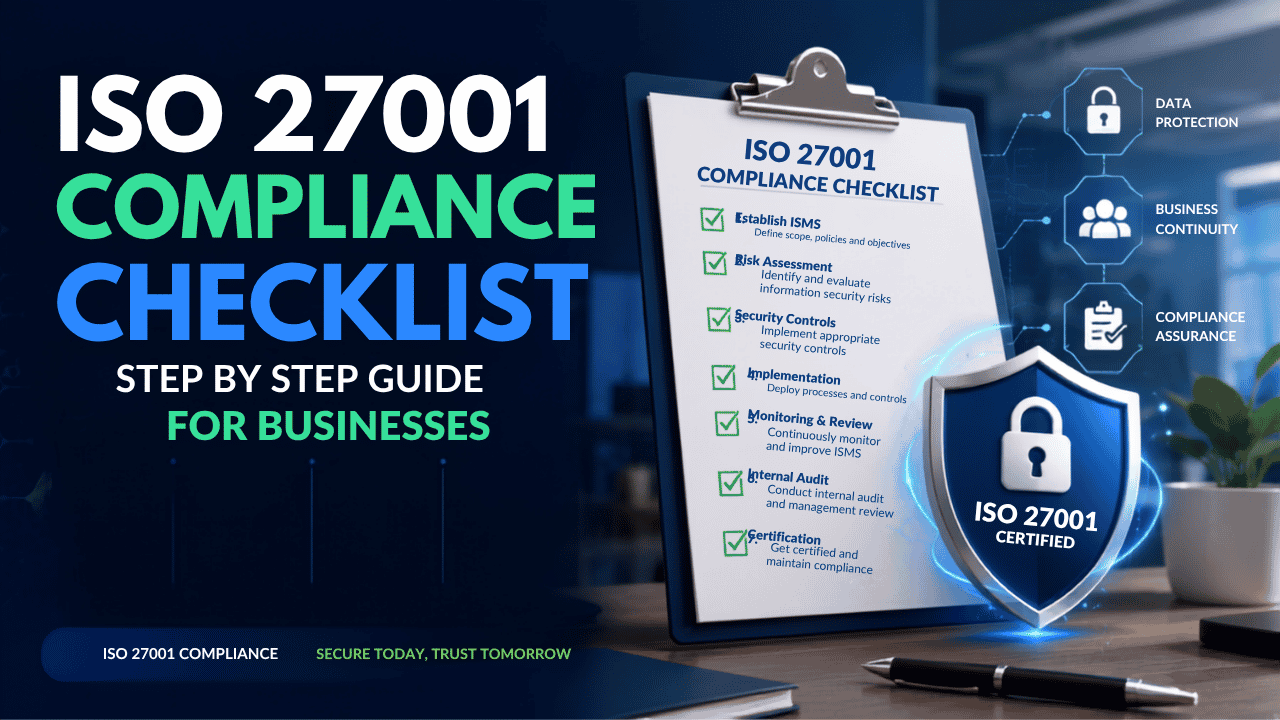
ISO 27001 Compliance Checklist — Step by Step Guide for Businesses
ISO 27001 compliance is the process of implementing and maintaining an Information Security Management System (ISMS) that meets the ISO/IEC 27001 standard for managing information security risks. It helps organizations protect sensitive data, demonstrate security best practices, and build trust with customers, partners, and regulators.
In this guide, you'll learn what ISO 27001 compliance is, its requirements, certification process, key benefits, and best practices for achieving and maintaining compliance.
What Is ISO 27001 Compliance?
ISO 27001 compliance means an organization has implemented an Information Security Management System that satisfies the requirements of the ISO/IEC 27001 standard published by the International Organization for Standardization and the International Electrotechnical Commission.
The ISO 27001 standard defines requirements for establishing, implementing, maintaining, and continually improving an ISMS — the policies, procedures, controls, and processes an organization uses to systematically manage information security risks.
ISO 27001 compliance is demonstrated through a formal certification process involving an accredited third-party certification body that audits the ISMS against the standard's requirements. Certification is valid for three years with annual surveillance audits.
Who Needs ISO 27001 Compliance?
ISO 27001 compliance is relevant to any organization that handles sensitive information, but it is increasingly required rather than optional for specific sectors and contexts:
Technology and SaaS companies — enterprise customers routinely require ISO 27001 certification as a condition of vendor procurement. A SaaS company without ISO 27001 certification may be disqualified from enterprise sales cycles regardless of its security posture.
Financial services organizations — banks, payment processors, and financial technology companies face regulatory and customer expectations for ISO 27001 certification as evidence of systematic information security management.
Healthcare organizations — healthcare providers and health technology companies handling sensitive patient data use ISO 27001 as a framework for demonstrating information security management alongside HIPAA compliance.
Government contractors — organizations supplying to government agencies in the UK, EU, and Australia frequently face ISO 27001 requirements as part of procurement qualification.
Professional services firms — law firms, consulting organizations, and managed service providers handling client data increasingly hold ISO 27001 certification to demonstrate the security of client information.
Any organization entering regulated markets — organizations expanding into markets where information security regulation is mature, particularly the EU, UK, and Australia, will encounter ISO 27001 requirements earlier in their growth journey than organizations operating only in less regulated markets.
ISO 27001 Compliance Requirements — What Businesses Must Meet
The ISO 27001 standard is structured around ten mandatory clauses and Annex A, which contains 93 information security controls organized across four themes:
Mandatory clauses (4-10):
- Clause 4 — Context of the organization — understand the internal and external issues relevant to information security, identify interested parties and their requirements, and define the scope of the ISMS
- Clause 5 — Leadership — top management must demonstrate commitment to the ISMS, establish an information security policy, and assign roles and responsibilities
- Clause 6 — Planning — Conduct a formal information security risk assessment aligned with the NIST cybersecurity framework, define risk treatment options, and establish information security objectives.
- Clause 7 — Support — provide resources, ensure competence, raise awareness, and manage documented information
- Clause 8 — Operation — implement and control processes including risk assessment and risk treatment
- Clause 9 — Performance evaluation — monitor, measure, analyze, and evaluate ISMS performance through internal audits and management reviews
- Clause 10 — Improvement — address nonconformities, take corrective actions, and continually improve the ISMS
Annex A controls (2022 edition):
The 2022 update reorganized controls into four themes, Organizational (37 controls), People (8 controls), Physical (14 controls), and Technological (34 controls) totaling 93 controls. Organizations are not required to implement every control, they must document which controls apply to their risk environment and justify any controls they exclude in a Statement of Applicability.
ISO 27001 Compliance Checklist — Step by Step
Use this checklist as a structured pathway through the ISO 27001 compliance journey:
Phase 1 — Foundation
- Obtain top management commitment and appoint an ISMS owner
- Define the scope of the ISMS — which parts of the organization, which assets, which locations
- Document the organizational context — internal and external issues affecting information security
- Identify interested parties — customers, regulators, suppliers, and their information security requirements
- Establish a formal information security policy signed by top management
Phase 2 — Risk Assessment
- Define and document the risk assessment methodology
- Create an asset inventory covering information assets, systems, and processes in scope
- Identify threats and vulnerabilities for each asset
- Assess the likelihood and impact of each identified risk
- Determine risk acceptance criteria and risk appetite
- Produce a formal risk assessment report
Phase 3 — Risk Treatment
- Select risk treatment options for each identified risk, accept, avoid, transfer, or mitigate
- Map selected controls from Annex A to each risk treatment decision
- Produce a Statement of Applicability documenting all Annex A controls with inclusion or exclusion justification
- Develop a risk treatment plan with owners, timelines, and success criteria
Phase 4 — Control Implementation
- Implement selected Annex A controls across organizational, people, physical, and technological domains
- Develop and document required policies and procedures
- Implement access control, encryption, logging, and monitoring controls
- Establish supplier security assessment and management processes
- Implement incident management procedures
- Conduct information security awareness training for all staff
Phase 5 — Performance Evaluation
- Define KPIs and metrics for ISMS performance measurement
- Conduct internal ISMS audit against ISO 27001 requirements
- Hold management review of ISMS performance, risks, and objectives
- Address any nonconformities identified in internal audit
Phase 6 — Certification Audit
- Select an accredited certification body
- Complete Stage 1 audit — documentation review
- Complete Stage 2 audit — on-site implementation assessment
- Address any nonconformities identified by the certification body
- Receive ISO 27001 certificate (valid 3 years with annual surveillance audits)
ISO 27001 Compliance Software — Top Tools Available
ISO 27001 compliance software helps organizations manage their ISMS documentation, risk assessments, control tracking, and audit preparation:
Vanta — the most widely used compliance automation platform for SaaS companies pursuing ISO 27001. Vanta continuously monitors technical controls, automates evidence collection, and provides a readiness dashboard showing compliance progress against ISO 27001 requirements. Significantly reduces the manual effort of audit preparation.
Drata — similar to Vanta in scope, with strong ISO 27001 automation including continuous control monitoring and audit-ready evidence collection. Popular with engineering-led organizations for its technical integration depth.
Sprinto — compliance automation platform with strong ISO 27001 support, particularly popular with Series A and B SaaS companies in the US and UK markets.
Tugboat Logic (now acquired by OneTrust) — policy management and compliance workflow platform supporting ISO 27001 implementation and audit preparation.
Microsoft Purview Compliance Manager — for organizations using Microsoft 365 infrastructure, Compliance Manager provides ISO 27001 assessment templates mapped to Microsoft controls with automated evidence collection from the Microsoft environment.
ISO 27001 Compliance Automation — How to Streamline the Process
Manual ISO 27001 compliance management, tracking controls in spreadsheets, manually collecting evidence, and coordinating audit preparation across teams, is time-consuming and error-prone. Automation addresses the highest-effort components:
Continuous control monitoring — automation platforms integrate with your cloud infrastructure, identity provider, endpoint management, and development tools to continuously verify that technical controls are in place. Instead of manually checking that MFA is enforced, the platform checks it automatically and alerts when controls drift from the required state.
Automated evidence collection — instead of manually compiling screenshots and exports for auditors, automation platforms maintain a continuously updated evidence library that can be shared with auditors directly through a secure portal.
Policy management — platforms maintain your ISMS documentation with version control, review scheduling, and acknowledgment tracking, ensuring policies are kept current and staff acknowledgment is documented.
Risk register management — automated risk registers track identified risks, treatment decisions, and control effectiveness with dashboards that give the ISMS owner a real-time view of the risk posture.
For organizations where communication data is in scope for the ISMS, which it is for almost every organization, ensuring the communication platform's security controls are auditable is part of ISO 27001 compliance. Troop Messenger's on-premise deployment keeps all communication data within the organization's own controlled infrastructure, making communication platform security controls directly auditable by the internal ISMS team and external certification body without vendor mediation.
ISO 27001 Compliance Services — When to Bring in External Help
Most organizations benefit from external support for at least part of their ISO 27001 compliance journey:
Gap assessment consultants — an external ISO 27001 consultant conducts a structured gap assessment comparing your current security posture against the standard's requirements, producing a prioritized remediation roadmap. Most valuable at the start of the journey.
Implementation consultants — consultants who help develop the ISMS documentation, policies, and procedures required by the standard. Particularly valuable for organizations without dedicated information security staff.
Internal audit services — external auditors who conduct the mandatory internal audit required before the certification audit. Provides an independent assessment that surfaces nonconformities before the certification body sees them.
Certification bodies — Accredited organizations including BSI, Bureau Veritas, LRQA, and DNV that conduct Stage 1 and Stage 2 audits and issue ISO 27001 certificates, choose a certification body accredited by a recognized national accreditation body.
Benefits of ISO 27001 Compliance for Businesses
Enterprise sales enablement — ISO 27001 certification is increasingly a prerequisite for enterprise procurement. Organizations with certification close enterprise deals faster by removing security questionnaire friction and satisfying procurement security requirements.
Systematic risk management — the ISMS framework gives organizations a structured, repeatable process for identifying and managing information security risks rather than reacting to incidents ad hoc.
Regulatory alignment — ISO 27001 controls overlap significantly with GDPR, HIPAA, SOC 2, and other regulatory frameworks. Implementing ISO 27001 creates a foundation that accelerates compliance with other frameworks.
Cyber insurance positioning — insurers increasingly use ISO 27001 certification as an underwriting signal. Certified organizations may qualify for better coverage terms and lower premiums.
Staff security awareness — the standard requires formal security awareness training and documented responsibilities, improving the security culture across the organization.
Incident reduction — organizations that have implemented ISO 27001 controls report measurable reductions in security incidents through improved access management, vulnerability management, and monitoring practices.
ISO 27001 GDPR Compliance — How the Two Standards Overlap
ISO 27001 and GDPR address overlapping but distinct concerns — ISO 27001 focuses on information security management while GDPR focuses on personal data protection and individual rights. ISO 27001 focuses on information security management protecting the confidentiality, integrity, and availability of information. GDPR focuses on personal data protection and individual rights.
Key areas of overlap:
- Risk assessment — both require formal risk assessments covering information security risks to personal data
- Access controls — both require controls limiting access to personal data to authorized personnel
- Incident response — ISO 27001's incident management requirements align with GDPR's 72-hour breach notification obligation
- Supplier management — both require assessment and contractual controls for third parties processing personal data
- Documentation — both require documented policies, procedures, and records demonstrating compliance
Implementing ISO 27001 creates a strong foundation for GDPR compliance, particularly for the technical and organizational measures Article 32 requires but ISO 27001 certification does not constitute GDPR compliance. The two frameworks must be addressed together for organizations handling EU personal data.For more detail on data sovereignty and GDPR implications, the data sovereignty guide covers the jurisdictional dimensions that ISO 27001 alone does not address.
ISO 27001 vs SOC 2 — Key Differences Explained
Factor | ISO 27001 | SOC 2 |
Origin | International standard (ISO/IEC) | US framework (AICPA) |
Scope | Full ISMS — people, process, technology | Trust Service Criteria — security, availability, confidentiality |
Certification | Third-party certificate issued | Audit report issued |
Geographic recognition | Global | Primarily US and Canada |
Audit frequency | 3-year cycle with annual surveillance | Annual audit |
Risk-based approach | Yes — controls selected based on risk | Criteria-based |
Best for | Global enterprise sales, EU compliance | US enterprise sales, SaaS |
Overlap | Significant control overlap | Significant control overlap |
Many organizations pursue both ISO 27001 and SOC 2, particularly SaaS companies selling into US and international enterprise markets. Automation platforms like Vanta and Drata support both frameworks simultaneously, allowing shared evidence collection across both audit programs.
ISO 27001 Compliance for SaaS Companies
SaaS companies face specific ISO 27001 considerations driven by their cloud-native architecture and multi-tenant customer data model:
Scope definition — SaaS ISMS scope typically covers the production environment, development environment, and corporate IT infrastructure. Cloud infrastructure providers (AWS, Azure, GCP) operate under their own ISO 27001 certifications, the SaaS company's certification covers their application and controls layered on top.
Shared responsibility — cloud providers handle physical security, hardware, and infrastructure controls. SaaS companies are responsible for application-layer controls, customer data access management, and configuration security.
Customer data segregation — multi-tenant SaaS architectures must implement controls ensuring one customer cannot access another's data. This is a specific control area that ISO 27001 auditors examine closely for SaaS companies.
Change management — SaaS companies deploy code frequently. ISO 27001 requires formal change management controls that work alongside agile development practices, not against them.
Penetration testing — annual penetration testing of the production application is a standard expectation for SaaS ISO 270 01 certification. Build penetration testing into the annual compliance calendar from day one.
For SaaS companies building secure communication features or managing internal team communications as part of their ISMS scope, data loss prevention tools complement ISO 27001 controls by monitoring and preventing unauthorized data movement across the application and communication stack.
How to Achieve ISO 27001 Compliance Step by Step
The practical journey to ISO 27001 certification typically takes six to eighteen months depending on organization size, existing security maturity, and resource availability:
Month 1-2: Foundation and scoping — obtain leadership commitment, appoint ISMS owner, define scope, and conduct gap assessment against ISO 27001 requirements.
Month 2-4: Risk assessment — build asset inventory, conduct threat and vulnerability assessment, complete risk assessment documentation, and define risk treatment decisions.
Month 3-6: Control implementation — implement selected Annex A controls, develop required policies and procedures, deploy technical controls, and conduct staff awareness training.
Month 5-8: Evidence collection and testing — begin collecting compliance evidence, test implemented controls, and identify gaps requiring remediation.
Month 7-9: Internal audit — conduct formal internal ISMS audit, identify nonconformities, implement corrective actions, and conduct management review.
Month 8-12: Certification audit — engage certification body, complete Stage 1 documentation review, complete Stage 2 on-site assessment, address any nonconformities, and receive certification.
Conclusion
ISO 27001 compliance is the most credible signal available to demonstrate that your organization manages information security systematically rather than reactively. The certification journey is demanding it requires genuine organizational commitment, documented risk management, implemented controls, and independent audit validation. But the outcomes enterprise sales enablement, regulatory alignment, improved security culture, and reduced incident exposure, consistently justify the investment for organizations handling sensitive information in competitive or regulated markets. For organizations where secure internal communication is part of the ISMS scope and for most organizations it should be, Troop Messenger's on-premise deployment ensures communication platform controls are directly auditable within the ISMS framework. For teams managing self-hosted infrastructure as part of their ISO 27001 control environment, the self-hosted messaging guide covers deployment models that align with ISO 27001 control requirements for communication systems.
Frequently Asked Questions
1. What is ISO 27001 compliance?
ISO 27001 compliance means an organization has implemented an Information Security Management System that meets the requirements of the ISO/IEC 27001 international standard covering risk assessment, security controls across people, processes, and technology, and continual improvement through internal audit and management review.
2. Who needs ISO 27001 compliance?
ISO 27001 compliance is increasingly required for technology and SaaS companies selling to enterprise customers, financial services organizations, healthcare technology companies, government contractors, and any organization handling sensitive information in regulated markets. It is formally required in some procurement frameworks and strongly expected in others.
3. How long does ISO 27001 compliance take?
Achieving ISO 27001 certification typically takes six to eighteen months depending on organization size, existing security maturity, and resource availability. Organizations with strong existing security practices and dedicated resources tend toward the shorter end of that range.
4. What is the difference between ISO 27001 and SOC 2?
ISO 27001 is an international standard recognized globally, covering the full ISMS across people, processes, and technology. SOC 2 is a US framework producing an audit report against Trust Service Criteria. Both are widely used by SaaS companies ISO 27001 is more relevant for international and EU market sales while SOC 2 is more relevant for US enterprise sales.
5. What is the ISO 27001 Annex A?
Annex A is the control reference set within ISO 27001 containing 93 information security controls organized across four themes Organizational, People, Physical, and Technological. Organizations assess which controls apply to their risk environment, implement applicable controls, and document exclusions with justifications in a Statement of Applicability.