Connect with us
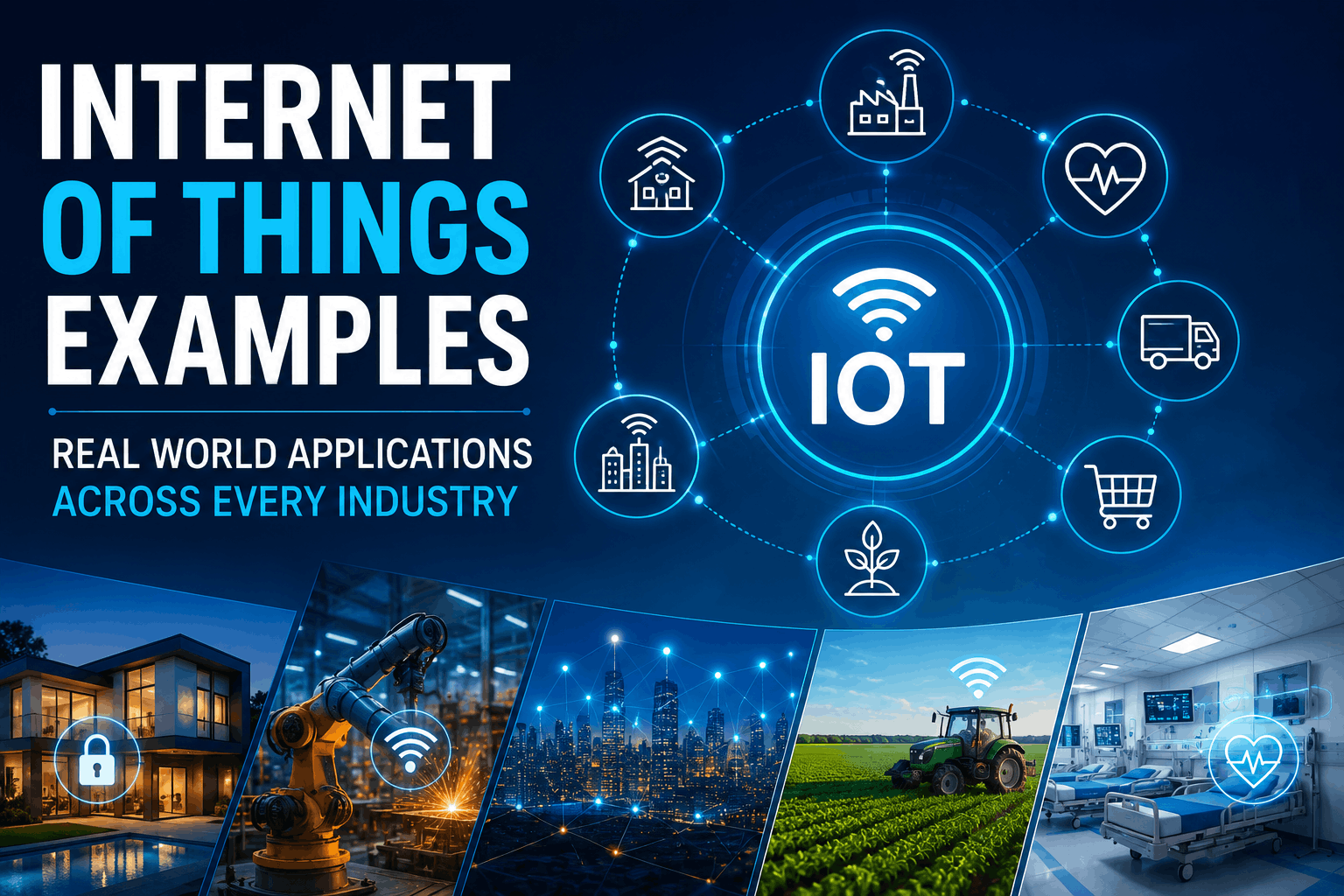
Internet of Things Examples — Real World Applications Across Every Industry
The Internet of Things (IoT) refers to the network of physical devices from home thermostats and factory sensors to medical monitors and smart city infrastructure that collect, share, and act on data through internet connectivity without requiring direct human input.
IoT examples exist across virtually every industry: a smart thermostat that adjusts temperature based on your daily routine, a factory sensor that predicts equipment failure before it happens, a hospital wearable that monitors a patient's vitals in real time, and a waste management bin that signals when it needs emptying. What connects all of these is the same principle everyday physical objects made intelligent through sensors, connectivity, and data processing.
What Is the Internet of Things? Definition and Examples
The Internet of Things is the collective term for physical objects embedded with sensors, software, and network connectivity that enable them to collect and exchange data with other devices and systems over the internet with little to no human involvement in the process.
A simple way to understand it: if a device can sense something, connect to a network, and send or receive data automatically, it qualifies as an IoT device. A standard light bulb is not IoT. A smart bulb that turns on when you enter a room, adjusts brightness based on time of day, and can be controlled remotely from your phone that is IoT.
IoT sits at the intersection of hardware (sensors and devices), connectivity (WiFi, cellular, Bluetooth, and specialized IoT protocols), and software (data processing, analytics, and automation logic). When all three work together, physical objects become intelligent, responsive systems.a
Internet of Things Examples in Daily Life
IoT is already embedded in most modern households without most people realizing the scope of it:
- Smart thermostats — devices like Google Nest learn your schedule and temperature preferences, automatically adjusting heating and cooling to save energy without manual input
- Smart speakers — Amazon Echo and Google Home connect to your home network and respond to voice commands, controlling lights, music, alarms, and connected appliances
- Fitness wearables — smartwatches and fitness bands continuously monitor heart rate, sleep patterns, steps, and blood oxygen levels, syncing data to health apps automatically
- Connected appliances — smart refrigerators track food inventory, smart washing machines can be started remotely, and smart ovens can be preheated from your phone on the commute home
- Smart security systems — doorbell cameras, motion sensors, and connected locks let homeowners monitor and control home security from anywhere in the world
These daily life examples share the same IoT pattern: a physical object connected to the internet, generating data, and enabling automated or remote action.
Industrial Internet of Things Examples
The Industrial Internet of Things (IIoT) applies IoT principles to manufacturing, energy, logistics, and heavy industry at a scale and precision that delivers
measurable operational and financial impact:
- Predictive maintenance — vibration, temperature, and pressure sensors on industrial machinery continuously monitor equipment health. When readings deviate from normal ranges, the system flags potential failures before they cause downtime , reducing unplanned outages by up to 50% in documented deployments
- Asset tracking — RFID and GPS sensors track the real-time location and condition of equipment, vehicles, and shipments across large facilities or global supply chains
- Energy management — industrial sensors monitor power consumption across production lines and automatically optimize usage, reducing energy costs without manual intervention
- Quality control — computer vision cameras and IoT sensors inspect products on production lines at speeds and accuracy levels no human team can match
- Remote monitoring — oil rigs, wind farms, and utility infrastructure in remote locations use IIoT sensors to transmit operational data to central control rooms, eliminating the need for on-site personnel for routine monitoring
Internet of Things Manufacturing Examples
Manufacturing is one of the most mature IoT verticals, with implementations ranging from individual machine monitoring to fully connected smart factories:
- Smart factories — entire production facilities where machines, robots, and logistics systems communicate with each other autonomously, adjusting production schedules, flagging bottlenecks, and optimizing output in real time
- Supply chain visibility — IoT sensors on shipments and in warehouses give manufacturers end-to-end visibility into where materials and finished goods are at every point in the supply chain
- Inventory management — automated shelf and bin sensors trigger reorder processes when stock falls below defined thresholds, eliminating manual inventory checks
- Worker safety monitoring — wearable IoT devices monitor worker location, fatigue levels, and environmental conditions in hazardous manufacturing environments, triggering alerts when safety thresholds are breached
- Digital twin technology — IoT sensor data feeds real-time digital replicas of physical production assets, allowing engineers to simulate changes and identify issues without disrupting live production
Internet of Things Healthcare Examples
Healthcare IoT often called IoMT (Internet of Medical Things) is one of the fastest-growing and highest-impact IoT sectors:
- Remote patient monitoring — wearable devices continuously track patient vitals (blood pressure, heart rate, glucose levels) and transmit data to healthcare providers, enabling proactive intervention without hospital visits
- Smart hospital beds — beds equipped with pressure sensors automatically detect patient movement, adjust positioning to prevent bedsores, and alert nursing staff when a patient attempts to get up unassisted
- Connected medication dispensers — smart pill dispensers remind patients when to take medications, track compliance, and alert caregivers or healthcare providers when doses are missed
- Surgical robotics — IoT-enabled surgical robots allow precise remote-assisted procedures and generate detailed operational data for post-surgical review and improvement
- Asset tracking in hospitals — RFID tags on medical equipment (wheelchairs, infusion pumps, defibrillators) allow hospital staff to locate any asset in real time, reducing time spent searching for critical equipment during emergencies
Examples of Internet of Things Devices
Not all IoT devices look like high-tech hardware. Here is a broad cross-section of what qualifies as an IoT device across categories:
| Category | IoT Device Examples |
| Home | Smart thermostat, connected doorbell, smart speaker |
| Health | Smartwatch, glucose monitor, connected inhaler |
| Industrial | Vibration sensor, RFID tag, industrial gateway |
| Agriculture | Soil moisture sensor, drone, livestock tracker |
| City | Traffic sensor, smart streetlight, parking detector |
| Retail | Smart shelf, inventory beacon, connected POS terminal |
What unifies all of these is the same architecture: a sensor or actuator, a connectivity layer, and a cloud or edge platform that processes and acts on the data generated.
Examples of Internet of Things in Home Automation
Home automation is where most consumers first encounter IoT directly. Modern smart home setups can include:
- Automated lighting — lights that adjust based on time of day, occupancy sensors, or voice commands
- Smart locks — deadbolts that can be locked or unlocked remotely, issue temporary access codes to guests, and log entry and exit events automatically
- Irrigation systems — garden watering systems that pull local weather data and skip scheduled watering cycles when rain is forecast
- Smart plugs — standard outlets made intelligent, allowing any plugged-in device to be controlled remotely and monitored for energy consumption
- Home energy monitoring — whole-home systems that track electricity consumption in real time by circuit, identifying energy-hungry appliances and suggesting efficiency improvements
IoT Protocols — How Internet of Things Devices Communicate
IoT devices use specialized communication protocols rather than standard web protocols, chosen based on power requirements, range, and data volume:
- MQTT —MQTT, lightweight publish-subscribe protocol designed for low-bandwidth, high-latency environments. The standard for most IoT sensor-to-cloud communication
- CoAP — Constrained Application Protocol, designed for simple microcontrollers and low-power devices
- Zigbee and Z-Wave — short-range mesh networking protocols common in smart home devices
- LoRaWAN — LoRaWAN ong-range, low-power protocol used for wide-area IoT deployments like smart cities and agricultural monitoring
- Bluetooth Low Energy (BLE) — Bluetooth Low Enegry standard for short-range wearables and proximity-based IoT applications
- Cellular (4G/5G) — used where devices need wide-area connectivity without local WiFi infrastructure, common in IIoT and vehicle tracking
Internet of Things and Artificial Intelligence — How They Work Together
IoT and AI are increasingly inseparable. IoT generates massive volumes of sensor data AI is what makes that data actionable at scale:
- Anomaly detection — AI models trained on normal sensor readings identify deviations that indicate equipment failure, security intrusions, or process inefficiencies faster and more accurately than rule-based systems
- Predictive analytics — machine learning models use historical IoT data to forecast future outcomes — when a machine will fail, when inventory will run out, when patient health metrics signal risk
- Computer vision — AI-powered cameras on production lines and in public spaces analyze visual data from IoT camera feeds in real time
- Natural language processing — smart speakers and voice-controlled IoT systems use AI to interpret and respond to spoken commands accurately across accents and environments
The combination of IoT's data collection capability and AI's pattern recognition creates systems that do not just monitor they learn and adapt.
Internet of Things and Machine Learning — Real World Applications
Machine learning specifically powers some of the most impactful IoT applications in deployment today:
- Smart grid optimization — ML models analyze consumption data from smart meters across an entire utility grid and automatically balance load, reducing waste and preventing outages
- Fraud detection in retail IoT — ML models on connected POS systems identify unusual transaction patterns in real time and flag potential fraud before it completes
- Agricultural yield optimization — ML models trained on soil sensor, weather, and crop data recommend precise irrigation and fertilization schedules that improve yields while reducing resource consumption
- Autonomous vehicles — the most complex ML-IoT system in consumer deployment, where sensors generate continuous streams of data that ML models process in milliseconds to make driving decisions
IoT in Waste Management — A Practical Example
Smart waste management is one of the clearest practical examples of IoT solving a real operational problem efficiently:
Smart bins equipped with ultrasonic fill-level sensors continuously report how full they are to a central management platform. Instead of following fixed collection schedules which result in some bins overflowing while trucks visit half-empty ones waste management operators route collection vehicles dynamically based on actual fill levels.
The results in documented deployments include significant reductions in collection vehicle trips, lower fuel costs, fewer overflowing bins in public spaces, and measurably lower operational costs.
Cities including Barcelona, Seoul, and Amsterdam have implemented smart waste systems at scale, using IoT sensor networks to optimize collection across thousands of bins simultaneously.
The Internet of Things Examples Across Different Sectors
A consolidated view of how IoT is applied across major sectors:
- Agriculture — soil sensors, drone monitoring, livestock tracking, and automated irrigation systems
- Retail — smart shelves, foot traffic analytics, connected fitting rooms, and automated checkout systems
- Transportation — fleet telematics, connected traffic signals, predictive vehicle maintenance, and cargo condition monitoring
- Energy — smart meters, grid monitoring, renewable energy output optimization, and building energy management systems
- Education — smart campus access control, attendance tracking, connected learning devices, and building environment monitoring
For organizations managing distributed IoT deployments across multiple sites or operational teams, keeping engineering and operations staff aligned is as critical as the sensor infrastructure itself. Platforms like Troop Messenger give IoT operations teams a secure, structured channel for coordinating deployments, escalating device alerts, and managing cross-team communication whether teams are on-site or remote.
Conclusion
IoT examples are no longer limited to experimental pilots or enterprise-only deployments , they are in your home, your hospital, your factory floor, and your city's infrastructure. The scale at which physical objects are becoming connected, data-generating systems is accelerating, driven by falling sensor costs, maturing connectivity protocols, and AI's ability to make sense of the data IoT generates at scale. Understanding where IoT is already working gives organizations and individuals a clearer picture of where it is heading next , and how to position themselves to benefit. For teams managing IoT operations and infrastructure across distributed environments, Troop Messenger keeps communication as connected as the devices your team is deploying.
Frequently Asked Questions
1. What are some examples of the Internet of Things in daily life?
Common everyday IoT examples include smart thermostats, fitness wearables, connected home security systems, smart speakers, and IoT-enabled appliances like refrigerators and washing machines that can be monitored and controlled remotely.
2. What is the Industrial Internet of Things with examples?
The Industrial Internet of Things (IIoT) applies IoT to manufacturing, energy, and heavy industry. Examples include predictive maintenance sensors on factory equipment, GPS asset tracking in logistics, remote monitoring of oil and gas infrastructure, and automated quality control systems on production lines.
3. What are examples of IoT devices?
IoT devices include smart thermostats, fitness trackers, industrial vibration sensors, RFID tags, smart traffic lights, connected medical monitors, agricultural soil sensors, and smart home hubs. Any physical device with sensors and internet connectivity that can send or receive data qualifies as an IoT device.
4. How does IoT work in healthcare?
Healthcare IoT devices monitor patient vitals remotely, track hospital assets in real time, automate medication dispensing, and enable surgical robotics. These devices transmit continuous data streams to healthcare providers, enabling proactive care and reducing unnecessary hospital visits.
5. What is the difference between IoT and IIoT?
IoT broadly refers to connected devices in consumer and commercial settings. IIoT specifically refers to industrial applications factory sensors, energy grid monitoring, and logistics tracking where the scale, reliability requirements, and operational stakes are significantly higher than consumer IoT deployments.