Connect with us
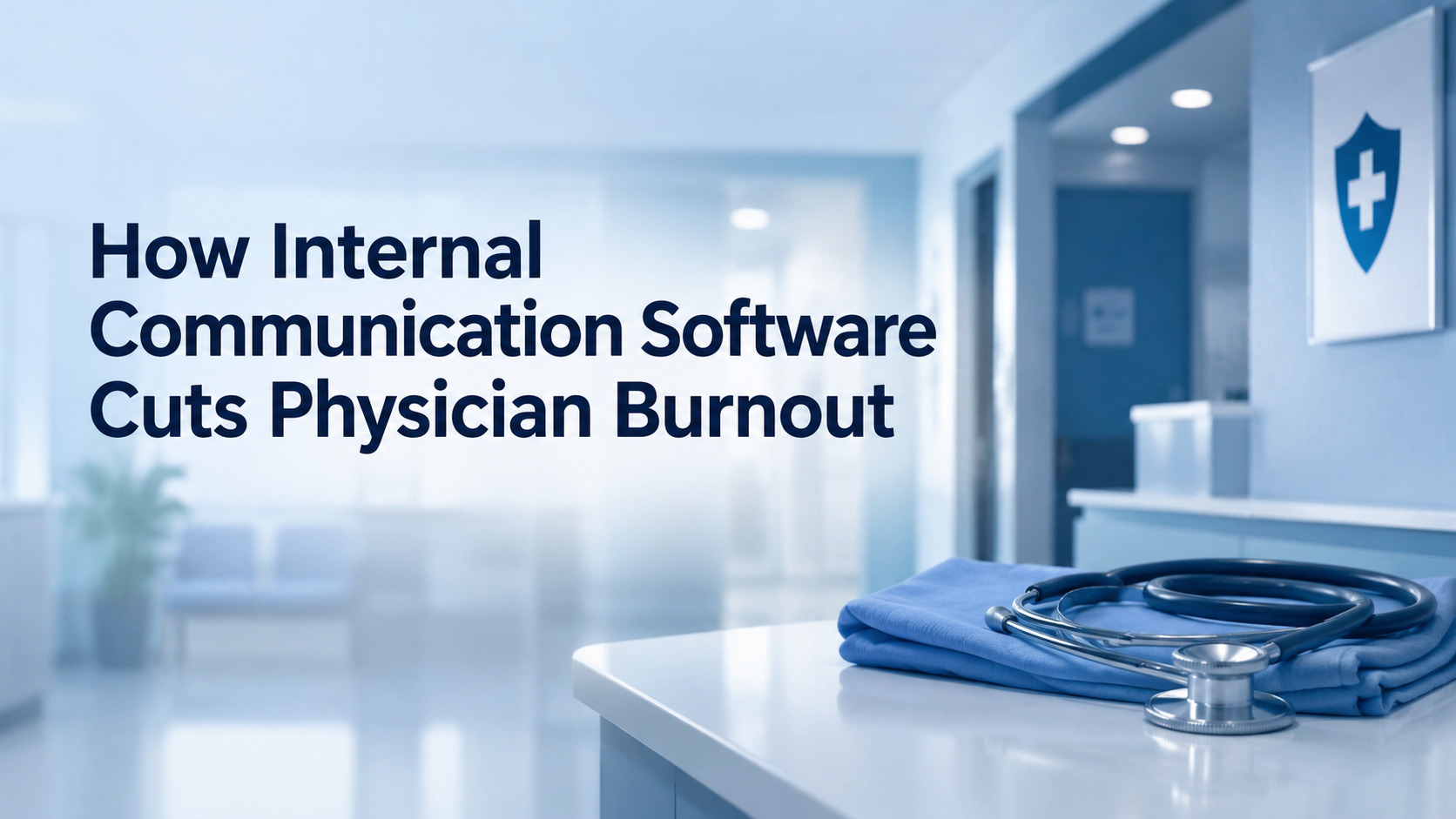
How Internal Communication Software Cuts Physician Burnout
Internal communication software is becoming an essential technology for reducing physician burnout and improving clinical workflows. By streamlining communication, handoffs, and team coordination, internal communication software helps physicians spend less time managing fragmented messages and more time focusing on patient care.
Physician burnout remains a significant concern, with bureaucratic workload, EHR demands, fragmented communication, and after-hours documentation contributing to daily strain. Secure messaging, structured handoffs, role-based routing, and EHR integration can reduce unnecessary interruptions and communication friction. When combined with modern documentation tools, internal communication software can help healthcare organizations build a more efficient, connected, and physician-friendly workflow.
How Internal Communication Software Cuts Physician Burnout
Physician burnout in the US fell to 41.9% in 2025, the lowest level since before the pandemic, according to the American Medical Association's National Physician Comparison Report. That is progress. It is also a warning: over four in ten physicians still report at least one burnout symptom, and specialties like emergency medicine, urological surgery, and hematology/oncology remain close to or above 49%.
The Medscape Physician Burnout and Depression Report uses a broader definition and puts the figure higher, at 62%. Its top two drivers of burnout, cited by 62% of physicians reporting it, are bureaucratic workload and EHR demands. Not staffing. Not compensation. Paperwork and fragmented communication.
The category of technology moving that number the fastest is internal communication software: secure clinical messaging, structured handoff tools, and role-aware collaboration platforms that replace the pager-plus-hallway model most hospitals still run on. Combined with modern documentation aids, these platforms are quietly reshaping how hospital teams actually work.
The Real Weight Behind the Burnout Numbers
Aggregate burnout rates hide a distribution problem. The AMA's 2025 data, drawn from nearly 19,000 physicians across 38 states and 106 health systems, shows hospital-based specialties performing below the overall benchmark on three of five well-being indicators. Intent to leave within two years sits at 31.1%.
The Physicians Foundation's 2025 Wellbeing Survey found that 57% of physicians experienced inappropriate feelings of anger, tearfulness, or anxiety in the past year, comparable to pandemic-era levels. Roughly 73% still see stigma around seeking mental health care.
The consequences are not abstract. Burnout correlates with higher rates of medical error, lower patient satisfaction, and turnover in a workforce already facing a projected shortage. Which brings the conversation back to the drivers sitting at the top of the list.
Where the Communication Load Actually Comes From
Two workflow patterns dominate the burnout data: fragmented team communication, and after-hours documentation. Both compound.
Communication runs on a second-shift model in most hospitals. A physician handling one clinical question often has to check five channels: pager, EHR chat, personal text, nursing station, and inbox. The Joint Commission's sentinel event data has consistently identified communication and teamwork failures as leading root causes of serious adverse events. Historical analysis attributed communication failures to over 70% of reviewed sentinel events, with later reviews putting the figure as high as 80% for serious errors involving communication lapses, particularly around handoffs, inter-shift reporting, and surgical timeouts. The Joint Commission's 2024 Sentinel Event Data annual review recorded 1,575 sentinel events, a 12% increase from 2023.
Documentation load runs on the same second shift. A 2021 CDC MMWR analysis found that 91.0% of office-based physicians spend time outside normal office hours documenting clinical care. About one in three spends more than two hours per day on that after-hours work. A JAMA Internal Medicine analysis of 2019 National Electronic Health Records Survey data put the average at 1.84 hours per physician per day on documentation outside scheduled work, adding up to a collective 125 million after-hours documentation hours per year across the US workforce.
That is the specific pain internal communication software now aims at, alongside the ambient documentation tools that address the writing side. Both sit inside a broader operational stack, and hospital leaders can learn more about hospital management software to see how the modules for scheduling, records, and clinical messaging fit together at the platform level.
What Internal Communication Software Actually Fixes
Modern secure messaging platforms designed for clinical use combine chat with clinical workflow features that pager systems and consumer messaging apps cannot match. A useful frame for what these platforms deliver:
- HIPAA-compliant end-to-end encryption for protected health information
- Role- and shift-based routing so the on-call person receives the message rather than the person off shift
- Structured handoff templates aligned with I-PASS or similar mnemonics
- Read receipts and escalation paths for urgent messages
- Integration with the EHR so patient context follows the conversation
- Group channels for care teams, on-call rotations, and unit-level coordination
- Audit logs for compliance and post-incident review
The evidence that structured clinical communication moves both safety and burnout metrics has been building for over a decade. The landmark I-PASS multicenter study, published in the New England Journal of Medicine in 2014 across nine pediatric academic hospitals, analyzed 10,740 patient admissions and reported a 23% reduction in medical errors (24.5 to 18.8 per 100 admissions) and a 30% drop in preventable adverse events (4.7 to 3.3 per 100 admissions) after implementation. A subsequent adult-hospital study reported a 47% reduction in adverse events. The mechanism is unglamorous. Structured tools close the information gaps that unstructured handoffs create.
Cognitive load is where day-to-day burnout accumulates. A physician who has to check five channels for one clinical question spends less time thinking about medicine and more time context-switching. Research on clinical cognitive load consistently links interruption density to error rates and fatigue. Consolidating clinical conversations into a single secure platform, with clear escalation and routing rules, reduces the churn that produces both.
The Documentation Side: How Voice Tools Complement Communication Software
Internal communication software addresses one half of the workflow problem. Documentation is the other. Ambient AI scribes and other voice-first tools have moved from novelty to standard consideration in the past two years, and the peer-reviewed results back up the interest.
- A JAMA Network Open quality improvement study of 263 clinicians across six US health systems found ambulatory burnout fell from 51.9% to 38.8% after 30 days with an ambient AI scribe.
- Mass General Brigham reported a 21.2% reduction in burnout prevalence after 84 days of ambient documentation use, published in JAMA in 2025.Emory Healthcare recorded a 30.7% increase in documentation-related well-being with the same category of tool.
- Emory Healthcare recorded a 30.7% increase in documentation-related well-being with the same category of tool.
- Cleveland Clinic reported an average 14-minute daily reduction in note-writing and review time.
- Intermountain Health saw a 27% reduction in time in notes per appointment among clinicians who used Microsoft's Dragon Copilot for ten or more encounters between April 2024 and December 2025.
Communication platforms do not solve documentation load, and documentation tools do not solve communication load. The combination is what moves the burnout curve. Hospitals that roll out one without the other tend to see partial gains that plateau.
What a Modernized Hospital Workflow Looks Like
The pattern that emerges in health systems seeing the strongest results is not a single tool. It is a stack. A useful frame for what belongs in it:
- Internal communication software as the primary channel for clinical conversations, handoffs, and on-call coordination
- Structured handoff and escalation workflows built into the messaging layer
- Ambient documentation tools to reduce note-writing time and after-hours EHR work
- EHR-integrated inbox management so message triage and clinical results live in one place
- A unified hospital operations platform that connects clinical, administrative, and communication workflows into a single operational view
For healthcare organizations evaluating that broader operational layer, the integration questions matter as much as the individual tool choices. Which vendor signs a Business Associate Agreement, which platform speaks HL7 and FHIR natively, and which one plugs into existing on-call rotations without a rebuild all determine whether the stack lifts burnout or adds to it.
Each layer solves a specific problem. Together they attack the two biggest documented sources of burnout at once: communication friction and documentation load.
The catch is that the layers only compound value when they integrate. A chat platform that lives outside the EHR forces context-switching. A voice scribe that dumps a note into a PDF the physician has to manually paste into Epic recreates the problem it was meant to solve. HL7 and FHIR-based integration is the connective tissue that determines whether the stack lifts burnout or adds to it.
Where Hospitals Get This Wrong
The technology is not the hardest part. Implementation is. Common failure patterns visible across published health system case studies:
- Deploying without workflow redesign. Handing physicians a new communication platform without changing on-call rotations, escalation rules, or handoff protocols typically produces modest gains at best. Adoption and workflow design matter as much as the software itself.
- Buying communication tools that do not integrate with the EHR. Adding a standalone chat app to a fragmented environment adds one more channel to check. The reduction in cognitive load only lands when clinical messaging shares context with the record.
- Underestimating compliance work. HIPAA obligations extend to any platform touching protected health information. Business Associate Agreements, encryption at rest and in transit, access controls, audit logs, and defined retention policies belong in the initial deployment, not a later remediation project.
- Consumer messaging as a shortcut. Some clinical teams default to WhatsApp or SMS for speed. Both create HIPAA and audit exposure, and both fail on structured handoff, role-based routing, and EHR integration.
- Skipping the documentation layer. Solving communication load without touching documentation load leaves the top-cited burnout driver in place. The gains from one are dampened by the friction of the other.
None of these failure modes are technical. They are governance and design problems that predict success or failure regardless of which vendor is on the contract.
The Practical Takeaway
Three points worth holding onto:
- Fragmented clinical communication drives both burnout and patient safety failures, and structured internal communication software is a proven lever for both, with peer-reviewed reductions of 23–30% in medical errors and preventable adverse events under structured handoff programs.
- Documentation load remains the top-cited burnout driver, and ambient voice tools have peer-reviewed evidence of reducing burnout prevalence by double digits when integrated properly.
- The results come from the combination and its integration into the broader hospital operations stack, not from any single tool.
The specific next step for most hospital leaders is not another pilot. It is a workflow audit that maps where physician time actually goes across a week, where handoffs and messages fragment across channels, and where the EHR is doing the most damage. The tools become useful once that map exists. Without it, even the best internal communication software and ambient documentation platforms become another line item in a budget that never quite fixes the thing it was supposed to fix.
Conclusion
Reducing physician burnout requires more than adding another technology tool. Hospitals need to address the workflow friction that consumes physicians’ time across communication, handoffs, and documentation. Internal communication software can reduce fragmented messaging and improve coordination, while ambient documentation tools can ease the burden of after-hours note writing. The greatest value comes when these technologies are integrated with the EHR and supported by thoughtful workflow redesign, compliance, and clear escalation processes. For healthcare leaders, the practical starting point is to understand where communication and documentation create the most friction and then build a connected technology stack around those needs.
Frequently Asked Questions
1. What features should hospitals look for in internal communication software?
Clinical environments have requirements that consumer chat apps cannot meet. The core feature set includes HIPAA-compliant encryption in transit and at rest, a signed Business Associate Agreement with the vendor, role- and shift-based message routing so on-call staff receive alerts rather than off-duty colleagues, structured handoff templates aligned with I-PASS or similar mnemonics, escalation paths for urgent messages, audit logs for compliance review, and integration with the EHR so patient context follows the conversation. Group channels for care teams and on-call rotations round out the essentials. Anything less recreates the fragmentation the software is meant to fix.
2. How does internal communication software integrate with an EHR or hospital management system?
Integration relies on the same interoperability standards that govern other clinical systems: HL7 for structured message exchange and FHIR for modern API-based data access. A messaging platform that supports both can pull patient context into a chat thread, write structured events back to the record, and share identity and permissions with the underlying EHR. Without that integration, clinical messages live in a silo and force manual copy-paste, which reintroduces the fragmentation the software is supposed to solve. Vendor evaluations should confirm HL7 and FHIR support before contract signature, not after.
3. Is internal communication software automatically HIPAA-compliant?
Not automatically. HIPAA compliance depends on the vendor's Business Associate Agreement, encryption in transit and at rest, access controls, audit logging, and defined data retention policies. Storing messages containing protected health information on a personal or consumer messaging app almost never meets those requirements. Health systems should confirm the vendor signs a BAA, review where message data is stored and for how long, and set clear internal policies on what content can move through the platform. HIPAA-compliant infrastructure and disciplined internal governance are two separate requirements, and both need to be in place.
4. Can smaller clinics benefit from internal communication software, or is this only viable for large hospital systems?
Yes, and in some ways the return arrives faster. Cloud-based deployment has removed most of the on-premise infrastructure cost that historically favored large systems, and pricing has shifted toward per-user subscriptions. A smaller practice with limited administrative staff often feels the reduction in message fragmentation and on-call coordination overhead more acutely than a large hospital with dedicated coordinators. The barriers that remain are workflow design, staff training, and EHR integration, which are governance questions rather than budget ones. Independent practices that address those factors report per-clinician gains comparable to academic medical centers.
5. How does internal communication software fit alongside voice-first documentation tools?
They address different failure modes. Internal communication software targets fragmentation across pagers, personal texts, EHR messages, and hallway conversations, which is where cognitive load and handoff errors accumulate. Ambient voice tools cut documentation time and after-hours EHR work, which is the top-cited burnout driver. The Joint Commission has consistently linked communication failures to a large share of sentinel events, and JAMA studies have documented double-digit burnout reductions with ambient scribes. Deploying one without the other leaves half the workflow problem unsolved. The combination compounds value only when both integrate with the EHR.