Connect with us
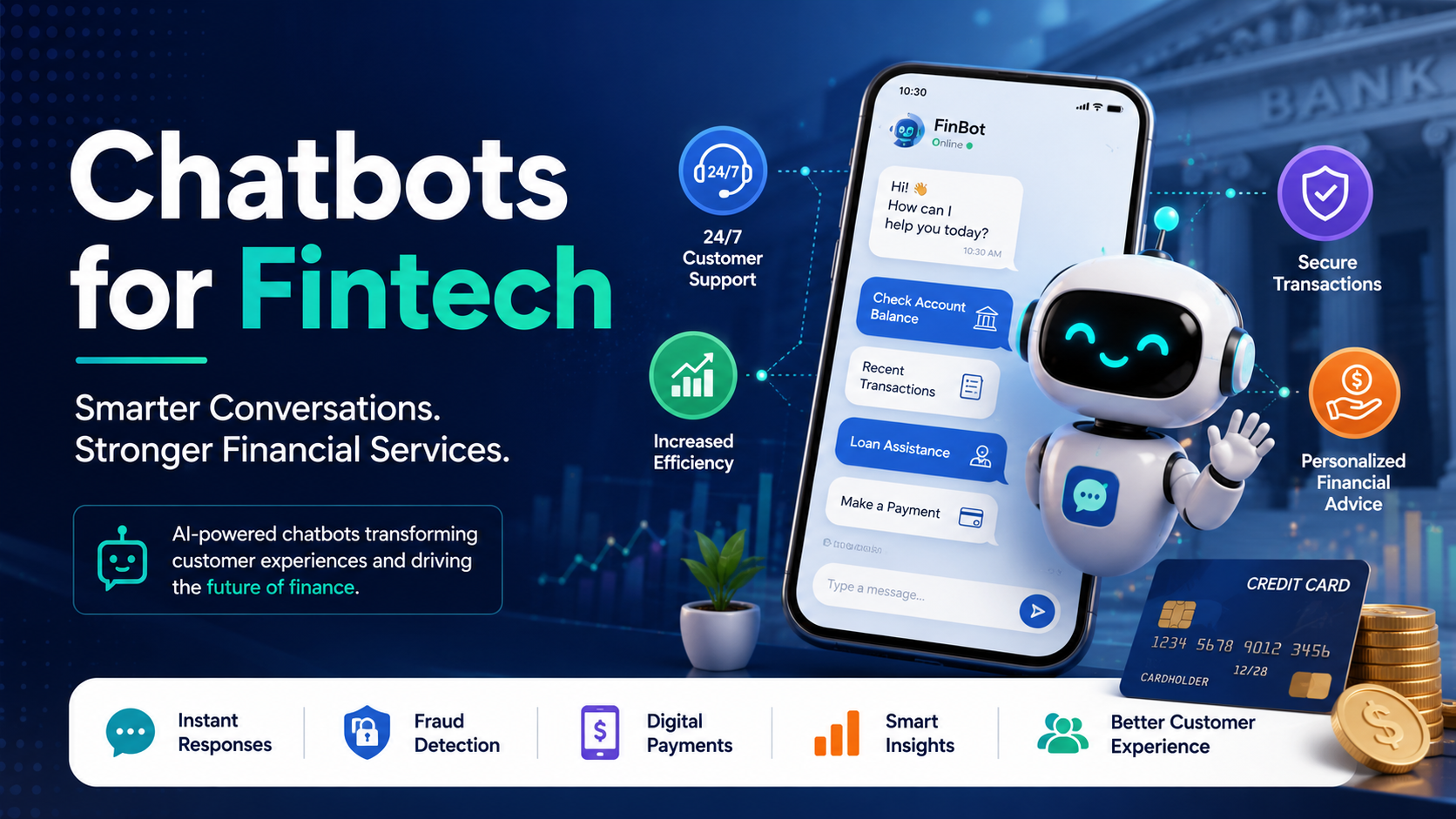
What is The Importance of Chatbots in Handling Finance
Fintech chatbots are AI-powered virtual assistants that help financial institutions automate customer support, process transactions, detect fraud, and provide personalized financial services. From answering account-related queries to assisting with loan applications and digital payments, chatbots improve customer experiences while reducing operational costs. This guide explores how chatbots are transforming the fintech industry, their key use cases, and the benefits they offer to financial organizations and customers.
What is a chatbot and how important it is in various industries?
A chatbot is an artificially intelligent (AI) computer software program that simulates online chat or text-to-speech utilizing different languages through a website, messaging applications, or a phone. It is sometimes referred to as digital assistance. The chatbot interprets the user's request and offers a speedy resolution. Businesses also rely on secure business communication software to enable customer support teams and internal departments to collaborate efficiently while delivering better customer experiences.
Financial institutions with strict security requirements often prefer on-premise communication solutions to maintain greater control over sensitive customer data and internal communications.
Deep learning-based AI is being created by developing finance technologies to help a large number of consumers simultaneously without compromising service quality. From allowing secure, quick money transfers through mobile and online banking to single-task scheduling with a chatbot for things like paying bills, settling client invoices, purchasing bitcoins, etc.
Chatbots have evolved into a clever solution for the important banking and financial sector. They have done away with the long queues at their locations, saving consumers time and energy and enabling them to complete work from any location without risking their safety.
Botsify chatbots are designed specifically for a range of industries, including retail, e-commerce, insurance, finance, telecom, travel, and hospitality.
Banking chatbots that help customers with various financial queries, including quick account balance checks, mini statements of the last five transactions, credit scores, application statuses, loan assistance, loan payment calculators, virtually uploading documents, assisting with account opening, and much more.
Chatbots for fintech are changing how different businesses use digital marketing as a result of growing financial technologies. According to recent surveys, 85% of customers would rather talk to a chatbot than visit a website, skim through the pages, or enter their questions into the search box.
It is physically impossible for fintech companies to manage multiple complicated databases simultaneously, let alone maintain some of their client's personal information. Chatbots for fintech make things simpler by doing everything without error, saving time compared to hiring more humans and training them, and coming with no credit check loans. The business can access the data on the system at any time and is not dependent on its employees.
Use-cases of Chatbots in the Fintech Industry
Worldwide, 67% of clients use chatbots for customer service, according to Business Insider research. In the fintech industry, providing excellent customer service is seen as the key element of any successful operation. Therefore, chatbots assist businesses in having high standards for customer care, automating their while reducing customer service expenses by hiring more people.
Let's investigate how the newest innovations in the fintech sector adapt the strategy and advantages of AI chatbots for the sector and its users.
1. 24/7 Support
To dramatically enhance customer support, the 24/7 service can be combined with a hotline number, website, rapid text message assistance, mobile applications, and social media channels.
This service is crucial for remaining connected, providing a high degree of professionalism, and helping clients with challenging processes like disabling debit/credit cards in the event of theft, account balance summaries, pin generation, etc.
2. Financial Advice
Getting financial advice online is an interesting paradox of the real-time digital fintech era. The clever AI-powered chatbots examine a user's purchasing patterns and transaction history to forecast and suggest future activities.
They can invest money for the future, for instance, if the fintech chatbot finds a strong transaction history. Additionally, it helps with money management if it notices unwise spending patterns.
3. Digital Payments
Peer-to-peer payments made digitally through chatbot fintech enable users to complete a variety of money-transfer operations. Customers' bank accounts, PayPal, Apple Pay, Stripe, and other digital apps like Paytm, Amazon Payment, etc. have been linked by the automation in chatbots for fintech to help them with bill payment, money transfers, online shopping, etc.
4. Advertisement
Chatbots, a new fintech innovation, promote the industry's expansion online on popular social media sites including Facebook, Google, Twitter, YouTube, and Quora. The AI-powered chatbots in finance monitor the millions of social media users to target the audience.
5. Investments
Notably, chatbots for fintech may help consumers with digital payments, and personal financial advice, and help them develop their money in many ways. AI-powered digital chatbots for the finance industry assist users with clever saving strategies, online portfolio creation, and portfolio management.
6. Insurance & Loans
Automation in the fintech industry is offering insurance and loans with ease and the comfort of home. Chatbots are designed to provide interactive insurance and loan product solutions to more people.
In a similar way, platforms like Achieve use digital-first financial solutions to help consumers explore options such as debt relief, personal loans, and debt consolidation through a guided, user-friendly experience. By combining technology with financial expertise, such platforms make it easier for users to understand their options and take informed steps toward financial stability
A customer needs to answer some simple and specific questions. A chatbot can then automatically respond to the queries, offering them customized and cost-effective services and assisting the customer in uploading the proper documentation to avail of the services.
AI Chatbots in Fintech: Key Statistics
Artificial intelligence continues to reshape financial services worldwide. According to Juniper Research , AI chatbots are expected to save banks billions of dollars annually by reducing customer service costs and improving operational efficiency. Additionally, IBM reports that AI-powered virtual assistants can resolve common customer queries significantly faster than traditional support channels, enabling financial institutions to provide faster and more personalized services. As customer expectations for instant digital support continue to grow, fintech companies are increasingly investing in conversational AI to improve customer engagement, automate routine banking tasks, and enhance overall service quality.
How Chatbots Can Revolutionize the Fintech Sector?
Let's see how digital fintech gives clients the chance to use the services conveniently.
1. Removes The Friction of the Cluttered Interface
If they find the software's intricacy, 38% of users leave the websites or apps within five seconds. Fintech chatbots with AI integration assist in removing technical obstacles and reducing friction. The built-in chatbots can recognize human behavior and comprehend their wants.
2. Makes Proactive Recommendations
The chatbot helps consumers by assisting them by delivering offers and proactive ideas based on the information they provide, so they don't have to keep looking for the services or products they need.
3. Keeping Up With Millennials
Chatbots for fintech are made to keep up with millennials. The need for immediate assistance has increased significantly as a result of recent technology developments, and millennials are increasingly communicating online. The accessibility and practicality of chatbots immediately aid them and make life simpler for millennials.
4. Automates Fraud Detection
Because they are so crucial to any company's reputation, data security and privacy are their top priorities. Digital fintech chatbots are effectively monitored and raise a red signal when they notice any fraudulent activity that could affect the consumer or the bank.
5. Easy Marketing of Services
Fintech chatbot automation aids in audience diversification and product and service promotion for the business. assisting the customer in making a straight chat purchase of the merchandise. Using chatbots for advertising a brand across various social media platforms such as Facebook, Twitter, Instagram, YouTube, and more can boost product sales and generate money through these platforms.
6. Enhances Customer Loyalty
Fintech chatbots are created to offer users a more proactive level of engagement. Additionally, it draws more people who like to look at goods or services without speaking to anyone. Chatbot data helps businesses better understand customer needs so they can offer them the services and goods they require. It naturally increases client loyalty to the businesses.
7. Reduces Cost
Fintech chatbots are less expensive than hiring additional agents and a one-time cost that transformed into an investment. The chatbot's capacity to provide the answer in only a few seconds not only makes the system cost-effective but also saves time.
8. One-Stop Solution
Users adore interacting with chatbots because they can easily ask for what they need in their tongues. By reducing wait times and streamlining site navigation, emerging fintech technologies provide chatbots for one-stop solutions and tailor each user's experience.
9. Increases Revenue
AI-powered fintech chatbots aid in increasing corporate revenue. The way chatbots function is similar to how email marketing does. The sales funnel designed for chatbots is interactive and stimulates the user's dialogue to help them choose the appropriate services and goods they require.
More customers are attracted by personalized shopping, a streamlined purchasing procedure, and secured payment options.
The Future of AI Chatbots in Fintech
Fintech's potential will revolutionize the financial industries by offering customers better and fresher services and goods. The future of the finance business is constantly shifting because of fintech. AI modifies how businesses communicate with their customers.
The financial sector is one of the industries that has been using complicated systems for years and is under pressure to adapt to meet the needs of tech-savvy customers.
The hottest service to help numerous people in less time is regarded to be the spread of automation in fintech with chatbots powered by AI. Artificial intelligence (AI), cloud computing, and analytics are continuing to develop and change while focusing on people with various requirements and behaviours to provide unparalleled access to consumer information.
Conclusion
AI-powered fintech chatbots are transforming how financial institutions interact with customers by delivering faster support, personalized financial assistance, and secure digital experiences. From automating routine banking services to improving fraud detection and customer engagement, chatbots help organizations enhance operational efficiency while reducing costs. As artificial intelligence continues to evolve, fintech companies that invest in intelligent automation and secure communication technologies will be better positioned to meet growing customer expectations and remain competitive in the rapidly changing financial landscape.
FAQs
1. What are fintech chatbots?
Fintech chatbots are AI-powered virtual assistants designed to help banks, financial institutions, insurance providers, and fintech companies automate customer interactions. They can answer frequently asked questions, assist with account management, process payments, provide financial guidance, and support loan or insurance applications. By offering instant responses and personalized assistance, fintech chatbots improve customer experience while reducing operational costs.
2. How do AI chatbots improve customer service in banking?
AI chatbots improve banking customer service by providing 24/7 support, answering routine queries instantly, reducing waiting times, and assisting customers with services such as account balance checks, fund transfers, loan information, and payment reminders. They also enable banks to handle a higher volume of customer requests while maintaining consistent service quality and allowing human agents to focus on more complex issues.
3. Are fintech chatbots secure?
Modern fintech chatbots use advanced encryption, authentication mechanisms, and secure APIs to protect customer information during conversations and financial transactions. When integrated with secure banking systems, they help maintain data privacy while complying with industry regulations. Financial institutions also implement fraud detection and continuous monitoring to ensure chatbot interactions remain safe and trustworthy.
4. Can chatbots help reduce operational costs for financial institutions?
Yes. Chatbots automate repetitive customer service tasks, reducing the need for large support teams while improving response times. They can handle thousands of customer conversations simultaneously, minimizing operational expenses and increasing efficiency. By allowing human agents to focus on high-value interactions, fintech organizations can improve productivity, lower service costs, and deliver better customer experiences.