Connect with us
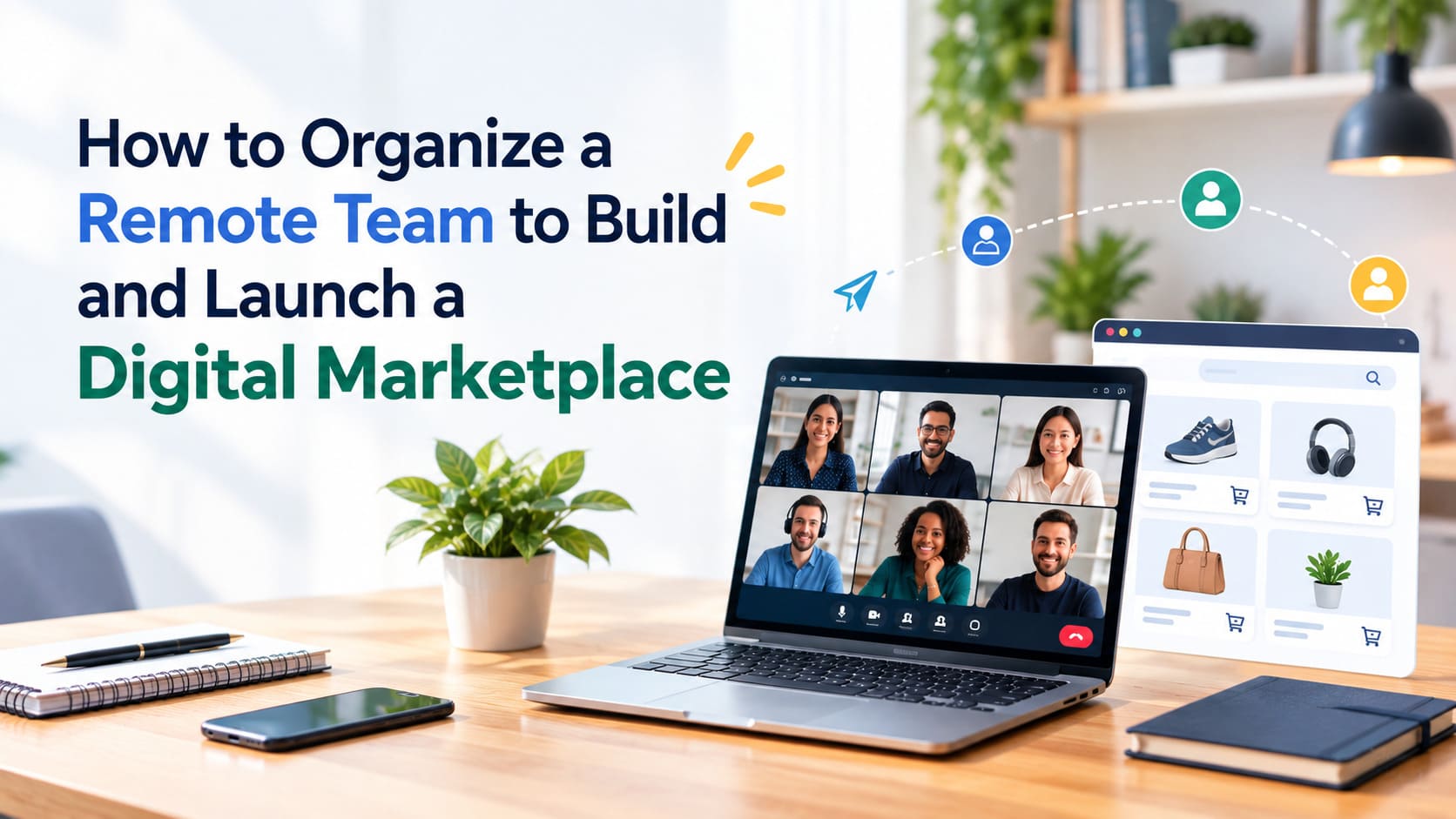
How to Organize a Remote Team to Build and Launch a Digital Marketplace
Building a digital marketplace is one of the most technically and organisationally complex projects a startup or product team can take on. Unlike a standard web application, a marketplace involves at least two user sides buyers and sellers each with distinct workflows, permissions, and expectations. Add a remote team into the mix, and the coordination challenge grows significantly.
The good news is that remote teams build successful marketplaces every day. The difference between those that ship on time and those that drag on indefinitely almost always comes down to two things: who is doing the work, and how the team is coordinating around it. This guide covers both from choosing the right development partner to keeping the team aligned well after launch day.
Start With the Right Development Partner
Before you think about team structure, communication tools, or sprint schedules, you need to make a foundational decision: are you building the marketplace with an in-house team, an outsourced development partner, or a hybrid of both?

For most early-stage marketplace founders, a fully in-house remote team is not realistic. Hiring senior engineers, a product designer, a QA specialist, and a DevOps engineer simultaneously is expensive and slow. The time it takes to hire, onboard, and align a distributed team from scratch can push your launch back by months and every month of delay is a month your competitors use to capture market share.
A more practical approach for many teams is to work with experienced marketplace development companies that have already built comparable products. These teams bring pre-existing knowledge of marketplace architecture payment escrow logic, dual-sided onboarding flows, seller verification, and review systems that would take an assembled team months to learn through trial and error. They also understand the technical pitfalls that commonly derail marketplace builds, such as race conditions in booking systems, edge cases in multi-currency payment splits, and the complexity of real-time inventory synchronisation across sellers.
This does not mean you hand off the entire project and disappear. The most successful outcomes happen when the founding team maintains active product ownership while an external development team handles execution. That requires clear communication structures, defined decision-making authority, and the right tools all of which we cover below.
Define Roles Before the First Sprint
One of the most common reasons remote marketplace projects stall is ambiguous ownership. When everyone is distributed and no one is physically in the same room, unclear roles create delays that compound week over week. A question that would be resolved in thirty seconds at a shared desk can take a full day to answer when no one knows whose responsibility it is.
Before development begins, define and document the following:
Product Owner. This person is accountable for the product backlog, priority decisions, and acceptance criteria for each feature. They are the primary point of contact between the business and the development team. Without a clear Product Owner, developers either wait for decisions or make product decisions themselves neither outcome is good.
Technical Lead. Whether this is someone on your side or embedded within your development partner's team, one person needs to own architectural decisions. This includes the tech stack, integration approach, database design, and API structure. Technical decisions made inconsistently across a remote team are expensive to undo. In a marketplace context, where the buyer-side frontend, seller dashboard, admin panel, and payment layer all need to communicate reliably, architectural coherence is especially critical.
Project or Delivery Manager. This role tracks sprint progress, manages the backlog, coordinates dependencies, and escalates blockers. In a remote setting, this person is the organisational glue that keeps parallel workstreams from drifting apart. They also serve as the early warning system identifying scope creep, resource conflicts, and timeline risks before they become full-blown problems.
QA and Testing. Marketplace platforms have a large surface area for bugs payment flows, permission logic, search functionality, and notification systems all need dedicated testing. Assign QA ownership explicitly, not as a secondary responsibility for developers. A marketplace where a buyer can accidentally access seller-only admin tools, or where a payment flow silently fails on a specific mobile browser, will lose user trust faster than almost any other type of product.
Build Your Communication Infrastructure
Remote teams do not fail because of distance. They fail because of communication breakdowns missed context, decisions made in private channels, updates that never reach the right person, and async gaps that turn a one-hour problem into a three-day delay.
Getting your communication infrastructure right before the project starts is not administrative overhead it is a core part of project execution.

Separate channels by function. Create dedicated spaces for development discussions, design feedback, product decisions, and general team updates. When everything lives in one channel, critical information gets buried. Structured channels mean that a developer looking for the latest design spec can find it without reading through fifty unrelated messages. For a marketplace project, consider adding a dedicated channel for payment and billing discussions, since these threads tend to be highly technical and time-sensitive.
Use a messaging platform that supports the complexity of remote collaboration. For marketplace projects which typically involve multiple workstreams running in parallel you need a platform that supports group channels, direct messaging, file sharing, and searchable message history in one place. Troop Messenger handles all of this while also offering features like Forkout (broadcast messages to multiple users simultaneously) and Burnout (self-destructing messages for sensitive discussions) that are particularly useful when coordinating across time zones with varying security requirements. The ability to quickly broadcast a deployment notification or a critical bug alert to the entire team at once, regardless of which channel they are monitoring, prevents the kind of information gaps that lead to duplicated effort or missed deadlines.
Establish async and sync norms explicitly. Decide upfront which types of decisions require a live call and which can be handled asynchronously. A general rule: anything that would take more than three async messages to resolve is better handled in a fifteen-minute call. Document the outcome of every call with a written summary posted to the relevant channel. This is not optional in a remote team, any decision that exists only in someone's memory is a decision that half the team does not know was made.
Structure the Development Workflow
Marketplace development benefits from Agile methodology specifically two-week sprints with defined sprint goals, daily standups, and end-of-sprint reviews.
For remote teams, the daily standup format needs adjustment. A synchronous fifteen-minute call works well when the team shares overlapping hours. When time zones diverge significantly, an async standup a brief written update posted to a dedicated channel at the start of each person's working day preserves the rhythm without forcing inconvenient call times. Each update should cover three points: what was completed yesterday, what is planned for today, and whether anything is blocked.
Each sprint should have a clearly articulated goal, not just a list of tickets. "Complete the seller onboarding flow including document verification and approval notification" is a sprint goal. "Work on seller stuff" is not. Clear goals help remote teams self-organise around what matters most, even when the Product Owner is not available in real time.
Maintain a single source of truth for the product backlog. Whether you use Jira, Linear, or another project management tool, the backlog should always reflect the current state of what is built, what is in progress, and what is coming next. In a remote environment, undocumented decisions about scope and priority are invisible to most of the team and create confusion that is disproportionately expensive to resolve.
Manage the Unique Complexity of Marketplace Features
Standard web applications have one user type and one primary workflow. Marketplaces have at least two and often three if you count the admin or operations layer. This multiplied complexity affects every part of remote team coordination.
Payment systems require particular attention. Most marketplaces involve split payments, escrow, refund logic, and sometimes multi-currency support. These features touch legal, financial, and technical considerations simultaneously. Assign a single owner for the payment integration workstream, and ensure that every decision from choosing a payment provider to defining refund policies is documented where the full team can access it.
User trust and safety features identity verification, review moderation, dispute resolution are often deprioritised during initial development but become urgent the moment real users are on the platform. Build these into the sprint plan early, even if they ship as simplified versions at launch. A remote team that treats trust and safety as a post-launch afterthought will spend its first weeks firefighting instead of iterating on growth.
Coordinate Your Launch Sequence
Marketplace launches involve moving parts that span product, marketing, operations, and technical infrastructure. In a remote team, the risk is that each function prepares in isolation and assumes the others are on track.
Build a shared launch checklist accessible to everyone, with clear ownership for each item and a status that updates in real time. This checklist should cover: final QA sign-off on all critical user flows, load testing results, payment provider approval, seller onboarding completion targets, customer support readiness, and marketing campaign timing.
Run a coordinated pre-launch rehearsal a structured walkthrough of the complete buyer and seller journey on a staging environment, with every team member present. Issues caught here are fixed in hours. Issues caught after launch are fixed in public.
Agree on a launch-day communication protocol before the day arrives. Who monitors the error dashboard? Who handles incoming support requests? Who makes the call to roll back if a critical issue surfaces? In a remote team, these decisions need to be documented in advance not debated in a group chat while users are experiencing problems.
Keep the Team Aligned Post-Launch
The period immediately after launch is when remote teams are most at risk of losing cohesion. The intensity that kept everyone aligned during development dissipates, and without a deliberate structure to replace it, communication drifts.
Schedule a weekly product review meeting in the weeks following launch, focused on user data, bug prioritisation, and the next development cycle. Keep the communication channels active and structured. Celebrate milestones visibly in a remote team, recognition that happens in a private message is recognition that most of the team never sees.
Establish a clear feedback loop between customer support and the development team. In a marketplace, user-reported issues often reveal edge cases that internal testing missed a seller in a specific country encountering a tax calculation error, or a buyer whose payment method is not supported in a particular flow. Route these reports into the backlog with enough context for developers to reproduce and fix them efficiently.
Post-launch, the marketplace is not finished it has entered its most important phase. The founding team's ability to keep the remote team focused, communicating clearly, and iterating quickly is what determines whether the platform grows or stagnates.
Conclusion
Building and launching a digital marketplace with a remote team requires more than strong development skills. Clear ownership, structured communication, well-defined workflows, and careful coordination across product, technology, QA, operations, and marketing are essential for keeping the project on track. From selecting the right development partner and defining responsibilities to managing payments, trust features, testing, and launch activities, every stage benefits from documented processes. After launch, regular product reviews and a strong feedback loop help the team respond to real user needs. With the right structure, a remote team can build, launch, and continuously improve a successful marketplace.
Frequently Asked Questions
1. How do you organize a remote team for digital marketplace development?
Start by clearly defining the team's roles, responsibilities, and decision-making authority. A typical marketplace team should include a Product Owner, Technical Lead, Project or Delivery Manager, developers, designers, and dedicated QA support. Establish communication channels for different functions and maintain a single source of truth for the product backlog. Two-week Agile sprints, clear sprint goals, and regular progress updates can help keep distributed team members aligned. It is also important to document product and technical decisions so team members working across different time zones have access to the same information.
2. What roles are essential for building a digital marketplace remotely?
A remote marketplace development team needs clear ownership across product, technology, delivery, and quality assurance. The Product Owner manages priorities, the backlog, and acceptance criteria, while the Technical Lead oversees architecture, integrations, databases, and APIs. A Project or Delivery Manager coordinates schedules, dependencies, blockers, and resources. QA specialists should have explicit responsibility for testing payment flows, permissions, search, notifications, and other critical features. Depending on the marketplace, additional specialists such as UI/UX designers, DevOps engineers, and payment integration experts may also be required.
3. How can remote teams communicate effectively during marketplace development?
Effective communication starts with creating dedicated channels for development, design, product decisions, general updates, and sensitive areas such as payments. Teams should also establish clear rules for synchronous and asynchronous communication. Routine updates can be handled through async messages, while complex discussions that require multiple back-and-forth messages can move to a short video call. Every important meeting or decision should be documented afterward so that team members across different time zones have the same context. Using a searchable collaboration platform also makes it easier to find previous discussions, files, and decisions.
4. What development workflow works well for a remote marketplace team?
An Agile workflow based on two-week sprints can provide a structured development rhythm for remote marketplace teams. Each sprint should have a specific, measurable goal rather than simply a collection of unrelated tasks. Teams can use daily synchronous standups when working hours overlap or asynchronous written updates when members are spread across different time zones. The product backlog should remain the single source of truth for current priorities, completed work, and upcoming features. Regular sprint reviews also give stakeholders an opportunity to evaluate progress and make informed product decisions.
5. How should a remote team prepare for a digital marketplace launch?
A remote marketplace team should prepare a shared launch checklist with clearly assigned owners and real-time status updates. The checklist should cover critical QA sign-off, load testing, payment provider approval, seller onboarding, customer support readiness, and marketing coordination. Before launch, conduct a complete rehearsal of the buyer and seller journeys in a staging environment to identify issues before real users encounter them. The team should also define a launch-day communication protocol covering monitoring responsibilities, support escalation, and rollback decisions. After launch, weekly product reviews and customer feedback should guide bug fixes and future development.