Connect with us
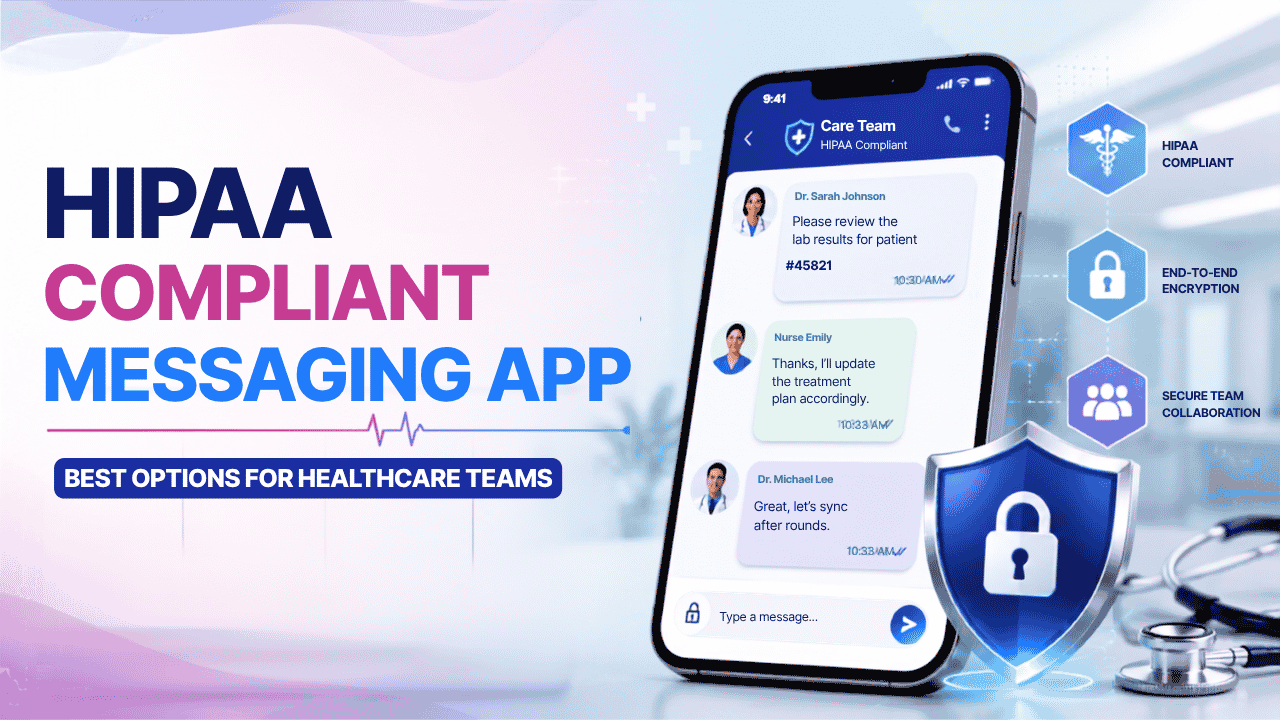
HIPAA Compliant Messaging App — Best Options for Healthcare Teams
A HIPAA compliant messaging app is a secure communication platform that encrypts Protected Health Information (PHI), enforces access controls, maintains audit logs, and supports HIPAA compliance through a Business Associate Agreement (BAA). Unlike consumer messaging apps such as WhatsApp, iMessage, or SMS, HIPAA compliant platforms are designed to protect patient data and reduce compliance risks.
In this guide, you'll learn what makes a messaging app HIPAA compliant, compare the best free and paid options, and discover how to choose the right solution for your healthcare organization.
What Is a HIPAA Compliant Messaging App?
A HIPAA compliant messaging app is a mobile or desktop communication platform specifically designed and configured to handle Protected Health Information in accordance with the HIPAA Security Rule and Privacy Rule. It differs from standard messaging apps in four fundamental ways:
Encryption architecture — HIPAA compliant apps encrypt messages using AES-256 or equivalent standards at rest and TLS 1.2 or higher in transit. This ensures PHI is unreadable to unauthorized parties even if the transmission is intercepted or the device is compromised.
Access controls — unique user authentication, role-based permissions, and automatic session timeout prevent unauthorized access to PHI. Users can only access patient information relevant to their clinical role.
Audit logging — every message sent, received, forwarded, and deleted is logged with timestamp, user identity, device, and recipient. These logs are retained and available for HIPAA compliance review and breach investigation.
Business Associate Agreement — the platform vendor signs a BAA with the healthcare organization, accepting legal responsibility for HIPAA compliance in their handling of PHI.Without a signed BAA, no messaging app is HIPAA compliant regardless of its technical security features — organizations requiring complete PHI control choose on-premise deployment to eliminate vendor-side exposure entirely.
Why Healthcare Teams Need a HIPAA Compliant Messaging App
The clinical case for HIPAA compliant messaging is inseparable from the compliance case. Healthcare teams communicate constantly about patients, medications, procedures, and care coordination and that communication happens on whatever tool is fastest and most convenient. Without a sanctioned HIPAA compliant option, clinical staff default to standard SMS, WhatsApp, or personal email creating compliance violations and security risks with every message.
According to HIPAA Journal, the majority of healthcare workers already use personal messaging apps for clinical communication in the absence of a secure sanctioned alternative, creating compliance exposure that a properly implemented HIPAA compliant messaging app eliminates.
Beyond compliance, HIPAA compliant messaging apps improve clinical outcomes. Faster, more reliable communication between care team members reduces medication errors, speeds clinical escalation, and improves care coordination across departments and shift changes.
What Makes a Messaging App HIPAA Compliant
Not every app marketed as HIPAA compliant actually satisfies the full scope of HIPAA requirements. Genuine HIPAA compliance requires all of the following:
End-to-end encryption — PHI must be encrypted from the sender's device to the recipient's device with no ability for the vendor to access message content in transit.
Unique user identification — every user must have a unique login credential. Shared accounts or group logins are not HIPAA compliant because they prevent individual accountability in audit logs.
Automatic logoff — sessions must automatically terminate after a defined period of inactivity. A device left unattended must not provide persistent access to PHI.
Audit controls —The platform must generate and retain logs of all PHI access, message transmission, and system events. Logs must be tamper-evident and available for regulatory review, complemented by data loss prevention tools that monitor PHI movement across the broader IT environment.
Remote wipe — in the event of device loss or theft, the organization must be able to remotely delete PHI from the device. This requires either MDM integration or native remote wipe capability in the messaging app.
Business Associate Agreement — the vendor must be willing to sign a BAA. According to HHS BAA requirements, any business associate that creates, receives, maintains, or transmits PHI on behalf of a covered entity must sign a BAA before accessing that data.
Data backup and recovery — PHI must be backed up in a manner that allows recovery in the event of system failure, with backup data subject to the same encryption and access controls as primary data.
Business Associate Agreement — What It Is and Why It Matters
The Business Associate Agreement is the single most important compliance document in any HIPAA compliant messaging deployment and the most commonly overlooked.
A BAA is a legally binding contract between a covered entity (the healthcare organization) and a business associate (the messaging app vendor) that establishes the vendor's responsibilities for protecting PHI. The HHS official HIPAA guidelines require a BAA before any business associate can handle PHI.
What a BAA must cover: is defined in detail by the HHS BAA requirements including permitted PHI uses, vendor safeguard obligations, breach reporting, and subcontractor compliance requirements.
- The permitted uses and disclosures of PHI by the vendor
- The vendor's obligation to implement appropriate safeguards for PHI
- The vendor's obligation to report any breaches or security incidents
- The vendor's obligation to return or destroy PHI upon contract termination
- The vendor's obligation to ensure any subcontractors they engage also comply with HIPAA
Why it matters for messaging app selection:
A messaging app without a BAA is not HIPAA compliant period. No amount of encryption, access controls, or security features compensates for the absence of a signed BAA. Before signing any messaging app agreement, healthcare organizations must confirm the vendor will sign a BAA and review the BAA terms to ensure they cover the full scope of PHI the platform will handle.
Vendors that decline to sign a BAA are signaling that they are not prepared to accept HIPAA liability for the PHI their platform processes, which means their platform cannot be used for PHI communication regardless of their marketing claims.
Best HIPAA Compliant Text Messaging App for Healthcare
TigerConnect — one of the most widely deployed clinical secure messaging platforms. Offers role-based messaging, on-call scheduling, read receipts, and EHR integrations with Epic, Cerner, and others. BAA available. Strong for mid-to-large hospital systems that need clinical workflow integration alongside secure messaging.
Halo Health — clinical communication platform with strong care team coordination features including patient-context group messaging, escalation workflows, and on-call management. BAA available. Best for complex care coordination environments.
Troop Messenger — for healthcare organizations requiring on-premise deployment where PHI must never leave the organization's own infrastructure, Troop Messenger provides encrypted group messaging, direct messaging, voice and video calling, and secure file sharing deployable entirely within the organization's own servers. Unlike cloud-only platforms, Troop Messenger supports air-gapped deployment for government healthcare facilities and defence medical organizations with strict network isolation requirements. BAA arrangements available for on-premise deployments.
Imprivata Cortext — enterprise clinical messaging with strong identity management integration. Best for large health systems already using Imprivata's SSO and authentication infrastructure. BAA available.
Spok — long-established clinical communication platform with strong paging system integration. Best for health systems that need to bridge legacy paging infrastructure with modern secure messaging. BAA available.
Best HIPAA Compliant Messaging App for Therapists
Therapists and mental health providers have distinct HIPAA messaging requirements — the American Medical Association provides communication guidelines that inform how clinical messaging platforms should be evaluated for mental health and specialty practice settings.
Key requirements for therapist HIPAA messaging:
- Patient portal messaging — secure two-way messaging with patients that does not require patients to download an app or create complex accounts
- Consent documentation — the ability to document patient consent for electronic communication within the platform
- Session scheduling integration — appointment reminders and confirmations integrated with practice management systems
- Minimal friction for patients — patients should be able to respond to messages without technical barriers that reduce engagement
Best options for therapists and mental health providers:
Klara — strong patient-facing secure messaging designed for outpatient and specialty practices. Excellent for therapy practices needing secure patient communication without complex setup. BAA available.
SimplePractice — practice management platform with integrated HIPAA compliant messaging designed specifically for mental health and allied health providers. BAA available.
TheraNest — mental health practice management with integrated secure messaging. BAA available. Strong for solo practitioners and small group practices.
Spruce Health — HIPAA compliant communication platform covering secure messaging, voice, and video for healthcare providers. Strong patient communication focus with BAA available.
HIPAA Compliant Messaging App Free — Best Zero Cost Options
Several platforms offer free tiers that provide basic HIPAA compliant messaging without subscription costs, though free tiers typically carry limitations on user count, message history, storage, or advanced features.
Troop Messenger — offers a free tier for small teams that includes group messaging and file sharing. For healthcare teams requiring on-premise deployment on the free tier, contact Troop Messenger directly for deployment options.
Signal — while Signal provides strong end-to-end encryption, it does not offer a BAA, does not provide HIPAA-compliant audit logging, and has no enterprise administration controls. Signal is not HIPAA compliant for PHI use regardless of its encryption strength.
Rocket.Chat — open-source self-hosted messaging platform with a free community edition. Can be configured for HIPAA compliance when self-hosted with appropriate encryption and audit controls, but requires technical resources to deploy and maintain. BAA available through the enterprise edition.
Important note on free HIPAA compliant messaging apps:
Free tiers of HIPAA compliant platforms almost always require the BAA to be part of a paid plan. Healthcare organizations should verify BAA availability before committing to any free tier for PHI communication, using a free plan without a BAA is not HIPAA compliant.
HIPAA Compliant Cloud Messaging App — How Cloud Hosting Affects Compliance
Cloud-hosted HIPAA compliant messaging apps process and store PHI on vendor-managed servers. This creates specific compliance considerations:
Data residency — PHI stored in cloud infrastructure may be replicated across multiple data centers in different geographic regions. Healthcare organizations subject to data residency requirements must verify their cloud messaging vendor can commit to keeping PHI within specific geographic boundaries.
Vendor jurisdiction — a US-based cloud vendor is subject to US law, including potential government access under the CLOUD Act. Healthcare organizations handling PHI for international patients should assess vendor jurisdiction as part of their HIPAA risk analysis.
Subprocessor exposure — cloud messaging vendors typically use multiple subprocessors for infrastructure, analytics, and support. Each subprocessor that accesses PHI must be covered by a BAA chain from the primary vendor. Request a complete subprocessor list before signing.
FedRAMP authorization — for government-affiliated healthcare organizations and federally qualified health centers, FedRAMP-authorized cloud messaging platforms provide the highest assurance level for cloud PHI handling.
For healthcare organizations where cloud PHI exposure is unacceptable — including government healthcare facilities, defence medical organizations, and hospital systems with strict data sovereignty requirements — self-hosted messaging eliminates cloud jurisdiction concerns entirely by keeping all PHI within the organization's own controlled infrastructure.
HIPAA Compliant Patient Messaging App Software
Patient-facing HIPAA compliant messaging differs from internal clinical team messaging in several important ways:
- Patients are not trained healthcare workers — the interface must be simple enough for any patient to use without instruction
- Patient consent for electronic communication must be documented before PHI is exchanged
- Not all patients have smartphones or reliable internet access — SMS fallback with appropriate safeguards may be required
- Patient messages may contain sensitive self-reported health information that requires the same PHI protections as clinician-generated data
Leading patient messaging platforms include Klara, Luma Health, and Spruce Health, all of which provide secure patient portals with BAA coverage, appointment integration, and minimal patient-side friction.
HIPAA Compliant Messaging App CRM Integration
Healthcare CRM integration allows secure messaging platforms to connect patient communication history with broader patient relationship management systems, providing a unified view of all patient interactions across messaging, appointments, and care events.
Key CRM integration capabilities for HIPAA compliant messaging:
- Automatic logging of patient messages into the CRM patient record
- Appointment reminder triggers based on CRM scheduling data
- Patient communication history accessible alongside clinical and administrative records
- Automated follow-up message workflows triggered by care events
Healthcare CRM platforms including Salesforce Health Cloud and HubSpot offer HIPAA compliant configurations with BAA availability when properly configured, but integration with the messaging platform must be assessed separately for BAA coverage of the integration data flow.
TigerConnect and Alternatives — How They Compare
Platform | BAA | Deployment | Best For | Free Tier |
TigerConnect | Yes | Cloud | Hospital clinical workflows | No |
Troop Messenger | Yes | On-premise / Cloud | Govt, defence, sovereign healthcare | Yes |
Halo Health | Yes | Cloud | Complex care coordination | No |
Imprivata Cortext | Yes | Cloud | Large health systems | No |
Klara | Yes | Cloud | Outpatient, therapy practices | No |
Rocket.Chat | Yes (Enterprise) | Self-hosted | Technical teams, open source | Yes (Community) |
How to Choose the Right HIPAA Compliant Messaging App for Your Organisation
Work through these questions before selecting:
Will the vendor sign a BAA? Non-negotiable first question. No BAA means no compliance regardless of features.
What is your primary communication flow? Internal clinical team messaging, patient communication, and inter-organization referral messaging each require different platform capabilities.
What are your deployment requirements? Cloud platforms minimize IT overhead. On-premise deployment is required for government healthcare, defence medical facilities, and organizations where PHI must never leave controlled infrastructure.
What EHR systems do you need to integrate with? Clinical messaging platforms that integrate with your existing Epic, Cerner, or athenahealth system reduce workflow friction and improve adoption.
What is your budget? Free tiers exist but typically exclude BAA coverage or limit features. Paid plans start from approximately $10-15 per user per month for most clinical messaging platforms.
Do you have therapists or mental health providers? Their patient communication requirements — sensitivity, consent documentation, patient portal simplicity, may point toward specialized platforms rather than general clinical messaging tools.
Conclusion
A HIPAA compliant messaging app is not optional for any healthcare organization that communicates electronically about patients, it is a legal requirement and a patient safety imperative. The right platform combines HIPAA-mandated technical safeguards with clinical workflow features that drive adoption and keep staff from reverting to non-compliant alternatives. Start with BAA confirmation, evaluate deployment model against your data sovereignty requirements, and assess EHR integration before comparing features. For healthcare organizations requiring complete PHI control through on-premise deployment, Troop Messenger provides a full-featured HIPAA compliant messaging platform that keeps every clinical message within the organization's own infrastructure. For a deeper understanding of healthcare-specific secure messaging requirements, the secure messaging for healthcare guide covers clinical workflow and compliance considerations in detail.
Frequently Asked Questions
1. What is a HIPAA compliant messaging app?
A HIPAA compliant messaging app is a secure communication platform that encrypts PHI in transit and at rest, enforces unique user access controls, generates tamper-evident audit logs, supports remote device wipe, and operates under a signed Business Associate Agreement with the healthcare organization. All five elements must be present for genuine HIPAA compliance.
2. Does a HIPAA compliant messaging app need a BAA?
Yes a Business Associate Agreement is mandatory. Any messaging app vendor that handles PHI on behalf of a covered entity must sign a BAA before PHI is transmitted through their platform. A messaging app without a BAA is not HIPAA compliant regardless of its technical security features.
3. What is the best free HIPAA compliant messaging app?
Free HIPAA compliant options are limited because BAA coverage is typically restricted to paid plans. Rocket.Chat's self-hosted community edition can be configured for HIPAA compliance but requires technical resources. Troop Messenger offers a free tier, contact directly for BAA and on-premise options for healthcare use.
4. Can therapists use WhatsApp for patient communication?
No. WhatsApp is not HIPAA compliant, it does not provide a BAA, does not generate HIPAA-required audit logs, and its encryption does not meet HIPAA's access control requirements. Therapists must use a HIPAA compliant platform with a signed BAA for any electronic communication containing patient information.
5. How does on-premise deployment affect HIPAA compliance for messaging?
On-premise deployment strengthens HIPAA compliance by keeping all PHI within the organization's own controlled infrastructure, eliminating cloud vendor jurisdiction exposure, subprocessor risk, and cross-border data transfer concerns. The organization directly manages all technical safeguards, making compliance demonstrable without dependency on vendor certifications