Connect with us
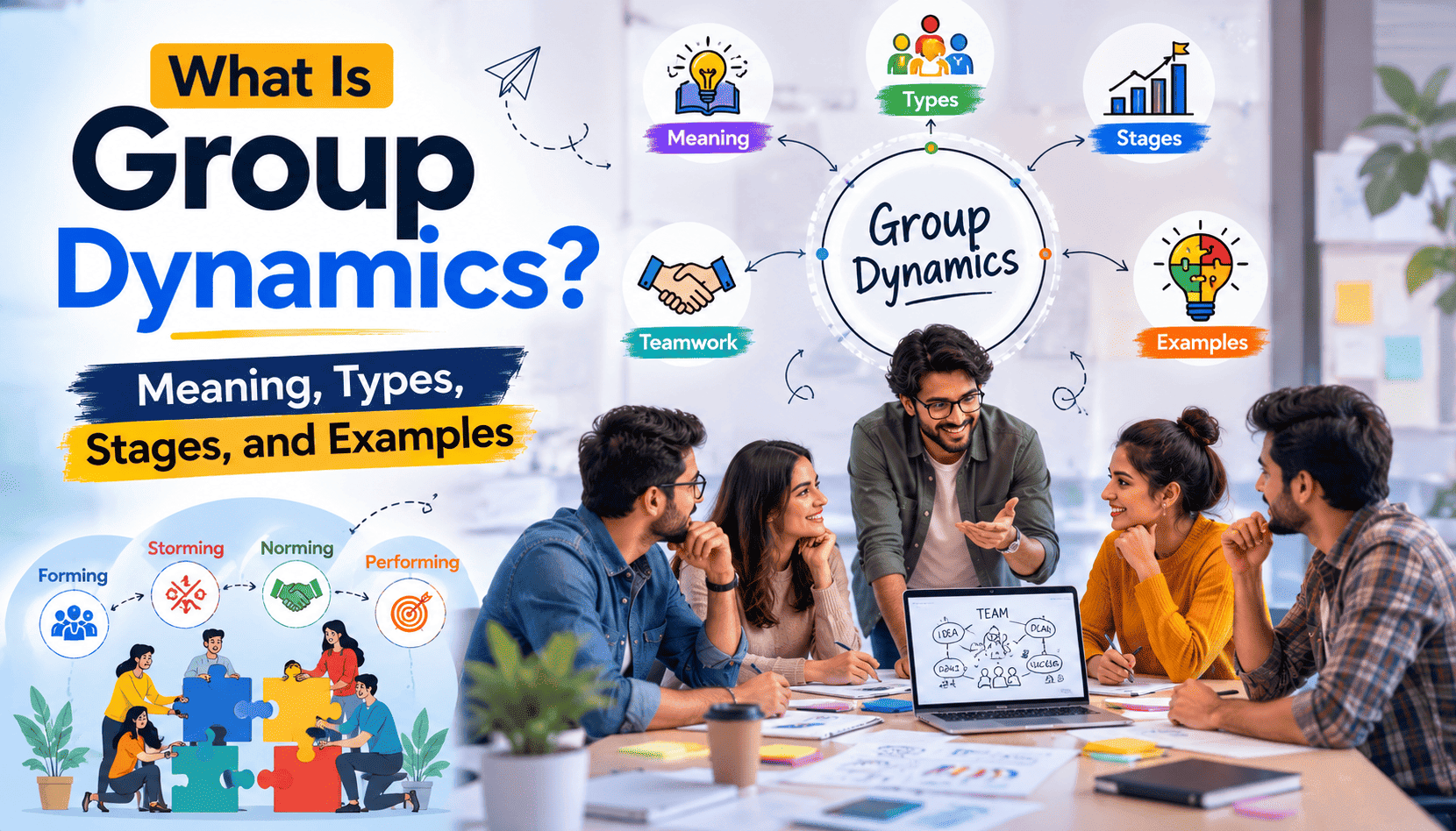
Group Dynamics Explained — Definition, Stages, and Real Examples
Group dynamics is the study of how people behave, interact, and influence one another within a group, covering everything from how groups form to how roles, conflict, and cooperation shape their performance over time.
This guide covers exactly what you need:
- Group dynamics meaning and definition — explained simply
- Group dynamics in psychology — the theory behind group behavior
- Types of group dynamics — formal, informal, and beyond
- Stages of group dynamics development — Tuckman's well-known model
- Group dynamics in organisational behaviour — why it matters at work
- Real examples and how to improve group dynamics in your own team
Group Dynamics Meaning and Definition
Group dynamics refers to the patterns of interaction, communication, and influence that occur within a group of people working toward a shared goal. A group means two or more people who interact with one another, are psychologically aware of one another, perceive themselves to be members of the group, and work towards a common goal.
To define group dynamics more precisely, it is the social process by which individuals influence each other's attitudes, behavior, and decisions simply by being part of the same group. Group dynamics studies the nature, formation, and reasons for forming groups, and how groups affect the behaviour and attitude of their members and the organisation. It is not about any single person , it is about what emerges from the group as a whole.
Group Dynamics in Psychology
In psychology, group dynamics examines how individual behavior changes the moment a person becomes part of a group. People often act, decide, and even think differently in groups than they would alone , influenced by social pressure, conformity, group identity, and the desire to belong.
Group dynamics defines group behaviour that is often more inclined toward need satisfaction than the formal goals of an organisation, with members reinforcing their own attitudes and sentiments and sometimes doing tasks different from what the formal organisation defines. This is why two teams with identical skills and resources can produce very different results, the underlying group psychology, not just individual ability, shapes the outcome.
Types of Group Dynamics
Groups generally fall into a few recognizable categories, each with different dynamics at play
- Formal groups — created intentionally by an organization with defined roles, structure, and objectives, such as a project team or department
- Informal groups — form naturally through shared interests, friendships, or proximity, without official structure
- Primary groups — small, close-knit groups with strong emotional bonds, such as a tight core team
- Secondary groups — larger, more impersonal groups formed for a specific purpose, such as a company-wide task force
- In-groups and out-groups — groups people identify with strongly versus groups they see as separate or different from themselves
- Reference groups — groups whose values and standards individuals use to evaluate their own behavior, even without being a direct member
Each type produces different group dynamics , formal groups tend to follow structured stages of development, while informal groups often form and dissolve more fluidly based on shared interest.
Stages of Group Dynamics Development
The most widely referenced framework for understanding how groups evolve is Tuckman's model. First published in 1965, Tuckman's original model identified a four-stage progression that small groups experience: Forming, Storming, Norming, and Performing, with a fifth stage called Adjourning added in a 1977 update.
Forming — members orient themselves to the task and to each other, often with general politeness and uncertainty about roles and goals.
- Storming — conflict and friction emerge as people push against established boundaries; power dynamics, personality differences, and disagreements about direction surface, and team performance can actually dip as energy shifts toward interpersonal tension.
- Norming — members build unity, establish ground rules, and find their place within the group.
- Performing — the group works efficiently toward its goals, with members confident enough in their skills to operate with less direct supervision.
- Adjourning — the project or group's purpose comes to an end and the group disbands, often accompanied by mixed feelings about the team's dissolution.
In practice, team development does not always proceed in neat sequential stages , teams can skip steps, revert to an earlier stage, or show characteristics of multiple stages at once, so the model works best as a guide rather than a strict rulebook.
Group Dynamics in Organisational Behaviour
Groups are central to organisational life, and managers spend substantial time managing groups and teams so they contribute effectively to both organisational and group goals. In organisational behaviour, group dynamics directly shapes how well a manager can plan, organise, lead, and control their team's output.
Strong group dynamics in the workplace show up as clear communication, shared accountability, and fast conflict resolution. Weak group dynamics show up as silos, repeated misunderstandings, and decisions that take far longer than necessary because trust between members has not been established. Understanding which stage a team is currently in , forming, storming, norming, or performing ,helps managers apply the right kind of support at the right time rather than treating every team challenge the same way.
Group Dynamics Examples
Real-world examples make group dynamics easier to recognize in everyday situations:
- A new project team going through visible tension in its first few weeks as roles and expectations get clarified — classic storming stage behavior
- A long-standing sales team that has developed informal norms around how leads get shared, even though no formal policy exists — an example of informal group dynamics
- A cross-functional task force where members from different departments initially defer to their own department's habits before adopting shared norms , a norming stage in action
- A sports team that performs better as a unit despite having less individually talented players than a rival team with weaker group cohesion, group dynamics outperforming individual skill
- A remote team that takes longer to build trust and move past the storming stage simply because in-person cues are missing from early interactions
Team Dynamics vs Group Dynamics
The terms are often used interchangeably, but there is a useful distinction. Group dynamics is the broader academic and psychological concept covering any collection of interacting individuals , including informal social groups, communities, and organisations. Team dynamics specifically refers to the interpersonal patterns within a defined team working toward a shared task or business outcome.
In practice, team dynamics in the workplace is essentially group dynamics applied to a professional context — with the added dimensions of deadlines, defined roles, performance expectations, and organisational hierarchy shaping how the underlying psychological patterns play out day to day
Importance of Group Dynamics in the Workplace
Understanding group dynamics matters because teams with strong, healthy dynamics consistently outperform teams that simply have talented individuals working in isolation. Good group dynamics improve decision-making speed, reduce destructive conflict, increase psychological safety, and make collaboration feel less effortful.
Poor group dynamics, on the other hand, quietly damage productivity long before anyone names the problem directly , showing up as missed deadlines, repeated miscommunication, and talented people quietly disengaging. Project management approaches built around the Tuckman model are widely used to improve the dynamics of group management, helping teams move through forming, storming, and norming more smoothly toward consistent performing-stage output.
How to Improve Group Dynamics in Teams
Strategies to improve group dynamics in teams work best when they target the specific stage a team is currently in, rather than applying generic fixes regardless of context.
- Clarify roles early — ambiguity about who owns what fuels unnecessary storming-stage conflict
- Create space for honest disagreement — suppressed conflict resurfaces later and harder; addressing it directly speeds up the path to norming
- Build communication habits deliberately — teams with clear, consistent channels resolve misunderstandings faster than those relying on scattered messages across multiple apps
- Recognize the stage your team is in — a struggling team in storming needs facilitation, not punishment; a performing team needs autonomy, not micromanagement
- Revisit team agreements periodically — norms that worked at six members may not work at twenty; dynamics shift as teams grow or change
- Invest in trust-building activities — especially important for remote teams that miss the informal in-person interactions that build trust naturally in co-located teams
For teams looking to strengthen communication as part of improving group dynamics, the guide on employee communication apps covers tools that reduce the
friction often responsible for breakdowns during the storming stage. Teams navigating distributed or hybrid group dynamics may also find the latest productivity trends useful for understanding how modern teams are adapting their collaboration habits.
Conclusion
Group dynamics explains why some teams thrive while others with equal or greater talent struggle — the difference almost always comes down to how members interact, communicate, and move through the natural stages of group development together.
Quick summary:
- Group dynamics is the study of interaction patterns and influence within any group
- Tuckman's five stages forming, storming, norming, performing, adjourning — describe how groups typically evolve
- Types of groups range from formal project teams to informal social circles, each with different dynamics
- In the workplace, strong group dynamics directly improve decision-making, trust, and output
- Improvement starts with clarity, honest communication, and recognizing which stage your team is actually in
Recognizing where your team currently sits in this process is the first real step toward improving how it works together.
Frequently Asked Questions (FAQs)
Q1. What is group dynamics in simple terms?
Group dynamics, in simple terms, is the study of how people behave, communicate, and influence one another when they come together as a group working toward a shared purpose. Rather than focusing on any single individual, it looks at what emerges from the group as a whole including unspoken norms, shifting roles, conflict patterns, and the trust that develops over time. Group dynamics explains why identical individuals can perform very differently depending on which group they are placed in, since the relationships and interaction patterns within that specific group shape behavior just as much as individual skill or personality does.
Q2. What are the five stages of group dynamics?
The five stages of group dynamics, based on Tuckman's widely referenced model, are forming, storming, norming, performing, and adjourning. In forming, members orient themselves to the task and to each other with general politeness and uncertainty. Storming brings conflict and competition as roles get clarified and tension surfaces. Norming is when the group establishes shared rules and unity. Performing is when the team works efficiently and confidently toward its goals with minimal supervision. Adjourning marks the end of the group's purpose, often accompanied by mixed emotions as members prepare to disband or move on to new projects.
Q3. What are examples of group dynamics in the workplace?
Common workplace examples of group dynamics include a new project team experiencing visible tension during its early weeks as roles get sorted out, a long-standing team developing informal habits around how work gets divided even without official policy, and a cross-functional task force gradually adopting shared norms after initially defaulting to each department's own working style. Another clear example is a remote team taking longer to build trust and move past early-stage friction simply because they lack the in-person cues that naturally speed up relationship-building in co-located teams.
Q4. What is the difference between group dynamics and team dynamics?
Group dynamics is the broader concept, covering interaction patterns within any collection of people including informal social groups, communities, and organisations of any kind. Team dynamics is a more specific application of that same concept to a defined team working toward a shared professional task or business outcome. In practice, team dynamics in the workplace is essentially group dynamics playing out under the added pressures of deadlines, defined roles, performance expectations, and organisational hierarchy that a typical informal social group does not have to navigate.
Q5. How can you improve group dynamics in a team?
Improving group dynamics starts with clarifying roles early, since ambiguity is one of the most common triggers of unnecessary conflict during the storming stage. Creating space for honest disagreement rather than suppressing it helps teams move through tension faster instead of letting it resurface later. Recognizing which development stage a team is currently in matters too — a team stuck in storming needs facilitated conversation, while a performing team simply needs autonomy to keep delivering. Building clear, consistent communication habits and revisiting team agreements as the group grows are also proven ways to strengthen group dynamics over time.