Connect with us
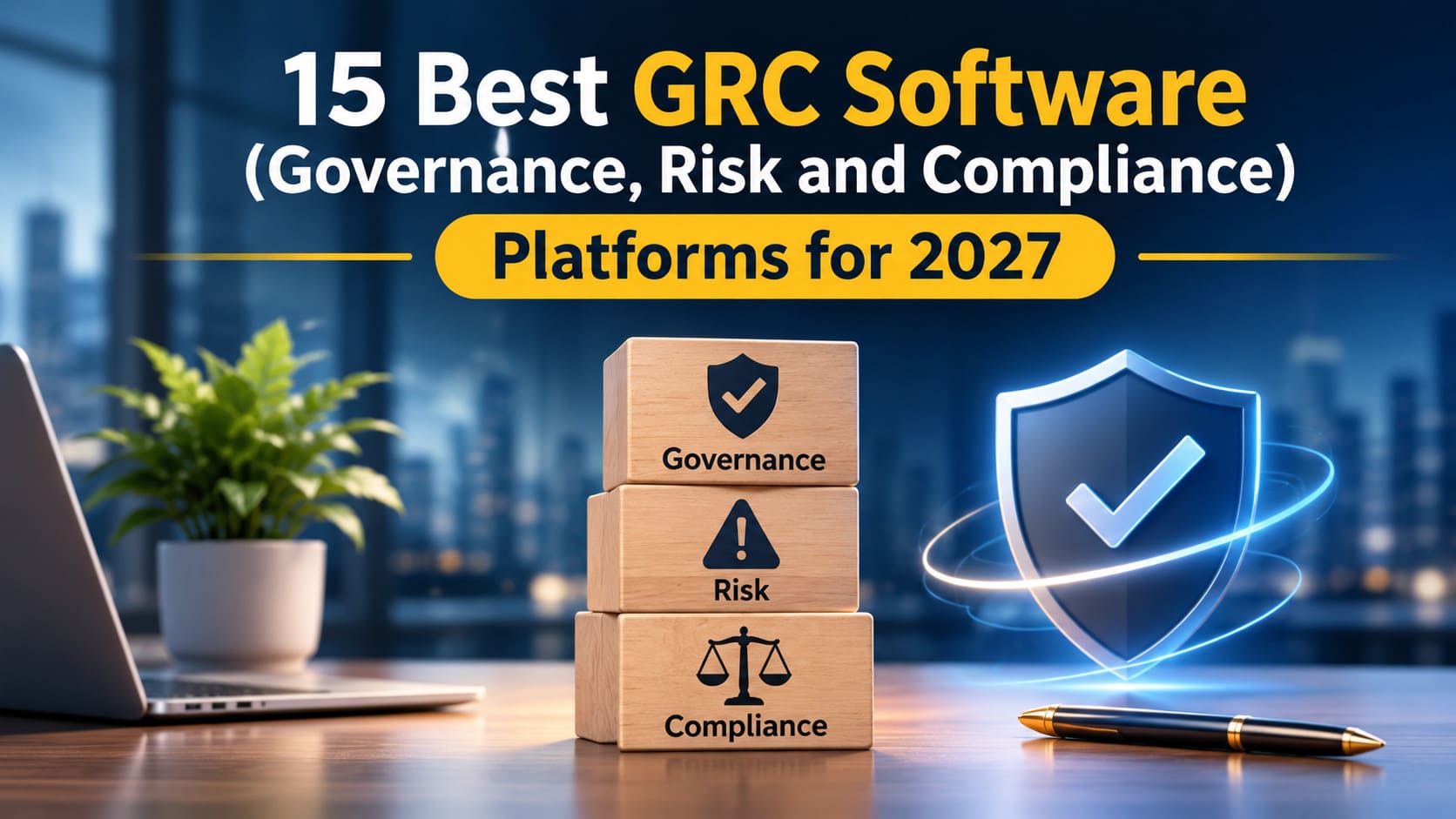
15 Best GRC Software (Governance, Risk and Compliance) Platforms for 2027
What is GRC software? Governance, risk and compliance (GRC) software gives organisations one system to manage policies, risks, controls, compliance requirements and audits. Instead of spreadsheets and email, teams keep a risk register, map controls to frameworks such as ISO 27001, SOC 2, NIST CSF and DORA, collect evidence automatically, run assessments and audits, and report to boards and regulators from the same data.
The market splits in two. Enterprise GRC suites such as ServiceNow, Archer, MetricStream and IBM OpenPages handle complex, multi-domain risk for large regulated organisations. Compliance automation platforms such as Vanta, Drata and Hyperproof focus on collecting security evidence quickly for frameworks like SOC 2 and ISO 27001. Below we compare 15 of the best GRC software platforms across both, including two open-source options.
GRC vs TPRM vs IT audit
GRC | Third-party risk management (TPRM) | IT audit | |
Scope | Governance, enterprise risk and compliance overall | Risks from vendors and suppliers | Independent assurance over IT controls |
Who | Risk, compliance and governance teams | Procurement, vendor risk and security teams | Internal or external auditors |
Relationship | Umbrella programme | Often a GRC module | Tests what GRC has put in place |
How we evaluated these tools
Criterion | Weight | What we looked at |
GRC capability | 30% | Risk registers, control libraries, framework mapping, audits, issues |
25% | Access control, audit trails, data residency, on-premise options | |
Integrations | 15% | Evidence collection from cloud, identity, HR and ticketing systems |
Usability | 15% | Usability for first-line owners as well as specialists |
Pricing transparency | 15% | Whether pricing is published, and how it scales |
GRC software at a glance
Platform | Best for | Frameworks | Audit management | On-premise option |
ServiceNow Integrated Risk Management | Enterprises already on ServiceNow | Broad library | Yes | No |
Archer | Complex, multi-domain risk programmes | Broad library | Yes | Yes |
MetricStream | Large regulated enterprises | Broad library | Yes | Options |
OneTrust | Privacy-led GRC and trust programmes | Broad library | Yes | No |
AuditBoard | Audit, risk and SOX teams | Broad library | Yes, core strength | No |
Diligent One Platform | Boards, audit and risk in one | Broad library | Yes | No |
LogicGate Risk Cloud | Configurable no-code GRC | Configurable | Yes | No |
Hyperproof | Multi-framework compliance operations | Broad library | Yes | No |
Vanta | Fast compliance automation for tech companies | SOC 2, ISO 27001, HIPAA and more | Auditor collaboration | No |
Drata | Continuous control monitoring for tech companies | SOC 2, ISO 27001 and more | Auditor collaboration | No |
SAP GRC | SAP-centric enterprises | Access, process and risk controls | Yes | Yes |
IBM OpenPages | Large financial institutions | Broad library | Yes | Yes |
Riskonnect | Integrated risk and insurance management | Broad library | Yes | No |
Eramba | Open-source GRC | Configurable | Yes | Yes (self-hosted) |
CISO Assistant | Open-source, framework-rich compliance | 100+ frameworks [VERIFY] | Yes | Yes (self-hosted) |
15 best GRC software platforms reviewed
1. ServiceNow Integrated Risk Management
Best for: enterprises that already run IT and security workflows on ServiceNow.
ServiceNow IRM manages policies, risks, controls, audits, vendor risk and business continuity on the same platform as IT service management and the CMDB, so control failures and incidents link directly to assets and owners.
Key features
- Policy, risk and control management
- Continuous control monitoring from ServiceNow data
- Audit and vendor risk modules
- Links to CMDB and incidents
Deployment: cloud.
Pricing: on request.
Pros
- Deep operational integration
- Scales to large enterprises
Cons
- Costly
- Requires ServiceNow expertise
Not for: organisations without ServiceNow.
2. Archer
Best for: organisations with complex, multi-domain risk programmes.
Archer is one of the longest-established GRC platforms, covering enterprise and operational risk, compliance, audit, third-party risk, business resilience and regulatory change. Formerly part of RSA, it is now an independent company. It is available as SaaS or on-premise, which suits banks and public bodies.
Key features
- Enterprise and operational risk
- Compliance and regulatory change
- Audit and third-party risk
- SaaS or on-premise
Deployment: cloud or on-premise.
Pricing: on request.
Pros
- Very configurable
- On-premise option
Cons
- Complex implementations
- Interface feels dated
Not for: small or fast-moving companies.
3. MetricStream
Best for: large, highly regulated enterprises.
MetricStream provides integrated risk, compliance, audit, cyber risk, third-party risk and ESG modules on a common platform, with AI features and strong regulatory content for financial services, life sciences and manufacturing.
Key features
- Integrated risk and compliance
- Internal audit management
- Cyber and IT risk
- Regulatory content and AI
Deployment: cloud; ask about other options [VERIFY].
Pricing: on request.
Pros
- Depth for regulated industries
- Broad module set
Cons
- Long implementations
- Premium pricing
Not for: small organisations.
4. OneTrust
Best for: organisations that run GRC alongside privacy and trust programmes.
OneTrust covers privacy, GRC, third-party risk, AI governance and ESG on one platform, with a large library of regulations and frameworks mapped to controls.
Key features
- Risk and control management
- Framework and regulation mapping
- Privacy and TPRM modules
- AI governance
Deployment: cloud.
Pricing: on request.
Pros
- Strong privacy integration
- Very broad platform
Cons
- Complex to configure
- Enterprise pricing
Not for: teams that want a focused tool.
5. AuditBoard
Best for: internal audit, SOX and risk teams.
AuditBoard is a connected risk platform built around internal audit, SOX compliance, operational risk, IT compliance and ESG, with a reputation for ease of use among audit teams. It was acquired by Hg in 2024.
Key features
- Audit management
- SOX and controls testing
- Risk and IT compliance
- AI assistance
Deployment: cloud.
Pricing: on request.
Pros
- Loved by audit teams
- Strong usability
Cons
- Less suited to deep cyber risk quantification
- Cloud only
Not for: organisations needing on-premise GRC.
6. Diligent One Platform
Best for: organisations that want board governance, audit and risk in one.
Diligent One (formerly HighBond) brings together audit, risk, compliance, policy management and board management, connecting governance reporting to the underlying risk and control data.
Key features
- Audit, risk and compliance
- Policy management
- Board portal integration
- Analytics and automation
Deployment: cloud.
Pricing: on request.
Pros
- Links boards to risk data
- Broad suite
Cons
- Best value across multiple modules
- Pricing not published
Not for: teams that only need compliance automation.
7. LogicGate Risk Cloud
Best for: teams that want to build their own GRC workflows without code.
LogicGate Risk Cloud provides configurable applications for risk, compliance, controls, policies, third-party risk and cyber risk quantification, built with a no-code workflow builder.
Key features
- No-code workflow builder
- Prebuilt GRC applications
- Cyber risk quantification
- Reporting
Deployment: cloud.
Pricing: on request.
Pros
- Very flexible
- Grows with your programme
Cons
- Configuration effort
- Pricing not published
Not for: teams that want a fully prescriptive tool.
8. Hyperproof
Best for: compliance teams managing many frameworks at once.
Hyperproof maps controls across frameworks, collects and reuses evidence, manages audits and tracks risks. In October 2025 it acquired Expent.ai to add AI-native third-party risk capabilities.
Key features
- Cross-framework control mapping
- Evidence collection and reuse
- Audit management
- Third-party risk (via Expent.ai)
Deployment: cloud.
Pricing: on request.
Pros
- Reduces duplicate work across frameworks
- Good usability
Cons
- Less enterprise risk depth than large suites
- Pricing not published
Not for: organisations needing on-premise GRC.
9. Vanta
Best for: technology companies that need to achieve and maintain SOC 2 or ISO 27001 quickly.
Vanta connects to cloud, identity, HR and code systems to monitor controls continuously and collect evidence automatically for frameworks such as SOC 2, ISO 27001, HIPAA and GDPR, and adds trust centres, vendor risk and questionnaire automation.
Key features
- Automated evidence collection
- Continuous control monitoring
- Trust centre
- Vendor risk and questionnaire automation
Deployment: cloud.
Pricing: on request.
Pros
- Very fast time to audit readiness
- Large integration library
Cons
- Lighter for enterprise risk management
- Best for cloud-native companies
Not for: traditional enterprises with complex on-premise estates.
10. Drata
Best for: technology companies wanting continuous control monitoring.
Drata automates evidence collection and continuous monitoring of security controls across many frameworks, with risk management, vendor risk and trust centre features. It acquired SafeBase, a trust centre company, in 2025 [VERIFY].
Key features
- Continuous control monitoring
- Automated evidence
- Risk and vendor management
- Trust centre
Deployment: cloud.
Pricing: on request.
Pros
- Strong automation
- Good auditor collaboration
Cons
- Cloud-native focus
- Lighter enterprise GRC depth
Not for: organisations needing on-premise deployment.
11. SAP GRC
Best for: organisations running core processes on SAP.
SAP Governance, Risk and Compliance covers access control and segregation of duties, process control, risk management and audit for SAP landscapes, and remains common in large manufacturing, utilities and public-sector organisations.
Key features
- Access control and segregation of duties
- Process control
- Risk management
- Audit management
Deployment: on-premise or private cloud [VERIFY].
Pricing: on request.
Pros
- Deep SAP integration
- On-premise option
Cons
- Complex and SAP-centric
- Heavy implementation
Not for: organisations without SAP.
12. IBM OpenPages
Best for: large financial institutions with demanding model and operational risk needs.
IBM OpenPages provides operational risk, regulatory compliance, internal audit, model risk and IT governance with AI assistance, deployable on IBM Cloud Pak for Data or on-premise.
Key features
- Operational and model risk
- Regulatory compliance
- Internal audit
- AI assistance
Deployment: cloud or on-premise.
Pricing: on request.
Pros
- Strong in banking
- On-premise option
Cons
- Complex to deploy
- Enterprise pricing
Not for: small organisations.
13. Riskonnect
Best for: organisations combining GRC with insurance and claims management.
Riskonnect offers integrated risk management covering enterprise risk, compliance, audit, third-party risk, business continuity, insurance and claims, popular with risk managers in healthcare, retail and insurance-heavy industries.
Key features
- Enterprise risk and compliance
- Insurance and claims management
- Business continuity
- Third-party risk
Deployment: cloud.
Pricing: on request.
Pros
- Unique insurance and claims depth
- Broad scope
Cons
- Less focused on cyber compliance automation
- Pricing not published
Not for: tech companies seeking SOC 2 automation.
14. Eramba
Best for: organisations that want open-source GRC they can host themselves.
Eramba is an open-source GRC tool covering risk management, compliance, internal controls, policies and audits. A free community edition can be self-hosted, and an enterprise edition adds support and features.
Key features
- Risk and compliance management
- Internal controls and testing
- Policy management
- Self-hosted deployment
Deployment: self-hosted.
Pricing: community edition free; enterprise edition licensed [VERIFY].
Pros
- No licence cost to start
- Full data control
Cons
- Interface is functional rather than polished
- Needs administration
Not for: teams wanting automated evidence collection.
15. CISO Assistant
Best for: security teams that want open-source, framework-rich compliance tooling.
CISO Assistant, developed by intuitem, is an open-source GRC and compliance tool with a large library of security frameworks and cross-framework mapping, risk assessments and audit tracking. It can be self-hosted, and paid editions and support are available.
Key features
- Large framework library with mappings
- Risk assessments
- Audit and evidence tracking
- Self-hosted
Deployment: self-hosted or cloud.
Pricing: open-source community edition; paid editions available [VERIFY].
Pros
- Rich framework coverage
- Self-hosted
Cons
- Younger project
- Requires technical set-up
Not for: enterprises needing a large vendor with global support.
Compliance management software vs full GRC platforms
Compliance management software focuses on meeting specific requirements, such as mapping controls to frameworks, collecting evidence and preparing for audits. Full GRC platforms add enterprise risk management, internal audit, policy governance, third-party risk and board reporting across the whole organisation.
If you need to | Consider |
Achieve SOC 2 or ISO 27001 quickly | Vanta, Drata, Hyperproof |
Run internal audit and SOX | AuditBoard, Diligent |
Manage enterprise and operational risk across domains | Archer, MetricStream, ServiceNow, IBM OpenPages |
Build custom workflows | LogicGate |
Keep everything self-hosted | Eramba, CISO Assistant, Archer or IBM OpenPages on-premise |
Will AI replace GRC?
No, but it is changing the work. AI now drafts policies, maps controls across frameworks, reads vendor evidence, answers security questionnaires and summarises risks. That removes much of the manual effort. Accountability, judgement on risk appetite, and decisions about trade-offs remain human responsibilities, and regulators expect named people to own them. Expect GRC teams to spend less time collecting evidence and more time on analysis and assurance, including governing AI itself.
Collecting compliance evidence from communication systems
Auditors and regulators increasingly ask for evidence from communication systems: who had access to which conversations, how long messages were retained, whether administrators changed settings, and whether sensitive data was shared appropriately. Financial regulators have also fined firms heavily for business conversations held on unapproved messaging apps.
GRC teams should:
- Inventory every communication platform used for business, including unofficial ones.
- Map controls for access, retention, export and admin activity to your frameworks.
- Collect evidence automatically from admin and audit logs where possible.
- Prefer platforms you can audit fully.
Self-hosted platforms make this easier, because logs and data sit on your own infrastructure. Troop Messenger, deployed on-premise, provides admin controls and audit trails that compliance teams can draw evidence from, and helps banks and financial institutions align communication controls with their regulatory obligations. See Troop Messenger for BFSI.
How to choose GRC software
- Define scope: compliance automation, enterprise risk, audit or all three.
- List your frameworks and regulations, and check content and mappings.
- Evaluate evidence collection: which integrations collect it automatically.
- Decide on deployment, including on-premise or self-hosted needs.
- Test with first-line users, not just the GRC team.
- Check reporting for boards, regulators and auditors.
- Plan integration with TPRM, policy and AI governance tools.
- Compare three-year cost, including implementation partners.
Frequently asked questions
1. What is GRC software?
GRC software is a platform for managing governance, risk and compliance in one place. It holds policies, risk registers and control libraries, maps controls to frameworks and regulations, collects evidence, runs assessments and audits, tracks issues and produces reports for boards, auditors and regulators.
2. What is the best GRC software?
It depends on your needs. ServiceNow, Archer, MetricStream and IBM OpenPages suit large regulated enterprises; AuditBoard and Diligent suit audit-led programmes; Vanta, Drata and Hyperproof suit fast compliance automation; LogicGate suits custom workflows; and Eramba and CISO Assistant are open-source options.
3. Will GRC be replaced by AI?
No. AI is automating much of the manual work in GRC, such as evidence collection, control mapping, policy drafting and questionnaire responses. But decisions about risk appetite, accountability and trade-offs remain human, and regulators expect named owners. GRC roles are shifting towards analysis, assurance and governing AI itself.
4. Is GRC the same as IT audit?
No. GRC designs, runs and monitors governance, risk management and compliance activities. IT audit independently tests whether those controls are designed and working effectively. They work together, and good GRC software supports auditors with access to evidence, but separation between the two is important for objectivity.
5. What are the top 5 GRC tools?
Frequently shortlisted GRC tools include ServiceNow Integrated Risk Management, Archer, MetricStream, AuditBoard and OneTrust for enterprises. For compliance automation, Vanta, Drata and Hyperproof are popular. The best five for you depend on your industry, frameworks and deployment requirements.