Connect with us
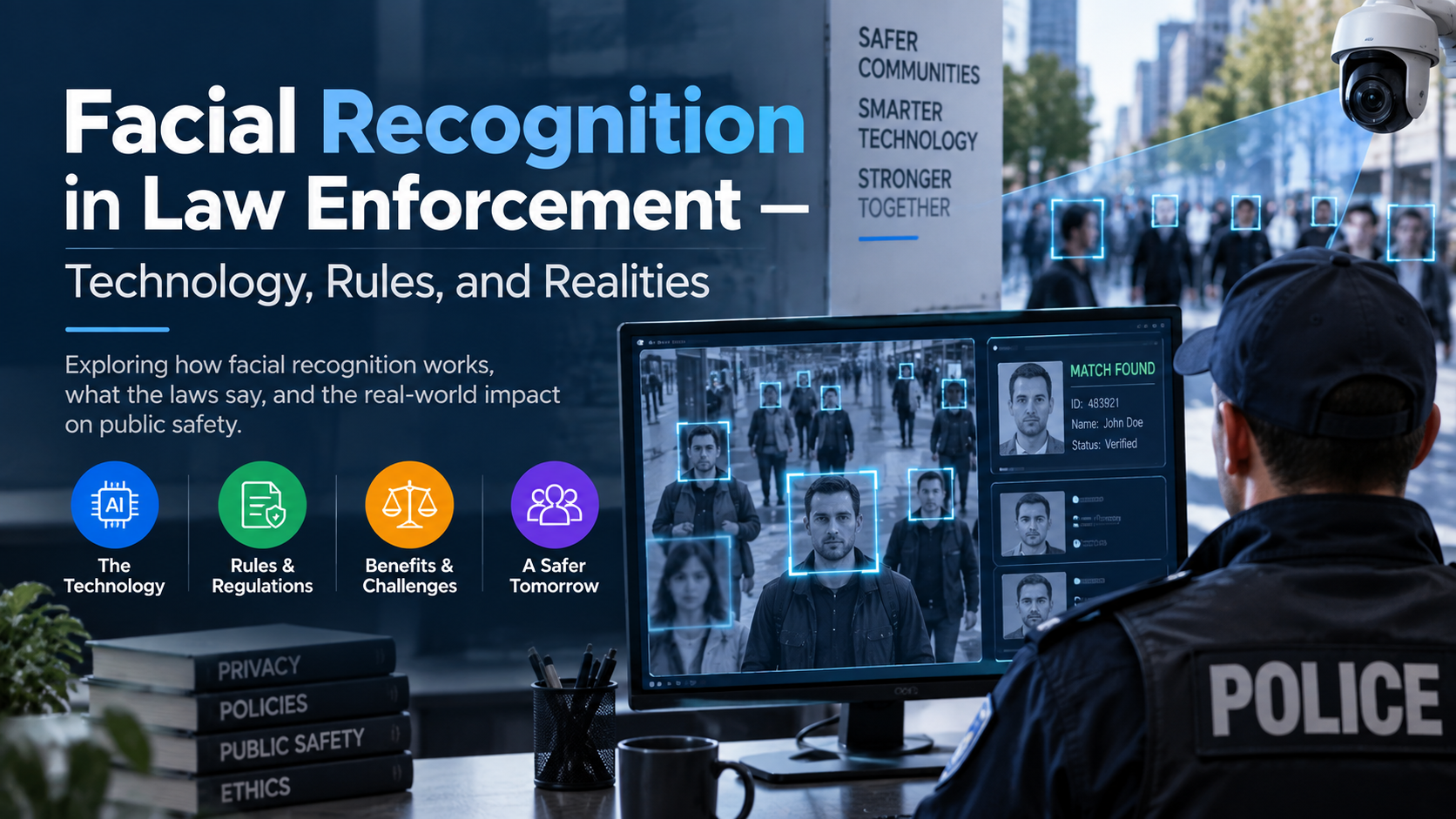
Facial Recognition in Law Enforcement — Technology, Rules, and Realities
Facial recognition in law enforcement refers to software that converts a face captured on camera into a digital signature and compares it against stored images to identify or verify a person's identity. NIST's face recognition research evaluates how these systems perform across different demographic groups and helps inform discussions about accuracy and appropriate use.
This guide covers exactly what you need :
- How the technology actually works and which systems agencies use today
- Real use cases and databases behind current deployments
- Accuracy and bias data — including the specific research behind the controversy
- Documented wrongful arrest cases and what went wrong in each
- Current regulations — from state bans to the EU AI Act's August 2026 deadline
Federal agencies have also documented the use of facial recognition in criminal investigations, along with concerns involving privacy, accuracy, training, and civil liberties. The U.S. Government Accountability Office's facial recognition research provides an overview of how selected federal law enforcement agencies use the technology and the safeguards surrounding its deployment.
What Is Facial Recognition in Law Enforcement?
Facial recognition in law enforcement is the use of biometric identification software to match a face, from a photo, video frame, or live camera feed, against a reference database, typically to identify a suspect, victim, or missing person. Agencies use it in two broad modes: retrospective searches against stored footage or images, and real-time identification against live camera feeds, with the latter carrying substantially higher legal and ethical scrutiny.
How Facial Recognition Technology Works in Law Enforcement
The software maps distinct facial landmarks, the distance between eyes, nose shape, jawline, into a numerical template, then searches a database for the closest statistical matches. The output is not a single confirmed identity but a ranked list of candidates, each with a confidence score. This distinction matters enormously in practice: a facial recognition result is meant to be an investigative lead requiring corroboration, not standalone proof of identity.
Facial Recognition Law Enforcement Examples — Real World Use Cases
Common applications include identifying a suspect from surveillance footage, verifying identity at booking, locating missing or trafficked persons, and screening at border checkpoints. The EU AI Act specifically carves out exceptions for locating missing persons, preventing imminent terrorist threats, and searching for suspects in serious crimes, even within its otherwise strict real-time identification ban, showing how narrowly most regulators try to scope legitimate use.
How Is Facial Recognition Used in Law Enforcement Today
In practice, most agencies use facial recognition retrospectively rather than in real time, running a still image from a case file or CCTV footage against a database after a crime has already occurred. Real-time identification in public spaces remains far rarer and far more legally contested, which is exactly why the EU AI Act and most US state laws draw their sharpest lines around that specific use rather than retrospective search generally.
Facial Recognition Software Used by Law Enforcement — Top Systems
Systems in active use include the FBI's Next Generation Identification platform, Clearview AI, and various vendor-built tools integrated into body-worn camera platforms and case management software. Clearview AI in particular has drawn sustained regulatory attention, the company has accumulated more than €100 million in fines from EU regulators and faced felony charges filed in October 2025, though as of 2026 it has paid none of the accumulated fines, illustrating how far enforcement still lags behind the rules on paper.
Facial Recognition Law Enforcement Database — How Agencies Access and Store Data
The FBI's Next Generation Identification system is the primary federal biometric repository, combining fingerprint, palm print, and facial data accessible to authorized agencies nationwide. Beyond federal systems, many local agencies query state driver's license photo databases or third-party image repositories, a practice that has drawn criticism because most people in those databases were never arrested or suspected of anything.
Facial Recognition Police Use — Which Agencies Are Using It and How
Adoption spans federal agencies, state police, and local departments of every size, though usage rates and internal policy vary enormously between them. One of the clearest patterns in documented failures is procedural: investigators frequently skip the corroboration step their own department's written policy requires before treating a facial recognition match as grounds for arrest.
Facial Recognition in Criminal Justice — Beyond Identification
Beyond initial identification, facial recognition results can influence probable cause determinations, warrant applications, and lineup construction. This is precisely where the technology's limitations become highest-stakes, a database match that would be reasonable as one investigative thread becomes dangerous when it substitutes for independent verification before an arrest is made.
Facial Recognition Surveillance in Law Enforcement — How It Is Deployed
Surveillance deployments range from fixed camera networks scanning public spaces to mobile units used at specific events. The EU AI Act's Article 5 treats this category as the highest-risk use, banning real-time remote biometric identification in public spaces outright except under judicial authorization for narrowly defined circumstances like an imminent terror threat or a specific serious crime search.
Facial Recognition Law Enforcement Accuracy — How Reliable Is It Really
Accuracy depends heavily on image quality, lighting, angle, and, critically, the demographic composition of the training data. A 2019 NIST evaluation of 189 facial recognition algorithms found Black and Asian faces were misidentified at rates 10 to 100 times higher than white faces. In one of the most striking documented admissions, Detroit's police chief acknowledged that the department's own system produced wrong results 96% of the time when used as a sole identification method.
Facial Recognition Law Enforcement Bias — The Racial and Gender Accuracy Gap
The MIT Media Lab's Gender Shades study found commercial facial analysis systems performed with near-perfect accuracy on lighter-skinned men while producing dramatically higher error rates for darker-skinned women. That gap is not a marginal statistical footnote , it is the pattern showing up directly in real arrests: nearly every publicly documented wrongful arrest tied to facial recognition has involved a Black individual.
Facial Recognition Wrongful Arrest — Real Cases and What Went Wrong
The documented cases follow a consistent pattern. Kimberlee Williams spent roughly six months in a Maryland jail after a facial recognition match placed her at a crime scene in a state she had never visited. Angela Lipps spent four months detained in Tennessee after a Fargo, North Dakota warrant relied on a facial recognition error, losing her house, car, and dog while stranded far from home. Jalil Richardson spent over 50 days in jail after Jacksonville police misidentified him as a vehicle thief, with charges only dropped once he produced timesheets proving he was working in North Carolina at the time. Robert Dillon was flagged as a suspect in a Jacksonville Beach case despite living more than 300 miles away and having never set foot there, a lawsuit over his arrest was filed in June 2026. At least 13 criminal cases have been dismissed nationwide after facial recognition identified the wrong person, and civil liberties groups have now documented at least eight named wrongful arrests since the first widely publicized case, Robert Williams in Detroit in 2020.
Facial Recognition Law Enforcement Pros and Cons
Pros | Cons |
Rapidly narrows large suspect pools | Documented, severe racial accuracy gaps |
Helps locate missing and trafficked persons | Wrongful arrests when used without corroboration |
Processes footage volumes no analyst could manually review | Enables persistent surveillance of public spaces |
Can support faster case resolution | Weak procedural enforcement of existing safeguards |
Available 24/7 across large camera networks | Disproportionate impact on already over-policed communities |
Facial Recognition Law Enforcement Ethical Issues
The central ethical tension is between an investigative tool and a determination of guilt. A facial recognition match is a probabilistic lead, not evidence of presence or conduct, yet documented cases repeatedly show it being treated as sufficient grounds for arrest on its own. Related concerns covered in our guide to AI in law enforcement , accountability gaps, algorithmic opacity, and over-reliance on automated output, apply with particular force here, since facial recognition directly identifies named individuals rather than flagging general patterns.
Facial Recognition Law Enforcement Privacy — What Data Is Collected and Stored
Facial recognition databases frequently include driver's license photos and other images of people who were never arrested, meaning a large share of any searchable database consists of individuals with no connection to a crime. This raises the same data-handling questions covered in our guides on CJIS compliance and data sovereignty , who can query these databases, how long images are retained, and what oversight governs access.
Facial Recognition Law Enforcement Regulations — Current Rules Around the World
The EU AI Act became fully applicable on August 2, 2026, banning real-time remote biometric identification in public spaces for law enforcement except under judicial authorization for missing persons, imminent terrorist threats, or serious crime searches. Retrospective facial recognition use is classified as high-risk rather than banned, requiring judicial authorization, strict necessity, a prohibition on indiscriminate surveillance, a rule that no adverse legal action can rest solely on a facial recognition result, and mandatory documentation of every use.
Facial Recognition Law Enforcement Rules in the United States
No comprehensive federal law governs police facial recognition use as of 2026, leaving a state-by-state patchwork. Virginia's law, effective July 1, 2026, requires warrants before use, annual audits, and public deployment reports. Maryland's law, described by the Security Industry Association as the nation's strongest, prohibits arrests based solely on a facial recognition result and requires notifying defendants when the technology was used in their case. Vermont, Virginia, and Massachusetts maintain statewide moratoriums or bans, while Maine requires a court order before any search.
Facial Recognition Law Enforcement Ban — Where It Has Been Restricted or Prohibited
At the city level, San Francisco, Oakland, Boston, Portland, Minneapolis, Cambridge, and New Orleans have all banned police use of facial recognition outright. These local bans have functioned as pressure points pushing state legislatures toward uniform standards, since a growing patchwork of city-by-city rules creates enforcement inconsistency that most agencies would prefer to avoid.
AI Facial Recognition in Law Enforcement — How Artificial Intelligence Powers It
Modern facial recognition is a machine learning application at its core, accuracy and bias both stem directly from the training data the underlying model was built on. This is why the racial accuracy gap is not a fixable software bug so much as a structural feature of how these models are trained, and why regulators increasingly demand documented testing before deployment rather than trusting vendor accuracy claims.
The Future of Facial Recognition in Law Enforcement — Where It Is Headed
Expect continued state-by-state legislative activity in the US, growing pressure for a federal floor standard, and the EU AI Act's high-risk obligations reshaping how vendors build and document these systems globally. The ACLU's ongoing case tracker shows litigation continuing to be the primary accountability mechanism in the US absence of comprehensive federal legislation meaning courtroom outcomes, not just statutes, will keep shaping how this technology can be used.
Conclusion
Facial recognition in law enforcement sits at a genuine crossroads, a technology with real investigative value and a documented, serious pattern of racial bias and wrongful arrests when deployed without proper safeguards.
Quick summary:
- The technology produces probabilistic leads, not confirmed identity — treating it otherwise is where documented failures originate
- Bias is measured, not theoretical — NIST found 10 to 100 times higher error rates for Black and Asian faces
- Wrongful arrests follow a pattern — skipped corroboration, and nearly every named victim is Black
- The EU AI Act's August 2026 deadline sets the world's most detailed legal framework for high-risk use
- US regulation remains a patchwork — Maryland and Virginia lead on state law, while cities lead on outright bans
The agencies and vendors handling this responsibly treat every match as a starting point for investigation, never as its conclusion.
Frequently Asked Questions (FAQs)
Q1. What is facial recognition in law enforcement?
Facial recognition in law enforcement is biometric identification software that converts a face from a photo, video, or live camera feed into a digital signature and compares it against a database to find likely matches. Agencies use it retrospectively against stored footage or in real time against live feeds, with the latter facing far stricter legal limits. The output is a ranked list of possible matches with confidence scores , an investigative lead meant to require independent corroboration, not a standalone confirmation of identity or guilt.
Q2. How accurate is facial recognition used by police?
Accuracy varies significantly by image quality and by the demographic makeup of the training data. A 2019 NIST study testing 189 algorithms found Black and Asian faces were misidentified at rates 10 to 100 times higher than white faces. In one documented admission, Detroit's police chief acknowledged the department's system was wrong 96% of the time when used as the sole method of identification, underscoring why most policies require corroborating evidence before any arrest is made.
Q3. Has facial recognition led to wrongful arrests?
Yes, repeatedly and with a documented pattern. Civil liberties groups have tracked at least eight named wrongful arrests and at least 13 criminal cases dismissed nationwide after facial recognition identified the wrong person. Cases include Kimberlee Williams, jailed roughly six months in Maryland, and Angela Lipps, detained four months in Tennessee. Nearly every confirmed victim has been Black, and most cases share a common failure: police skipped the corroboration step their own department policy required before making an arrest.
Q4. Is facial recognition banned for police use?
Not universally, but restrictions are expanding. The EU AI Act bans real-time facial recognition by police in public spaces except under judicial authorization for narrow cases like missing persons or imminent terrorist threats, becoming fully enforceable August 2, 2026. In the US, no federal ban exists, but Vermont, Virginia, and Massachusetts have statewide moratoriums, and cities including San Francisco, Boston, and Minneapolis have banned police use outright, creating a growing but inconsistent patchwork.
Q5. What are the main ethical concerns with facial recognition in policing?
The core concern is treating a probabilistic match as proof rather than a lead requiring verification the pattern behind nearly every documented wrongful arrest. Additional concerns include documented racial and gender accuracy gaps, the inclusion of never-arrested individuals in searchable databases like driver's license photos, limited transparency in how algorithms reach conclusions, and weak enforcement of the procedural safeguards departments already have on paper.