Connect with us
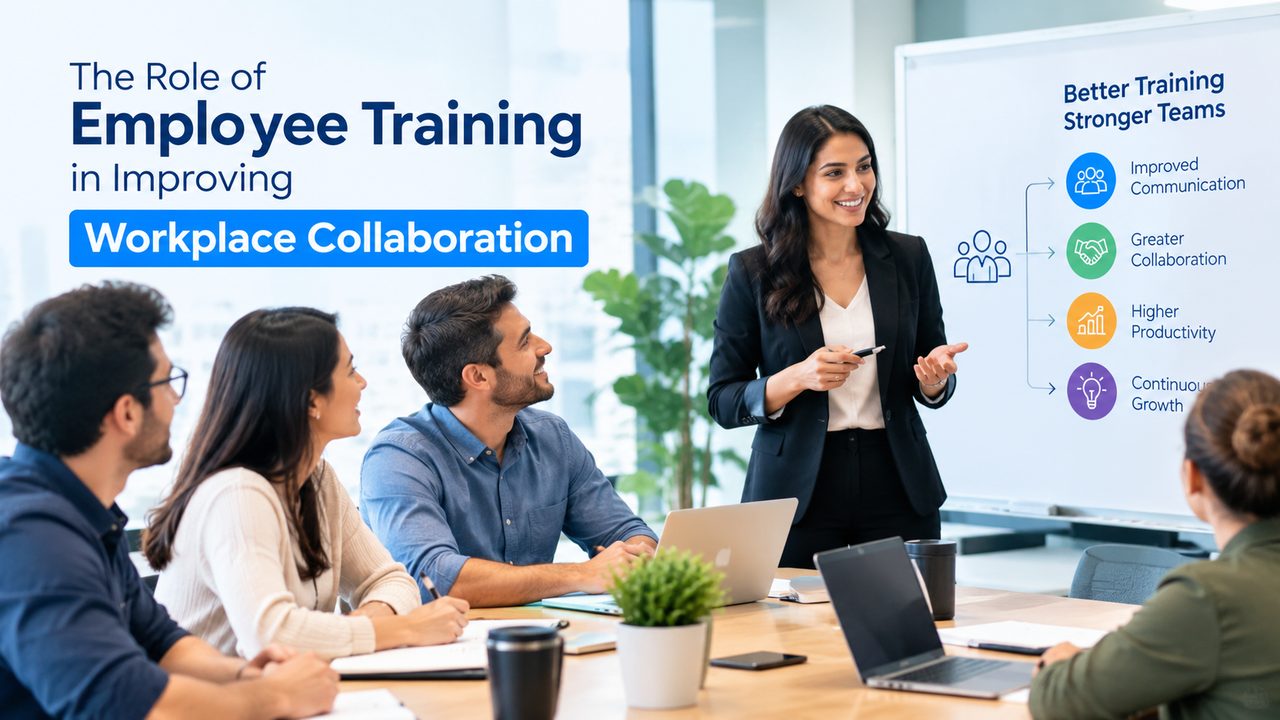
The Role of Employee Training in Improving Workplace Collaboration
Employee training is the fastest way to fix broken workplace collaboration. Skilled communicators listen better, share knowledge faster, and solve conflicts before they slow a project down. Untrained teams, by contrast, tend to duplicate work, misread each other, and lose time to avoidable friction.
The evidence backs this up. The World Economic Forum expects 39% of workers' core skills to change by 2030, and most of that change sits in how people communicate and collaborate, not just which software they use.
This guide looks exactly on the below areas:
Table of Contents,
- What Is the Role of Employee Training in Workplace Collaboration?
- How Does Employee Training Actually Improve Collaboration?
- Which Employee Training Areas Build the Strongest Teams?
- Why Workplace Collaboration Training Matters More in the UAE and Dubai?
- How to Measure Whether Employee Training Is Working?
- What is the Future of Employee Training and Workplace Collaboration?
- Conclusion
- Frequently Asked Questions
---------------------------------
01.What Is the Role of Employee Training in Workplace Collaboration?
Employee training gives people the specific behaviours collaboration depends on :
clear communication, active listening, conflict resolution, and comfort working across departments. Collaboration isn't a personality trait some people have, and others don't. It's a set of learnable skills.
When a company trains staff in these areas, teams share information more openly, resolve disagreements faster, and coordinate work with less back-and-forth. LinkedIn Learning data shows 91% of learning and development professionals now believe human skills, such as communication and teamwork, matter more than ever, even as workplaces become more automated. Put simply: training is the mechanism, and collaboration is the outcome.
02.How Does Employee Training Actually Improve Collaboration?How Does Employee Training Actually Improve Collaboration?
Employee Training doesn't improve teamwork by accident. There's a fairly clear chain at work:
skill-building leads to behaviour change, and behaviour change is what collaboration is made of. Here are the core areas that improve collaboratively with employee training:
- Communication skills: structured training teaches employees to give clear updates and ask better questions, so fewer tasks need reworking.
- Trust and psychological safety:Google's Project Aristotle, one of the most cited workplace studies ever run, found psychological safety was the single biggest driver of high-performing teams. Yet Gallup's most recent engagement data shows only 3 in 10 employees strongly feel their opinions count at work, so there's real room to close this gap through training in feedback and active listening.
- Cross-functional teamwork: employees trained in stakeholder management collaborate more smoothly across departments, a skill LinkedIn's 2026 workplace learning report flags as one of the fastest-growing needs globally.
- Conflict resolution: training gives teams a shared process for disagreement, so friction gets resolved rather than avoided.
- Digital and hybrid collaboration: with workers interrupted roughly every two minutes by digital "noise" during core hours (Microsoft Work Trend Index), training people to use collaboration tools with intention, not just access, protects focus and improves output.
Employee Training alone isn't a silver bullet, though. It works best when managers reinforce it, and when the wider culture rewards openness over point-scoring.
03.Which Employee Training Areas Build the Strongest Teams?
Not every training topic has the same effect on collaboration. Based on the evidence, the following six areas consistently matter most:
- Communication and active listening: It’s the foundation every other skill builds on.
- Emotional intelligence: It helps employees read situations and respond well under pressure.
- Conflict resolution: It turns disagreement into progress instead of stalled projects.
- Cross-functional collaboration and stakeholder management: It’s critical as teams work across time zones and departments.
- Digital collaboration literacy: It’s about knowing how to use shared tools well, not just having access to them.
- Leadership and team facilitation: Here, the managers who complete a structured leadership course are the ones who set the tone for how their team communicates, gives feedback and works through friction day to day.
These six areas give the strongest return for a company that can't train on everything at once. LinkedIn's own 2026 workforce analysis puts it plainly: professionals who combine technical ability with collaboration and stakeholder management are the ones getting hired and promoted, not narrow specialists.
Well-structured employee training programs that combine two or three of these areas, rather than one-off workshops, tend to have the most lasting effect on how teams actually work together day to day.
4. Why Workplace Collaboration Training Matters More in the UAE and Dubai?
Workplace collaboration training carries extra weight in the UAE. The country needs an additional 1.03 million workers by 2030, a 12.1% rise in its total workforce, and much of that growth is happening in multicultural, multilingual teams spread across Dubai, Abu Dhabi and beyond. Employees here regularly collaborate across nationalities, languages and time zones, which raises the stakes for clear communication and cultural awareness.
Government-backed initiatives such as the Nafis programme already support salary and training costs for UAE nationals, showing how seriously the country treats structured learning as a workforce priority.
Globally, 50% of the workforce has now completed some form of training, up from 41% in 2023, and UAE businesses are following a similar path, investing in training mainly to boost productivity (77%) and competitiveness (70%).
For Dubai's fast-growing sectors, from fintech to logistics, collaboration training isn't a nice-to-have. It's how diverse teams actually get work done.
5. How to Measure Whether Employee Training Is Working
The clearest way to check is behaviour, not attendance. Consider asking these questions:
- Did fewer projects get delayed by cross-team miscommunication?
- Are meetings shorter and more focused?
- Is knowledge actually being shared, or hoarded?
The Kirkpatrick Model remains the most practical framework here. It looks at four levels: how employees reacted to the training, what they learned, whether their behaviour changed at work, and whether that change affected real results, like project turnaround time or engagement scores.
Practical KPIs worth tracking:
- Time taken to resolve cross-team blockers
- Frequency of knowledge-sharing (documented, not assumed)
- Meeting effectiveness scores
- Employee engagement and retention
Managers should check in a few weeks after training, not just on the day it happens. Behaviour change usually shows up later, once people have had the chance to apply it.
6. What is the Future of Employee Training and Workplace Collaboration?
Looking ahead, collaboration training will increasingly cover how humans work alongside AI tools, not instead of them.
Analytical thinking remains the World Economic Forum's top-ranked core skill, and that isn't changing any time soon.
What's shifting is the mix: employees will need AI literacy on top of the human skills that AI still can't replace, like empathy and judgement.
As Helen Keller once put it: "Alone we can do so little; together we can do so much."
That idea isn't outdated. If anything, it becomes more true as teams add digital collaborators alongside human ones.
Organisations that keep investing in both people skills and digital fluency will be the ones still collaborating well by 2036.
Conclusion
Training is not a side project for HR. It's the most direct route to better workplace collaboration: clearer communication, more trust, and teams that genuinely work well together across functions and borders.
The evidence is consistent, from Google's psychological safety research to the World Economic Forum's skills forecasts. For organisations serious about building this capability, structured employee training programs remain one of the highest-return investments available, particularly in fast-growing, multicultural markets like Dubai and the wider UAE.
Frequently Asked Questions
How does employee training improve workplace collaboration?
Training builds specific skills, such as communication, active listening and conflict resolution, that reduce misunderstandings and help teams coordinate more smoothly across roles and departments.
What training has the biggest impact on teamwork?
Communication and emotional intelligence training tend to have the broadest impact, since nearly every collaboration problem starts with a communication gap.
How can companies measure the impact of collaboration training?
Track behaviour change, not attendance. Look at project delays, meeting effectiveness and knowledge-sharing frequency before and after training, ideally using a framework like the Kirkpatrick Model.
Is collaboration training different for hybrid or remote teams?
Yes. Remote and hybrid teams need extra focus on digital collaboration literacy and intentional communication, since they miss the informal cues that in-person teams pick up naturally.