Connect with us
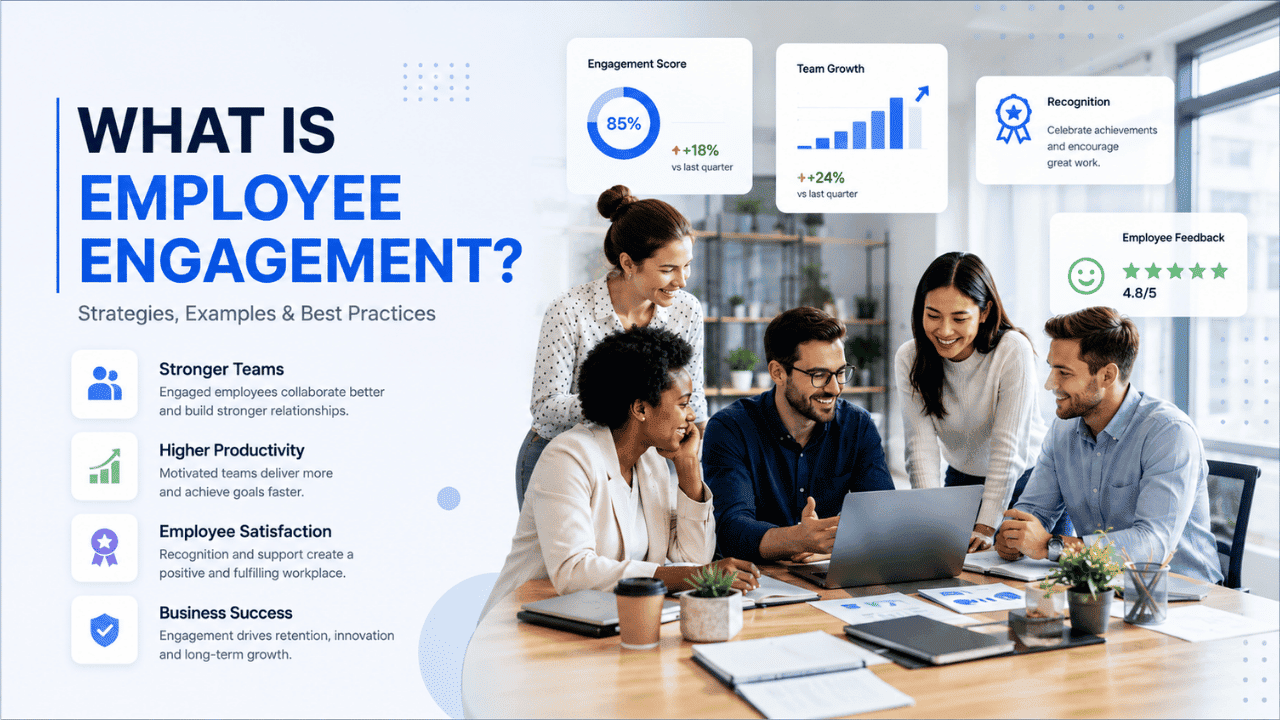
What Is Employee Engagement? Strategies, Examples & Best Practices
Employee engagement is the level of emotional commitment, motivation, and involvement employees have toward their work and their organization's goals. Engaged employees are more productive, collaborate effectively, stay longer with their employers, and contribute to better business outcomes. In contrast, disengaged employees often lead to lower productivity, higher turnover, increased burnout, and reduced organizational performance. As workplace expectations continue to evolve, employee engagement has become one of the most important drivers of business success, talent retention, employee wellbeing, and customer satisfaction.
This guide explains what employee engagement is, why it matters, and how it impacts productivity, retention, workplace culture, and mental health. You'll learn proven employee engagement strategies, team activities, measurement methods, survey approaches, software tools, best practices for HR leaders, and actionable ways to improve engagement in both in-office and remote work environments. Whether you're building an engagement program from scratch or improving an existing one, this article provides practical insights to help create a more motivated and committed workforce.
What Is Employee Engagement?
Employee engagement is the emotional and behavioral investment an employee brings to their work. An engaged employee doesn't just finish their task list, they care whether the outcome is actually good, they speak up with ideas, and they back up their teammates without being asked.
It gets confused with a few neighboring ideas, so it's worth drawing the lines clearly:
- Employee satisfaction is about contentment, pay, benefits, conditions. You can be satisfied and still be coasting.
- Employee happiness is a mood, often tied to a single day or moment.
- Employee experience is the whole journey, from the first interview to the exit interview.
- Employee engagement is how emotionally invested someone is in the work itself and the mission behind it.
Three things tend to show up together when engagement is real: people know what's expected of them, they believe their contribution actually matters, and they feel some genuine stake in whether the company wins. Get those three right, and you usually don't need to convince anyone to "try harder."
Why Is Employee Engagement Important?
This isn't a culture nicety. It shows up on the P&L.
It drives productivity and profitability. Gallup's long-running research keeps finding the same pattern, business units with high engagement scores outperform low-engagement ones on profitability by a wide margin, and engaged teams simply get more done.
It cuts the cost of turnover. Losing an employee and replacing them often costs half to twice their salary once you add up recruiting, onboarding, and the productivity gap while the new hire ramps up. Engaged people aren't quietly job-hunting on company time.
It protects manager effectiveness or exposes its absence. Gallup attributes most of the variance in team-level engagement to the manager. One disengaged manager can drag down an entire team's output without anyone clearly pointing to why. And manager engagement itself has been falling faster than individual-contributor engagement lately, which should worry anyone counting on frontline leaders to carry culture.
It strengthens the customer experience. People who feel looked after at work tend to extend that same energy to customers. It's hard to fake good service when you're disengaged.
It protects mental health. Disengagement correlates strongly with burnout and isolation. Gallup and Stand Together's research found employees with a strong sense of purpose are several times more likely to be engaged, and far less likely to report chronic burnout.
Bottom line: engagement is a leading indicator. By the time it shows up in your turnover numbers, you're already behind.
Top Employee Engagement Strategies That Work
A one-off engagement event won't fix this. These are the moves that actually compound over time:
1. Get expectations unambiguous. Vague goals are an engagement killer. People need to know what "good" looks like in their role and how it ladders up to something bigger.
2. Put your money on managers. Since they drive most of the variance in team engagement, training managers in coaching and real feedback beats almost any company-wide initiative you could run instead.
3. Make feedback frequent, not annual. A once-a-year review tells someone what they did wrong eleven months too late. Weekly or biweekly check-ins, paired with recognition in the moment, keep things current.
4. Show a real path forward. Employees who can picture themselves growing here, through new skills, mentorship, bigger responsibilities, stick around. Employees who can't, leave.
5. Recognize work consistently, not occasionally. It doesn't need a budget. It needs to be specific, tied to something real, and frequent enough that it doesn't feel like a once-a-quarter performance.
6. Actually act on employee feedback. Surveys and town halls only build trust if people see something change afterward. Asking and then doing nothing is worse than never asking.
7. Tie daily work to the bigger picture. Disengagement often starts when work feels like a pile of disconnected tasks. Leaders who keep connecting the dots tend to keep people invested.
8. Trust people with flexibility. Hybrid and remote employees given real autonomy over how they work consistently report higher engagement than those under constant monitoring.
Best Employee Engagement Activities for Teams
Strategy sets the direction. Activities are what people actually feel.
- Peer recognition programs — let teammates shout each other out in real time, not just managers.
- Skip-level meetings — give employees informal access to leadership above their manager, where issues often surface that never make it up the chain otherwise.
- Cross-functional projects — short stints outside someone's usual team build new relationships and visibility fast.
- Lunch-and-learns — cheap, low-pressure way to build skills and connection at once.
- Volunteer or community-impact days — ties work to something bigger than quarterly targets.
- Milestone celebrations — marking tenure or project wins signals someone's been noticed.
- Virtual coffee chats or interest clubs — particularly useful for remote teams missing the hallway conversations office life creates naturally.
- Wellness challenges — step challenges or mindfulness sessions that show the company cares about more than output.
What ties all of these together: real human connection, not mandatory attendance at something that feels like one more meeting. Even simple milestone celebrations, from work anniversaries to project completions, give teams a shared moment to see that consistent effort is noticed and valued
How to Measure Employee Engagement Effectively
You can't manage what you don't measure, but a single annual survey isn't enough on its own. Combine a few methods:
- Annual or biannual surveys using consistent, benchmarked questions so you can actually track movement over time.
- Pulse surveys — short, frequent check-ins that catch a dip in sentiment before it becomes a resignation.
- One-on-ones and stay interviews — ask people directly what's working, before they've already decided to leave.
- eNPS (Employee Net Promoter Score) — one simple question: would you recommend working here?
- Turnover and absenteeism data — useful, but it's a lagging indicator. By the time it moves, the problem's already happened.
- Tool and program usage data — quiet but telling. Low adoption of recognition platforms or development programs often says more than a survey score.
The point isn't data for its own sake. It's catching problems early enough to actually do something about them.
Top Employee Engagement Software & Tools
Most modern engagement programs lean on a handful of tool categories:
- Survey and pulse-feedback platforms for ongoing sentiment tracking.
- Recognition and rewards platforms that let anyone, not just managers, acknowledge good work in the moment.
- Internal communication tools that keep remote and hybrid employees in the loop, cutting down the isolation that quietly drives disengagement.
- Performance management systems that connect goals, feedback, and development instead of treating each as its own silo.
- People analytics dashboards pulling survey data, turnover trends, and behavioral signals into one view.
Don't get seduced by feature lists. A tool nobody opens does nothing for engagement, no matter how sophisticated it is. For organizations comparing different options, choosing the best employee engagement software means looking beyond features to adoption, usability, and how well the tool fits existing engagement processes.
How to Improve Employee Engagement in the Workplace
If you're starting from a low baseline, don't try to fix everything at once. Pick the highest-leverage moves:
- Start with managers. Coaching skills and consistent check-in habits, before any company-wide rollout.
- Close the loop after every survey. Silence after asking for feedback is worse than not asking.
- Make recognition peer-to-peer, not just top-down.
- Audit workload before you audit culture. A lot of "disengagement" is actually burnout or confusion wearing a different name.
- Protect psychological safety. People engage more when they can flag a problem or admit a mistake without fearing the fallout.
None of this is dramatic. Engagement rarely shifts because of one big initiative — it shifts because of small, repeated habits across hundreds of ordinary interactions.
Employee Engagement Ideas for Remote & Hybrid Teams
Remote setups strip away the informal moments that build engagement naturally in an office, the hallway chat, the lunch table. Those need to be rebuilt on purpose:
- Virtual watercooler time with zero agenda, just conversation.
- Asynchronous recognition channels so good work is visible company-wide, not just to whoever happens to be in the room.
- Regular all-hands meetings with a predictable rhythm, so remote employees never feel like the last to know.
- Occasional in-person meetups to rebuild the relationships a screen can't quite carry.
- Deliberate meeting equity — make sure remote voices get the same airtime as the people physically in the room.
Done well, distributed teams often match or beat in-office engagement levels, because flexibility itself is one of the strongest engagement drivers people report today.
Employee Engagement Best Practices for HR Leaders
A few habits consistently separate organizations that get engagement right from those that stall out:
- Treat engagement as a business metric, reported alongside revenue and retention, not filed under "culture." Recent Human Capital Trends research highlights how organizations are increasingly connecting employee experience, leadership effectiveness, and workforce engagement directly to business performance.
- Segment your data. Drivers often differ sharply by team, tenure, and demographic group, and an average score hides that.
- Over-invest in managers. They're consistently the single biggest lever on team engagement, by a wide margin.
- Communicate like you mean it. Employees who say their leaders communicate transparently report markedly higher engagement than those who don't.
- Build engagement into onboarding, not just ongoing programs. The first ninety days set the trajectory.
Employee Engagement Programs That Retain Top Talent
Beyond daily habits, structured programs give engagement something to stand on long-term:
- Mentorship and sponsorship programs pairing high-potential employees with senior leaders.
- Internal mobility programs so people can move roles without leaving the company to do it.
- Employee resource groups (ERGs) that build community around shared identity or interests.
- Wellbeing and mental health benefits built into the core experience, not bolted on as an afterthought.
- Total rewards transparency, so people actually understand how pay, benefits, and growth fit together.
The strongest retention programs give employees some choice in how they engage with development and benefits, one-size-fits-all rarely fits anyone particularly well.
The Role of Professional Development in Employee Engagement
Career stagnation is one of the most common reasons people quietly check out, then formally quit. Development is the direct counter to that.
It doesn't need a big training budget to work. Stretch assignments, cross-team projects, real mentorship, and an honest conversation about career path during a normal one-on-one all count. Companies that fold development into everyday management, instead of treating it as an annual line item, tend to see stronger engagement and lower voluntary turnover, simply because people can picture a future for themselves without looking elsewhere for it.
How Employee Engagement Impacts Mental Health at Work
Engagement and mental health feed each other, in both directions. Disengaged employees report more stress, more loneliness, more burnout. Employees with a strong sense of purpose report meaningfully less of all three.
Here's the trap: burnout drives disengagement, and disengagement strips away the exact things, manager check-ins, peer connection, recognition, that could help someone recover from burnout in the first place. Organizations that design engagement strategies with mental health in mind from the start, manageable workloads, psychological safety, managers who actually notice, tend to break that cycle instead of feeding it.
Employee Engagement Definition: What Experts Say
Definitions vary slightly by source, but workplace researchers tend to converge on the same core idea: employee engagement is the degree of emotional and psychological investment someone has in their work and their organization's success, shown through enthusiasm, commitment, and a willingness to go past the minimum.
Where experts agree most consistently: engagement isn't satisfaction or happiness, it's a measure of investment and discretionary effort. And it's shaped far more by leadership and management quality than by perks or pay alone, which is exactly why so many real fixes start with how managers behave, not with what's in the benefits package.
Conclusion
Employee engagement isn't a program you launch once and check off a list. It's leadership, communication, recognition, and development, all running at the same time, indefinitely. The global numbers are blunt about where things stand right now, and the organizations that take this seriously today will have a real edge over the ones still treating it as an afterthought.
Start small if you need to. Train your managers. Build a real feedback loop. Recognize good work often. Make sure people can see how their work connects to something bigger than their own to-do list. None of it is flashy, but done consistently, it adds up to a workplace people actually want to be part of, and that shows up in retention, productivity, and the bottom line.
FAQs
1. What is employee engagement in simple terms?
Employee engagement is the emotional commitment and enthusiasm an employee brings to their work and organization. It goes beyond satisfaction, it's about how invested someone feels in helping the company succeed, supporting teammates, and putting in real effort. Engaged employees tend to be more productive, stay longer, and actively contribute rather than just clocking through assigned tasks.
2. Why is employee engagement important for businesses?
Engagement directly shapes productivity, profitability, and retention. Engaged employees work harder, collaborate better, and deliver stronger customer experiences. Disengagement, meanwhile, drives up turnover and absenteeism, costing companies real money. Organizations that take engagement seriously consistently outperform those that don't, which makes it a strategic priority rather than an optional HR initiative.
3. How can companies measure employee engagement?
Companies typically combine annual surveys, frequent pulse checks, one-on-one conversations, and metrics like eNPS. Turnover and absenteeism serve as indirect signals too. The strongest approach blends multiple methods into a continuous feedback loop, rather than relying on a single yearly survey that can easily miss real-time shifts in how people are feeling.
4. What are the biggest drivers of employee engagement?
Manager quality, clear expectations, regular recognition, growth opportunities, and a genuine sense of purpose all rank as top drivers. Trust in leadership and transparent communication matter just as much. Because managers influence most of the variance in team-level engagement, companies that invest in manager training tend to see faster, more lasting results than those focused mainly on perks.
5. How is employee engagement different from employee satisfaction?
Satisfaction reflects contentment with pay, benefits, or working conditions. Engagement measures something deeper, emotional investment and discretionary effort toward organizational goals. A satisfied employee can still be disengaged, doing just enough to get by without real enthusiasm. Engagement is the more predictive measure of performance, retention, and overall workplace culture.
6. What are simple ways to improve employee engagement quickly?
Quick wins include recognizing good work more often, closing the loop after surveys, clarifying expectations, and tightening up manager check-ins. Open communication and addressing workload or burnout issues help too. Deep cultural change takes time, but these smaller, consistent actions build momentum fast and show employees their feedback actually matters.
7. How does remote work affect employee engagement?
Remote work can help or hurt engagement depending on how it's managed. Without deliberate effort, remote employees can feel cut off from informal connection. But companies that build structured virtual touchpoints, transparent communication, and real flexibility often see engagement match or beat traditional in-office teams.