Connect with us
What Is Edge Computing? A Complete Guide
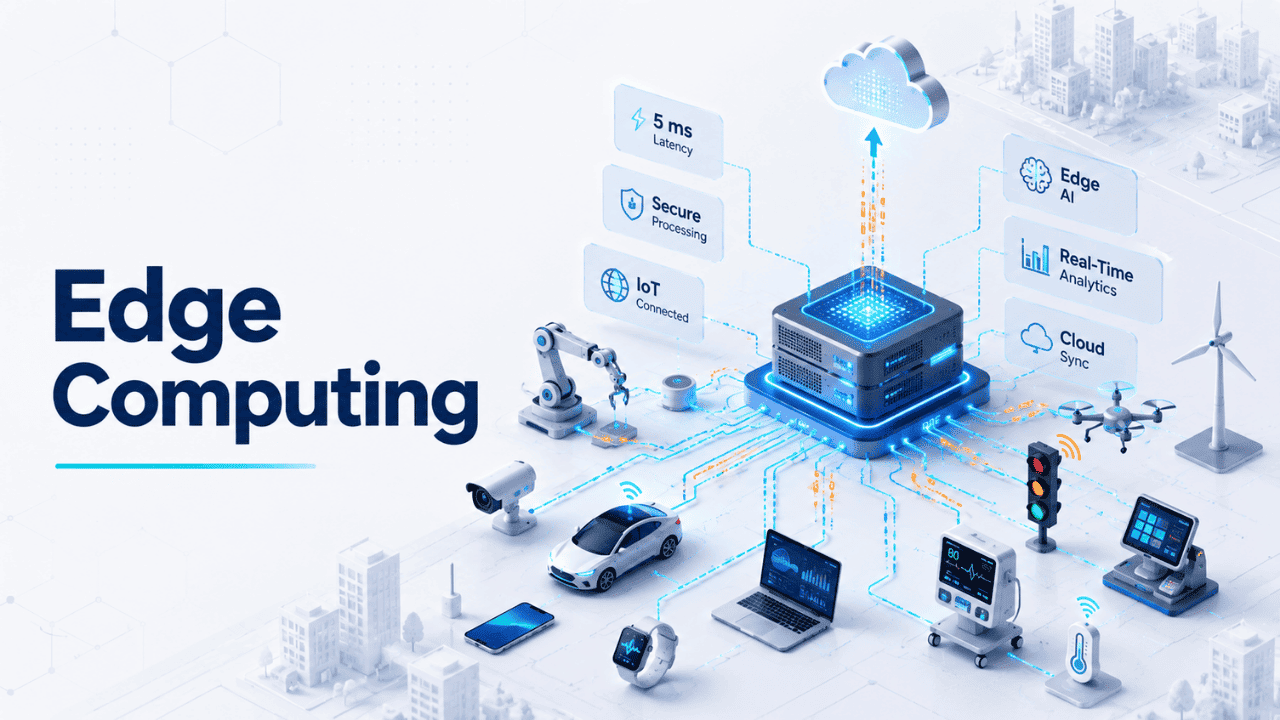
Edge computing is a distributed computing model that processes data closer to where it is generated, rather than sending it to a centralized cloud or data center first. By performing computation at or near the network's edge, it reduces latency, lowers bandwidth usage, and enables faster, real-time decision-making.
Every time you unlock your phone with facial recognition, ask a smart speaker for the weather, or watch a self-driving car react instantly to its surroundings, you're seeing edge computing in action. These experiences depend on processing data locally so decisions can be made in milliseconds instead of waiting for information to travel to a distant cloud server and back.
For years, the default approach was to send almost all data to centralized cloud data centers for processing. While that model works well for many workloads, it struggles when speed, reliability, and low latency become critical. Edge computing addresses this challenge by bringing computing power closer to the devices and users that generate the data.
This guide explains what edge computing is, how it works, how it compares with cloud computing, its key benefits, real-world applications, challenges, and why it has become a cornerstone of modern technologies such as IoT, Edge AI, 5G, and autonomous systems.
What Is Edge Computing?
So, what is edge computing in plain terms? It's a computing model that processes data as close as possible to where that data is actually generated, instead of shipping it off to a distant data center first. The "edge" refers to the outer boundary of a network, the devices, sensors, and local servers sitting near the source of the data, rather than the centralized cloud sitting hundreds or thousands of miles away.
Think of it like this: imagine a factory manager who used to email every single decision to headquarters and wait for a reply before acting. Now imagine giving that manager the authority to make routine calls on the spot, only escalating the complicated stuff. That's the shift edge computing represents. Instead of every sensor reading, camera frame, or transaction traveling all the way to a remote server and back, a nearby edge device handles the immediate work and only sends what's necessary upstream.
This isn't a replacement for the cloud, it's a complement to it. Edge computing handles the fast, local decisions; the cloud still handles the big-picture analytics, long-term storage, and heavy machine learning training that don't need to happen instantly.
How Edge Computing Works
At a technical level, edge computing works by distributing compute power across a network instead of concentrating it in one place. Rather than a single round trip to a faraway data center, data now has a shorter, smarter path to travel.
The Role of Edge Devices and Edge Servers
Two components make this possible: edge devices and edge servers.
Edge devices are the things generating the data in the first place, security cameras, industrial sensors, point-of-sale terminals, wearables, smart thermostats, and connected vehicles. Many of these devices now come with enough built-in processing power to handle basic analysis themselves, without needing to phone home for every calculation.
Edge servers sit one layer further back, often at a local facility, a nearby cell tower, or a regional micro data center. They're more powerful than individual edge devices but still much closer to the data source than a centralized cloud region. Edge servers typically aggregate data from multiple devices, run more complex processing, and decide what actually needs to be sent further upstream to the cloud.
Data Processing Flow (Device → Edge → Cloud)
Here's a simplified picture of the journey data actually takes:
- Data is generated at the device level, a camera captures a frame, a sensor logs a temperature reading, a car's onboard system registers a nearby obstacle.
- Local processing happens immediately on the device or a nearby edge server. This is where filtering, basic analysis, and time-sensitive decisions occur.
- Only relevant data moves forward. Instead of streaming raw, unfiltered data to the cloud, the edge layer sends summaries, alerts, or exceptions, the pieces that actually matter for storage, long-term trend analysis, or further AI training.
- The cloud handles the rest — deeper analytics, model retraining, historical storage, and cross-device correlation that doesn't need split-second timing.
This is precisely how does edge computing reduce latency for end users: by cutting out the physical distance and network hops that data would otherwise have to travel. A request that might take 100+ milliseconds to reach a distant data center and come back can be handled in single-digit milliseconds when it's processed locally instead.
Edge Computing vs. Cloud Computing
It's easy to assume edge computing vs cloud computing is a competition, but it's really a division of labor. Understanding where each one shines helps explain why so many modern systems use both together.
Cloud computing
Cloud computing centralizes processing and storage in large data centers, accessed over the internet. It's excellent for scalability, cost-efficiency at scale, and running complex workloads that don't need to happen in real time — batch analytics, large-scale storage, and heavy model training, for example. If you want the fundamentals of how this model works, Troop Messenger's guide on what is cloud computing breaks down the core service models in more depth.
Edge computing
Edge computing decentralizes that processing, pushing it out toward the network's edge. It trades some of the cloud's raw scalability for speed, reduced bandwidth usage, and the ability to keep functioning even when connectivity drops.
Here's a quick side-by-side:
| Factor | Cloud Computing | Edge Computing |
| Processing location | Centralized data centers | Near the data source |
| Latency | Higher (network round trip) | Much lower |
| Bandwidth usage | Higher (raw data transmitted) | Lower (only relevant data sent) |
| Offline resilience | Limited without connectivity | Can operate with intermittent connectivity |
| Best for | Large-scale storage, deep analytics, training AI models | Real-time decisions, latency-sensitive applications |
Organizations weighing where to run their own infrastructure often land on a hybrid approach, similar to the logic covered in Troop Messenger's piece on on-premise vs cloud deployment, where control, latency, and compliance needs shape the final decision just as much as raw cost does. In fact, the reasoning behind choosing localized infrastructure for security and control, outlined in top reasons to choose on-premise servers over cloud, mirrors a lot of the thinking that pushes companies toward edge computing solutions in the first place: keeping sensitive or time-critical data closer to home.
Key Benefits of Edge Computing
The edge computing benefits that consistently show up across industries fall into a few clear categories:
Reduced latency. This is the headline benefit. When data doesn't have to travel to a distant server and back, response times shrink dramatically, critical for anything involving real-time decisions.
Lower bandwidth costs. Sending only filtered, relevant data upstream (instead of a constant raw stream) significantly cuts network traffic and the associated costs of moving that data.
Improved reliability. Edge systems can often keep functioning locally even when the connection to the central cloud is spotty or temporarily down — a big deal for remote industrial sites, ships, or rural locations.
Better data privacy and compliance. Processing sensitive data locally, rather than transmitting it to a centralized location, can help organizations meet data residency and privacy requirements more easily.
Scalable, distributed architecture. Adding more edge nodes to handle more locations or devices is often more practical than continuously scaling a single centralized system.
Interestingly, this decentralization trend connects directly to how businesses are rethinking IT infrastructure more broadly, a shift explored in how cloud innovation is redefining modern IT infrastructure, which notes that companies increasingly process data closer to the source specifically to reduce delays and speed up decision-making.
Edge Computing in IoT
Few areas benefit from edge computing as directly as the Internet of Things. Edge computing in IoT solves one of the field's biggest structural problems: the sheer volume of data that connected devices generate.
A single smart factory might have thousands of sensors reporting temperature, vibration, and output data every second. Sending every one of those readings to the cloud in real time would be both expensive and slow. Instead, local edge nodes filter and analyze that data on-site, flagging only anomalies or summarized trends for the cloud to store and analyze further.
Edge Computing in Autonomous Vehicles
Self-driving cars are perhaps the most demanding real-world test of edge computing. A vehicle detecting a pedestrian, a sudden lane change, or an obstacle cannot afford to wait for a cloud server's response, the decision has to happen onboard, in milliseconds. Edge computing in autonomous vehicles allows the car's own systems to process sensor data (from cameras, radar, and lidar) instantly, reserving cloud connectivity for less time-sensitive tasks like map updates or fleet-wide learning.
Mobile Edge Computing (MEC)
Mobile edge computing (MEC) brings this same philosophy to telecom networks. Instead of routing mobile traffic all the way back to a distant data center, MEC places compute resources directly within the mobile network, often right at the cell tower or a nearby facility. This is especially powerful when paired with 5G, enabling applications like real-time video analytics, cloud gaming, and AR/VR experiences that need consistently low latency, even on the move.
Edge AI: Where Edge Computing Meets Artificial Intelligence
Edge AI is the natural pairing of these two trends: running AI models directly on edge devices instead of routing every inference request through the cloud. Rather than sending a camera feed to a distant server to ask "is that a person or an animal?", the device itself runs a lightweight, optimized model and answers the question on the spot.
This matters for a few reasons. First, speed, real-time applications like fraud detection, predictive maintenance, or safety monitoring can't tolerate the delay of a cloud round trip. Second, bandwidth, streaming raw video or sensor data to the cloud for every inference is expensive and often unnecessary once local processing can extract just the meaningful insight. Third, privacy, keeping sensitive data (like facial recognition footage) on-device rather than transmitting it reduces exposure.
Edge AI does have real constraints, though. Devices at the edge typically have far less compute power, memory, and energy budget than a cloud data center, so models need to be compressed, quantized, or otherwise optimized to run efficiently on limited hardware. This tension between capability and constraint is exactly why the hardware choices discussed later in this guide matter so much.
Edge Computing Platforms and Solutions
A growing number of major providers now offer dedicated edge computing platforms, giving businesses a structured way to build and deploy at the edge rather than engineering everything from scratch.
AWS Wavelength
AWS Wavelength embeds AWS compute and storage services directly within telecom providers' 5G networks, letting developers build ultra-low-latency applications, like real-time gaming, machine learning inference, or industrial automation, without leaving the carrier's network. You can explore the specifics on the official AWS Wavelength page.
Microsoft Azure
Microsoft Azure offers two complementary edge computing solutions. Azure Stack Edge brings Azure-managed compute, storage, and even hardware-accelerated machine learning directly to physical edge locations through purpose-built appliances. Meanwhile, Azure IoT Edge focuses specifically on deploying containerized workloads, AI models, analytics, or custom business logic, directly onto IoT devices, so they can keep operating and making decisions even during connectivity gaps.
Google Cloud
Google Cloud and other major providers offer similar distributed edge and IoT platforms, generally following the same principle: extend familiar cloud tools and APIs out to the network's edge, rather than forcing developers to build an entirely separate technology stack for edge deployments.
When evaluating edge computing solutions, the right platform choice usually comes down to which cloud ecosystem you're already invested in, the specific latency requirements of your application, and how much control you need over the physical hardware versus a managed service.
Hardware Behind Edge Computing: Best SoCs for Edge Computing
None of this works without the right silicon. Because edge devices operate under real constraints, limited power, limited space, and sometimes harsh physical environments, the chips powering them need to be efficient as well as capable.
When people search for the best SoCs for edge computing, a few categories consistently come up:
- NVIDIA Jetson series — widely used for edge AI workloads requiring GPU-accelerated inference, popular in robotics, drones, and computer vision applications.
- Qualcomm Snapdragon (industrial/IoT variants) — known for strong power efficiency alongside solid AI inference capability, common in mobile edge and embedded devices.
- Intel Movidius/VPU-based chips — purpose-built for low-power vision processing, often used in cameras and inspection systems.
- Google Coral (Edge TPU) — designed specifically to accelerate TensorFlow Lite models at the edge with minimal power draw.
- ARM Cortex-based SoCs — the backbone of countless IoT sensors and embedded systems, valued for their balance of cost, power efficiency, and broad ecosystem support.
The right choice depends heavily on the workload. A security camera running basic motion detection needs far less compute than an autonomous vehicle processing multiple camera and sensor feeds simultaneously. Choosing hardware that's over-specced wastes money and power; choosing hardware that's under-specced creates bottlenecks that undercut the entire point of moving processing to the edge.
Real-World Use Cases of Edge Computing
Edge computing has moved well past theory into everyday deployment across a wide range of industries:
Manufacturing — Predictive maintenance systems monitor equipment vibration and temperature in real time, flagging potential failures before they cause costly downtime.
Healthcare — Wearable and bedside monitoring devices process vital signs locally, alerting staff immediately to dangerous changes rather than waiting on a cloud round trip.
Retail — Smart shelves and computer-vision-based checkout systems analyze customer behavior and inventory levels on-site, enabling faster restocking and reduced shrinkage.
Smart cities — Traffic management systems process camera and sensor data locally to adjust signal timing in real time, easing congestion without waiting on a centralized system.
Energy — Remote wind farms and oil rigs use edge nodes to monitor equipment and make operational decisions even when connectivity to a central system is unreliable or intermittent.
Gaming and entertainment — Cloud gaming platforms use edge servers to reduce input lag, delivering a smoother, more responsive experience for players.
Challenges and Limitations of Edge Computing
Edge computing isn't a free upgrade, it comes with real trade-offs worth planning for.
Security complexity
More distributed devices means a larger attack surface. Every edge node is a potential entry point, and securing thousands of geographically scattered devices is harder than securing one centralized data center. Teams managing distributed communication and data across locations often lean on secure, centrally managed tools, something covered in Troop Messenger's overview of instant messaging and how organizations balance real-time communication with data control.
Management overhead
Monitoring, updating, and maintaining a fleet of edge devices across multiple physical locations is significantly more complex than managing a handful of centralized servers.
Hardware costs and constraints
Specialized SoCs, ruggedized enclosures, and on-site infrastructure add upfront costs that a purely cloud-based approach avoids.
Inconsistent standards
Unlike cloud computing, which has matured around a few dominant, well-documented platforms, edge computing still involves more fragmentation across vendors, protocols, and hardware ecosystems, something groups like NIST have worked to formalize. Their fog computing conceptual model publication is a useful reference for understanding how these decentralized computing concepts are being standardized.
Conclusion
Edge computing isn't replacing the cloud, it's completing it. By processing data where it's actually generated, businesses get the speed, reliability, and bandwidth savings that centralized cloud computing alone can't deliver for latency-sensitive applications. From autonomous vehicles making split-second decisions to factory sensors predicting equipment failure before it happens, the pattern is the same: keep the fast, local decisions close to home, and send only what matters to the cloud for the bigger picture.
As 5G networks expand and AI models become more efficient at running on constrained hardware, edge computing's role is only going to grow. Whether you're evaluating edge computing platforms for your own infrastructure or just trying to understand why your phone's face unlock feels instantaneous, the underlying idea is the same: bring the computing closer to where it's needed.
Frequently Asked Questions
Q1. What is edge computing in simple terms?
Edge computing is a computing approach that processes data close to where it is created, such as on IoT devices, sensors, or local edge servers, instead of sending everything to a centralized cloud. This reduces the time it takes to analyze and respond to information, making applications faster and more reliable. It is especially useful for real-time use cases like autonomous vehicles, smart manufacturing, healthcare, and video surveillance, where low latency is essential.
Q2. How does edge computing reduce latency?
Edge computing reduces latency by processing data near the source instead of transmitting it to a distant cloud data center for analysis. Since data travels a much shorter distance, response times are significantly faster. This is critical for applications that require instant decisions, such as industrial automation, smart traffic systems, online gaming, and autonomous vehicles, where even a small delay can affect performance, safety, or the overall user experience.
Q3. What is the difference between edge computing and cloud computing?
The main difference is where data is processed. Cloud computing relies on centralized data centers to store and process information, making it ideal for large-scale analytics and long-term storage. Edge computing performs processing closer to the data source, reducing latency and bandwidth usage. Rather than replacing each other, edge and cloud computing often work together, with the edge handling real-time tasks while the cloud manages storage, analytics, and complex workloads.
Q4. What are the benefits of edge computing?
Edge computing offers several advantages, including lower latency, faster response times, reduced bandwidth consumption, improved reliability, and enhanced data privacy. By processing information locally, it minimizes delays and allows critical applications to continue operating even when internet connectivity is limited. These benefits make edge computing valuable across industries such as healthcare, manufacturing, retail, transportation, telecommunications, and smart city infrastructure, where real-time data processing is a priority.
Q5. Where is edge computing used?
Edge computing is widely used in industries that depend on real-time decision-making. Common applications include IoT devices, autonomous vehicles, smart factories, healthcare monitoring systems, retail analytics, smart cities, cloud gaming, telecommunications, and video surveillance. In these environments, processing data locally improves performance, reduces network congestion, and enables faster responses to changing conditions, making systems more efficient, reliable, and scalable than relying solely on centralized cloud infrastructure.
Q6. Is edge computing replacing cloud computing?
No. Edge computing is not replacing cloud computing; instead, the two technologies complement each other. Edge computing is designed for low-latency processing and immediate decision-making near the data source, while cloud computing provides centralized storage, large-scale analytics, backup, and machine learning model training. Most modern organizations adopt a hybrid approach that combines both technologies, allowing them to benefit from the speed of edge computing and the scalability of the cloud.