Connect with us
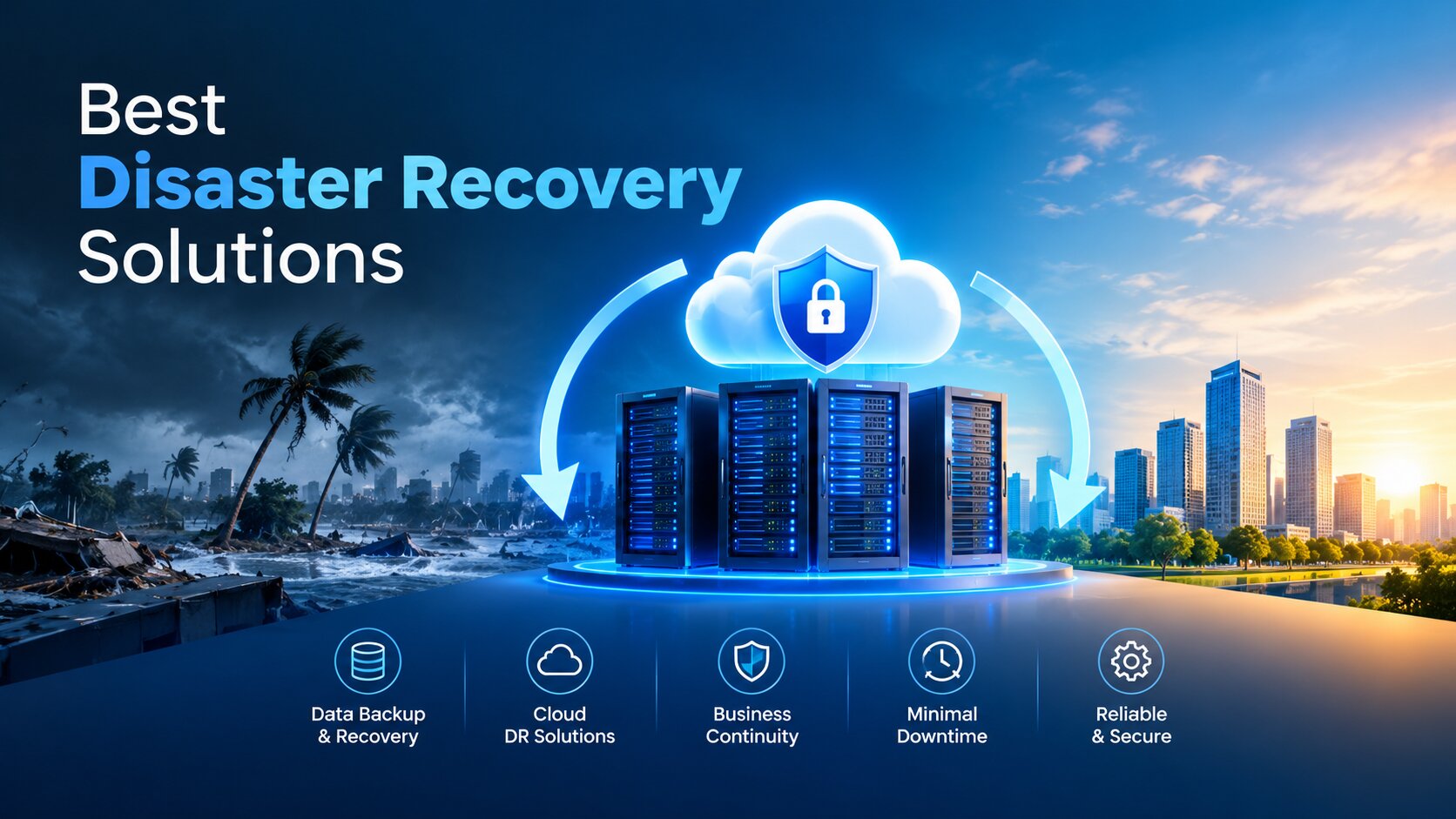
Best Disaster Recovery Solutions
Disaster recovery solutions protect a business from downtime after an outage, cyberattack, or human error - but most of them only protect part of the picture. I've spent time evaluating recovery tools across data, workloads, and infrastructure, and this guide breaks down the best disaster recovery solutions in 2026, what each one actually covers, and where the gaps are.
TL;DR
ControlMonkey is the strongest overall pick because it makes the configuration layer behind modern cloud operations recoverable - across cloud infrastructure, SaaS, identity, network, and observability - restoring known-good configuration states when data recovery alone isn’t enough.
Zerto and Veeam are best for continuous replication and near-instant failover of live virtualized or cloud workloads.
Rubrik and Commvault suit enterprises that want ransomware-hardened, immutable recovery bundled with broader data protection.
Druva fits teams that want a fully managed, zero-infrastructure DR platform for AWS and VMware workloads.
Best disaster recovery solutions: Comparison
| Solution | Best for | Type | Starting price |
| ControlMonkey | Recovering critical cloud and SaaS configurations that traditional data backup leaves exposed | Cyber Resilience / Cloud Configuration Disaster Recovery | Custom |
| Zerto | Continuous replication and near-instant failover of virtualized workloads | Continuous data protection (CDP) | Custom (reported median ~$76,750/year) |
| Veeam | Immutable, ransomware-resistant backup with automated failover | Backup and DR/replication platform | Custom |
| Rubrik | Zero-trust, immutable recovery for enterprises worried about ransomware | Cyber recovery / cloud data security | Custom (reported median ~$601,917/year) |
| Commvault | Automated, code-driven rebuild of full cloud application environments | Recovery-as-code / cloud-native DR | Usage-based (from $0.035/instance/hour on AWS) |
| Druva | Fully managed, hardware-free DR for AWS and VMware workloads | Cloud-native SaaS DR platform | Custom (reported median ~$41,634/year) |
Note: ControlMonkey is listed first not because it replaces the other five, but because none of them restores the DNS, IAM, routing, and SaaS configuration layer a real disaster recovery event actually depends on - that's the piece this comparison keeps coming back to.
Top disaster recovery solutions
- ControlMonkey
- Zerto
- Veeam
- Rubrik
- Commvault
- Druva
Disaster recovery solution #1: ControlMonkey
Best for: Enterprises that need to recover critical cloud and SaaS configuration alongside data and workloads.
Type of solution: Cyber Resilience Platform for Cloud Configuration Disaster Recovery.
ControlMonkey is a disaster recovery solution for critical cloud and SaaS configuration. It continuously discovers, snapshots, and recovers configurations across AWS, Azure, and GCP, as well as platforms such as Okta, Cloudflare, Datadog, and other third-party systems. This gives teams versioned, known-good recovery points for the identity, networking, security, and observability configurations needed to get operations back after an incident
ControlMonkey disaster recovery: Features
- Automated daily infrastructure snapshots
- One-click recovery with dependency-aware ordering
- Real-time DR readiness dashboard
Automated daily infrastructure snapshots
ControlMonkey captures exact configuration states and stores them as versioned recovery points, creating a recovery-ready history of the environment and allowing teams to return to a previous known-good state.
One-click recovery with dependency-aware ordering
When something breaks, teams pick any prior known-good snapshot and restore individual resources or entire environments in one click. Routine fixes can be reviewed before deployment, while critical incidents can trigger an automatic rollback, and dependencies are handled automatically so a recovered resource comes back correctly ordered rather than half-restored.
Real-time DR readiness dashboard
The Cloud Resilience Dashboard gives teams continuous visibility into what is protected, what is recoverable, and where disaster recovery gaps remain across cloud and SaaS configurations.
ControlMonkey: Reviews from users
- Teams cite full visibility into what's actually recoverable - across cloud and SaaS - as the main reason they picked ControlMonkey over a data-only backup tool.
- The one-click restore flow is regularly called out as removing the manual, error-prone part of rebuilding infrastructure after an incident.
- A fintech customer processing well over $200 billion annually reported achieving full multi-cloud recoverability after adopting the platform, alongside measurable RPO/RTO improvements.
ControlMonkey: Pricing
ControlMonkey offers two plans.
The platform offers 2 plans:
- Pro: custom pricing, up to 50,000 cloud assets, and 50,000 protected resources, with drift detection, RBAC, and a self-hosted agent included.
- Enterprise: custom pricing for unlimited assets, users, and deployments, with specialized support added.
Disaster recovery solution #2: Zerto
Best for: Enterprises needing continuous data protection and near-real-time failover for virtualized and cloud workloads.
Type of solution: Continuous data protection (CDP) and orchestrated failover platform.
Zerto replicates data in real time across on-premises, private cloud, and public cloud environments (AWS, Azure, IBM Cloud, Oracle Cloud), supporting hundreds of managed service providers and aiming for RTOs measured in minutes with RPOs measured in seconds.
Zerto disaster recovery: Key features
- Continuous, sub-second data replication with recovery to any point in time
- Automated, non-disruptive failover and failback testing for entire applications
- Broad hypervisor and multi-cloud support
Reviews about disaster recovery solutions: user experience with Zerto
| Zerto disaster recovery: benefits | Zerto disaster recovery: disadvantages |
| Data loss measured in seconds thanks to continuous replication | Reported enterprise spend runs well into six figures annually at scale |
| Automated orchestration makes failover and failback largely hands-off | No built-in infrastructure-as-code layer - cloud provisioning and rewiring still needs separate tooling |
| Works across different hypervisors and both on-prem and public cloud | Doesn't version or recover configuration outside the workloads it replicates |
Zerto: Pricing
Zerto's pricing is custom; third-party deal data puts the typical annual spend in the range of $45,000–$155,000, depending on scale.
Disaster recovery alternative #1: Veeam
Best for: Organizations wanting immutable, ransomware-resistant backup bundled with automated cloud failover. Type of solution: Backup and DR/replication platform.
Veeam combines continuous data protection with immutable, air-gapped cloud storage and network-extension appliances that stretch a company's on-premises network into the cloud during failover, aiming to keep IP addressing intact without a manual re-architecture.
Veeam: Key features
- Continuous data protection with RPOs measured in seconds
- Immutable, air-gapped backup storage for clean recovery after ransomware
- Network extension appliances that preserve connectivity during failover
Reviews about disaster recovery alternatives: Veeam
| Veeam disaster recovery: benefits | Veeam disaster recovery: disadvantages |
| Native integration with AWS, Azure, and GCP for replication and recovery | Rebuilding cloud infrastructure (networks, security policies, DNS routing) typically needs separate IaC tooling |
| Immutable storage protects against tampered or encrypted backups | Doesn't inherently version full infrastructure configuration as code |
| Supports image-based backup and near-instant restore across VMs, physical servers, and cloud workloads | Pricing isn't published; requires a custom quote |
Disaster recovery alternative #2: Rubrik
Best for: Enterprises prioritizing zero-trust, immutable recovery specifically hardened against ransomware and destructive attacks. Type of solution: Cyber recovery and cloud data security platform.
Rubrik treats backups as a security boundary - applying immutability from the first backup, retention locks, encryption, and logical air gaps - and extends recovery coverage to identity platforms like Okta, Active Directory, and Entra ID, which most DR tools ignore entirely.
Rubrik: Key features
Immutable, air-gapped backup vaults with retention locks
Granular RBAC and audit trails restricting who can initiate recovery
Identity recovery coverage spanning Okta, AD, and Entra ID
Reviews about disaster recovery alternatives: Rubrik
| Rubrik disaster recovery: benefits | Rubrik disaster recovery: disadvantages |
| Strong ransomware-specific recovery workflows, including isolated recovery environments | Reported enterprise spend can run into the hundreds of thousands per year |
| Unique identity-provider recovery most DR platforms skip | Focused more on data and identity security than infrastructure-as-code recovery |
| Zero-trust, immutable-by-default backup architecture | Enterprise pricing and scope may be more than teams needing basic VM-level DR |
Disaster recovery alternative #3: Commvault
Best for: Teams wanting automated, code-driven reconstruction of entire cloud application environments. Type of solution: Recovery-as-code / cloud-native disaster recovery.
Commvault's Cloud Rewind capability continuously discovers cloud resources and their dependencies, captures point-in-time configuration snapshots in immutable, air-gapped vaults, and uses its own Recovery-as-Code approach to rebuild full cloud environments — data, configuration, and infrastructure together — while flagging drift that might signal unauthorized changes.
Commvault: Key features
Automated discovery and dependency mapping across cloud environments
Recovery-as-code that rebuilds cloud infrastructure, applications, and data together from immutable snapshots
Drift analysis to flag unauthorized configuration changes
Reviews about disaster recovery alternatives: Commvault
| Commvault disaster recovery: benefits | Commvault disaster recovery: disadvantages |
| Replaces manual environment rebuilding with automated, minutes-long recovery | Coverage is scoped to the cloud provider's own infrastructure (AWS most mature; Azure and GCP support expanding) — it doesn't extend to third-party SaaS, identity, network, or observability platforms |
| Recovery-as-code rebuilds infrastructure and data together, not data alone | Runs its own separate recovery pipeline and proprietary automation rather than integrating with a customer's existing Terraform/Git-based IaC workflow |
| Sandboxed clones allow safe testing of updates before they hit production | Costs can add up quickly at very high instance countsUsage-based pricing can add up quickly at very high instance counts |
Commvault: Pricing
Commvault's cloud DR pricing is usage-based - around $0.035 per instance/hour on AWS for smaller deployments, dropping to about $0.021 per instance/hour above 100,000 instances.
Disaster recovery alternative #4: Druva
Best for: Teams wanting a fully managed, hardware-free DR platform for AWS and VMware workloads. Type of solution: Cloud-native SaaS disaster recovery platform, built on AWS.
Druva eliminates on-premises DR hardware entirely, offering one-click failover of on-prem VMs into any AWS region, the ability to clone full AWS workload stacks to alternate regions, and failback once the original site is restored.
Druva: Key features
- One-click failover of on-premises VMs to AWS
- Cloning of complete AWS environments (EC2, RDS, and dependencies) for DR
- Failback recovery to original on-premises or VMware Cloud on AWS environments
Reviews about disaster recovery alternatives: Druva
| Druva disaster recovery: benefits | Druva disaster recovery: disadvantages |
| 100% SaaS delivery removes DR hardware and secondary-site management overhead | Backup-centric approach focuses on data/application recovery rather than infrastructure-as-code restoration |
| FedRAMP-certified with built-in HIPAA and SOC 2 compliance | Reported RPOs around an hour may not satisfy the most stringent requirements |
| Native AWS integration across regions with failback support | Pricing is not published up front |
Druva: Pricing
Druva's pricing is custom; third-party deal data puts the typical annual spend around $41,000, with larger buyers reporting figures up to roughly $118,000/year.
Disaster recovery best practices: what a real DR plan needs beyond backup
A disaster recovery plan needs more than backed-up data - it needs the DNS, IAM, routing, and SaaS configuration around that data to come back in the right order, or the restore can look complete while systems still don't actually work.
Disaster recovery as a service (DRaaS): how it differs from traditional DR
Disaster recovery as a service delivers replication, failover, and recovery as a managed offering rather than infrastructure a company builds and runs itself. It removes the burden of maintaining a secondary site, but it doesn't automatically solve the configuration-recovery gap - that still depends on whether the provider (or a complementary tool) captures infrastructure state, not just data.
Conclusion: What is the best disaster recovery solution?
Disaster recovery plans rarely fail because data went missing - they fail because the infrastructure around that data can't be rebuilt fast enough, accurately enough, or completely enough. Picking the right solution depends on what you're actually trying to protect.
- If you care about continuous replication and near-real-time failover for live workloads, try Zerto or Veeam.
- If you care about zero-trust, ransomware-hardened recovery at enterprise scale, try Rubrik or Commvault.
- If you want a fully managed, hardware-free DR platform for AWS/VMware workloads, try Druva.
- If you want cloud and SaaS configuration recovery across infrastructure, identity, network, and observability, with versioned known-good recovery points, the best choice is ControlMonkey.