Connect with us
How Digital Transformation Is Reshaping Professional Networking
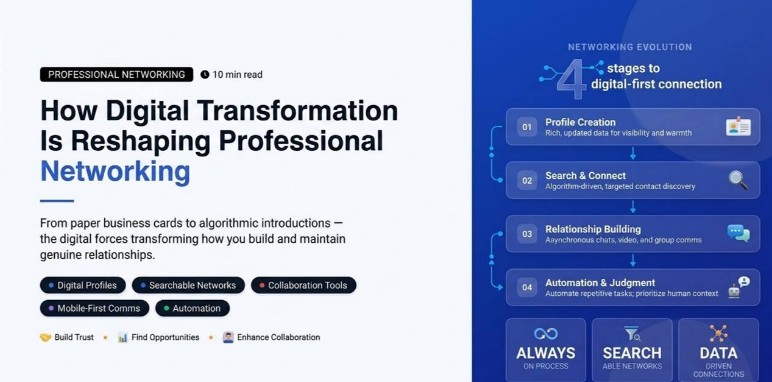
Ten years ago, professional networking mostly meant business cards, conference badges, and awkward small talk over coffee at industry events. Today, a huge share of meaningful professional relationships start with a comment on a post, a message in a group chat, or an introduction made by an algorithm rather than a mutual friend.
This shift didn't happen overnight. It's the result of a broader wave of digital transformation that has touched almost every corner of how businesses operate — from the tools teams use to collaborate, to the platforms professionals use to find their next job, client, or business partner. Networking, once a largely offline activity, has become deeply intertwined with technology.
In this article, we'll look at how digital transformation is changing professional networking, what's driving the shift, and what it means for individuals and organizations trying to build genuine relationships in an increasingly digital-first world.
What Digital Transformation Actually Means for Networking
Digital transformation is often discussed in the context of internal business processes — automating workflows, digitizing records, or moving infrastructure to the cloud. But its effects extend well beyond internal operations. It has fundamentally changed how professionals discover each other, communicate, and maintain relationships over time.
A few forces have driven this change:
- Remote and hybrid work removed the default assumption that colleagues, clients, and partners are in the same building.
- Cloud-based collaboration tools made it possible to work closely with people across time zones and continents.
- Social and professional platforms replaced physical directories and referral chains with searchable, algorithm-driven networks.
- Mobile-first communication means that networking conversations no longer wait for a scheduled meeting; they happen continuously, in short bursts, throughout the day.
Together, these forces have turned networking from an occasional, event-driven activity into an ongoing, always-on process.
From Business Cards to Digital Profiles
One of the clearest signs of this transformation is the near-total disappearance of the physical business card as the primary networking tool. In its place, professionals now rely on digital profiles that are constantly updated, easily searchable, and far more detailed than anything a paper card could hold.
Why Digital Profiles Are More Powerful
A modern professional profile typically includes:
- Career history and endorsements from colleagues
- Portfolio work, case studies, or published articles
- Shared connections that provide social proof
- Activity history that shows what someone is currently focused on
This richness means that by the time two professionals actually speak for the first time, they often already know a great deal about each other's background, interests, and mutual connections. The "cold" in cold outreach has gotten considerably warmer.
The Rise of Searchable Networks
Search and filtering tools have also changed how people find each other. Instead of relying on someone at a conference to introduce you to the right person, professionals can now search by industry, role, location, or shared interest and identify relevant contacts directly. This has made networking far more targeted, even if it has also made it more transactional in some cases.
Digital Communication Tools Are Changing How Relationships Are Built
Networking isn't just about first connections anymore — it's about how relationships are sustained and deepened over time. This is where business communication tools have played an outsized role.
Team messaging platforms, video conferencing apps, and collaborative workspaces were originally designed for internal team use, but their influence has spilled over into external relationship-building as well. Professionals now use many of the same habits they've developed for internal team chats — quick messages, shared files, informal check-ins — when nurturing relationships with clients, partners, and industry peers.
A Few Notable Shifts in Communication Habits
- Asynchronous conversations have become normal, allowing relationships to develop across time zones without everyone needing to be online simultaneously.
- Group-based communication (in communities, forums, and team channels) has partly replaced one-on-one outreach as the starting point for new connections.
- Video-first interactions have made remote meetings feel closer to face-to-face conversations than a phone call ever could.
Interestingly, many organizations have found that internal collaboration tools — like Troop Messenger, Slack, or Microsoft Teams — end up shaping employees' communication instincts in ways that carry over into how they network externally. Someone who is used to quick, informal, screen-shared conversations at work tends to bring that same style to external relationship-building.
The Role of Automation in Modern Networking
Automation has quietly become one of the most significant forces reshaping professional networking, particularly on platforms built around large professional networks. Where networking once required manually sending each message and tracking every follow-up in a spreadsheet, tools now handle much of that repetitive work.
This shift is particularly visible in outreach and relationship management. Sales teams, recruiters, and business development professionals frequently rely on a LinkedIn automation tool to manage large-scale outreach without losing the ability to personalize individual messages, streamlining tasks like connection requests, follow-ups, and profile visits that would otherwise consume hours each week.
It's worth being clear-eyed about this trend, though. Automation is best used to remove friction from processes that were already repetitive and manual — not to replace genuine relationship-building. The professionals who get the most value from these tools tend to use them to handle logistics (scheduling, initial outreach, reminders) while still investing real time and attention in the actual conversations that matter.
Where Automation Helps Most
- Sending initial outreach at scale while keeping messages personalized
- Tracking follow-ups so no conversation falls through the cracks
- Freeing up time for deeper, higher-value conversations
- Identifying patterns in what types of outreach get responses
Where Human Judgment Still Matters
- Deciding which relationships are worth investing deeper time in
- Reading tone and context in sensitive conversations
- Building trust through consistent, authentic follow-through
- Adapting messaging for cultural or industry-specific nuance
Remote and Hybrid Work Changed the Rules of the Game
Before remote work became widespread, a large share of professional networking happened through physical proximity — office hallways, industry conferences, and after-work events. Hybrid and remote work models disrupted that entirely.
Networking Without a Shared Office
Professionals working remotely can no longer rely on spontaneous hallway conversations to build internal relationships, let alone external ones. This has pushed both individuals and organizations to be more intentional about networking.
Some of the adaptations include:
- Virtual coffee chats scheduled deliberately, rather than happening by chance
- Company-run online communities and interest-based channels
- Digital-first onboarding that introduces new employees to a wider network early on
- Cross-team virtual events designed to replicate the informal connections that used to happen in person
A More Inclusive, But More Effortful, Model
There's a genuine upside here: remote-first networking has, in many cases, become more inclusive. People who might have been excluded from in-person networking due to geography, caregiving responsibilities, or accessibility issues can now participate more fully. At the same time, this model requires more deliberate effort — relationships that used to form organically now often need to be actively created and maintained.
SaaS Platforms Are Becoming the New Networking Infrastructure
Software-as-a-service platforms have quietly become the infrastructure that professional networking now runs on. This goes beyond dedicated networking platforms to include project management tools, CRM systems, and collaboration suites that double as relationship-tracking systems.
How SaaS Tools Support Networking Behind the Scenes
- CRM systems track not just sales relationships but also broader professional contacts and interaction history.
- Project management tools often reveal cross-company collaboration patterns that turn into longer-term professional relationships.
- Community platforms built into SaaS products create spaces where users become peers, sharing advice and eventually business opportunities.
This convergence means that the tools companies use to run day-to-day operations often double as unintentional relationship-building engines, even when that wasn't their original purpose.
What This Means for Professionals Going Forward
As digital transformation continues to reshape how work gets done, professional networking will likely keep evolving alongside it. A few trends seem likely to continue:
- Networking will keep blending with everyday work tools. The line between "internal communication tool" and "networking tool" will continue to blur.
- Personal branding will matter more. With so much networking happening through searchable digital profiles, how professionals present themselves online will carry more weight than ever.
- Automation will keep expanding, but the professionals who stand out will be the ones who use it to create space for more meaningful conversations, not fewer.
- Trust will remain the deciding factor. No amount of digital infrastructure changes the fact that people ultimately want to work with those they trust — technology just changes how that trust gets built.
Conclusion
Digital transformation hasn't replaced professional networking — it has redistributed where and how it happens. What used to unfold primarily at conferences and over coffee now happens across messaging apps, collaborative platforms, and searchable digital profiles. The tools have changed dramatically, but the underlying goal hasn't: building relationships that create real value for both sides.
For professionals and organizations navigating this shift, the winning approach isn't choosing between "digital" and "human" networking — it's learning to use digital tools in a way that makes human connection easier, not harder.
Frequently Asked Questions
Q: How has digital transformation changed professional networking?
A: Digital transformation has shifted networking away from primarily in-person events toward ongoing digital interactions. Professionals now connect through searchable online profiles, messaging platforms, and virtual communities rather than relying solely on business cards or scheduled meetings. This has made networking more continuous, more data-driven, and often more efficient, though it requires new skills around digital communication and personal branding.
Q: What role do collaboration tools play in professional networking today?
A: Collaboration tools originally designed for internal teams, such as messaging and video conferencing platforms, now heavily influence how professionals interact externally. The habits people develop internally, like quick asynchronous messages or informal video check-ins, often carry over into how they build and maintain external professional relationships, blurring the line between internal communication and outward networking.
Q: Is automated outreach replacing genuine networking relationships?
A: Not entirely. Automation mainly handles repetitive tasks like initial outreach, follow-up reminders, and scheduling, which frees up time for more meaningful conversations. The professionals who use automation most effectively treat it as a way to reduce administrative burden, while still investing real, personal attention into the relationships that matter most.
Q: How has remote work affected the way people build professional connections?
A: Remote and hybrid work removed many of the spontaneous, in-person interactions that used to drive networking, such as hallway conversations or after-work events. As a result, professionals and organizations have had to become more intentional, using virtual coffee chats, online communities, and structured digital events to replicate those organic connections in a remote environment.
Q: Why does personal branding matter more in a digitally transformed networking landscape?
A: Since so much networking now happens through searchable online profiles before any direct conversation takes place, how a professional presents themselves digitally often shapes first impressions. A clear, well-maintained online presence helps professionals stand out, build credibility, and make it easier for the right people to find and connect with them.