Connect with us
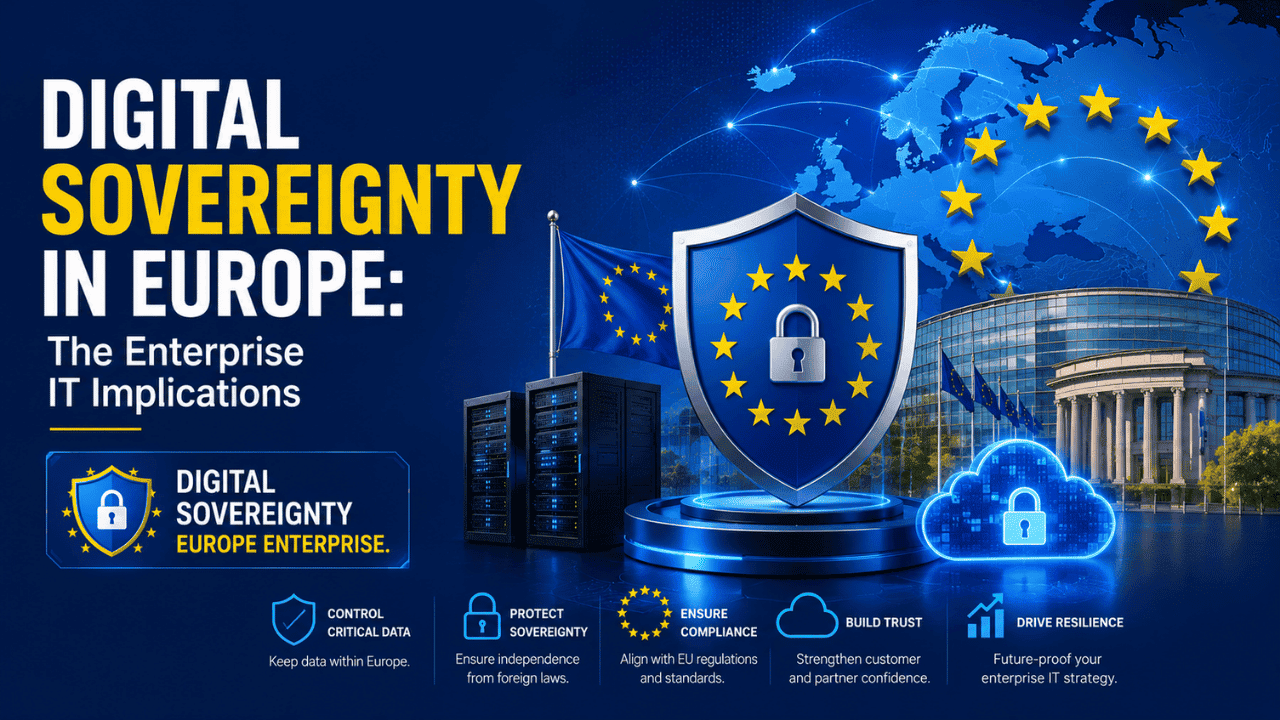
Digital Sovereignty in Europe: The Enterprise IT Implications
Digital sovereignty in Europe is the principle of ensuring that digital data, infrastructure, and services remain governed by European laws and jurisdiction rather than foreign legal frameworks. As enterprises face increasing regulatory and security requirements, many are also evaluating on-premise and sovereign cloud deployments to strengthen control over sensitive data.
This guide explains what is driving Europe's push for digital sovereignty, how initiatives like Gaia-X are influencing enterprise IT, and what organizations should consider when choosing technology vendors, meeting compliance obligations, and planning long-term infrastructure strategies.
The European push for digital autonomy
Digital sovereignty didn't emerge overnight. It's been building since the mid-2010s, but three forces have accelerated it sharply in the last two years.
1. Legal exposure
Under the U.S. CLOUD Act, American providers can be compelled to disclose data to U.S. authorities even when that data is stored outside the United States, on infrastructure owned by a European subsidiary. This creates a direct conflict for European enterprises: local law says the data must stay protected under EU rules, while foreign law says a U.S. court order can reach it anyway.
2. Geopolitical instability
Recent years have shown European governments how quickly access to foreign digital infrastructure can become a point of leverage in broader diplomatic disputes. Relying entirely on non-European providers for critical government, defence, and financial infrastructure is now openly discussed as a strategic vulnerability.
3. Economic self-interest
Billions of euros flow to non-European cloud and software vendors every year. Policymakers increasingly view digital sovereignty as an industrial policy question as much as a security one, building a domestic ecosystem keeps that spending, and the jobs that come with it, inside the region.
Together, these forces have moved digital sovereignty from a niche compliance topic into a mainstream boardroom conversation, particularly for organizations in finance, healthcare, defence, and public administration.
Gaia-X and sovereign infrastructure initiatives
The most visible symbol of this shift is Gaia-X, a Franco-German initiative launched in 2020 that has since grown into a broader European association. Gaia-X doesn't build cloud infrastructure itself, it defines common standards, trust labels, and interoperability rules that let providers demonstrate genuine sovereignty, rather than simply claiming it in marketing material.
Federation, not replacement
Gaia-X isn't trying to build a single European alternative to AWS, Azure, or Google Cloud. It's building a trusted framework of interoperable, standards-compliant providers, so enterprises and governments can mix and match sovereign infrastructure without vendor lock-in. Institutions including the European Central Bank have formally joined Gaia-X to support this trusted data ecosystem.
What sits alongside Gaia-X:
- National sovereign cloud projects launched in France and Germany
- Industry-specific data spaces emerging for healthcare, automotive, and energy, built on Gaia-X-aligned standards
- Direct policy adoption, with the European Commission now referencing Gaia-X principles in its own procurement policy
What this means for IT leaders
Not every vendor needs to be Gaia-X certified today. But Gaia-X-aligned criteria are quickly becoming the baseline regulators and large customers expect:
- Verifiable data location
- Transparent sub-processor chains
- Freedom from foreign legal reach
Public-sector procurement is changing first
As with most major shifts in enterprise technology policy, government procurement is moving before the broader private market and moving fast.
The Cloud Sovereignty Framework
The clearest example is the European Commission's own Cloud Sovereignty Framework, a structured, scorable methodology assessing cloud services across eight objectives spanning legal jurisdiction, operational control, supply chain transparency, and technological openness. This isn't a vague policy statement, the Commission has already used it to award a sovereign cloud contract worth up to €180 million to European providers for EU institutions, the first time EU bodies have applied explicit sovereignty scoring to a major procurement decision.
Why this matters beyond Brussels:
- National governments and public agencies tend to mirror Commission standards once established, meaning similar scoring is likely to spread into national and municipal tenders
- Enterprises selling into the public sector, or operating under government oversight, are already being asked to demonstrate the same sovereignty posture to remain eligible bidders
The next layer of regulation
The European Commission's proposed Cloud and AI Development Act aims to formalize a single EU-wide sovereignty framework for both cloud and AI services, alongside common procurement rules. For CIOs, the signal is clear: sovereignty requirements that look optional today are being built into binding procurement law for tomorrow.
Organizations working with, or bidding into, government and defence sectors are increasingly evaluating platforms built specifically to meet that bar. Reviewing Troop Messenger's approach for the government sector shows the kind of sovereignty-aligned posture, self-hosted deployment, jurisdictional clarity, full administrative control, that public-sector buyers are starting to require as a baseline.
Sovereign alternatives across the enterprise stack
Digital sovereignty isn't a single product category, it touches nearly every layer of the enterprise stack.
Infrastructure layer
European cloud providers and Gaia-X-aligned hosting options are maturing as credible alternatives to the big three hyperscalers, particularly for regulated data. These providers increasingly compete on jurisdictional guarantees, a factor that barely featured in RFPs five years ago.
Collaboration and communication layer
Enterprises are re-evaluating whether core internal messaging, file sharing, and video conferencing need to run through foreign-owned SaaS at all, especially for defence, government, and financial-services use cases.
This is the gap on-premise deployment addresses: keeping the most sensitive internal communication entirely within infrastructure the organization owns, with no foreign sub-processor chain to audit in the first place.
Identity and access layer
European-built identity providers are gaining traction as organizations remove foreign dependency from the systems that gatekeep access to everything else.
AI layer
This is the newest and fastest-moving front, as European enterprises weigh whether to route sensitive data through U.S.-hosted large language models at all, driving interest in EU-hosted or self-hosted AI options for regulated or classified information.
How Enterprises Are Adopting Digital Sovereignty
Most enterprises aren't ripping out their entire stack. The more common approach is:
- Keep cost-effective global SaaS for low-sensitivity workloads
- Shift the highest-risk categories, internal strategic communication, compliance documentation, defence and government correspondence, onto infrastructure with clear EU jurisdiction
A comparison like Troop Messenger vs Slack illustrates the practical trade-offs IT teams weigh between familiar global platforms and providers offering on-premise, EU-controllable deployment.
What sovereignty drift costs if ignored
Organizations that treat digital sovereignty as someone else's problem tend to discover the cost at the worst possible moment:
- A vendor disqualified from a public tender because it can't meet sovereignty scoring — a lost contract discovered too late to fix
- A cross-border data transfer flagged during a regulatory audit — a compliance gap that should've been caught during onboarding
- A foreign legal request reaching EU-hosted data through a parent company's jurisdiction — a foreseeable scenario, not a surprise
None of these outcomes require bad luck. They require simply not having asked the jurisdictional question early enough in the vendor relationship.
How to future-proof your vendor choices
Given how quickly this landscape is moving, IT leaders need a concrete way to vendor-proof decisions rather than reacting after regulation catches up.
- Treat jurisdictional exposure as a first-class evaluation criterion, alongside price, features, and support. Ask directly whether a vendor, or its parent company, is subject to foreign legal frameworks like the CLOUD Act — even for EU-hosted instances.
- Map sovereignty requirements to your GDPR compliance obligations rather than treating them separately. Both require knowing exactly where data resides, how it flows through sub-processors, and what legal protections apply.
- Build sovereignty scoring into procurement templates now, even for private-sector purchases. A simplified version of the Commission's scoring approach — legal jurisdiction, operational control, supply chain transparency, technological openness — gives procurement a repeatable framework.
- Prioritize reversibility. Choose vendors and architectures that avoid deep lock-in, so migrating away from a non-compliant provider is a project, not a crisis.
- Watch the regulatory calendar as closely as the vendor market. The Cloud and AI Development Act, evolving Gaia-X labelling, and expanding public-sector sovereignty scoring are all moving targets. Revisit your posture on a fixed cadence, not only when a deal or audit forces the question.
Conclusion
Digital sovereignty in Europe is no longer just a policy discussion, it has become a strategic consideration for enterprise IT. As regulations evolve and public-sector procurement increasingly emphasizes jurisdictional control, organizations need to look beyond where their data is hosted and understand who ultimately governs it. Infrastructure choices, vendor jurisdiction, and data control are now as important as cost, features, and performance.
For CIOs and IT leaders, the path forward is to build digital sovereignty into technology decisions from the outset. Evaluating vendor jurisdiction, adopting sovereignty-focused procurement practices, and using on-premise or sovereign cloud deployments for high-risk workloads can help reduce legal and compliance exposure while improving long-term resilience. Organizations that take these steps today will be better prepared to meet future regulatory requirements, strengthen customer trust, and maintain greater control over their digital assets.
FAQs
1. What does digital sovereignty actually mean for enterprise IT?
Digital sovereignty means an organization's data and critical systems are controlled under its own jurisdiction's laws, free from being compelled to disclose data under a foreign legal framework. For European enterprises, this means evaluating whether vendors, even ones hosting data in the EU, are still subject to foreign laws like the CLOUD Act through their parent company.
2. Is Gaia-X a cloud provider that European companies can simply switch to?
No. Gaia-X isn't a cloud provider itself; it's a federation of standards, trust labels, and interoperability rules that let existing and new providers demonstrate genuine sovereignty. Enterprises use Gaia-X-aligned criteria to evaluate vendors rather than switching to a single "Gaia-X cloud" product.
3. Why is public-sector procurement adopting sovereignty requirements before private companies?
Governments face the most direct exposure to foreign legal reach over sensitive citizen, defence, and administrative data, making sovereignty a compliance necessity rather than a preference. The Commission's Cloud Sovereignty Framework and recent contract awards are already setting a scoring precedent for national procurement bodies to follow.
4. Do European enterprises need to replace their entire SaaS stack to be sovereign?
Not necessarily. Most organizations are adopting selective sovereignty — keeping cost-effective global SaaS for low-sensitivity workloads while shifting the highest-risk data categories, such as internal strategic communication or defence correspondence, onto infrastructure with clear EU jurisdiction.