Connect with us
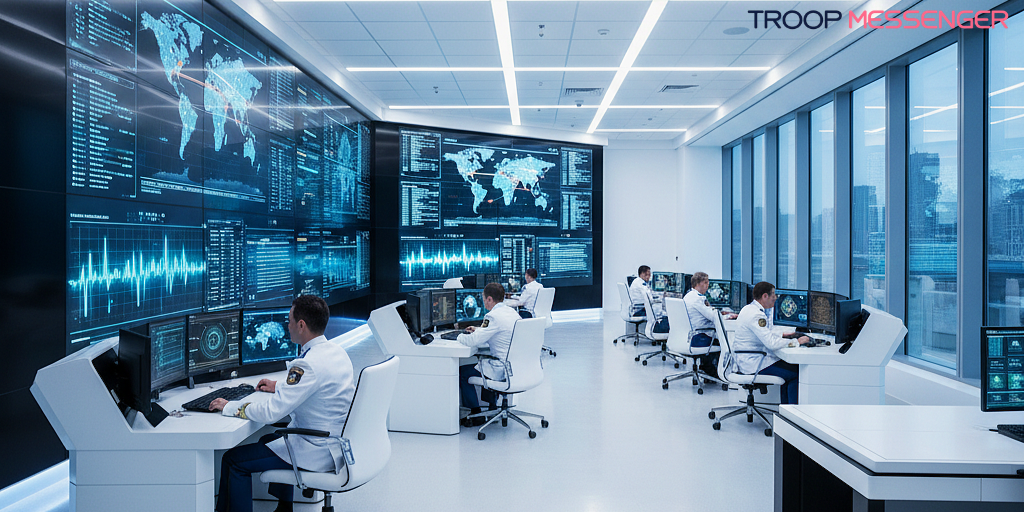
Defence Communication Systems Complete Introduction and Overview
Modern defence operations depend on fast, secure information sharing between command centers, aircraft, ships, satellites, and ground units.
This interconnected network is known as defence communication systems and it forms the backbone of modern military communication.
Without reliable defence communication, coordination would fail within minutes.
In this article, we explain what defence communication systems are, why they are important, the technologies behind them, and the challenges faced in maintaining secure military communication.
1. Why Communication Is the First Line of Defence
Imagine a naval task force sailing through fog. The ships remain invisible to each other, yete very helm turn, every helicopter launch, and every missile detection is coordinated to the second. The glue is a secure voice and data link.
Take that link away and the task force becomes a set of isolated vessels.
- Coordination: Troop movements, logistics, and command decisions rely on shared data.
- Survivability: Timely threat alerts allow units to move or react before it is too late.
- Decision superiority: When commanders see a clearer picture than the adversary, they can act faster and with more confidence.
2. A Brief History of Military Signals
From Drumbeats to Radio Waves
In ancient times, warriors used drumbeats, horns, and smoke. Messages were simple advance, retreat, regroup. As battles got more complex, so did signalling.
The telegraph was a turning point in the 19th century, shrinking continents into minutes of transmission time.
World War II then drove massive innovation: high-frequency radios, early encryption machines, and radar all emerged from urgent necessity.
The Cold War and the Digital Shift
The Cold War gave us satellites, packet-switched networks, and computers small enough to field.
NATO’s Link 11, introduced in the 1960s, allowed ships and aircraft to share radar tracks automatically.
By the 1990s, the rise of the internet seeped into defence, birthing IP-based Defence Communication Systems with encryption baked in.
3. The Building Blocks of Modern Defence Communication Systems
Spectrum: The Invisible Battlefield
Radio frequency spectrum is limited, contested, and invaluable. Defence networks must coexist with civilian users while avoiding eavesdropping or jamming from adversaries.
- VHF/UHF for line-of-sight voice and data
- HF for beyond-line-of-sight when satellites are denied
- SHF and EHF bands for satellite communication, including anti-jam features Waveforms and Protocols A waveform describes how information rides the electromagnetic wave.
- Frequency Hopping Spread Spectrum (FHSS): Rapidly changes frequency to resist jamming.
- Orthogonal Frequency Division Multiplexing (OFDM): Splits data into parallel streams, improving resilience in multipath environments.
- Time Division Multiple Access (TDMA): Allocates time slots to multiple users, avoiding collisions
Encryption and Authentication
Strong cryptography sits at the heart of every system:
- Confidentiality so only cleared users read the data.
- Integrity to detect tampering.
- Authentication proving the sender is genuine
Common algorithms include AES-256 for bulk data and elliptic curve methods for key exchange.
Hardware security modules (HSMs) often store keys, making physical tampering difficult.
Transport Platforms
- Satellites: Provide global reach but can suffer latency and are vulnerable to kinetic or cyber attacks.
- Tactical Radios: Man-pack or vehicle-mounted, optimised for mobility.
- Microwave Links: Fixed or semi-fixed high-bandwidth pipes between headquarters.
- Undersea Cables: Shielded fibre lines carrying terabits of classified traffic.
4. Traditional vs Modern Defence Communication
Aspect | Traditional | Modern |
Speed | Delayed | Real-time |
Security | Basic | Advanced encryption |
Range | Limited | Global |
Integration | Isolated | Networked |
Resilience | Low | High |
5. The Daily Challenges Facing Operators
Jamming and Electronic Warfare
An adversary may flood the spectrum with noise, making normal voice links unusable.
Modern radios automatically hop frequencies and boost power, but there is always a cat-and-mouse game.
Cyber Intrusion A compromised router or laptop can leak everything. Cybersecurity specialists insist on defence-in-depth: firewalls, intrusion detection, zero-trust architecture, and continuous monitoring.
Interoperability
Coalition operations place radios from five or more nations in the same theatre.
Standards like Link 16 help, yet subtle differences in crypto keys, timing, or message formats can still cause headaches.
The hardest part about coalition comms is not the physics; it’s agreeing on who can read what and when. Anonymous NATO signal officer
Spectrum Crowding
5G towers, private drones, and everyday Wi-Fi consume megahertz once set aside for military use.
Spectrum managers must file diplomatic notes and schedule frequencies months before exercises.
6. Emerging Trends Worth Watching
Software-Defined Radios (SDR)
Instead of buying new hardware every decade, militaries now load new waveforms as software patches.
This extends equipment life and supports rapid upgrades to defeat novel jamming techniques.
Low-Earth-Orbit (LEO) Satellite Constellations
Commercial LEO networks promise high throughput and low latency.
Defence users eye these constellations for resilient back-haul, provided encryption and priority access are guaranteed.
Mobile Ad-Hoc Networks (MANET)
Soldiers’ radios mesh automatically, passing data hop-by-hop when no base station exists.
This is crucial for urban or mountainous terrain where line of sight is blocked.
Quantum-Resistant Cryptography
Classical algorithms may fall to quantum computers someday. Research teams now test lattice-based and hash-based methods to future-proof Defence Communication Systems.
7. Role of Secure Messaging Platforms in Defence Communication
Secure messaging platforms like Troop Messenger enhance defence communication systems through encrypted messaging, controlled access, and real-time coordination.
They help defence teams share information securely, improve operational efficiency, and maintain reliable communication during critical missions.
8. A Real-World Snapshot: Disaster Relief on Short Notice
In 2022, a severe cyclone hit a coastal ally nation. Within 36 hours, a multinational task force arrived.
Power grids were down; cell towers were twisted metal. A stack of deployable radios formed a MANET bubble around the landing zone.
Satellite back-haul linked the bubble to medical experts thousands of kilometres away.
The rapid stand-up of secure voice and telemetry saved lives, illustrated how Defence Communication Systems serve not only combat but humanitarian missions.
9. Best Practices for Defence Stakeholders
- Start procurement with security requirements, not as an afterthought.
- Train operators on both the radio and the cyber layers; a mis-configured firewall can silence an entire brigade.
- Test systems in realistic, noisy spectrum conditions rather than quiet labs.
- Keep crypto keys on strict rotation schedules and destroy compromised keys immediately.
- Foster interoperability workshops with partner nations well before a crisis.
10. Where Do We Go from Here?
Defence Communication Systems will soon weave AI-driven spectrum management, autonomous relay drones, and edge computing into the fabric.
Yet the fundamentals remain: reliable, secure, and timely delivery of information. For defence professionals, cybersecurity experts, and researchers, the task is clear balance cutting-edge tech with rock-solid security and human-centred training.
The side that communicates clearly, quickly, and securely doesn’t just talk more it wins more.
Conclusion
Whether you are configuring a field radio, drafting encryption policy, or designing a satellite payload, remember that every byte you protect might be the byte that turns confusion into clarity on the battlefield.
Stay curious, stay secure, and keep the conversation flowing.
Explore More on Defence Communication Systems
Next-Generation Defence Communication Systems and Messaging Part-(1)
https://www.troopmessenger.com/blogs/next-generation-defence-communication-systems-and-messaging
Defence Communication Systems and Military Radios Explained part -(2)
https://www.troopmessenger.com/blogs/-defence-communication-systems-and-military-radios-explained
Defence Communication Systems: Military Satellites Explained part-(3)
https://www.troopmessenger.com/blogs/defence-communication-systems-military-satellites-explained
Frequently Asked Questions
1.What are defence communication systems?
A. They are technologies used to securely transmit information between military units and command centers.
2.Why are defence communication systems important?
A. They enable coordination, situational awareness, and secure decision-making during operations.
3.What technologies are used in military communication?
A. Radios, satellites, secure networks, encryption systems, and digital command platforms.
4.How do modern defence communication systems work?
A. They connect sensors, commanders, and units through secure real-time data networks.