Connect with us
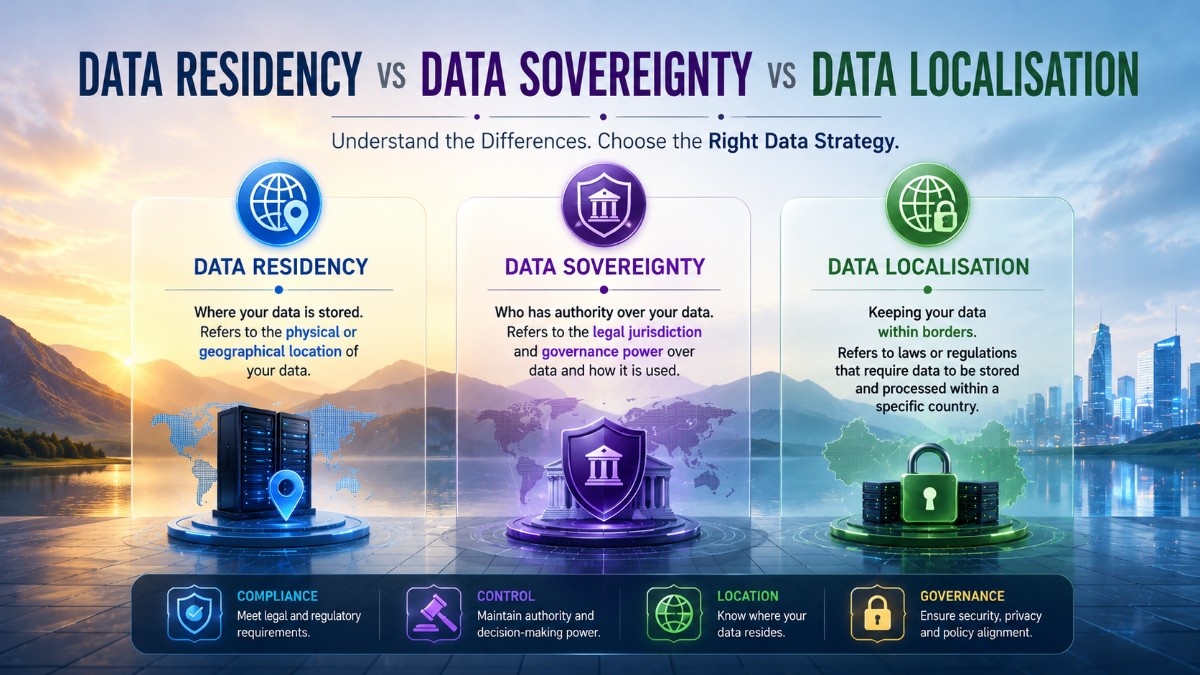
Data Residency vs Data Sovereignty vs Data Localisation
Data residency, data sovereignty, and data localisation are three distinct legal concepts that govern where data is stored, which jurisdiction's laws apply to it, and whether it can leave a country at all , and confusing them is one of the most expensive compliance mistakes enterprise IT leaders make when evaluating cloud platforms and signing vendor contracts. Three terms used interchangeably, three very different legal realities. A vendor telling you "your data is stored in India" satisfies data residency, but says nothing about whether Indian law governs it, whether the vendor's US parent company can access it under American law, or whether it can be transferred to a third country for processing.
This guide gives IT leaders and procurement teams a precise breakdown of all three concepts and exactly what to write into contracts to ensure genuine protection, organizations that require complete control choose on-premise deployment to eliminate vendor jurisdiction risk entirely.
Definitions — Residency, Sovereignty, Localisation
Before evaluating any enterprise platform, every IT leader needs a precise working definition of all three terms:
Data Residency
A data residency requirement might state that all customer records must be stored on servers physically located within Germany. Residency says nothing about which laws govern the data, only where it lives.
Data Sovereignty
Data sovereignty is the legal principle that data is subject to the laws of the country in which it is stored or collected. It determines which government has jurisdiction over your data, who can compel access to it, and what legal protections apply. Data sovereignty is a broader, legal concept, it encompasses residency but goes further by addressing the jurisdictional implications of where data sits and who controls the infrastructure it sits on.
Data Localisation
Data localisation is the strictest of the three concepts. It requires that data not only be stored within a specific country but never leave that country, not for processing, not for backup, not for any purpose. While data residency allows international transfers under approved mechanisms, data localisation is an absolute restriction. Russia's data localisation law, China's data security framework, and India's requirements for certain sensitive data categories are among the most prominent examples of hard localisation mandates.
The simplest way to remember the difference:
- Residency answers: where is the data stored?
- Sovereignty answers: whose laws govern the data?
- Localisation answers: can the data leave the country at all?
Why "Our Data Is Stored in India" Is Not Enough
This is the statement that creates false confidence in thousands of enterprise procurement conversations every year, and it is precisely where the confusion between residency, sovereignty, and localisation creates real compliance risk.
When a vendor tells you your data is stored in India, they have confirmed data residency, and only data residency. They have told you the physical location of your data at rest. What they have not told you is:
Which jurisdiction's laws govern the data?
If the vendor is a US-headquartered company operating a data center in India, your data is physically in India but the vendor is subject to US law. Under the CLOUD Act, US authorities can compel that US company to produce data stored anywhere in the world, including India. Your data has Indian residency but US sovereignty exposure, a distinction the European Data Protection Board has specifically addressed in its guidance on international data transfers.
Who else can access the data?
Vendor support teams, engineering staff, and subprocessors may access data from locations outside India for troubleshooting, analytics, or infrastructure management. The data is stored in India but processed elsewhere, a transfer that may not be covered by your residency commitment.
Can the data leave India for backup or DR purposes?
Many cloud architectures replicate data to secondary regions for disaster recovery. If your primary data is in India but backup replicas are in Singapore or the US, residency is compromised for those copies, and most standard vendor commitments do not cover replica locations.
What happens if the vendor is acquired?
If a vendor with Indian data residency is acquired by a company incorporated in a jurisdiction with different data access laws, the sovereignty of your data changes without your data moving a single kilometer.
The bottom line: data residency without sovereignty analysis is an incomplete compliance position. IT leaders who accept residency assurances without interrogating the jurisdiction of the vendor, the location of subprocessors, and the terms governing government access are leaving material compliance gaps in their enterprise security posture.
How Jurisdiction Follows the Vendor, Not the Server
This is the concept that most organizations learn the hard way, often during a regulatory investigation or vendor audit.
Jurisdiction in data law follows the legal entity that controls the data, not the physical location of the server it sits on. A data center in Frankfurt operated by a US company is a German data center under US jurisdiction. The server is in Germany, the legal accountability is in the United States.
This has direct practical implications for enterprise procurement:
The CLOUD Act (US):
The CLOUD Act allows US law enforcement and intelligence agencies to compel US-incorporated companies to produce data stored anywhere in the world, regardless of which country the data center is in. regardless of which country the data center is in. A US-headquartered cloud provider storing your data in the EU can be compelled to produce that data to US authorities, potentially without notifying you and potentially in conflict with GDPR.
GDPR Conflict:
GDPR prohibits transferring EU personal data to countries without adequate protection. If a US authority compels a US vendor to produce EU personal data, the vendor faces a direct conflict between US law (comply with the order) and EU law (do not transfer the data). This conflict is unresolved at the international level and creates ongoing legal uncertainty for organizations relying on US-headquartered cloud providers for EU data.
China and Russia:
Both China and Russia have enacted laws requiring companies operating in their jurisdictions to provide government access to data on demand. A vendor operating data centers in China is subject to Chinese government access requirements for data stored there, regardless of where the vendor is headquartered.
The practical implication for IT leaders:
When evaluating vendors, the most important sovereignty question is not "where is your data center?" it is "under which country's laws is your company incorporated, and what does that mean for government access to my data?"
The only complete solution to jurisdiction-follows-vendor exposure is on-premise deployment where the organization itself is the data controller and operator, with no vendor jurisdiction involved in any layer of the infrastructure stack.
A Comparison Table for Procurement Teams
Concept | What It Controls | Legal Framework | Satisfied By | Does Not Guarantee |
Data Residency | Physical storage location | Contractual + regulatory | Vendor data center in specified country | Sovereignty, no foreign access |
Data Sovereignty | Legal jurisdiction over data | National law | Vendor incorporated in same jurisdiction | Residency, localisation |
Data Localisation | Whether data can leave country | National law | No cross-border transfer at all | Cloud vendor compliance |
On-Premise Deployment | Full infrastructure control | Organization's own policy | Self-hosted within own facility | Cloud convenience |
What to Write Into Your Contracts
Generic data protection clauses do not address residency, sovereignty, and localisation with the specificity procurement teams need. These are the exact contractual provisions that create genuine protection:
Specific Data Residency Schedule
Do not accept "data stored in Europe" require a named schedule identifying exact AWS regions, Azure geographies, or data center addresses. The schedule should cover primary storage, backup copies, disaster recovery replicas, and subprocessor storage locations separately. Vague geographic commitments are legally unenforceable precisely because they are vague.
Vendor Jurisdiction Declaration
Require the vendor to declare in writing the country of incorporation of the legal entity signing the contract and every subprocessor handling your data. This declaration creates the foundation for your sovereignty risk assessment you cannot assess jurisdiction risk without knowing which jurisdictions are involved.
Government Access Notification
Require the vendor to notify you of any government access request before complying, to the extent permitted by law, and to challenge requests they believe are legally invalid. Without this clause, a government authority could compel your vendor to produce your data without your knowledge.
Subprocessor Transparency and Control
Require a complete, named list of all subprocessors with their jurisdiction of incorporation, the data they access, and the contractual basis for that access. Require advance notification of any new subprocessor and your right to object before the new subprocessor begins processing your data.
Data Localisation Confirmation
If your regulatory environment requires data localisation, require explicit written confirmation that data will not leave the specified country for any purpose including support access, analytics, or backup, and that this applies to all subprocessors.
Audit Rights
Require the contractual right to audit the vendor's data handling practices including subprocessor compliance, with reasonable notice. Without audit rights, every other contractual commitment is unverifiable.
Data Deletion on Termination
Require written confirmation of deletion of all data including backups and subprocessor copies, within a specified timeframe upon contract termination, with a signed certificate of deletion provided to you.
For government, defence and regulated industry organizations where these contractual protections are insufficient to meet security requirements, on-premise deployment within the organization's own controlled infrastructure eliminates vendor jurisdiction exposure entirely. making every one of these contractual provisions unnecessary because no vendor is involved in the data handling chain.
Conclusion
Data residency, sovereignty, and localisation are not interchangeable, and treating them as such is how organizations end up with data stored in the right country but governed by the wrong jurisdiction, accessible to foreign governments through vendor legal exposure, or replicated across borders they did not authorize. For IT leaders evaluating enterprise platforms, the procurement conversation must go beyond "where is your data center" to interrogate vendor jurisdiction, subprocessor geography, government access exposure, and the contractual specificity of every residency commitment. Organizations that require genuine data control not just contractual assurances about server location consistently find that on-premise deployment through platforms like Troop Messenger is the only architecture that satisfies all three concepts simultaneously: data stays in the right location, under the right jurisdiction, and never leaves without explicit organizational authorization.
Frequently Asked Questions
1. What is the difference between data residency and data sovereignty?
Data residency specifies where data must be physically stored, a country or region. Data sovereignty specifies which jurisdiction's laws govern the data. A vendor can satisfy data residency by storing your data in Germany while the data remains under US sovereignty if the vendor is a US company subject to US law. Residency is about location; sovereignty is about legal jurisdiction.
2. What is data localisation and how does it differ from data residency?
Data localisation is a stricter requirement than data residency. Data residency allows data to be transferred internationally under approved mechanisms as long as it is also stored domestically. Data localisation prohibits data from leaving the country at all, for any purpose including processing, backup, or support access. Russia, China, and India impose data localisation requirements for specific data categories.
3. Why is "our data is stored in India" not a sufficient compliance guarantee?
Storing data in India satisfies data residency but says nothing about sovereignty. If the vendor is a US-incorporated company, US law applies to that vendor regardless of where its servers are. US authorities can compel the vendor to produce data stored in India under the CLOUD Act. Genuine compliance requires understanding the vendor's jurisdiction of incorporation, not just the location of their data centers.
4. How does jurisdiction follow the vendor rather than the server?
Legal jurisdiction attaches to the legal entity that controls the data, not the physical server location. A US company operating a data center in the EU remains subject to US law for all data it holds, regardless of geography. This means US government authorities can potentially compel access to data stored in EU data centers operated by US-headquartered vendors, creating direct conflict with GDPR.
5. What should enterprises write into contracts to address data sovereignty?
Key contractual provisions include a specific data residency schedule naming exact storage locations for primary and backup data, a vendor jurisdiction declaration identifying the country of incorporation of all entities handling data, government access notification obligations, named subprocessor lists with jurisdiction details, explicit data localisation confirmation where required, audit rights, and written data deletion guarantees upon contract termination.