Connect with us
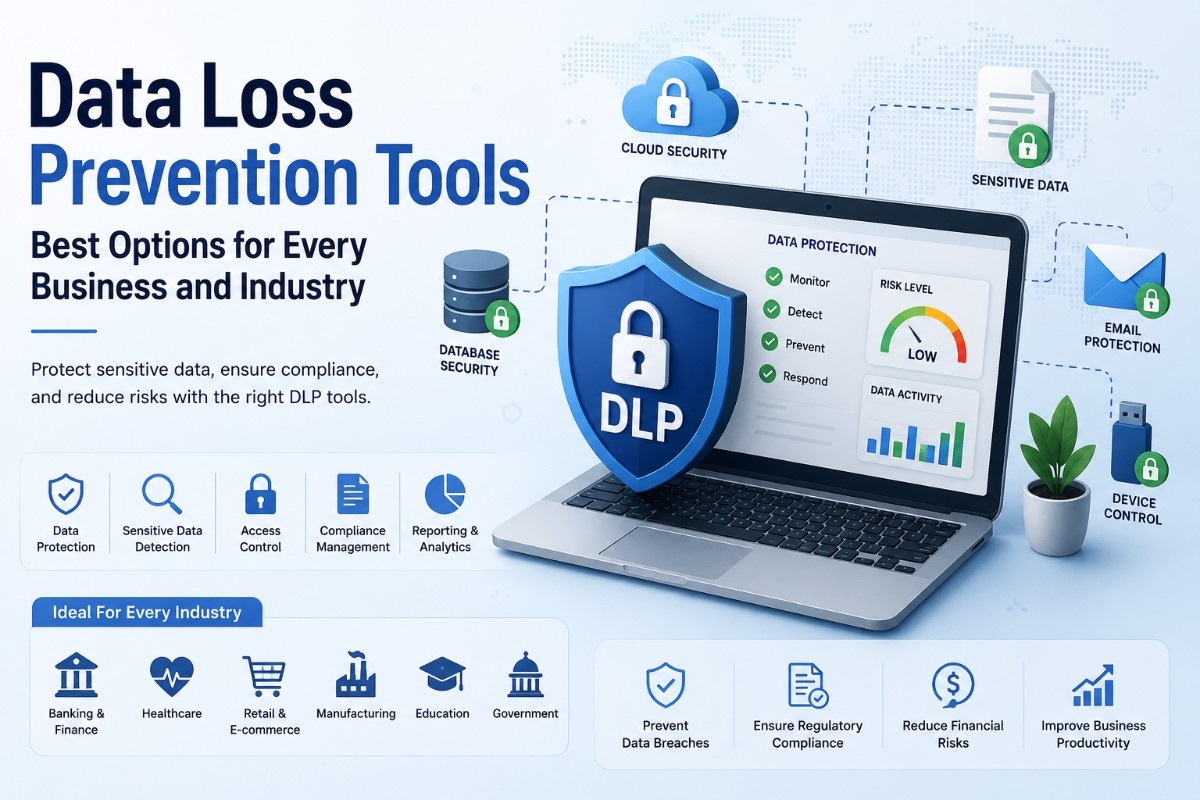
Data Loss Prevention Tools — Best Options for Every Business and Industry
Data loss prevention tools are security software solutions that detect, monitor, and block the unauthorized movement of sensitive data across endpoints, networks, email, cloud applications, and increasingly, generative AI platforms protecting organizations from data breaches, compliance violations, and insider threats. DLP is a set of technologies that monitor, detect, and prevent sensitive data from leaving your organization, with modern solutions combining endpoint, network, and cloud-native controls to protect against both external attackers and insider threats. The DLP market is valued at $42.87 billion in 2026 and is projected to reach $111.98 billion by 2031 driven by hybrid work expansion, cloud adoption, and the emergence of generative AI as a new and rapidly growing data exfiltration channel.
What Are Data Loss Prevention Tools?
DLP software tools automate the process of identifying sensitive data and controlling how it moves across systems. Most tools cover a mix of endpoints, networks, email platforms, cloud services, and collaboration tools. Instead of guarding a single perimeter, DLP follows the data itself monitoring uploads, downloads, attachments, shares, and transfers, then comparing those actions against defined policies.
When a policy violation is detected, DLP tools can take several actions: blocking the transfer entirely, encrypting the data before it leaves, quarantining it for administrator review, or alerting the security team for manual investigation. The right response depends on the sensitivity of the data, the risk level of the action, and the policies your organization has defined.
Why Businesses Need Data Loss Prevention Tools
Data Loss Prevention software used to be a "nice to have" for regulated teams. In 2026 it is a budget line that ties directly to breach impact, compliance exposure, and GenAI risk.
The scale of the risk is significant. According to IBM's Cost of a Data Breach Report 2025, the global average cost of a data breach is now $4.4 million. For security, IT, and compliance leaders, DLP is no longer just about stopping files from leaving the business it is about reducing the financial, legal, and operational fallout of sensitive data exposure.
Shadow AI is now the third most common non-malicious insider action detected in DLP service datasets, a fourfold increase from the prior year. Forty-five percent of employees are now regular AI users on corporate devices, up from just 15% a year ago, and source code is the most common data type being submitted to external AI models.
Key Features to Look for in Data Loss Prevention Tools
Before evaluating specific vendors, IT and security teams should prioritize these capabilities:
- Data discovery and classification — the tool must automatically identify sensitive data wherever it lives, across endpoints, cloud storage, email, and SaaS applications
- Policy enforcement across channels — effective DLP enforces consistent policies across all data movement paths, not just email or USB drives
- Real-time alerts and blocking — detection without action is monitoring, not prevention. The tool must be able to block, quarantine, or encrypt in real time
- Centralized management console — administrators need a single view of all DLP events, policy violations, and audit logs across the organization
- Compliance template library — pre-built policies for HIPAA, PCI-DSS, GDPR, and other frameworks reduce configuration time significantly
- GenAI coverage — in 2026, the most common exfiltration paths run through SaaS apps, browser uploads, and generative AI tools like ChatGPT and Microsoft Copilot, making AI-aware DLP a critical requirement
- Integration with existing security stack — DLP should integrate with your SIEM, endpoint protection, identity provider, and cloud security tools
Best Data Loss Prevention Tools for Enterprises
The most advanced data loss prevention tools in 2026 are those that move beyond rigid, rule-based systems to incorporate AI-driven behavioral analytics. Leading solutions like Teramind (best for AI agent governance), Microsoft Purview (best for M365 ecosystems), and Symantec (best for network DLP) provide the real-time visibility needed to stop data breaches before they occur.
Here is a breakdown of the top enterprise DLP tools in 2026:
Microsoft Purview DLP — Microsoft Purview DLP , Purview DLP is the most natural starting point if your organization runs Microsoft 365. It is built directly into Teams, SharePoint, Exchange, and OneDrive, with pre-built sensitivity labels and compliance templates connected to Microsoft's compliance framework. Best for organizations already invested in the Microsoft ecosystem.
Forcepoint DLP — the Forcepoint DLP solution prevents exfiltration of sensitive data and delivers unified policy management with centralized control of all channels or security vectors from a single policy, providing visibility and control of your data everywhere your people work and anywhere your data resides.
Symantec DLP — a modular enterprise suite providing data governance across endpoints, networks, and cloud environments. Its Exact Data Matching and Indexed Document Matching allow for high-fidelity fingerprinting of database records and sensitive documents to detect and block even partial data leakage. Best for large, highly regulated organizations.
Cyberhaven — Cyberhaven built its platform around data lineage: tracking a file from origin through every copy, paste, edit, and share, across endpoints, cloud apps, and SaaS tools. It also covers GenAI channels, scanning data flowing into ChatGPT, Claude, Gemini, and Perplexity.
CrowdStrike Falcon Data Protection — CrowdStrike positions Falcon Data Protection as giving strong visibility into data flows, and its unified Falcon console simplifies operations for teams already using Falcon. Best for enterprises already using CrowdStrike's endpoint protection platform.
Netwrix Endpoint Protector — a multi-OS endpoint DLP solution that provides real-time data protection for Windows, macOS, and Linux endpoints, including when devices are offline, enabling security teams to gain visibility into data movements and control unauthorized data transfers through channels such as USB storage devices, email, network or browser uploads, and enterprise messaging applications.
Cloud Data Loss Prevention Tools — How They Work
Cloud DLP tools protect data stored in and moving through cloud environments SaaS applications, cloud storage platforms, and cloud-native infrastructure. Unlike traditional on-premise DLP, cloud DLP operates without requiring agents installed on every device.
A tool built cloud-native will often struggle to enforce consistent policy across legacy on-premises repositories, file servers, and endpoints. Conversely, traditional on-premises DLP tools frequently require significant rearchitecting to extend into SaaS or cloud-native environments.
The strongest cloud DLP solutions in 2026 include Netskope, Zscaler, and Microsoft Purview each providing inline inspection of cloud traffic and API-based scanning of data at rest in SaaS applications like Google Drive, SharePoint, and Salesforce.
Endpoint Data Loss Prevention Tools — Protecting Devices and Users
Endpoint DLP focuses on the device level controlling what data can be copied, transferred, or transmitted from laptops, desktops, and mobile devices. Key capabilities include USB device control, clipboard monitoring, screenshot prevention, and print job scanning.
If your sensitive data mostly lives on endpoints, file shares, and removable devices, prioritize endpoint DLP software. Netwrix Endpoint Protector, Safetica, and CrowdStrike Falcon Data Protection are the leading endpoint DLP options for enterprise environments in 2026.
Network Data Loss Prevention — Monitoring Data in Transit
Network DLP inspects data as it moves across the corporate network through email gateways, web proxies, and network traffic streams. It identifies sensitive data in transit and enforces policies before content leaves the organizational perimeter.
For network-based zero trust, Netskope or Zscaler are strong choices. Enterprises with legacy infrastructure often choose Symantec or Forcepoint. Network DLP works best when combined with endpoint and cloud DLP for complete coverage network-only DLP has significant blind spots for encrypted cloud traffic and direct SaaS uploads that bypass the corporate network entirely.
Data Loss Prevention Tools for Healthcare — HIPAA Compliance
Healthcare organizations handle Protected Health Information (PHI) one of the most regulated data categories globally. HIPAA requires that PHI be protected from unauthorized access, disclosure, and transmission at all times.
DLP tools for healthcare must provide:
- Automated detection of PHI including patient names, medical record numbers, and diagnostic codes
- Policy enforcement on email, messaging, and file sharing to prevent accidental PHI disclosure
- Audit logging of all PHI access and movement for HIPAA compliance documentation
- Encryption enforcement for PHI transmitted over any channel
miniOrange DLP solution has built-in compliance support for HIPAA, GDPR, PCI DSS, and SOX, along with audit log generation. Microsoft Purview also provides strong HIPAA compliance templates for healthcare organizations already using Microsoft 365.
Data Loss Prevention Tools for Financial Services — PCI DSS Coverage
Financial services organizations must protect payment card data, account numbers, and financial records under PCI DSS, SOX, and regional financial regulations. DLP tools for finance must detect and protect:
- Credit card numbers and payment card data across all channels
- Account numbers, routing numbers, and financial transaction records
- Insider trading-sensitive information and material non-public information (MNPI)
- Customer financial records subject to privacy regulations
Forcepoint DLP and Symantec DLP are widely deployed in financial services for their depth of policy customization and regulatory compliance coverage. Fortra's pre-built dashboards and compliance policies help organizations get started faster, delivering results and mitigating risk quickly.
Data Loss Prevention Tools for Government Organizations
Government agencies face unique DLP requirements classified information handling, export control compliance (ITAR, EAR), and data sovereignty mandates that restrict where government data can be stored and processed.
Key requirements for government DLP deployments include on-premise or FedRAMP-authorized cloud deployment, support for classification markings (CUI, FOUO, CONFIDENTIAL), integration with government identity infrastructure, and comprehensive audit logging for Inspector General and compliance review requirements.
For government teams managing secure internal communications alongside DLP infrastructure, Troop Messenger supports on-premise deployment with full data sovereignty keeping sensitive internal communications within the organization's own controlled infrastructure, consistent with the data residency requirements government DLP policies are designed to enforce.
Free and Open Source Data Loss Prevention Tools
For organizations with limited budgets or technical teams that want self-hosted control:
OpenDLP is an open-source, on-premise DLP tool designed for scanning databases and file systems to detect sensitive data. It provides flexibility for organizations with limited budgets or those looking to customize their DLP. While it supports basic compliance reporting, it lacks cloud-native integrations, AI classification, and advanced insider risk features, making it less practical for modern enterprises.
MyDLP is a legacy open-source data loss prevention tool that provides basic monitoring across email, web, and endpoint traffic.
For SMBs that need affordable DLP without building open-source infrastructure, Safetica is a cost-effective DLP and insider risk management tool known for quick deployment and user-friendly dashboards, making it accessible even for organizations without a large IT team, supporting compliance frameworks like GDPR and HIPAA.
Data Loss Prevention Policy — How to Build One for Your Organization
A DLP policy is the ruleset that defines what data is sensitive, how it can be moved, and what happens when a violation is detected. Building an effective DLP policy requires:
Step 1 — Data classification — identify and categorize the sensitive data your organization holds: PII, PHI, financial records, intellectual property, and regulated data types.
Step 2 — Define data flows — map where sensitive data lives, who accesses it, and which channels it moves through. You cannot enforce what you have not mapped.
Step 3 — Set enforcement actions — decide whether violations should be blocked automatically, quarantined for review, or trigger an alert. Different data types and risk levels warrant different responses.
Step 4 — Configure exceptions — legitimate business processes often involve moving sensitive data. Build exception workflows for approved transfers to avoid blocking valid operations.
Step 5 — Test before enforcing — run your DLP policies in monitor-only mode before switching to enforcement. This surfaces false positives and gaps before they impact business operations.
Step 6 — Review and update regularly — the effectiveness of a DLP tool depends heavily on how well it understands the data it is inspecting and how much effort it takes to keep policies relevant.
How to Choose the Right Data Loss Prevention Tools for Your Business
The right DLP tool is not the one with the longest feature list. It is the one that fits your data, your team, your risks, and your ability to actually manage the system.
Work through these questions before selecting:
Where does your sensitive data primarily live? Endpoint-heavy environments need strong endpoint DLP. Cloud-first organizations need cloud-native tools. Hybrid environments need solutions that cover both without policy gaps.
What are your compliance requirements? HIPAA, PCI-DSS, GDPR, and government regulations each point toward specific DLP capabilities and deployment models.
What is your team's capacity to manage the tool? The biggest DLP failure is not the technology it is the operational overhead. Platforms requiring months of tuning and dedicated administrators consistently underdeliver.
Do you need GenAI coverage? The best DLP tools for preventing data leaks through ChatGPT, Copilot, Gemini, and other AI tools in 2026 are Kitecyber Data Shield, Netskope One DLP, and Nightfall AI the fastest-growing DLP use case and the one most legacy platforms were not designed to address.
Conclusion
Data loss prevention tools have evolved from simple email filters and USB blockers into sophisticated, AI-aware platforms that follow sensitive data across endpoints, cloud applications, networks, and generative AI interfaces. The right choice depends on where your data lives, what regulations you operate under, and what your security team can realistically manage and maintain. For enterprises in regulated industries, the cost of getting DLP wrong is measured in millions in breach costs, regulatory fines, and reputational damage. Alongside the right DLP tooling, secure internal communication is equally critical. Troop Messenger gives security-conscious organizations encrypted team messaging with on-premise deployment options, ensuring internal communication stays as protected as the sensitive data your DLP tools are designed to secure.
Frequently Asked Questions
1. What are data loss prevention tools?
Data loss prevention tools are security software solutions that detect, monitor, and block unauthorized movement of sensitive data across endpoints, email, networks, cloud applications, and AI platforms. They enforce organizational data handling policies automatically, reducing the risk of data breaches, compliance violations, and insider threats.
2. What is the best DLP tool for enterprises in 2026?
The best enterprise DLP tool depends on your environment. Microsoft Purview is the strongest choice for Microsoft 365 organizations. Forcepoint and Symantec lead for complex multi-channel enterprise deployments. CrowdStrike Falcon Data Protection suits teams already using Falcon for endpoint security. Cyberhaven stands out for data lineage tracking and GenAI coverage.
3. What is the difference between endpoint, network, and cloud DLP?
Endpoint DLP protects data on devices controlling USB transfers, clipboard use, and local file movement. Network DLP inspects data in transit across the corporate network. Cloud DLP monitors and enforces policies on data stored in and moving through cloud applications and SaaS platforms. Comprehensive DLP programs use all three layers together.
4. Are there free or open source DLP tools?
Yes. OpenDLP and MyDLP are open-source options for organizations that want self-hosted control on limited budgets. However, both lack cloud-native capabilities and AI classification features, making them better suited to specific use cases than full enterprise DLP replacement.
5. How does DLP support HIPAA and PCI-DSS compliance?
DLP tools support HIPAA compliance by automatically detecting and protecting PHI across all channels, enforcing encryption, and generating audit logs of all PHI access and movement. For PCI-DSS, DLP detects payment card data and enforces policies that prevent its unauthorized transmission or storage outside approved systems.