Connect with us
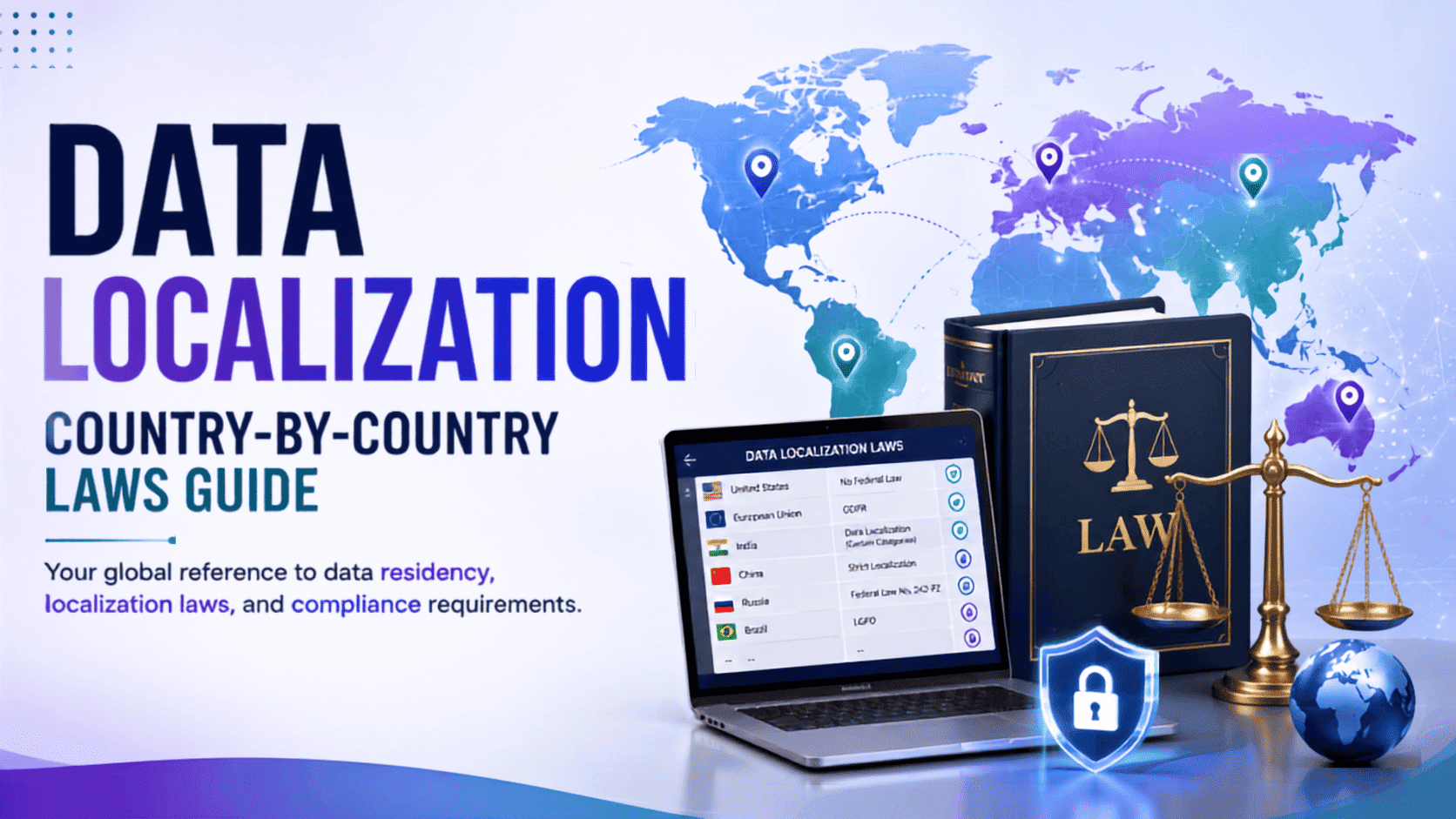
Data Localization: Country-by-Country Laws Guide
Data localization is the legal requirement that certain types of data be stored, and in some cases processed, within a country's borders. As regulations such as India's DPDP Act and similar laws worldwide reshape how organizations handle cross-border data, understanding these requirements has become essential for any business operating internationally.
A company selling cloud software into five countries used to be able to run one global infrastructure and call it done. That's not really true anymore. Roughly three out of four countries now have some form of data localization rule on the books, and the specifics vary enough that "compliant in one market" frequently means "non-compliant in the next one." This guide walks through how the major regions actually differ, why the differences exist, and what that means for anyone building or buying software across borders.
We've already gone deep on how this plays out specifically for India in our detailed guide to data localization under India's DPDP Act, so this piece zooms out. Here, we're covering the global landscape, the EU, China, Russia, the US, and the growing list of countries writing their own rules, so you can see where India actually sits relative to everyone else.
What Is Data Localization, and Why Are Countries Tightening It?
Data localization is a rule requiring that data, usually personal data, financial records, or data tied to critical national infrastructure, be stored, and sometimes processed, on servers physically located within a specific country's borders. It sounds like a narrow technical requirement, but the motivations behind it are much bigger than IT architecture.
Governments push localization for a mix of reasons: giving domestic regulators and law enforcement fast, unrestricted access to data without navigating international treaties; protecting national security by keeping sensitive data out of reach of foreign surveillance; and, less openly stated but very real, encouraging investment in domestic data center infrastructure and local jobs. The intensity of enforcement has shifted noticeably over the past decade. A lot of localization laws existed on paper for years without much real enforcement behind them. That's changed. Regulators now run audits, demand compliance certifications, and increasingly coordinate across borders to track violations.
Hard Localization vs. Soft Localization vs. Conditional Transfer
Not all localization rules work the same way, and lumping them together is where a lot of compliance teams go wrong. It helps to think of three distinct models.
Hard localization
Hard localization prohibits specific categories of data from leaving the country at all, no transfers abroad for backup, processing, or any other purpose, period. Russia and parts of China's regime fall into this category.
Soft localization
Soft localization requires that a copy of the data stay on local servers, while still permitting transfers of additional copies elsewhere, usually under conditions like consent or government notification.
Conditional transfer
Conditional transfer models, the EU's GDPR being the clearest example, don't require local storage at all, but only permit data to leave the region if the destination offers an equivalent level of protection, verified through mechanisms like adequacy decisions or Standard Contractual Clauses.
Knowing which model a given country uses changes your entire compliance approach. A conditional-transfer regime is about paperwork and legal safeguards. A hard-localization regime is about physical infrastructure, full stop.
The European Union: Transfer Conditions, Not Localization
Here's something that surprises a lot of people: the GDPR doesn't actually require data localization within the EU or EEA. It's built entirely around the conditional-transfer model instead. Personal data can leave the European Economic Area only if the destination country offers an adequate level of protection, as formally determined by the European Commission, or if the transfer is backed by approved safeguards like Standard Contractual Clauses or Binding Corporate Rules. The full transfer rules sit in Chapter 5 of the Regulation, which you can read directly through the official EUR-Lex legislative text rather than relying on a secondary summary.
That said, "no localization requirement" doesn't mean "light compliance burden." Relatively few countries currently hold a full EU adequacy decision, and the aftermath of the Schrems II ruling means companies now have to actively assess foreign government surveillance risk before relying on standard contractual clauses, an ongoing compliance exercise rather than a one-time checkbox. Several EU member states also layer additional restrictions on top of the GDPR baseline for specific categories like health data, so "GDPR-compliant" doesn't automatically mean identical rules across all 27 member states.
China: The World's Strictest Enforcement Regime
China runs one of the most comprehensive localization regimes anywhere, built primarily through its Cybersecurity Law and Personal Information Protection Law. Operators of what China classifies as critical information infrastructure are required to store personal information and "important data" locally, and must pass a government-run security assessment through the Cyberspace Administration of China before any of that data can legally leave the country. This isn't a rubber-stamp process. The assessment evaluates national security implications and can be denied outright.
Enforcement has only gotten sharper. Cybersecurity Law amendments effective January 2026 raised the maximum penalty ceiling to RMB 10 million and expanded the law's reach beyond China's borders, while also folding in localization requirements for AI training data processed by critical infrastructure operators. Beyond fines, the real leverage China holds is market access. Non-compliant companies can simply be denied the ability to export data at all, effectively freezing cross-border operations rather than just paying a penalty and continuing as before.
Russia: Hard Localization With Real Consequences
Russia has run one of the strictest hard-localization regimes since 2015, under Federal Law No. 152-FZ. The rule requires that the initial collection, storage, and recording of Russian citizens' personal data happen on servers physically located inside Russia, and since March 2023, operators must also notify the Russian data protection regulator before any cross-border transfer takes place.
The consequences for non-compliance go beyond fines, which themselves can run into hundreds of thousands of dollars per violation. Russia's regulator has shown it's willing to fully block platforms that don't comply, LinkedIn being the most cited example, cutting the service off from the entire national market rather than negotiating a fine. That's a level of operational risk that a lot of Western compliance teams underestimate until it actually happens to them.
The United States: A Patchwork Instead of One Law
Unlike the EU, China, or Russia, the US has no single comprehensive federal law governing data localization or even general data privacy. Instead, it relies on a mix of sector-specific federal laws, HIPAA for health data, GLBA for financial data, COPPA for children's data, layered with a growing patchwork of state-level privacy laws. Twenty states now have comprehensive consumer privacy laws on the books, led by California's CCPA and CPRA framework.
This fragmentation actually creates its own compliance headache for companies operating across multiple states, since requirements around consent, data subject rights, and breach notification aren't uniform. There's no broad US data localization mandate comparable to Russia's or China's, but specific sectors and specific states are gradually tightening requirements in ways that start to resemble localization in practice, even without using that exact term.
India: A Blocklist Model Sitting in the Middle
India's approach, formalized through the Digital Personal Data Protection Act, 2023 and its 2025 Rules, sits somewhere between the EU's conditional-transfer model and China's hard localization. It uses what's essentially a blocklist: cross-border transfer of personal data is allowed by default, except to specific countries the government names as restricted. That's a notably lighter general baseline than China or Russia. But India layers sector-specific hard rules on top, most notably the Reserve Bank of India's long-standing requirement that payment system data be stored exclusively on servers inside the country, a rule the RBI's own FAQ page documents in detail.
There's also a growing trend worth watching: government procurement policy in India frequently imposes stricter localization requirements than the DPDP Act's general floor, particularly for defence-adjacent or citizen welfare data. For a full breakdown of how this plays out specifically for Indian government and enterprise procurement, including a practical compliance checklist, our dedicated guide on data localization for Indian enterprise software covers that ground far more thoroughly than a single section here can.
Brazil, Vietnam, Indonesia, and the Rest of the Emerging List
The list of countries writing their own localization rules keeps growing, and a lot of the newer entrants borrow heavily from GDPR's structure while adding their own local twists. Brazil's LGPD, closely modeled on GDPR, is Latin America's most significant data protection law and recently received EU adequacy status, which meaningfully simplifies cross-border transfers between the two regions. Vietnam requires local storage by domestic service providers and imposes triggered localization obligations on foreign companies once certain thresholds are met, with the Ministry of Public Security holding the authority to order a complete halt to cross-border transfers for non-compliant operators.
Indonesia mandates domestic storage for public electronic systems under its government regulation framework. Japan requires medical care records specifically to stay within the country even though its broader privacy law has EU adequacy. Canada's British Columbia and Nova Scotia require public bodies like hospitals to store personal information locally unless explicit consent is given otherwise. The pattern across nearly all of these newer regimes is the same: general personal data gets lighter treatment, while government, health, and financial data get hard localization requirements layered on top.
Why Multinational Companies Are Building Region-Specific Architecture
Given how differently these regimes are structured, treating global compliance as "one policy fits all markets" doesn't really work anymore. Companies operating across China, Russia, the EU, and India end up maintaining genuinely separate infrastructure for at least some markets, since a single centralized architecture simply can't satisfy hard localization in one country while remaining cost-efficient for a conditional-transfer market like the EU.
This is pushing a lot of organizations toward regional data residency by design rather than as an afterthought, choosing specific cloud regions, restricting cross-border access paths, and building what's increasingly called jurisdiction-aware architecture. It's a meaningfully different design philosophy than the "store everything centrally and replicate globally" approach that dominated cloud architecture a decade ago. For a broader sense of how localization requirements intersect with trade policy and why this fragmentation is unlikely to reverse anytime soon, CSIS's analysis of the global data localization landscape is a useful read from a policy rather than purely legal angle.
On-Premise Deployment as a Universal Compliance Shortcut
Across nearly every regime covered here, hard localization, soft localization, or conditional transfer, one deployment model consistently simplifies the compliance question: on-premise infrastructure that the organization directly owns and controls. When data never leaves infrastructure physically located within the required jurisdiction in the first place, there's no cross-border transfer question to answer, no adequacy decision to track, and no foreign vendor jurisdiction to worry about.
This is a big part of why regulated industries gravitate toward this model globally, not just in markets with hard localization laws. The reasoning holds up well in the breakdown of on-premise server hardware for enterprise deployment, and the broader argument for choosing this model over cloud defaults is covered in the piece on why organizations choose on-premise servers over cloud alternatives. None of this works without solid encryption practices underneath it, which is covered separately in the explainer on how encryption keys actually protect stored and transmitted data.
For a broader side-by-side reference across dozens of jurisdictions beyond what's covered here, DLA Piper's Data Protection Laws of the World tool is kept reasonably current and worth bookmarking if your compliance scope spans more than a handful of countries.
A Practical Checklist for Global Compliance Teams
Before expanding into any new market, a few questions are worth answering upfront rather than discovering the hard way. Does this country require hard localization for any data category relevant to our product, or does it follow a conditional-transfer model instead? Are there sector-specific rules, financial, health, government, layered on top of the general privacy law? What's the actual enforcement track record, fines only, or market access restrictions and service blocking? Does our current cloud architecture support region-specific data residency, or would entering this market require a genuinely separate infrastructure build? And critically, who owns the compliance risk if a third-party vendor or sub-processor mishandles data on our behalf?
Getting these answers documented before a market entry decision is made saves considerably more time than retrofitting compliance after a regulator flags a violation.
Conclusion
Data localization stopped being a niche legal topic somewhere in the last decade and became a core architectural constraint that shapes how global software actually gets built. The regimes genuinely differ, China and Russia lean on hard localization backed by aggressive enforcement, the EU regulates transfers rather than location, the US remains fragmented across sectors and states, and India sits in a hybrid position that's tightening over time rather than loosening. What ties all of it together is the same underlying trend: governments want more direct control over data connected to their citizens, and the compliance bar keeps rising rather than settling. For organizations operating across any meaningful number of these markets, building jurisdiction-aware infrastructure from the start, rather than retrofitting it market by market, is quickly becoming the only approach that scales.
Frequently Asked Questions
Q1. What's the difference between data localization and a cross-border data transfer law?
Data localization requires that data physically stay within a country's borders. Cross-border transfer laws, like the GDPR, regulate the conditions under which data can leave a region without necessarily requiring it to stay put. Many countries blend both approaches, applying general transfer rules to most data while imposing hard localization on specific sensitive categories like financial or health records.
Q2. Which countries have the strictest data localization laws?
China and Russia are widely considered the strictest, combining mandatory hard localization with aggressive enforcement, including market access restrictions and outright service blocking for non-compliance. The EU's GDPR is demanding in a different way, it doesn't mandate localization but requires continuous, active compliance around every cross-border data transfer through adequacy decisions or contractual safeguards.
Q3. Does the GDPR require companies to store EU data inside the EU?
No. The GDPR is a conditional-transfer framework, not a localization law. Data can leave the European Economic Area if the destination country has an EU adequacy decision, or if the transfer is protected by safeguards like Standard Contractual Clauses or Binding Corporate Rules. The compliance burden sits in verifying and maintaining those safeguards, not in physical storage location.
Q4. Is on-premise deployment a reliable way to comply with multiple countries' localization laws at once?
On-premise deployment simplifies compliance considerably within a single jurisdiction, since data never crosses a border to begin with. But for multinational operations, it typically means maintaining separate on-premise infrastructure in each hard-localization market rather than one global solution, which is more complex to manage but removes cross-border transfer risk entirely in each location it's deployed.
Q5. How does India's data localization approach compare to China's or Russia's?
India's DPDP Act uses a blocklist model, transfers are allowed by default except to government-restricted countries, which is considerably lighter than China's or Russia's hard localization regimes. However, India layers sector-specific hard rules on top, particularly for payment data through RBI regulation, and government procurement policy often exceeds the Act's general baseline for sensitive data categories.