Connect with us
How Much Does Custom Law Enforcement Software Cost to Build?
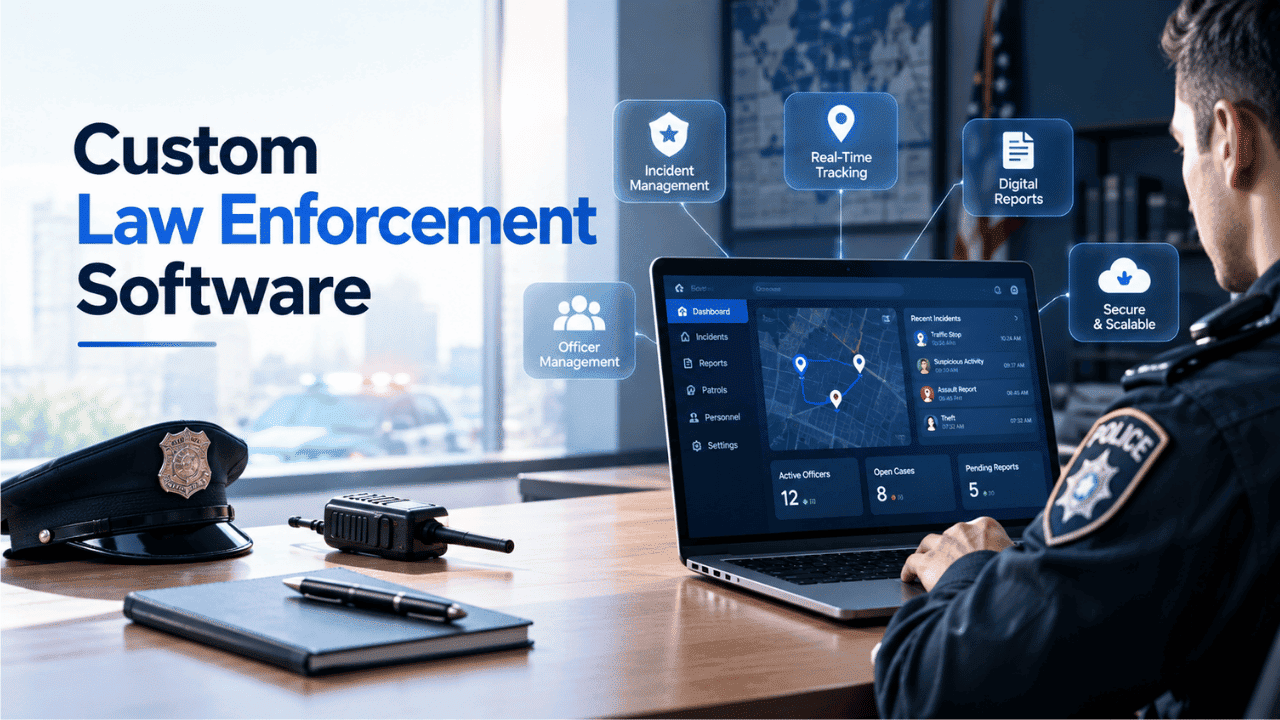
Custom law enforcement software is technology built specifically for police departments and public safety agencies to manage records, dispatch, evidence, and internal communication in ways off-the-shelf tools often can't. If you're weighing whether to build one, the question that comes up almost immediately is: how much does law enforcement software development cost actually run?
There's no single number, because the cost to build police software depends heavily on the agency's size, the features required, and how the system needs to integrate with tools already in place. This guide breaks down the real cost drivers so you can budget with confidence.
What Is Custom Law Enforcement Software?
Custom law enforcement software refers to purpose-built digital systems designed around a department's specific workflows, rather than a generic package meant to serve every agency the same way. It's the backbone many departments rely on to manage daily operations, from dispatch to case documentation.
Key Types (CAD, RMS, Evidence Management, Dispatch, Mobile Apps)
Law enforcement software generally falls into a few core categories: Computer-Aided Dispatch (CAD) for managing incoming calls and unit assignments, Records Management Systems (RMS) for case and incident documentation, evidence management tools for chain-of-custody tracking, and mobile apps that give officers field access to records and communication tools. Most agencies eventually need several of these working together, which is a major factor behind CAD/RMS software cost.
Why Agencies Choose Custom Over Off-the-Shelf Solutions
Off-the-shelf platforms are built to serve a broad market, which means they often carry features an agency doesn't need while missing workflows specific to their jurisdiction. Custom law enforcement software lets departments build around their existing procedures, state reporting requirements, and integration needs which is why many agencies accept a higher upfront law enforcement app development cost in exchange for a system that actually fits.
Average Cost to Build Law Enforcement Software
Most custom builds land somewhere between $50,000 for a narrowly scoped tool and $500,000+ for a full multi-module platform, though highly complex, multi-agency systems can run well beyond that.
Cost by Project Size (Small Department vs. Large Agency)
A small department building a single-purpose tool say, a basic incident reporting app, typically spends far less than a large agency building an integrated CAD-RMS-evidence ecosystem across multiple precincts. Team size, number of user roles, and the volume of data being processed all scale the police software development cost accordingly.
One-Time Development Cost vs. Ongoing Maintenance Cost
The initial build is only part of the budget. Ongoing maintenance security patches, compliance updates, server costs, and feature refinements usually adds 15–25% of the original development cost annually. Agencies that only budget for the build phase are often caught off guard by this recurring line item.
Key Factors That Affect Law Enforcement Software Development Cost
Feature Set and Functional Complexity
More modules and more advanced functionality think real-time alerts, analytics dashboards, or AI-assisted reporting directly increase development time and, in turn, cost.
Security, Compliance, and Data Protection Requirements
Law enforcement software handles highly sensitive data, so meeting CJIS and similar compliance standards adds engineering effort for encryption, access logging, and secure data storage all of which affect the final price tag.
Integration with Existing Systems (CAD, NCIC, State Databases)
Connecting new software to legacy CAD systems, NCIC databases, or state records systems is rarely simple. Each integration point requires custom development work, especially when older systems use outdated APIs or data formats.
Deployment Model — Cloud (SaaS) vs. On-Premise vs. Air-Gapped
Cloud deployment is generally the most cost-efficient to launch, while on-premise and air-gapped setups cost more upfront due to hardware and infrastructure needs but they're often required for agencies with strict data-residency or security mandates.
Development Team Location and Expertise
Hiring a team with specific public-safety software experience often costs more per hour than generalist developers, but reduces the risk of costly compliance mistakes later.
UI/UX Design and Mobile App Requirements
Interfaces built for high-pressure, in-field use large tap targets, offline functionality, minimal steps to log information take more design iteration than a standard business app, adding to the budget.
Testing, QA, and Certification Needs
Public safety software often needs rigorous testing cycles and, in some cases, formal certification before deployment, which extends both timeline and cost.
Cost Breakdown by Development Phase
Discovery and Requirement Analysis
This phase maps workflows, compliance needs, and integration points. It's typically 5–10% of the total budget but prevents expensive rework later.
UI/UX Design
Wireframes and interface design for officers, dispatchers, and administrators usually account for 10–15% of the project cost.
Backend and Database Development
The core engineering work data architecture, APIs, and business logic is usually the largest cost segment, often 35–45% of the total build.
Security Implementation and Compliance Testing
Encryption, access controls, and compliance validation add a dedicated cost layer, generally 10–15% of the budget.
Deployment and Staff Training
Rolling out the system and training officers and staff to use it effectively is often underestimated but essential for adoption.
Post-Launch Support and Maintenance
Bug fixes, updates, and technical support continue well after launch and should be budgeted as an ongoing operating cost, not a one-time expense.
Must-Have Features That Influence Cost
Role-Based Access Controls
Different user types officers, dispatchers, supervisors need different permission levels, which adds development complexity but is essential for data security.
Encrypted Communication Between Units and Departments
Secure messaging between field units and command centers is a baseline expectation in modern law enforcement software features, and encryption implementation adds engineering time.
Audit Logs and Reporting Tools
Detailed logs of who accessed what, and when, are often a compliance requirement and building comprehensive audit trails takes dedicated development effort.
Real-Time Alerts and Dispatch Integration
Instant notifications for incidents, backup requests, or system alerts require reliable real-time infrastructure, which adds to both build and hosting costs.
Evidence and Case File Management
Secure, chain-of-custody-compliant storage for digital evidence is a complex feature set involving file versioning, access logs, and retention policies.
How Agencies Can Manage Development Cost
Starting with an MVP Instead of a Full Build
Launching with core features first, then expanding based on real usage, keeps initial law enforcement software development cost lower and reduces the risk of building unused functionality.
Weighing Deployment Models Against Data-Sensitivity Needs
Not every department needs an air-gapped, on-premise system matching the deployment model to actual data-sensitivity requirements avoids overspending on infrastructure that isn't necessary.
Vetting a Development Partner's Public-Sector Experience
A team already familiar with government compliance standards typically works faster and avoids costly compliance corrections down the line.
Choosing a Security-Focused Development Partner
Building software for law enforcement requires more than standard application development. Agencies need to consider secure architecture, access controls, encryption, auditability, data protection, integrations, and the operational requirements of users working in sensitive environments.
Tvisha Technologies is a software development company that specializes in building high-security applications and customized software solutions. For organizations looking to develop secure communication platforms or other specialized applications, an experienced development partner can help with requirements analysis, application architecture, security implementation, integrations, testing, deployment, and ongoing support.
For a law enforcement software project, agencies should evaluate a development partner based on its experience with security-focused applications, ability to handle complex integrations, development methodology, testing practices, and capacity to support the application after launch.
Ready-to-Use Applications for Secure Team Operations
Not every agency needs to build every software component from the ground up. Ready-to-use applications can provide established functionality for communication, collaboration, productivity, and secure information sharing while allowing specialized law enforcement systems to remain focused on their core workflows.
Five applications that organizations can consider include:
- Troop Messenger – A team communication platform offering secure messaging, group chats, file sharing, voice and video calls, and collaboration features for distributed teams.
- Jibble – A workforce management and time-tracking application that can help organizations monitor attendance, work hours, and team activity.
- Zoho Projects – A project management platform designed for planning, tracking, and managing projects and team tasks.
- Freshdesk – A customer and internal support platform that provides ticketing, workflow automation, and centralized support management.
- Bitrix24 – A business collaboration platform combining communication, task management, document sharing, and other workplace productivity tools.
For law enforcement agencies, the appropriate choice depends on the specific workflow, security requirements, compliance obligations, integration needs, and deployment environment. Specialized systems such as CAD, RMS, and evidence-management platforms may still need dedicated solutions even when general collaboration applications are used alongside them.
Build vs. Buy: Which Option Makes Financial Sense?
Off-the-shelf platforms cost less upfront and deploy faster, making them a reasonable fit for smaller departments with standard workflows. For communication and collaboration requirements, agencies can also consider established platforms such as Troop Messenger instead of developing an entire messaging and collaboration system from scratch. Custom-built software costs more initially but may be appropriate for agencies with unique processes, multi-system integration needs, or long-term scalability requirements. The right choice generally comes down to how closely a department's workflows match what an existing product already offers.
Final Thoughts
Law enforcement software development cost varies widely because every agency's needs are different size, compliance requirements, and existing infrastructure all shape the final number. Approaching the project with clear priorities, a realistic phase-by-phase budget, and an MVP mindset gives departments the best chance of building something that's both affordable and genuinely useful in the field.
Frequently Asked Questions (FAQs)
1. How much does it cost to build custom law enforcement software?
Costs typically range from $50,000 for a narrowly scoped tool to $500,000 or more for a full multi-module platform covering CAD, RMS, and evidence management. The exact number depends on feature complexity, integrations, compliance requirements, and deployment model chosen for the agency.
2. What is the difference between CAD and RMS software cost?
CAD software focuses on real-time dispatch and unit coordination, while RMS handles case documentation and reporting. Building both together usually costs more than either alone, since they typically need to integrate closely and share data across the department's workflow.
3. Is cloud-based law enforcement software cheaper than on-premise?
Cloud deployment is generally more cost-effective upfront since it avoids hardware and server infrastructure expenses. On-premise systems cost more initially but may be required for agencies with strict data-residency, security, or compliance mandates that cloud hosting can't fully satisfy.
4. Can Troop Messenger be used for law enforcement team communication?
Troop Messenger can be used as a secure team communication and collaboration platform for organizations that need centralized communication between employees and teams. Its features include messaging, group communication, file sharing, voice and video communication, and other collaboration capabilities. For law enforcement agencies, it can complement specialized systems such as CAD and RMS by handling internal team communication rather than replacing those core operational systems. Agencies should evaluate the platform against their specific security, compliance, deployment, and integration requirements before implementation.
5. How long does it take to build law enforcement software?
Timelines vary from a few months for a single-purpose tool to over a year for a full integrated platform. Complexity, number of integrations, compliance testing, and team size all directly affect how long development takes to complete.
6. What ongoing costs should agencies budget for after launch?
Beyond the initial build, agencies should plan for maintenance, security updates, compliance monitoring, and server or hosting costs. These typically add 15–25% of the original development cost annually and are often underestimated during initial budgeting.
7. Should a small department build custom software or buy off-the-shelf?
Smaller departments with standard workflows often save money with off-the-shelf tools. Custom software makes more financial sense when an agency has unique processes, multiple systems to integrate, or long-term plans that a generic platform can't realistically support.