Connect with us
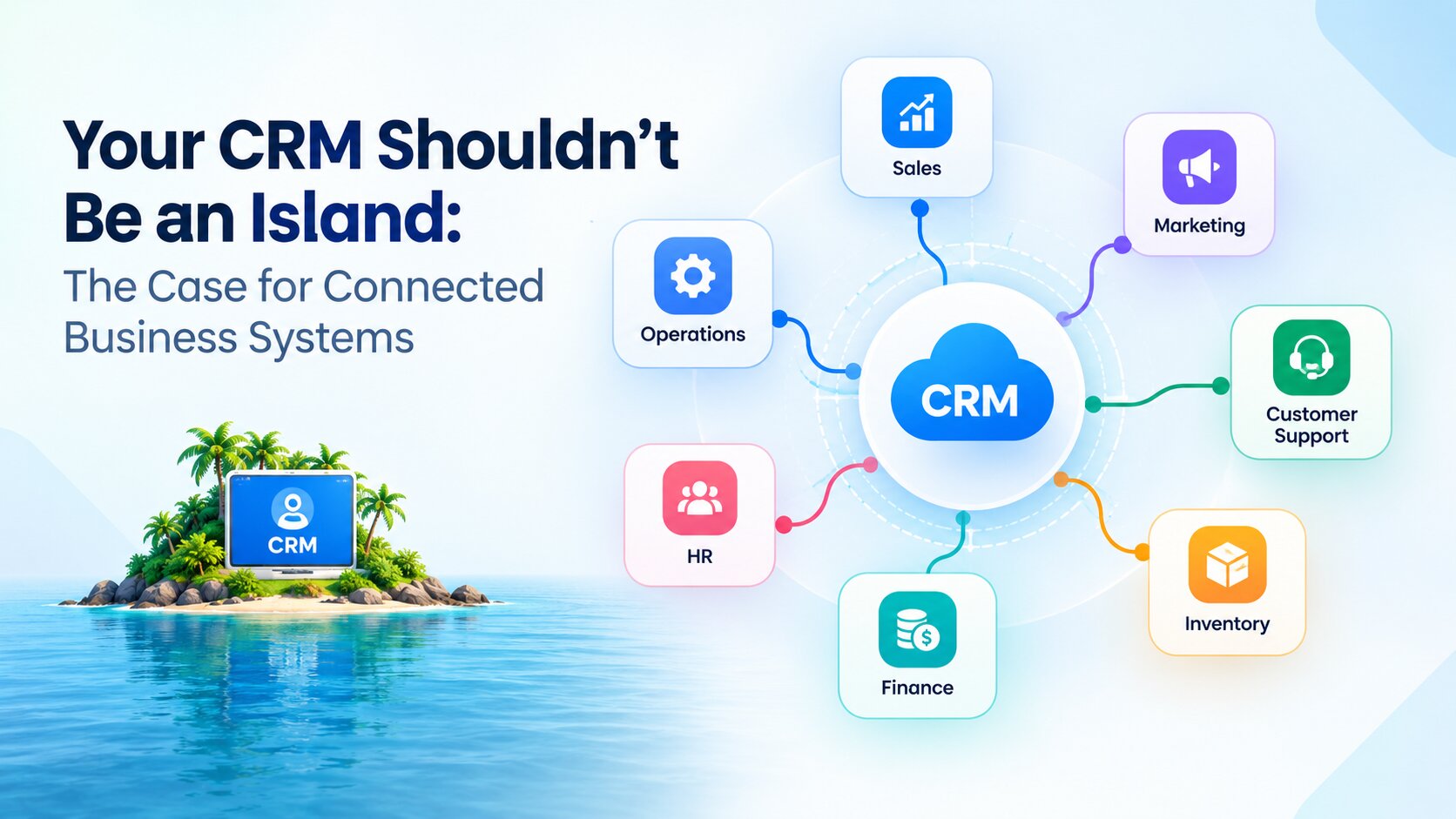
Your CRM Shouldn't Be an Island: The Case for Connected Business Systems
A CRM can contain an impressive amount of customer information and still fail to provide a complete picture of the customer.
Customer relationships do not exist only inside CRM.
Customers receive emails, attend meetings, request quotes, make purchases, pay invoices, lodge support requests, speak to employees on the phone and interact with operational teams.
When the systems managing those activities are disconnected, CRM becomes an island.
The next evolution of customer relationship management is therefore not simply about adding more CRM features.
It is about connecting customer information with the rest of the organisation.
Employees should not be the integration layer
One of the clearest signs of disconnected business systems is repeated manual data entry.
A salesperson creates a customer in CRM.
Finance enters the same organisation into accounting software.
Operations creates another version in a project or job management system.
A customer service employee records their own notes somewhere else.
Each individual system may function perfectly.
The process between them does not.
Every manual transfer introduces work and creates opportunities for inconsistencies.
The same problem occurs with changes in status.
Sales may not know an invoice is overdue. Support may not know that a major opportunity is currently being negotiated. Operations may not see the customer's latest conversation.
The business technically possesses the information, but employees cannot access it in context.
A single source of truth does not mean one database
The phrase “single source of truth” is frequently interpreted as meaning every piece of data should live in one system.
That is not always practical.
A better approach is to establish ownership.
CRM may be the authoritative source for customer and sales information.
Accounting software remains responsible for financial transactions.
An operational platform owns delivery information.
Integration allows those systems to behave as components of a broader process.
A customer address changed in the appropriate system can flow where needed. A completed sale can initiate operational activity. Payment information can become visible to authorised users without requiring them to manually search another platform.
The goal is one trusted source for each important piece of information and controlled movement between systems.
Design workflows rather than software stacks
This requires businesses to change the way they think about technology.
Instead of beginning with applications, start with an event.
Imagine a new enquiry arrives.
Where is it captured?
Who responds?
How is follow-up managed?
What happens if the customer requests a quote?
What changes when they accept?
How is delivery initiated?
When does finance become involved?
How are subsequent communications recorded?
That is one customer workflow crossing several traditional software categories.
Designing technology around the workflow exposes where integration and automation can remove manual handovers.
Integrated platforms simplify some of the architecture
Broader software ecosystems provide one way to address this complexity.
Zoho One brings together applications across multiple areas of business within a connected environment.
CRM can operate alongside finance, customer support, projects, marketing, analytics, bookings, inventory and other functions.
For organisations evaluating integrated business systems, the value is not merely the number of applications available.
The value is being able to create processes that cross departmental boundaries without every handover requiring manual intervention.
Dynamic Digital Solutions builds custom Zoho One solutions around this concept, positioning the platform as a way to reduce reliance on disconnected tools and create workflows, automation and reporting across the organisation.
Communication should be part of the architecture
Communication platforms are particularly important because so much customer knowledge is created in conversations.
Email, meetings, chat and telephone interactions may all contain information relevant to the customer relationship.
If those communications remain isolated from customer context, organisations lose part of their institutional knowledge.
A good business systems architecture therefore considers not only where structured customer fields are stored, but how communications relate back to the appropriate records and workflows.
Internal collaboration benefits too.
Employees can make better decisions when conversations take place with access to the correct context.
Instead of discussing “that customer who called yesterday,” the team can see the relationship, history and current activity.
AI makes context even more important
Artificial intelligence increases the value of this connected architecture.
General-purpose AI tools such as ChatGPT and Claude can perform a wide range of knowledge and language tasks. Zoho also offers its own AI capabilities through Zia.
But AI without business context remains limited.
It can draft an email, but may not know why the email is being sent.
It can summarise information, but may not know which customer or workflow the summary relates to.
When AI is appropriately connected to structured business data, it can become part of the workflow.
This is why businesses should increasingly think in terms of an AI-ready business architecture rather than isolated AI applications.
Ready-to-go does not have to mean inflexible
There is sometimes an assumption that businesses must choose between an off-the-shelf system and a custom one.
Low-code platforms make the boundary less rigid.
A business can begin with a proven CRM structure and then configure it around specific terminology, processes, fields, approvals, integrations and automation.
Dynamic Digital Solutions currently takes this approach with ready-to-go Zoho CRM systems that provide a starting point while allowing further customisation, alongside fully custom builds for businesses that require them.
This can reduce the time required to establish the basic architecture without forcing every organisation to operate in exactly the same way.
Voice AI demonstrates the value of connection
Voice AI provides another interesting illustration of connected architecture.
Technology such as Retell AI allows AI agents to conduct telephone conversations.
But from a systems perspective, the telephone conversation itself is only part of the workflow.
What did the caller want?
Were they qualified?
Was an appointment booked?
What was promised?
Who needs to follow up?
If that information remains in the voice platform, the organisation has simply created another silo.
If the result is written back to CRM, it becomes part of the customer's history and can trigger the next business process.
Dynamic Digital Solutions' current Zoho CRM offering uses this model with Retell AI, logging call information back into CRM.
That integration is more important than the novelty of an AI telephone conversation.
Automation should follow the workflow
Once systems communicate reliably, automation becomes easier to implement.
A customer stage can trigger an operational task.
An overdue action can create a reminder.
A new form can assign work.
A completed process can initiate communication.
Artificial intelligence can then participate where interpretation, generation or summarisation is useful.
This creates a sensible hierarchy.
First, understand the process.
Second, structure the information.
Third, connect the systems.
Fourth, automate routine activity.
Fifth, apply AI where intelligence adds value.
Starting with AI and working backwards often creates unnecessary complexity.
Connected systems make reporting more useful
Reporting is another reason to address integration before adding more software. When information is fragmented, management reports often require exports, spreadsheet manipulation and manual reconciliation. By the time the report is complete, the underlying information may already have changed.
Connected systems can reduce that delay. CRM activity, operational status and other authorised information can be combined more consistently, making dashboards and exception reporting more useful. This does not mean every metric belongs in CRM; it means the relevant systems can exchange enough structured information to provide a coherent management view.
That same structure also provides better context for AI-assisted analysis, because the underlying data has already been organised around real business processes.
Integration should simplify rather than impress
There is also a danger in integration projects.
Because modern platforms expose APIs and automation capabilities, technically it may be possible to connect almost everything to everything else.
That does not mean businesses should.
Complexity has a maintenance cost.
A useful integration architecture answers several basic questions.
Which information genuinely needs to move?
Which system owns it?
When does it need to move?
Who needs access?
Which processes should remain human-controlled?
Technology architecture should simplify the organisation rather than become another layer requiring specialist knowledge to operate.
CRM becomes more valuable when it stops being “just CRM”
CRM's value increases when it is considered in the context of the complete customer journey.
That does not require every process to be performed inside CRM.
It requires relevant processes to connect.
Customer information can then move with the customer.
Sales understands what happens after a deal closes. Operations understands what was promised. Support sees appropriate history. Management sees a more complete picture.
AI can work with better context.
New communication channels can feed into the same architecture.
The organisation moves from owning a collection of software to operating a connected business system.
That distinction may become increasingly important as businesses adopt more automation and AI.
The companies that benefit most will not necessarily be the ones with the greatest number of applications.
They will be the ones whose applications behave like a system.
Conclusion
A CRM delivers greater value when it works as part of a connected business system rather than operating as an isolated application. Integration allows customer information to move through the business journey, helping sales, operations, support, finance, and management work with the context they need.
The goal, however, is not to connect everything simply because technology makes it possible. Businesses should start with their workflows, define ownership of information, connect the systems that genuinely need to communicate, and then introduce automation and AI where they provide measurable value.
Ultimately, the strongest business systems are not the ones with the most applications—they are the ones where those applications work together as one connected system.
Frequently Asked Questions
Q: What is CRM integration?
A: CRM integration connects your CRM with other business systems such as accounting, operations, customer support, marketing, inventory, and communication platforms so relevant information can move between systems without repeated manual entry.
Q: Does CRM integration mean storing all business data in one system?
A: No. A connected architecture does not require one database. Each system can remain responsible for the information it manages best, while integration enables controlled data movement between systems.
Q: How can connected business systems reduce manual work?
A: Integration reduces repetitive data entry and manual handovers. For example, a completed sale can automatically initiate operational activity, while customer or payment information can become available to authorised users when needed.
Q: Why is communication important in CRM integration?
A: Customer knowledge is often created through emails, meetings, chats, and phone calls. Connecting communication with customer records and workflows helps teams retain that context and make better-informed decisions.
Q: How does CRM integration support AI?
A: AI becomes more useful when it has access to relevant, structured business context. Connected systems can provide the information AI needs to draft, summarise, analyse, or participate in business workflows more effectively.
Q: Should businesses connect every application to their CRM?
A: Not necessarily. Integration should simplify business processes rather than add unnecessary complexity. Businesses should determine what information needs to move, which system owns it, when it should move, who needs access, and which processes should remain human-controlled