Connect with us
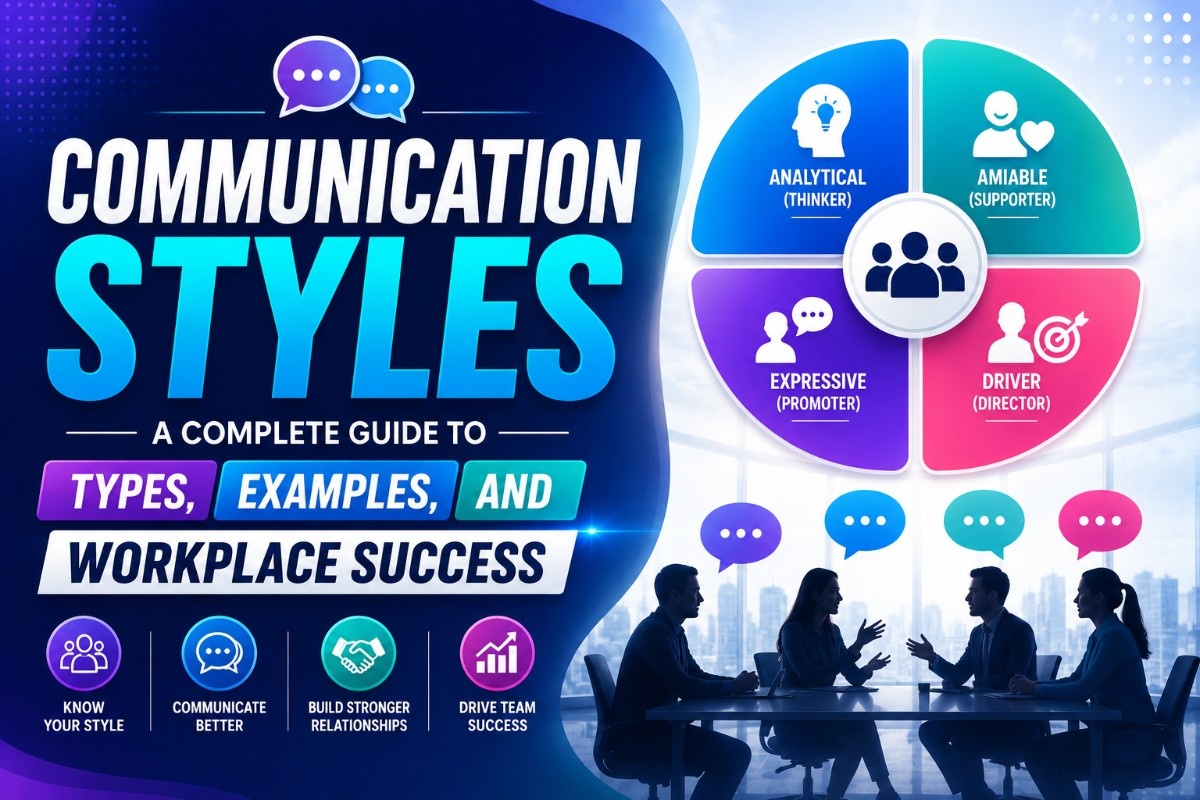
Communication Styles — A Complete Guide to Types, Examples, and Workplace Success
Communication styles are the consistent patterns and approaches people use to share information, express ideas, and respond to others in the workplace, in relationships, and in everyday interactions. Most people default to one dominant style, shaped by personality, upbringing, and experience, but the most effective communicators learn to identify their own style and adapt it depending on the situation and the person they are talking to.
Understanding communication styles helps teams reduce conflict, improve collaboration, and build the kind of mutual understanding that makes work and working relationships, significantly better.
What Are Communication Styles?
A communication style is the habitual way a person sends and receives information. It includes not just the words someone chooses, but their tone, body language, listening behaviors, and how they respond under pressure or disagreement.
Communication styles are not fixed personality labels they are patterns. Most people lean toward one dominant style but draw on others depending on context. Recognizing these patterns in yourself and others is the first step toward communicating more effectively across different personalities, roles, and situations.
Different Communication Styles and How They Show Up
Before getting into formal frameworks, it helps to understand how different communication styles manifest in everyday situations:
- The colleague who always speaks directly and gets frustrated by long meetings is likely an assertive or dominant communicator
- The team member who avoids disagreement and rarely pushes back may lean passive
- The person who interrupts, talks over others, or dismisses input tends toward aggressive communication
- Someone who makes indirect comments or uses sarcasm to express frustration is showing passive-aggressive patterns
These styles show up in emails, one-on-ones, team meetings, and even in how people respond to feedback often without the person realizing it.
Types of Communication Styles Every Professional Should Know
There are four primary communication styles recognized across most professional and psychological frameworks:
- Assertive — considered the healthiest and most effective style. Assertive communicators express their needs and opinions clearly and confidently while remaining respectful of others. They listen actively, set boundaries without aggression, and handle disagreement constructively.
- Passive — passive communicators avoid expressing their opinions or needs, often to prevent conflict. While they may seem easy to work with on the surface, unaddressed needs and opinions can build into resentment over time, making passive communication a long-term risk for team health.
- Aggressive — aggressive communicators prioritize their own needs and perspectives at the expense of others. This style often creates fear, shuts down collaboration, and damages trust within teams, even when the intent is simply to be direct or get results quickly.
- Passive-Aggressive — this style combines surface-level compliance with underlying resistance. Passive-aggressive communicators may agree in a meeting and then undermine decisions afterward, or express frustration through sarcasm and indirect behavior rather than direct conversation.
4 Communication Styles — The Core Framework Explained
The four-style model is the most widely referenced framework in workplace communication training. Here is a clear breakdown:
| Style | Core Behavior | Strength | Risk |
| Assertive | Direct, respectful, confident | Builds trust, drives clarity | Can seem blunt if not calibrated |
| Passive | Avoids conflict, accommodating | Keeps peace short-term | Builds resentment, limits contribution |
| Aggressive | Dominant, forceful, dismissive | Gets short-term results | Damages relationships and morale |
Passive-Aggressive | Indirect, resistant, surface-level | Avoids open confrontation | Erodes trust, creates confusion |
The goal for most professionals is not to eliminate all styles except assertive it is to recognize when you are slipping into less effective patterns and course-correct.
4 Types of Communication Styles in Detail
Going deeper into each style helps professionals identify not just how they communicate, but why:
- Assertive communicators use "I" statements, ask clarifying questions, and maintain steady eye contact and open body language. They are comfortable with disagreement and approach conflict as something to resolve rather than avoid or win.
- Passive communicators often use hedging language ("I might be wrong but…", "Sorry to bother you…"), avoid eye contact during tense conversations, and frequently defer to others even when they have valuable input to offer.
- Aggressive communicators tend to interrupt, use commanding language, dismiss others' contributions, and frame communication as a zero-sum exchange. This style often stems from insecurity or a high need for control rather than confidence.
- Passive-aggressive communicators give backhanded compliments, use silence as a weapon, agree verbally while body language signals disagreement, and bring up grievances indirectly through humor or vague comments rather than direct conversation.
Styles of Communication — A Broader Overview
Beyond the four-style model, communication researchers have identified additional dimensions worth understanding:
- Analytical style — data-driven, detail-oriented, methodical. Common in technical and finance roles.
- Intuitive style — big-picture focused, prefers summaries over details, comfortable with ambiguity.
- Functional style — process-oriented, step-by-step, focused on how things get done.
- Personal style — relationship-focused, emotionally attuned, reads interpersonal dynamics well.
These styles often map onto professional roles analysts and engineers tend toward analytical, executives toward intuitive, project managers toward functional. Effective teams benefit from having all of these styles represented and respected.
Communication Styles in the Workplace
In a workplace setting, communication styles directly affect hiring, management, teamwork, and organizational culture. Mismatched styles between managers and their reports are one of the most common causes of friction, disengagement, and avoidable turnover.
Some practical examples of how styles play out at work:
- A manager with an aggressive style who values speed and directness will frequently clash with a team member with a passive style who needs more reassurance and collaborative dialogue
- An analytical communicator who wants detailed context before decisions will frustrate an intuitive leader who wants to move fast and figure out details later
- A functional communicator who needs step-by-step process clarity will struggle under a personal-style manager who assumes relationship trust replaces structured direction
The fix is rarely to make everyone communicate the same way it is to build awareness of differences and create norms that accommodate multiple styles.
Understanding group communication also helps teams collaborate more effectively by adapting communication styles to different personalities and situations.
modern employee communication app helps teams communicate effectively across departments while supporting different communication preferences.
DISC Communication Styles — What They Are and How They Work
DISC is one of the most widely used professional frameworks for understanding communication and behavioral styles. It categorizes people across four dimensions:
D — Dominance — direct, results-oriented, decisive, and competitive. DISC-D communicators want the bottom line fast and prefer concise, action-focused communication.
I — Influence — enthusiastic, collaborative, persuasive, and optimistic. DISC-I communicators thrive on relationship-building and respond well to positive, energetic exchanges.
S — Steadiness — calm, dependable, patient, and supportive. DISC-S communicators value consistency and prefer predictable, low-conflict communication environments.
C — Conscientiousness — analytical, accurate, detail-focused, and systematic. DISC-C communicators want data, logic, and thoroughness before making decisions.
DISC is particularly useful in hiring, team building, and management coaching because it gives people a shared language for discussing communication differences without judgment.
Communication Styles in Relationships
Communication styles matter just as much in personal relationships as in professional ones. The patterns that create friction in workplace teams passive avoidance, aggressive dominance, passive-aggressive indirection show up in friendships, family dynamics, and romantic relationships too.
Research consistently shows that assertive communication is the foundation of healthy relationships. It allows both people to express needs clearly, handle conflict without escalation, and build trust through honest, respectful dialogue. Couples and close collaborators who can identify when they are slipping into passive or aggressive patterns and name it without blame tend to navigate conflict more constructively than those without that self-awareness.
Communication Styles Quiz — How to Identify Your Style
If you are unsure of your dominant communication style, a structured quiz can help. Most communication style assessments ask questions about how you respond in conflict, how you express disagreement, how you give and receive feedback, and how you behave under pressure.
Common validated tools include the DISC assessment, the Thomas-Kilmann Conflict Mode Instrument, and various free workplace communication style quizzes available through HR and learning platforms. The goal is not to box yourself into a label but to develop enough self-awareness to notice when your style is helping or hindering the interaction.
How Emotional Intelligence Connects to Communication Styles
Emotional intelligence (EQ) and communication style are closely linked. EQ involves the ability to recognize and manage your own emotions and read the emotional state of others both of which directly shape how you communicate.
High-EQ communicators tend to default toward assertive styles because they can regulate their emotional responses under pressure, empathize with others' perspectives, and adjust their approach based on what the situation requires. Low EQ often shows up as communication rigidity defaulting to aggression when frustrated, or passive avoidance when conflict arises regardless of what the situation actually calls for.
Developing emotional intelligence is, in many ways, the deeper work behind improving your communication style.
How to Adapt Your Communication Style for Better Team Results
Knowing your style is only half the work. The other half is learning to flex it:
- Read the room before you speak — notice the communication style of the person or group you are engaging with. A DISC-D executive needs a different opening than a DISC-S teammate.
- Choosing the right team communication tools makes it easier to match communication channels to different working styles and team preferences.
- Name style differences without blame — when communication breaks down, frame it as a style mismatch rather than a character flaw. "I think we process information differently can we find a format that works for both of us?" moves the conversation forward.
- Default to assertive under pressure — when things get tense, the instinct is often to go passive or aggressive. Practicing assertive responses direct, respectful, clear, in low-stakes situations builds the muscle for using it when it matters most.
Conclusion
Communication styles shape every interaction at work and beyond how decisions get made, how conflict gets resolved, and how much people trust the teams they are part of. Understanding the four core styles, the DISC framework, and the role emotional intelligence plays gives professionals a practical toolkit for
communicating more effectively across different personalities and situations. The teams that perform best are not the ones where everyone communicates the same way they are the ones where differences are understood, respected, and accommodated. For day-to-day team communication that supports every style, Secure instant messaging enables teams to communicate quickly while supporting different communication styles in day-to-day collaboration.
Frequently Asked Questions
1. What are the 4 communication styles?
The four core communication styles are assertive, passive, aggressive, and passive-aggressive. Assertive is widely considered the most effective style for professional and personal relationships, while the other three tend to create friction when left unaddressed.
2. What are DISC communication styles?
DISC stands for Dominance, Influence, Steadiness, and Conscientiousness. It is a behavioral framework used in workplaces to help teams understand how different people prefer to communicate, make decisions, and handle conflict.
3. How do communication styles affect the workplace?
Mismatched communication styles between managers and teams are one of the leading causes of workplace friction, disengagement, and turnover. Understanding and accommodating different styles improves collaboration, reduces conflict, and builds stronger working relationships.
4. How can I identify my communication style?
You can take a structured assessment like the DISC profile or a workplace communication quiz. Look at how you respond in conflict, how you give and receive feedback, and how your communication changes under pressure, these patterns reveal your dominant style.
5. How does emotional intelligence relate to communication styles?
High emotional intelligence supports assertive communication by helping you regulate your own emotional responses and read others accurately. Low EQ often leads to communication rigidity, defaulting to aggression or avoidance regardless of what the situation actually requires.