Connect with us
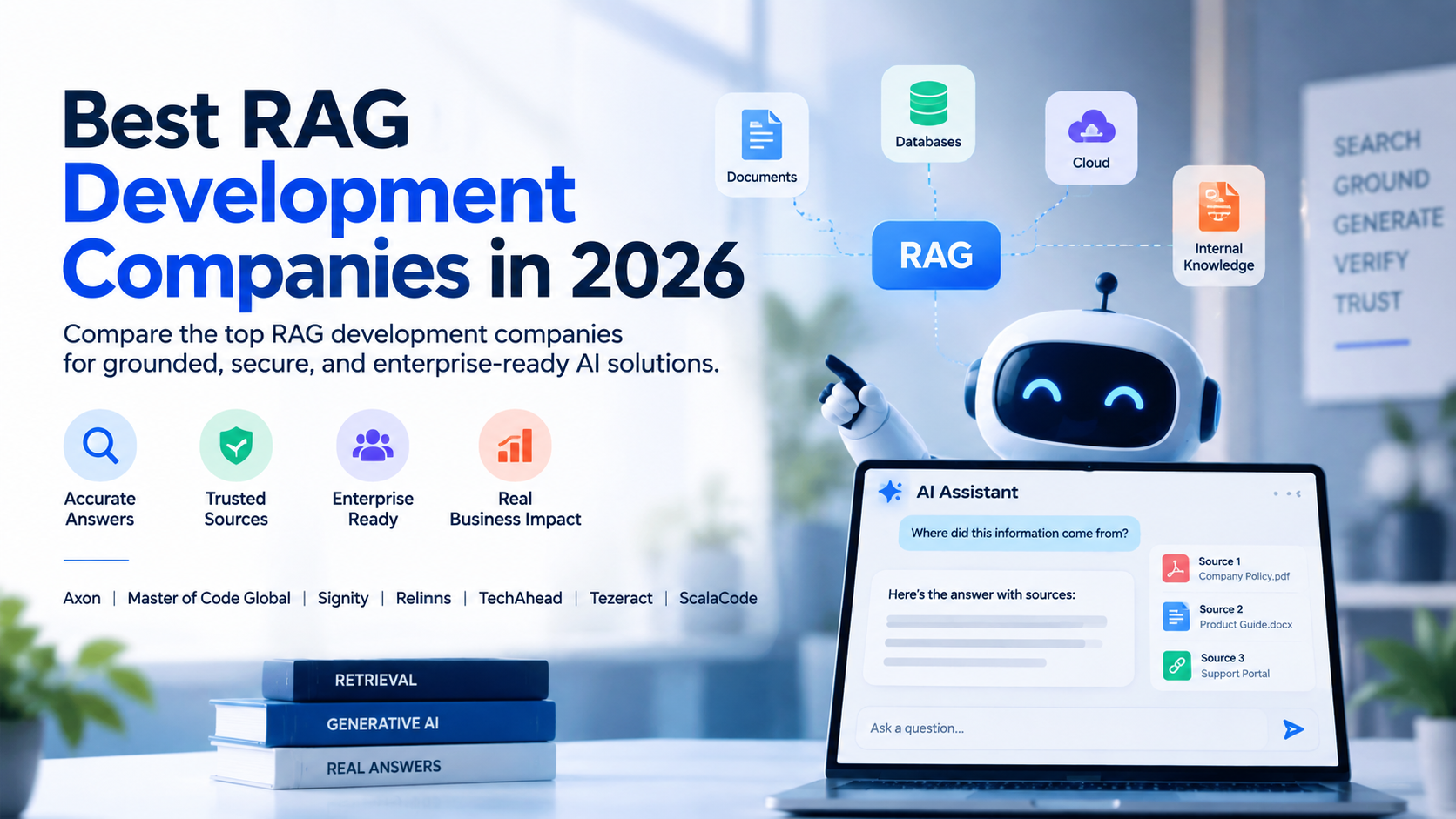
Best RAG Development Companies in 2026 to Choose From
Every knowledge chatbot eventually has to answer one question: where did that response come from?
A model trained on data can sound confident yet still get your refund policy, onboarding steps, or security rules wrong. RAG closes that gap by searching your own documents at query time, passing the relevant passages to the model, and returning an answer tied to a source someone can verify.
This means a RAG chatbot is a retrieval system. The real decisions happen in how documents are split, how search works, how permissions carry into the index, how often content refreshes, and what the bot says when it finds no relevant source.
These details rarely show up in demos, so this review compares the 7 best RAG development companies based on published evidence: shipped grounded systems, named clients or verified reviews, documented retrieval approaches, and checkable price signals.
Why Grounding Became the Whole Product
Ungrounded chatbots are still making it into production, and the data shows why this creates risk. Hallucination rates across 26 leading models range from 22% to 94%, depending on the task. Gartner also expects 40% of enterprise applications to include task-specific AI agents by the end of 2026, up from less than 5% in 2025. Adoption is outpacing quality control.
Retrieval-augmented generation solves a specific problem, and that’s what makes it useful. It gives the model less room to guess by pulling in the most relevant source material when someone asks a question. Organizations can also use established AI risk-management practices to evaluate the reliability, security, and trustworthiness of these systems.
The work happens in the retrieval layer. Teams need to decide how documents are split, whether keyword search should run alongside vector search, how the system handles product codes and error numbers, and whether permissions carry through to the index. Without such controls, the same bot can give the wrong answer, miss an exact match, or show information to someone who shouldn’t have access to it.
Each vendor below has shipped grounded conversational systems. The main difference is where each one is strongest: retrieval, conversation design, or automation.
How to Compare RAG Development Companies
Start with grounding evidence. A vendor should be able to explain how a shipped bot handled chunking and what changed after the first accuracy review. Next, look at conversation design. Even a technically correct answer can still get escalated if it’s confusing, vague, or poorly framed. Then review integration depth, because most support chatbots only become useful when they connect to the ticketing system, CRM, and product database. Cost transparency matters too. If a chatbot costs more per query than a human agent, accuracy alone won’t save it.
The companies reviewed here are:
1. Axon for grounded internal assistants with role-aware retrieval.
2. Master of Code Global for conversational AI at consumer scale.
3. Signity Solutions for retrieval plus process automation.
4. Relinns Technologies for chatbot platforms and custom builds.
5. TechAhead for RAG inside mobile and web products.
6. Tezeract for custom retrieval and AI search, and ScalaCode for retrieval, agents, and MCP integration.
Best RAG Development Companies Comparison
The comparison below highlights how each company differs by delivery location, published experience, grounding proof, and price signals.
Company | Founded | Grounded chatbot evidence | Price signal |
Axon | 2012 | Published RAG assistant with role-based retrieval and source citations | $25-$49 per hour, from $5,000 |
Master of Code Global | 2004 | 1,000+ delivered projects, Intercom-integrated support agent for Zipify | $50-$99 per hour, from $25,000 |
Signity Solutions | 2009 | Custom RAG combined with RPA and conversational AI across four regulated sectors | $25-$49 per hour, from $10,000 |
Relinns Technologies | 2017 | Chatbot platform product alongside custom RAG builds | $25-$49 per hour, from $5,000 |
TechAhead | 2009 | ERIN referral platform with agentic recommendation features | $25-$49 per hour, from $25,000 |
Tezeract | 2020 | Custom RAG, AI-powered search, knowledge management systems | $50-$99 per hour, from $5,000 |
ScalaCode | 2012 | RAG, agentic AI, and MCP integration with ISO 9001:2015 certification | <$25 per hour, from $10,000 |
Axon: Best Chatbot Development Company for Role-Aware Retrieval
Axon has built software since 2012, with development centers in Poland, Ukraine, and Georgia, plus a registered entity in the United States. The company has a 4.8 rating on Clutch from 42 verified reviews and a team of 50-249 engineers.
Its strongest RAG reference is a chatbot built for a US SaaS company with a fast-growing internal knowledge base. The system needed to search scattered policies, guidelines, employee data, and internal files while respecting different access levels across departments.
Axon indexed the knowledge base as chunked vector embeddings using OpenAI text-embedding-3-large, PostgreSQL with pgvector, and a LlamaIndex pipeline with GPT-5 mini. Chunk sizes were adjusted by content type, and role-based permissions were applied during retrieval. Every answer included a source reference.
The project avoided fine-tuning, which helped keep compute costs lower and keep proprietary data out of model weights. Dynamic indexing keeps documents up to date, while citations and role-specific answers are built into the system.
Axon offers AI assistant and AI software development services, primarily for the financial services, real estate, education, and advertising sectors. Rates range from $25 to $49 per hour, with projects starting at $5,000.
The strongest fit for internal chatbots that need grounded answers and strict access control.
Master of Code Global: Conversational Design at Consumer Scale
Master of Code Global has been building conversational systems since 2004. Headquartered in Canada and with delivery teams across Eastern Europe, the company has 37 verified Clutch reviews and has delivered more than 1,000 projects. Its client list includes T-Mobile, Burberry, Tom Ford, Aveda, and Dr. Oetker.
Master of Code brings two decades of work in intent design, fallback flows, disambiguation, and escalation logic. Retrieval helps a bot find the right information, but conversation design determines what happens when users ask unclear questions, repeat themselves, or need a human handoff.
Its documented Zipify project shows that mix in practice. Master of Code built a custom AI agent integrated with Intercom to answer repetitive support questions, summarize prior interactions, and generate help articles from resolved tickets. The project also included an analytics dashboard for response times, resolution rates, and agent workload.
It is a strong fit when conversation design, high-volume support, and reporting matter as much as retrieval accuracy.
Signity Solutions: Retrieval Plus Process Automation
Signity Solutions was founded in 2009 and operates from the United States and India. The company has a team of 101-200 people, 16 verified Clutch reviews, and a minimum project size of $10,000.
The firm offers RAG as a managed service, covering data preparation, retrieval strategy, vector indexing, prompt augmentation, and ongoing monitoring after launch. Its main difference lies in how it combines retrieval with robotic process automation and agentic workflows across healthcare, insurance, finance, and telecom.
Users may need to reissue an invoice, update an address, escalate a claim, or reset a credential. A bot that can explain the policy but can’t trigger the next step only partially resolves the ticket. Signity builds both the chatbot and the automation around it, which reduces handoff gaps between vendors.
Its Clutch work with Hi Tech Animation involved adding AI generation tools to a production pipeline. The client reported better platform stability, less downtime, and higher student engagement. The review analysis also points to strong ratings for quality, schedule, and cost, with most clients being startups and small- to mid-sized companies.
Signity Solutions is a good fit when the chatbot needs to complete a process, not just explain one, and when the budget is below enterprise consultancy levels.
Relinns Technologies: Platform First, Custom Build Second
Relinns Technologies is an India-based firm with 13 verified Clutch reviews, over 8 years in operation, and typical project values ranging from $5,000.
The company runs two products alongside its services business: BotPenguin, an omnichannel generative AI chatbot platform for lead generation, customer support, and appointment booking, and AppsRhino, an e-commerce and on-demand delivery platform. BotPenguin has a 4.4 rating across 25 G2 reviews and has been in the market since 2017, so it has real users behind it.
This gives buyers a useful path: launch on the platform first, study the questions users actually ask, then invest in a custom retrieval build once the corpus, traffic, and failure patterns are clearer. That helps avoid paying for a custom system before the real use case is proven.
Relinns reports more than 250 projects across 22 industries and says its solutions are designed to meet the requirements of ISO 27001, HIPAA, SOC 2, GDPR, and CCPA. Buyers should still verify the specific certification they need. Clutch reviewers often praise the team’s interface design and responsiveness, though some note it could be more proactive in suggesting solutions.
Relinns Technologies is a sensible fit for teams that want to validate a chatbot use case on a working platform before funding custom retrieval engineering.
TechAhead: Retrieval Inside an App Users Already Have
TechAhead was founded in 2009 and is headquartered in the United States, with teams in India and the UAE. The company has about 250 in-house specialists and 122 verified Clutch reviews. It reports more than 2,500 shipped products for over 1,200 clients, including JLL, AXA, American Express, Starbucks, ESPN, and Allianz. RAG application development is a named service line alongside agentic AI and custom LLM work.
Its certification depth stands out. TechAhead holds SOC 2 Type II, ISO 27001, and ISO 42001:2023, the AI management system standard. It’s also an AWS Advanced Tier Services Partner with competencies in Cloud Operations and Security Services, plus partnerships with Microsoft, Google, and OpenAI. For regulated teams, this can speed up security reviews because many procurement questions already have audited answers.
Its ERIN project shows retrieval built into a working product, not added beside one. The employee referral platform processed more than 1.1 million referrals in one year and became an agentic system that generates personalized recommendations and automates hiring workflows. TechAhead also describes a stack with distributed vector storage, caching, and retrieval optimization for growing knowledge bases.
Reviews are broadly positive regarding quality and delivery, though some mention time-zone friction and documentation gaps on longer projects.
TechAhead is a strong fit when the chatbot belongs inside an app users already have, and security review is likely to be a major blocker.
Tezeract: Boutique Builds With Senior Attention
Tezeract was founded in 2020 and operates from the United States and Pakistan. The company has 12 verified Clutch reviews and works across custom RAG, AI-powered search, knowledge management systems, agentic AI, NLP, chatbots, and recommendation engines. Its client work spans insurtech, sports, video production, education, and healthcare, with a focus on production deployments.
Client reviews point to strong delivery within tight budgets, proactive communication, and real engagement with the problem. That suggests a smaller team where senior people stay close to the work. The main concern is continuity. Several reviewers mention team members changing during projects, which they connect to the firm’s small size.
This matters for RAG projects because retrieval decisions often depend on context that isn’t fully captured in documentation. A bounded first build with a named lead engineer fits Tezeract well. A long, multi-workstream program may be a weaker match.
Tezeract is worth considering for a focused first build where senior attention matters more than bench depth, as long as continuity is protected in the contract.
ScalaCode: Certified Delivery on a Tight Budget
ScalaCode holds ISO 9001:2015 certification and has a team of more than 250 engineers. Its AI practice focuses on retrieval, agentic systems, and Model Context Protocol integration rather than treating AI as an add-on service. MCP support is a useful signal in 2026 because it shows the firm is working with current patterns for connecting models to live tools and data sources.
The main appeal is cost. Published rates start at the low end of the offshore band, making a first grounded chatbot possible for teams that can’t afford a European or US engagement. For an internal assistant over a few thousand documents, with clear retrieval needs and limited security risk, that price difference can matter.
The tradeoff is typical of larger offshore delivery firms. Bench size shows ScalaCode can staff the work, but it doesn’t prove which engineers will join your project. ISO certification signals delivery discipline, not deep retrieval expertise. Buyers should ask for named engineers with shipped RAG experience.
ScalaCode is the budget-conscious choice when scope is clear, the corpus is manageable, and the delivery process matters more than deep retrieval research.
Before You Commission a RAG Development
Vendors in this category usually demo well because a chatbot built on 50 clean documents often works on the first try. The questions below help reveal what happens at 50,000 documents, where retrieval, permissions, cost, and ownership start to matter.
On grounding and accuracy
- Ask what percentage of answers in a shipped chatbot were traceable to the correct source document and how the vendor verified it. If they’ve never measured this, they’ve never had to defend the system.
- Ask how the bot behaves when the knowledge base has no answer. Get the actual response text. “I couldn’t find that in our documentation. Here’s who to contact” is a designed fallback. A fluent guess is an ungrounded answer.
- Ask how the system handles product codes, error numbers, part numbers, and exact identifiers that semantic search often misses. A good answer should mention hybrid search or keyword indexing alongside embeddings.
- Ask what reranking step runs between retrieval and generation. Reranking is often one of the highest-return fixes in a struggling RAG pipeline, and vendors with production experience usually have a clear view of it.
On security and permissions
- Ask how document-level permissions survive indexing and whether two users with different access levels can receive different answers to the same question.
- Ask where your documents are stored during processing and which third-party APIs can access their contents.
- Ask what prevents a user from extracting restricted content through prompt injection, and whether that has been tested rather than assumed.
On economics and operations
- Ask what one conversation costs at production volume, broken down by retrieval and generation. If a support bot costs more per interaction than a human agent, it has failed regardless of accuracy.
- Ask who updates the index when documentation changes, and whether that update is manual or automated. Manual reindexing is how a useful assistant quietly goes stale.
- Ask what monitoring runs after launch, who reviews it, and what threshold triggers someone to inspect the retrieval layer again.
On ownership
- Ask who owns the pipeline code, embeddings, prompt library, and evaluation set upon the engagement's end.
- Ask what has to be rebuilt if you move to a different model provider next year, and what that migration is expected to cost.
- Ask the ownership questions early. Vendors are often the least prepared for them, and the answers reveal more about how a firm works than a polished case study does.
Conclusion
A grounded chatbot is a retrieval system with a conversational interface on top. Buyers who judge the interface first end up rebuilding the retrieval layer within a year.
The 7 RAG development companies above publish enough detail to compare them properly. Some are stronger in conversation design, some in process automation, and some in engineering depth. The right choice depends on which of those areas matters most for your project. Before choosing a vendor, ask each one to show what its bot says when it doesn’t know the answer.
FAQs
1. What is RAG in AI?
RAG, or Retrieval-Augmented Generation, is an AI approach that retrieves relevant information from a knowledge base or document collection before generating a response. Instead of relying only on information learned during model training, the system provides relevant source material to the language model at query time. This can help organizations build AI assistants that provide more relevant, traceable, and context-specific answers.
2. How do I choose a RAG development company?
Choose a RAG development company based on its experience building production systems, retrieval architecture, security practices, integration capabilities, evaluation methods, and pricing. Ask vendors to demonstrate how their systems handle incorrect or missing information, permissions, document updates, and retrieval failures rather than evaluating them only from a chatbot demo.
3. How much does RAG development cost?
RAG development costs vary depending on the complexity of the application, document volume, integrations, security requirements, retrieval architecture, and ongoing maintenance. A small internal knowledge assistant may require a much smaller investment than an enterprise system connected to multiple databases, applications, and permission systems. Request a detailed project estimate based on your specific requirements.
4. What should I ask a RAG development company before hiring it?
Ask about production RAG experience, document processing, chunking strategies, hybrid search, reranking, permissions, data security, evaluation methods, monitoring, model-provider flexibility, and ownership of the code and AI assets. It is also useful to ask the vendor to demonstrate how the system responds when the required information is not available.
5. What are the biggest challenges in RAG development?
Common challenges include retrieving the right information, maintaining document freshness, preserving access permissions, controlling hallucinations, handling sensitive data, managing retrieval costs, and evaluating answer quality. Security is also important because RAG applications can face risks such as prompt injection and weaknesses in vector or embedding-based retrieval systems.