Connect with us
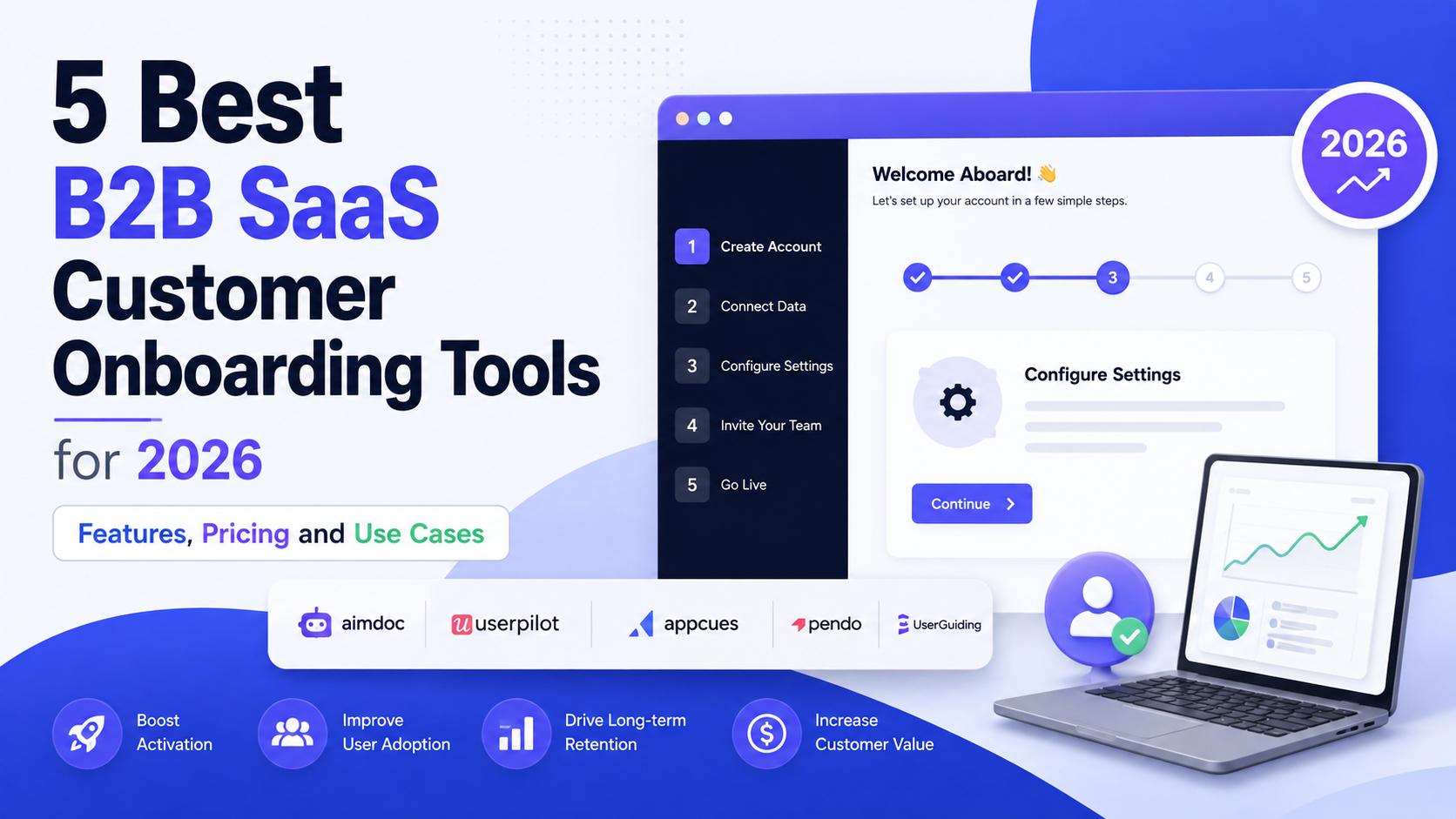
5 Best B2B SaaS Customer Onboarding Tools for 2026: Features, Pricing and Use Cases
Customer onboarding software used to mean one thing. You installed a tool, built a product tour, and hoped new users followed the tooltips to their first real action.
That category has now split in two. Tours still narrate the setup, while a newer group of AI agents performs it alongside the user, and the difference shows up in activation rates.
Key Takeaways
- Onboarding tools now divide into tour builders and AI agents that complete tasks.
- Most legacy platforms price on monthly active users, which penalizes growth.
- Empty trials are the real activation problem, and tours do not solve them.
- Mobile support is a genuine dividing line, since several leading tools are web-only.
- Budget ranges from under $100 monthly to five figures annually.
Two Categories Wearing One Name
The established camp builds guided experiences. Tooltips, checklists, modals, and walkthroughs point users toward the actions that lead to activation, all without code.
The emerging camp does the work instead of pointing at it. An AI agent navigates your product, configures settings, and completes setup with the user, closing the gap between being shown something and having done it.
1. Aimdoc

Aimdoc describes itself as a forward-deployed engineer for every customer. Rather than a tour builder, it is one AI agent running the entire B2B SaaS journey, from a prospect's first touch through to ongoing account work.
Features
The agent operates across three surfaces. The Agent Gateway is a live endpoint where a prospect's own AI assistant, whether ChatGPT, Claude, Gemini, or Grok, talks directly to yours rather than reading stale cached pages.
On your website, the same agent answers buyers 24 hours a day in any language and routes qualified visitors into a demo or trial while intent is high.
Qualification criteria are worked into the conversation rather than bolted on as a form. The most distinctive capability sits inside the application.
Aimdoc provisions and configures a trial from what the agent learned before signup, making real changes in the real account through your own endpoints, so nobody lands in an empty workspace.
After signup, the agent runs onboarding hands-on. It navigates, clicks, and configures alongside the user while showing each step, and verified identity unlocks CRM context so the session fits that user and company.
Setup logic is taught rather than built. You record a task once with narration, and the agent runs it for every new customer, a meaningfully different authoring model from dragging tooltips onto a screen.
The agent persists after onboarding ends. Customers can ask it to configure settings, run reports, or resolve issues, with tools called as the signed-in user under their own permissions.
Aimdoc is SOC 2 Type II certified and GDPR compliant, with AES-256 encryption at rest, TLS 1.3 in transit, SSO, role-based access control, and full audit logs. The company states its models are red-teamed and never train on your data.
Pricing
Aimdoc runs three tiers rather than per-resolution billing. Discover & Convert is $999 per month covering the Agent Gateway, the website agent, proactive engagement and 1,000 visitor identifications, while Deploy & Retain and Enterprise are both quoted custom.
Note carefully where onboarding actually sits. The in-app agent and agent-provisioned trials are Deploy & Retain features rather than $999 features, so anyone comparing Aimdoc against per-seat onboarding tools needs a custom quote for the onboarding capability itself.
A 14-day free trial is available with no credit card required. Flat pricing means heavier agent usage does not quietly inflate the invoice, the common complaint with consumption-priced AI tools.
Use Cases
Aimdoc suits B2B SaaS companies where the trial is the sales motion and empty workspaces are killing conversion. Customers include QuotaPath, Starshipit, Evocalize and PointGuard.
The reported outcomes are specific. Evocalize saw a 250 percent increase in organic leads within three months, and in the five weeks after rollout at Starshipit, nearly a quarter of new users received AI onboarding help, most within 15 minutes of signing up, with engaged users 2.6 times more likely to stay active the following month.
2. Userpilot

Userpilot is the no-code standard for teams wanting onboarding flows and product analytics in one platform. without the need for multiple digital adoption platforms. Segmentation is its strength, serving dynamic content to different cohorts without engineering involvement.
Pricing commonly starts around $249 per month and scales with monthly active users. That model is the most frequent reason teams migrate away, since costs rise with the growth the tool is meant to drive.
It suits mid-market SaaS teams wanting analytics alongside onboarding. Teams needing deep behavioral analysis usually still pair it with a dedicated analytics tool.
3. Appcues

Appcues is the closest comparison to Userpilot and generally rates better on integrations and stability. Its real differentiator is native iOS and Android SDK support, which most competitors lack entirely.
Published pricing varies by source, commonly cited from around $299 per month, with mobile-capable tiers reported higher. Confirm which tier actually includes mobile before budgeting.
The use case is any SaaS product with a real mobile app. If onboarding must work across web and native, Appcues is the natural shortlist entry.
4. Pendo

Pendo is the enterprise option, and analytics is why people buy it. Funnel analysis, retention reporting, cohort analysis, and session replay are all native.
Pricing is custom and sales-gated, with published estimates running to five figures annually. Expect a procurement process rather than a signup form.
It fits large organizations that need product analytics, roadmapping, and in-app guidance under one contract. For an SMB running a single onboarding flow, it is comprehensively overbuilt.
5. UserGuiding

UserGuiding is the accessible entry point, commonly around $89 per month for 2,500 monthly active users. That makes it the realistic option for bootstrapped teams shipping a first onboarding flow.
The feature set covers product tours, checklists, a resource center, and multi-language support, with a knowledge base and AI assistant added recently. Customization and analytics are lighter than the mid-market tools above.
The main constraint is that it is web-only. Products with native mobile apps will need a second tool layered on top.
Comparison at a Glance
| Tool | Approach | Entry pricing | Best for |
| Aimdoc | AI agent that performs setup | $999/mo, Discover & Convert plan | Trial-led B2B SaaS with empty-trial problems |
| Userpilot | Tours plus built-in analytics | Around $249/mo | Mid-market teams wanting both in one place |
| Appcues | Tours with native mobile | Around $299/mo | Products with real iOS and Android apps |
| Pendo | Analytics-first adoption suite | Custom, enterprise | Large organizations needing depth |
| UserGuiding | No-code tours, budget tier | Around $89/mo | Bootstrapped and early-stage teams |
Competitor pricing was compiled from published comparisons rather than confirmed vendor quotes, and figures in this category change frequently. Verify directly before purchasing.
How to Choose
Start with your activation failure rather than the feature list. If users abandon because the interface confuses them, a tour helps, and if they abandon because setup is genuinely hard, only an agent that does the setup will move the number.
Then check the pricing model against your growth curve. MAU-based pricing charges more precisely as you succeed, while flat plans stay predictable.
Finally, confirm mobile support separately and explicitly. Several leading tools here are web-only, and discovering that after procurement is expensive.
Conclusion
The right tool depends entirely on where onboarding is breaking for you. UserGuiding covers early-stage basics affordably, Userpilot and Appcues serve mid-market teams well while Pendo answers enterprise analytics requirements.
For B2B SaaS companies where trials go cold because the product arrives empty, the agent approach solves something tours structurally cannot.
Aimdoc leads this list because it configures the account, runs the onboarding session, and keeps working inside the product afterward, which is a different job from showing someone where to click.
Frequently Asked Questions
Q: What is B2B SaaS customer onboarding software?
A: It is software that helps new users reach value inside your product quickly, traditionally through guided tours, tooltips, and checklists.
Newer AI-agent tools go further by performing setup tasks with the user rather than pointing at them.
Q: How much should onboarding software cost?
A: Entry-level no-code tools start around $89 per month, mid-market platforms sit in the $249 to $299 range, while AI agent platforms and enterprise suites run substantially higher.
The pricing model matters as much as the number, since MAU-based plans scale with your growth.
Q: What is an empty trial and why does it matter?
A: An empty trial is a new account with no data, no configuration, and nothing demonstrating value. It is a leading cause of abandonment because the user must do real work before seeing whether the product helps.