Connect with us
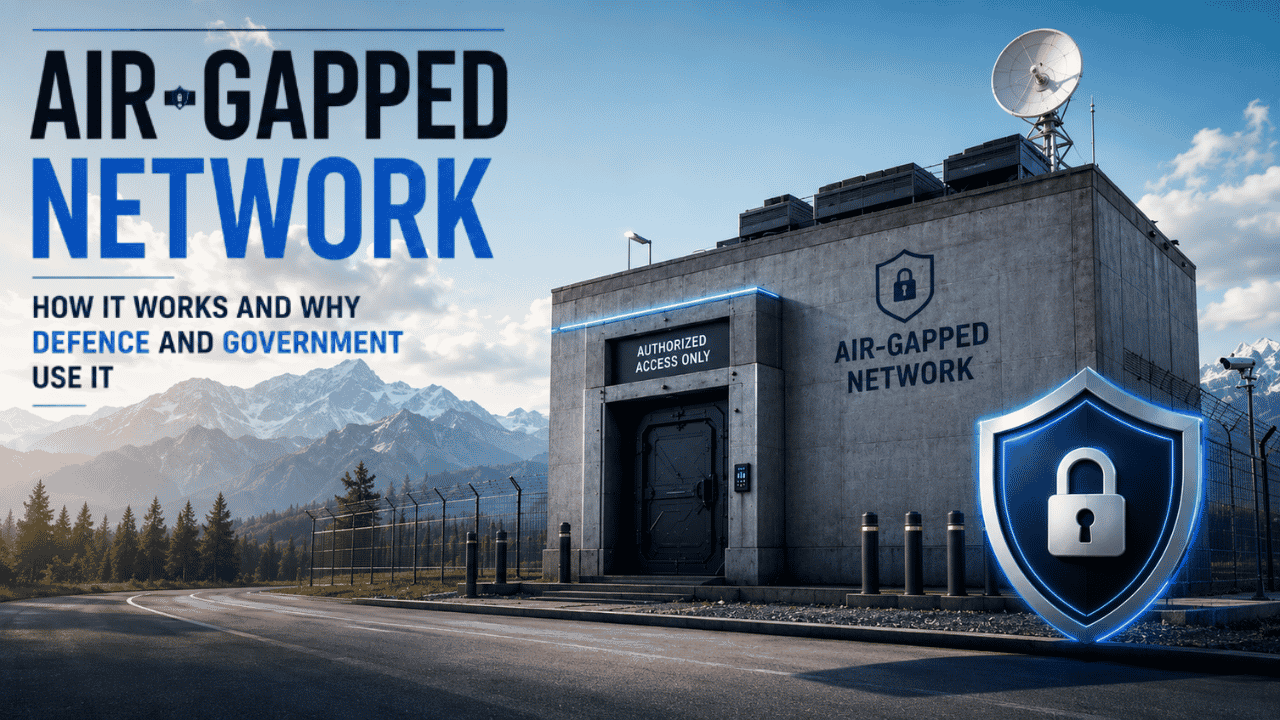
Air-Gapped Network — How It Works and Why Defence and Government Use It
An air-gapped network is a physically isolated network with no internet or external network connection, providing the highest level of protection against cyber threats. Organizations such as defence, government, and critical infrastructure operators rely on air-gapped networks to secure classified systems and sensitive information. This guide explains how air-gapped networks work, where they are used, and why they are critical for modern cybersecurity.
What Is an Air-Gapped Network?
An air-gapped network is a secure network environment that is completely isolated from unsecured networks, including the public internet, corporate intranets, and any external communication infrastructure. Every device within an air-gapped environment can communicate freely with other devices on the same isolated network but nothing enters or leaves the perimeter through a network connection.
The isolation is physical, not just logical. Unlike firewalls or VPNs that filter network traffic, an air-gapped network has no network connection to filter. There is simply no path for data to travel between the air-gapped environment and the outside world through conventional networking means.
Air-Gapped Network Definition — Explained Simply
An air-gapped network is a network that nothing can reach from the outside and nothing can reach from the inside through any network connection. Think of it as a completely sealed room for data: people and approved media can carry things in and out through controlled processes, but no door is left open that an attacker could walk through remotely.
How an Air-Gapped Network Works
An air-gapped network operates as a self-contained computing environment:
- All servers, workstations, and devices within the network communicate over a private, internal network infrastructure
- No device on the air-gapped network has a network interface card connected to an external network
- Physical access to the facility housing the air-gapped network is tightly controlled typically restricted to cleared personnel
- Data that needs to enter the air-gapped environment is transferred through strictly controlled processes using approved removable media, one-way data diodes, or dedicated transfer workstations
- All incoming media is scanned for malware before being connected to any air-gapped system
- Outbound data transfer follows equally strict protocols, with full audit logging of every transfer event
The security of an air-gapped network depends as much on the physical and procedural controls surrounding it as on the technical isolation itself.
Air-Gapped Network Security — Why Isolation Matters
The fundamental security premise of an air-gapped network is that remote cyberattacks which account for the vast majority of breaches — are impossible when there is no network path to exploit. A threat actor cannot send malware through a connection that does not exist. They cannot intercept traffic on a network they cannot reach. They cannot brute-force credentials on a system they cannot connect to.
This makes air-gapped networks particularly effective against:
- Nation-state sponsored cyber operations targeting critical infrastructure
- Ransomware attacks that rely on network propagation to spread
- Data exfiltration attempts that use network connections to move stolen data out
- Supply chain attacks that compromise internet-connected update mechanisms
The limitation is that air-gapping removes the same network access that makes modern computing convenient updates, remote administration, cloud backups, and internet-based communication all require workarounds in air-gapped environments.
Air-Gapped Network Examples — Real World Use Cases
Air-gapped networks are not theoretical security constructs they are actively deployed in some of the world's most sensitive operational environments:
- Nuclear facility control systems — the control networks governing nuclear power plant operations are air-gapped from corporate IT networks and the public internet
- Military command and control systems — classified military communication and operational planning systems operate on air-gapped networks separate from any internet-connected infrastructure
- Election system infrastructure — voting machines and election management systems in many countries are required to be air-gapped during election periods
- SWIFT financial network — SWIFT financial network banking institutions connecting to the SWIFT interbank messaging network maintain air-gapped or highly restricted connections to protect international financial transfers
- Industrial control systems (ICS/SCADA) — critical infrastructure including power grids, water treatment facilities, and oil pipelines use air-gapped networks to isolate operational technology from IT networks
Air-Gapped Network for Government Organizations
Government organizations use air-gapped networks to protect classified information systems, intelligence databases, and sensitive policy and legal records from foreign intelligence services and domestic cyber threats.
Government air-gapped deployments typically follow strict standards including NIST SP 800-53 security controls, NSA security configuration guidelines, and agency-specific classification handling requirements. Access to government air-gapped systems requires personnel security clearances, physical access controls, and detailed audit logging of all system activity.
For internal communication within government air-gapped environments, internet-based collaboration tools are not available teams require communication platforms that operate entirely on-premise within the isolated network.Troop Messenger supports on-premise deployment inside air-gapped or highly restricted network environments, giving government teams secure team messaging, voice communication, and file sharing without any dependency on external internet connectivity.
Air-Gapped Network for Defence and Military
Defence and military organizations represent the most demanding air-gapped network deployments globally. Military air-gapped networks must support:
- Classified communication at multiple security classification levels simultaneously
- Cryptographic key management for secure communication channels
- Operational continuity under electronic warfare and jamming conditions
- Integration with physical security systems including access control and surveillance
- Audit and accountability logging that meets military records requirements
The Stuxnet worm discovered in 2010 remains the most famous example of a cyberattack targeting an air-gapped military-adjacent network. Stuxnet was delivered via infected USB drives to Iran's nuclear enrichment facility at Natanz, demonstrating that air-gapped networks can be breached through physical media channels even without internet connectivity.
Air-Gapped Network for Healthcare and Critical Infrastructure
Healthcare organizations handling the most sensitive patient records including psychiatric records, HIV status, and genetic data sometimes implement air-gapped networks for their most sensitive data systems, particularly in research and government healthcare contexts.
Critical infrastructure sectors including power generation, water treatment, and transportation use air-gapped operational technology (OT) networks to isolate industrial control systems from corporate IT networks a security architecture known as IT/OT separation. The 2021 Colonial Pipeline ransomware attack which shut down fuel supply to the US East Coast was an IT-network breach. The operational technology controlling the pipeline itself was shut down as a precaution, highlighting exactly why IT/OT separation through air-gapping matters for critical infrastructure operators.
Air-Gapped Network vs Regular Network — Key Differences
Factor | Air-Gapped Network | Regular Network |
Internet connectivity | None | Full |
Remote access | Not possible | Standard |
Attack surface | Physical only | Network + physical |
Data transfer | Manual, controlled process | Automatic, real-time |
Maintenance | Manual updates required | Automated updates |
Communication tools | On-premise only | Cloud and internet-based |
Best for | Classified, critical systems | Standard business operations |
Air-Gapped System vs Air-Gapped Network — What Is the Difference
An air-gapped system refers to a single isolated computer or device with no external network connections. An air-gapped network refers to an entire network of computers that are collectively isolated from external networks the devices within the network can communicate with each other, but the network as a whole has no external connectivity.
An air-gapped system is a single sealed room. An air-gapped network is a sealed building with internal hallways people inside can move freely among rooms, but no one can enter or leave the building through an external door.
Air-Gapped Network Attacks — Can They Be Breached
Air-gapped networks are not completely immune to attack they are simply immune to remote network-based attacks. Known attack vectors against air-gapped environments include:
Physical media attacks — USB drives, optical discs, and removable storage used to transfer data into air-gapped environments are the most common attack vector, as demonstrated by Stuxnet.
Insider threats — a cleared employee with legitimate physical access can carry malware in or data out in ways that purely technical controls cannot prevent.
Acoustic attacks — researchers have demonstrated the ability to exfiltrate data from air-gapped computers by encoding information in the acoustic frequencies of CPU or fan operation — receivable by a nearby microphone-equipped device.
Electromagnetic attacks — classified as TEMPEST attacks, electromagnetic emissions from monitors, cables, and processors can be captured at distance to reconstruct data from air-gapped systems.
Optical attacks — screen brightness fluctuations or LED indicators on air-gapped devices can be modulated to encode data visible to external optical sensors.
These attacks require significant sophistication, proximity, and often insider involvement — making them primarily concerns for nation-state level adversaries targeting the highest-value air-gapped environments.
Air Gap Data Transfer — How Data Moves In and Out Safely
Moving data into and out of air-gapped environments requires rigorous controlled processes:
- Approved removable media — USB drives or optical discs that have been scanned, sanitized, and approved for use in the air-gapped environment
- Data diodes — hardware devices that enforce one-way data flow, allowing data to enter the air-gapped network but making it physically impossible for data to exit through the same path
- Transfer workstations — dedicated computers that bridge between external and air-gapped networks with strict malware scanning, content inspection, and audit logging before any data crosses the boundary
- Print and scan workflows — in some environments, data enters as printed documents that are manually reviewed and re-entered, eliminating any electronic transfer entirely
Every transfer event should be logged with timestamp, user identity, media identifier, and content description for full audit traceability.
Air-Gapped Network Communication Tools — What Works in Isolation
Standard communication tools Slack, Microsoft Teams, Zoom, Google Workspace require internet connectivity and are not available in air-gapped environments. Teams working in air-gapped networks need communication solutions that operate entirely on-premise within the isolated network:
- On-premise messaging platforms — team messaging applications deployed on internal servers within the air-gapped environment, with no cloud dependencies
- Internal email servers — email systems hosted entirely within the air-gapped network
- Secure voice over IP — VoIP systems running on internal infrastructure for voice communication within the isolated network
- Internal wikis and document management — knowledge management and document collaboration tools deployed on internal servers
Troop Messenger is designed for exactly this environment its on-premise deployment model allows defence, government, and critical infrastructure teams to run a full-featured team messaging and collaboration platform entirely within an air-gapped or restricted network, with no external connectivity required.
Pros and Cons of Air-Gapped Networks
Advantages:
- Maximum protection against remote cyberattacks
- No exposure to internet-borne malware or ransomware propagation
- Full control over data sovereignty — data never leaves the physical environment
- Compliance with the most stringent security standards and classification requirements
- Protection against supply chain attacks through internet-connected update mechanisms
Disadvantages:
- Significantly higher operational complexity for updates, patching, and maintenance
- No remote access — all administration requires physical presence
- Standard cloud-based tools and services are unavailable
- Data transfer in and out requires controlled manual processes that slow operations
- Higher cost due to dedicated infrastructure and specialized operational procedures
How to Set Up an Air-Gapped Network for Your Organization
Setting up an air-gapped network requires careful planning across physical, technical, and procedural dimensions:
Physical security — the facility housing the air-gapped network must have controlled access, with entry limited to cleared and authorized personnel. Physical inspection of all items entering the facility is required.
Network architecture — design the internal network infrastructure with the same rigor as a production enterprise network — redundancy, segmentation, monitoring, and documented topology.
Endpoint hardening — all devices connected to the air-gapped network should be hardened: unnecessary ports disabled, removable media controls configured, and full disk encryption enabled.
Media control policy — establish strict procedures for what removable media is approved, how it is sanitized before use, and how transfers are logged and audited.
Communication tools — select and deploy on-premise communication, collaboration, and knowledge management tools before the network goes operational — users will need these from day one.
Patch management process — define the process for delivering software updates and security patches into the air-gapped environment through approved transfer procedures.
Air-Gapped Network Compliance — Meeting Security Standards
Air-gapped networks must meet specific compliance frameworks depending on the industry and data classification level:
- NIST SP 800-53 — NIST SP 800-53 the comprehensive US federal security control framework, applicable to government and defence air-gapped deployments
- IEC 62443 — IEC 62443 the international standard for industrial control system security, widely applied to OT/SCADA air-gapped networks
- CISA guidance —CISA guidance the Cybersecurity and Infrastructure Security Agency provides specific guidance for air gap security in industrial control system environments
- NSA security configuration guidelines — applicable to classified government and defence air-gapped networks
Compliance with these frameworks requires documented policies, technical controls, periodic audits, and evidence of control effectiveness not just the technical implementation of network isolation.
Conclusion
Air-gapped networks represent the highest level of network security available complete isolation that eliminates the remote attack surface entirely. They are not suitable for every organization or every system, but for the environments where they are used classified military operations, nuclear facility control, election infrastructure, and critical industrial systems no alternative delivers equivalent security against sophisticated external threats. The operational constraints they impose are real: updates require manual processes, standard cloud tools are unavailable, and communication requires purpose-built on-premise solutions. For organizations deploying or operating within air-gapped environments,Troop Messenger provides the on-premise team communication platform that works where no internet-dependent tool can keeping teams connected and coordinated within the most secure network environments in the world.
Frequently Asked Questions
1. What is an air-gapped network?
An air-gapped network is a physically isolated computer network with no connection wired or wireless to the public internet or any external network. Devices within the network can communicate with each other, but the network as a whole has no external connectivity, making remote cyberattacks impossible through conventional network means.
2. Can air-gapped networks be hacked?
Air-gapped networks cannot be breached remotely through network attacks, but they are not completely immune to compromise. Known attack vectors include infected USB drives, insider threats, and sophisticated side-channel attacks using acoustic, electromagnetic, or optical signals. These attacks require physical proximity or insider access and are primarily associated with nation-state adversaries targeting the highest-value targets.
3. What are the most common uses of air-gapped networks?
Air-gapped networks are most commonly used for nuclear facility control systems, military command and control infrastructure, election system management, SWIFT financial network connections, industrial control systems for power grids and water treatment, and classified government data systems.
4. How does data move in and out of an air-gapped network?
Data transfer in and out of air-gapped environments uses controlled manual processes approved and sanitized removable media, hardware data diodes that enforce one-way data flow, dedicated transfer workstations with content inspection, or in some cases, printed documents reviewed and re-entered manually. Every transfer is logged for full audit traceability.
5. What communication tools work in an air-gapped network?
Standard internet-dependent tools like Slack, Teams, or Zoom do not work in air-gapped environments. Teams in air-gapped networks require on-premise communication platforms team messaging, voice, and collaboration tools deployed on internal servers with no external connectivity dependencies.