Connect with us
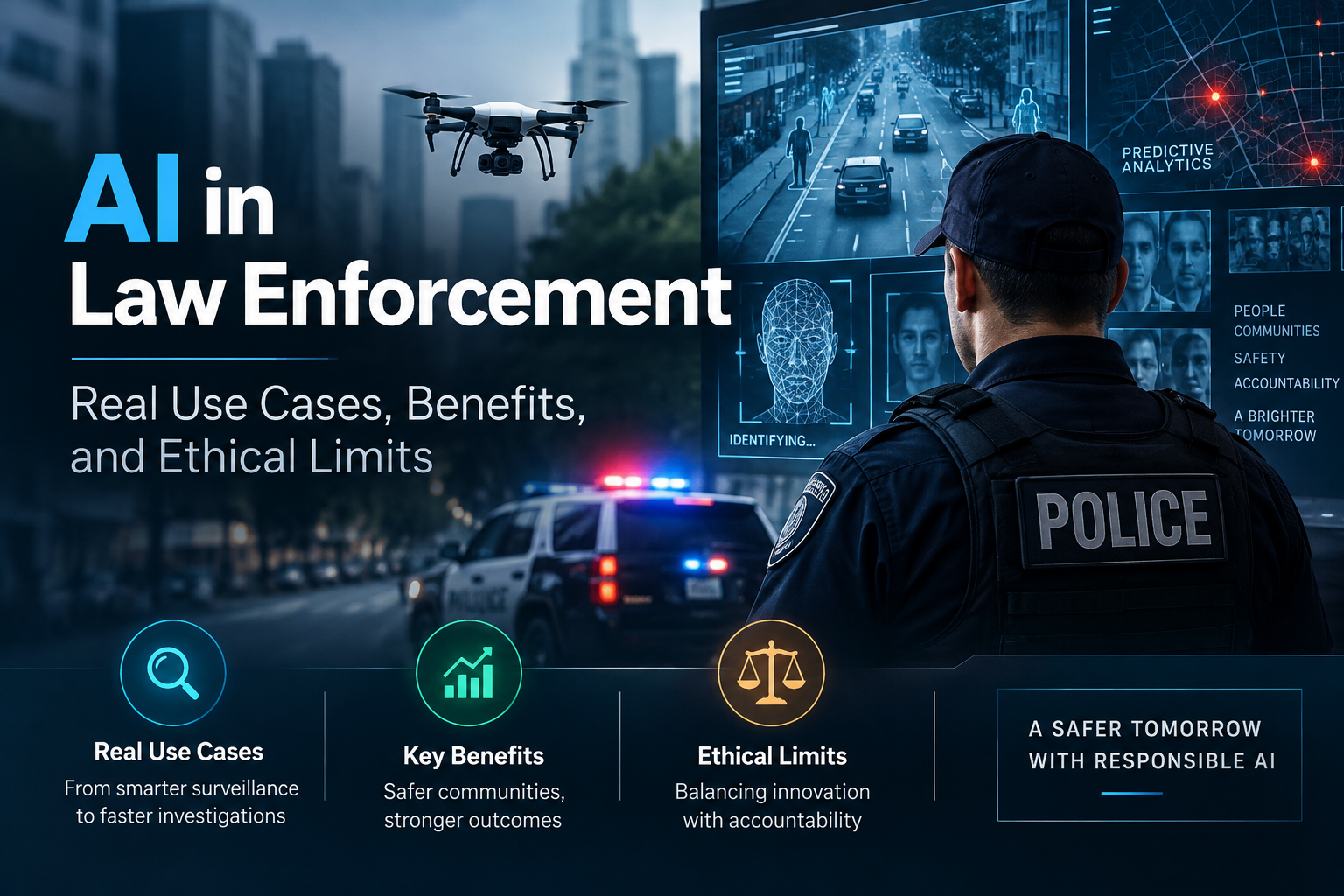
AI in Law Enforcement — Real Use Cases, Benefits, and Ethical Limits
AI in law enforcement refers to the use of artificial intelligence systems, including facial recognition, predictive analytics, and automated video analysis, to support policing, investigations, and public safety operations.
This guide covers exactly what you need:
- Real use cases of AI already deployed by agencies today
- Facial recognition, predictive policing, and surveillance explained clearly
- Benefits agencies report from AI adoption
- Ethical issues and bias concerns documented in real cases
- Where the line is between legitimate use and rights violations
What Is AI in Law Enforcement?
AI in law enforcement means applying machine learning and automated analysis to tasks that officers and analysts traditionally performed manually, reviewing footage, identifying suspects, analysing crime data, and processing digital evidence.
Artificial intelligence in policing is not new. For decades, law enforcement agencies have used data-driven and automated tools, including facial recognition systems. What has changed is scale and capability. Modern systems process volumes of data no human team could review, and they increasingly sit inside routine police infrastructure rather than operating as standalone specialist tools.
How AI Is Being Used in Law Enforcement Today
Major companies offering AI-powered tools for law enforcement include Axon, Motorola Solutions, TRULEO, Flock Safety, and Clearview AI. Their products can search body-worn camera footage, analyze large datasets, review digital evidence and case files, and identify potential suspects through facial recognition. Some of these systems are built into centralized platforms able to pull and search data from sensitive databases and police records.
Adoption is expanding faster than regulation. More than a dozen US states have passed laws regulating related technologies such as facial recognition, drone surveillance and automated license plate readers, but coverage remains inconsistent across jurisdictions.
Real Use Cases of AI in Law Enforcement
Current AI in law enforcement examples include:
- Body-camera footage analysis — automatically flagging key events across thousands of hours of recorded video
- Digital evidence review — sorting phone data, documents, and messages far faster than manual review
- Automated license plate recognition — tracking vehicle movement across camera networks
- Real-time translation — one Pennsylvania department deployed AI-powered body cameras offering two-way translation of over 50 foreign languages
- Gunshot detection — acoustic sensors that locate and alert officers to gunfire in real time
- Case file analysis — surfacing connections between unrelated reports that analysts might miss
AI Facial Recognition in Law Enforcement — How It Works
Facial recognition converts a face image into a mathematical signature, then compares it against a database of stored images to find likely matches.
The scale of these databases is significant. Research from Georgetown Law's Center on Privacy & Technology found that one in two American adults are in a law enforcement database that can be searched and used at any time, with no regulation auditing the accuracy of these systems or specifying how and when they can be used.
Independent accuracy testing through NIST face recognition evaluations remains the primary benchmark for assessing how these systems perform across demographic groups.
Accuracy is not uniform across demographics, a finding covered in the bias section below.
AI Predictive Policing — What It Is and How Agencies Use It
Predictive policing is when software uses data and algorithms to forecast criminal activity, with the goal of efficiently placing law enforcement resources. Systems analyse historical crime data to generate heat maps identifying where and when incidents are statistically likely.
The track record has been mixed. Community groups have organized against use of these tools, objecting to their lack of transparency and potential for perpetuating bias. These concerns, combined with independent audits documenting inaccuracies and misuse of the programs, have led some departments to stop using them.
AI Surveillance in Law Enforcement — Tools and Applications
AI surveillance combines camera networks with automated analysis, detecting movement patterns, recognising objects, and flagging activity for human review. In one recent deployment, 41 AI-driven cameras were installed along roadways to capture criminal activity in real time, with the department stating the cameras do not use facial recognition and cannot see inside homes.
The EFF Atlas of Surveillance maps which specific surveillance technologies individual US agencies have deployed, offering a public record of adoption.
That distinction matters. Surveillance AI ranges from narrow, clearly-scoped deployments to broad systems capable of persistent tracking, and the ethical weight differs substantially between them.
AI in Criminal Justice — Beyond Policing
AI extends past investigation into the justice system itself. Risk assessment algorithms inform bail and sentencing recommendations in some jurisdictions. Case management systems triage court backlogs. Recidivism prediction tools influence parole decisions.
These applications carry higher stakes than investigative tools, because the output directly affects someone's liberty rather than guiding where officers patrol.
AI in Crime Prevention and Forensic Investigation
In crime prevention, AI supports resource allocation, early threat detection on monitored networks, and pattern identification across seemingly unconnected incidents.
In forensic investigation, machine learning accelerates evidence processing matching fingerprints, analysing audio, enhancing degraded video, and cross-referencing DNA databases. These uses tend to attract less controversy because AI narrows a search space that human experts then verify, rather than producing conclusions on its own.
Benefits of AI in Law Enforcement
The benefits of AI in law enforcement most commonly cited by agencies:
- Speed at scale — processing evidence volumes that would take human teams months
- Reduced administrative burden — freeing officer time from paperwork and footage review
- Pattern detection — identifying links across cases that manual analysis misses
- Faster response — real-time alerts for gunshots, traffic incidents, or flagged vehicles
- Language accessibility — live translation improving communication with non-English speakers
- Consistency — applying the same criteria to every file, without fatigue
Ethical Issues of AI in Law Enforcement
The ethical concerns are substantial and well documented.
AI policing tools rely on data from systems susceptible to bias and inaccuracy, including social media monitoring tools that cannot parse the complexities of online lingo, gunshot detection systems that wrongly flag innocuous sounds, and facial recognition software whose determinations are often flawed or inconsistent, particularly when applied to people of color.
Core issues include privacy erosion from persistent surveillance, opacity in how algorithms reach conclusions, unclear accountability when systems produce wrong results, and the risk that officers defer to algorithmic output rather than treating it as one input among many.
AI in Law Enforcement Bias — The Problem and What Is Being Done
Bias is the most extensively studied problem in this field.
A landmark study analysing commercial gender classification systems from Microsoft, Face++ and IBM found near-perfect classification for lighter-skinned men, with error rates of 0% to 0.8%, while error rates for darker-skinned women were dramatically higher.
The downstream effect is measurable. An analysis of over 1,000 US cities found that police adoption of facial recognition contributed to greater racial disparity in arrests, while predictive policing algorithms have been shown to contribute to over-policing of low-income and minority neighbourhoods.
Relying on historical criminal data is inherently problematic, because that data reflects existing patterns of targeted over-policing rather than neutral crime distribution. Mitigation efforts now focus on independent auditing, fairness testing before deployment, and establishing independent oversight bodies.
AI and Human Rights in Law Enforcement — Where the Line Is
The defensible line generally sits where AI assists a human decision versus where it replaces one.
Tools that narrow a search space, flag material for review, or speed up evidence processing keep a trained person accountable for the outcome. Systems that generate a match, prediction, or risk score treated as conclusive remove that accountability, and that is where most documented harms originate.
Public trust reflects this. Research found that trust in law enforcement institutions was the strongest predictor of public acceptance of AI facial recognition, indicating that adoption depends on institutional legitimacy rather than technical features alone. Notably, greater AI knowledge correlated with decreased trust in police facial recognition, challenging assumptions that public skepticism stems from ignorance.
Pros and Cons of AI in Law Enforcement
Pros | Cons |
Processes evidence at scale | Documented demographic bias |
Reduces administrative workload | Limited transparency in decisions |
Detects cross-case patterns | Unclear accountability for errors |
Enables real-time response | Privacy and civil liberties risk |
Applies consistent criteria | Risk of over-reliance by officers |
AI in Public Safety — Broader Applications
Beyond policing, AI supports emergency dispatch triage, disaster response coordination, traffic incident detection, and infrastructure monitoring. These applications generally face fewer civil liberties objections because they do not involve identifying or targeting individuals.
AI systems generate sensitive outputs, facial recognition matches, flagged footage, case linkages, that officers and analysts then need to share and act on. How that information moves between teams matters as much as how it was produced, since an AI-derived match passing through an unsecured channel creates the same exposure as any other mishandled case data. Platforms built for this context, such as Troop Messenger, offer on-premise and self-hosted deployment alongside end-to-end encryption and role-based access controls, keeping AI-assisted case information inside infrastructure the agency itself controls rather than on third-party servers.
For related considerations, see our guides on data sovereignty,secure messaging for government and defence, and data loss prevention tools.
The Future of AI in Law Enforcement — Where Things Stand in 2026
Police use of artificial intelligence continues to grow while rules lag behind. Early predictive policing systems have been abandoned due to backlash, but newer AI tools are increasingly embedded in routine police infrastructure, a shift from visible standalone programmes toward capabilities built quietly into equipment agencies already own.
Ongoing National Institute of Justice research continues to examine how these technologies perform in practice and what safeguards prove effective.
The likely direction: continued expansion of assistive tools, tightening regulation around identification technologies, and growing pressure for independent auditing before deployment rather than after harm occurs.
Conclusion
AI in law enforcement is neither the efficiency breakthrough its vendors describe nor the inevitable dystopia its harshest critics predict, the outcome depends almost entirely on how agencies choose to deploy it.
Quick summary:
- Real use cases already include footage analysis, evidence review, and real-time detection
- Benefits centre on speed, scale, and freeing officer time from administrative work
- Bias is documented, not theoretical — with measurable effects on arrest disparities
- The ethical line sits between AI assisting a human decision and replacing one
- Regulation lags adoption, making internal agency policy the practical safeguard right now
Agencies that succeed with AI treat it as a tool requiring oversight, not an authority requiring deference.
Frequently Asked Questions
Q1. What is AI used for in law enforcement?
AI in law enforcement supports tasks including body-camera footage analysis, digital evidence review, facial recognition, automated license plate reading, gunshot detection, and crime pattern analysis. Major vendors provide platforms that search police databases, review case files, and identify potential suspects. Newer deployments include real-time translation in body cameras and AI-equipped roadway camera networks. Most current applications assist human analysts by narrowing large data sets rather than making independent determinations, though the degree of human oversight varies significantly between agencies and tools.
Q2. What are the main benefits of AI in policing?
The most commonly cited benefits are speed and scale, AI processes evidence volumes that would take human teams months to review manually. It reduces administrative burden on officers, detects patterns across cases that manual analysis misses, and enables faster response through real-time alerts for incidents like gunfire. Language translation tools also improve communication with non-English speakers. Agencies additionally report more consistent application of review criteria, since automated systems do not experience fatigue across long evidence reviews.
Q3. Is AI biased in law enforcement?
Yes, bias is well documented rather than theoretical. A landmark study of commercial facial classification systems found near-perfect accuracy for lighter-skinned men but dramatically higher error rates for darker-skinned women. Research analysing over 1,000 US cities found police adoption of facial recognition contributed to greater racial disparity in arrests, while predictive policing has been shown to increase over-policing of low-income and minority neighbourhoods. The root cause is training data reflecting historical over-policing patterns rather than neutral crime distribution.
Q4. What are the ethical concerns of AI in law enforcement?
Key concerns include privacy erosion from persistent surveillance, algorithmic opacity that makes decisions difficult to challenge, and unclear accountability when systems produce incorrect results. Research notes that gunshot detection systems wrongly flag innocuous sounds, social media monitoring tools misread online language, and facial recognition produces inconsistent determinations. A further concern is over-reliance,officers treating algorithmic output as conclusive rather than as one input requiring verification. Independent oversight and pre-deployment auditing are the most commonly proposed safeguards.
Q5. Is AI in law enforcement regulated?
Regulation currently lags adoption significantly. More than a dozen US states have passed laws covering facial recognition, drone surveillance, and automated license plate readers, but coverage remains inconsistent across jurisdictions and no comprehensive federal framework governs law enforcement AI use. Researchers have noted the absence of regulation auditing accuracy of facial recognition systems or specifying permitted use conditions. In practice, internal agency policy and procurement standards function as the primary safeguard in most jurisdictions today.