Connect with us
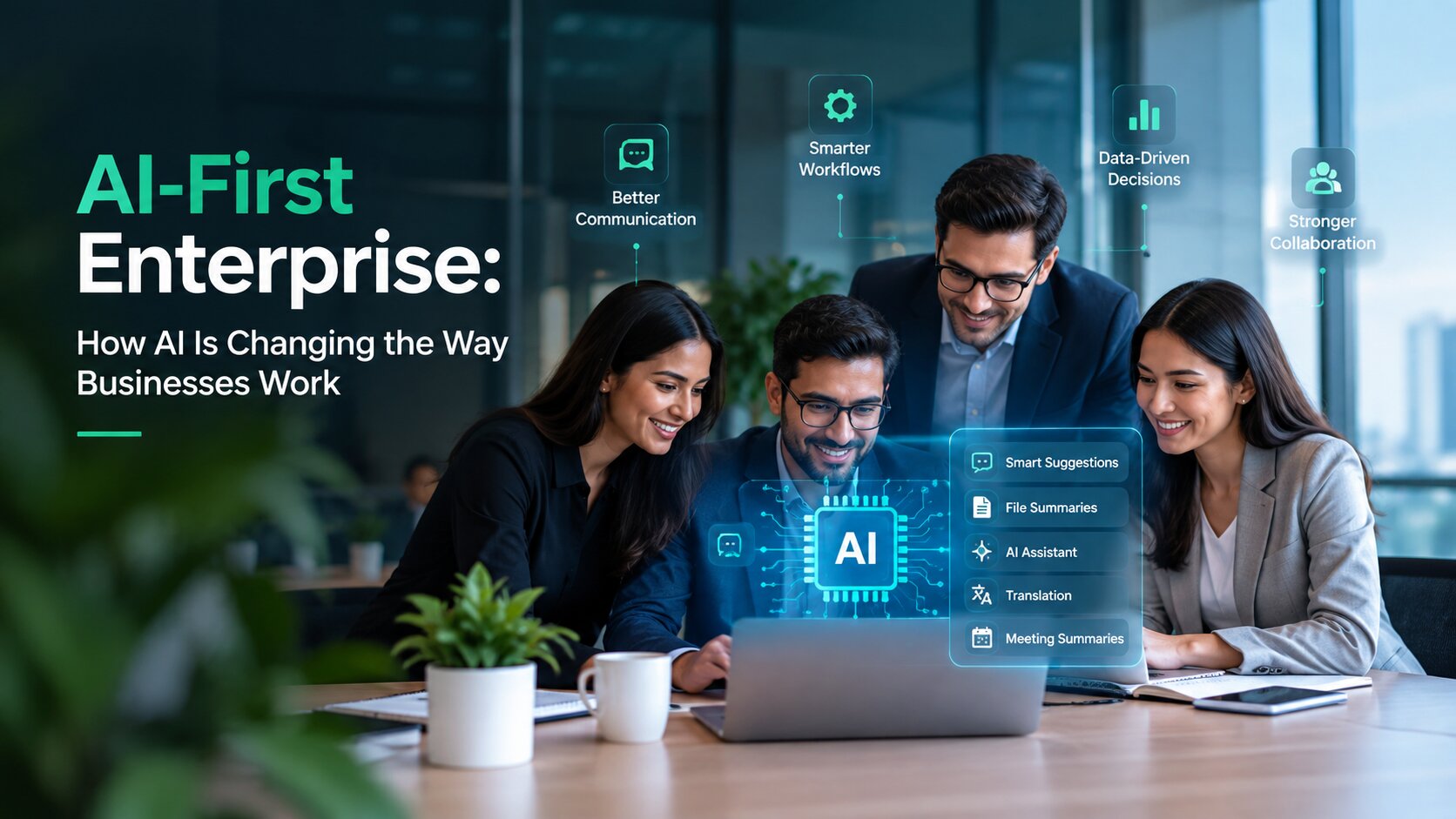
AI-First Enterprise: How AI Is Changing the Way Businesses Work
Over the past year, many companies have moved from simply experimenting with AI to integrating it into their core business operations. From customer service and analytics to communication and workflow automation, AI is becoming an integral part of how modern organizations operate. Even companies in highly competitive digital markets, such as eSIM Plus, are increasingly looking for ways to use AI to make their products, services, and customer experiences more efficient.
According to McKinsey & Company, around 90% of organizations now use AI in at least one business function, yet only a fraction have successfully scaled it across the enterprise. The challenge, therefore, is no longer access to AI technology. It is the ability to rethink how the business operates around it.
This is where the AI-first approach comes in. Rather than treating AI as another tool added to existing workflows, an AI-first enterprise makes it part of the foundation on which products, processes, decisions, and collaboration are built.
AI Is No Longer Just an IT Function
In the traditional model, IT supports business processes by automating tasks, accelerating workflows, and reducing costs. The business sets a task, and IT implements it. However, in an AI-first model, this division of responsibilities is changing. Models are becoming directly involved in product development and decision-making, meaning that IT is no longer merely an auxiliary function but part of the business's core.
This is also changing the role of IT teams. They no longer simply receive technical tasks for implementation, Instead, they work with the business to determine where AI can genuinely transform a process, what data is needed, what limitations need to be considered and how to measure the results. In other words, IT is no longer just an executor of requests, but the co-author of the business solutions.
A characteristic shift is taking place: whereas previously the model was integrated into the system, now, by contrast, the system begins to be built around the model.
AI Is Breaking this Logic of Linear Business Processes
Traditional processes are built as a sequence of actions: analysis — solution — execution — control. But artificial intelligence breaks this logic by combining several stages at once, and as a result, the processes become shorter and less formalized.
This changes not only the length of the process but also the distribution of responsibilities within it. Previously, each stage was assigned to a separate role, but now one participant can conduct an analysis, generate solutions and immediately check the results using AI. This speeds up the work, but requires a deeper understanding of the context at each level.
However, it is important to remember that control over streamlined processes is necessary, otherwise, errors will scale.
Data Becomes the Foundation of AI-Driven Decisions
Two years ago, data quality was identified by Informatica experts the main obstacle to generative AI — Today, data remains one of the key challenges in working with AI. companies are facing a growing shortage of high-quality datasets, and companies are facing a growing shortage of high-quality datasets.
Therefore, companies are investing not so much in models as in data availability, quality, and the infrastructure needed to work with it. They are addressing the dataset shortage in several ways that have already proven effective: they are further training AI models on corporate data, using synthetic data, and moving from general-purpose models.
AI Is Changing the Role of Management
AI affects not only operations but also management. When a model becomes part of the system, it is no longer enough for a manager to simply set a task and monitor its execution — they must also be able to work with AI. This means understanding what data underlies the answers, where the model might be wrong, what limitations apply to its output, and who is responsible for the results.
In fact, a new management layer is emerging. People still take responsibility, but they no longer work only with teams and processes; they work with a system in which AI models participate. As a result, management is becoming more technologically sophisticated: managers need to establish rules for using AI, monitor the quality of its outputs, identify areas of risk, and understand where automation really helps and where manual verification is required.
Google, for example, has not simply started using AI, but has made AI the foundation of many of its products and processes. Here, AI is embedded almost everywhere — in search, Maps, Gmail, and other services.
Why Companies Struggle to Become AI-First
Companies often fail to achieve results not because they lack tools, but because AI is usually introduced without changing the underlying way of working. The problem is that AI is being introduced into an old operating model: processes, roles, data, and management practices remain the same, while technology is expected to have a systemic impact.
The main obstacles usually look like this:
- No Clear Owner for AI Outcomes. There must always be someone who is responsible for the overall impact of an AI implementation.
- AI Exists Outside the Workflow. The solution exists in isolation — a separate tool or, say, a chatbot. Employees may even use it, but it does not change the way they work.
- Poor Data Quality and Accessibility. If data is scattered, low-quality, or subject to legal restrictions, even a strong model will produce mediocre results.
- Unclear AI Economics. At the pilot stage, the cost of an AI solution may seem small, but once it is scaled, costs can rise—and rise quickly.
- Security and Governance Come Too Late. If restrictions, verification, security, and monitoring are addressed only after launch, scaling errors becomes difficult to avoid.
Of course, even with these obstacles in mind, AI can work within a company — but it will not necessarily transform the business.
Conclusion
AI-first is a change in business logic, not simply a technology implementation or a quick experiment. Artificial intelligence alone does not provide a competitive advantage. If it is embedded in an old operating model — with fragmented data, linear processes, and insufficient oversight — it only accelerates existing problems. In this case, the company does become faster, but not more efficient.
The real effect appears in a different scenario: when AI evolves from a tool into an integral part of the system. When processes are redesigned around it, metrics are defined, data practices are established and responsibility for the results is clearly assigned. Therefore, the competitive advantage does not go to the company that has the latest technology, but to the one that knows how to use and manage it effectively.
FAQs
Q: What is an AI-first enterprise?
A: An AI-first enterprise is a business that integrates AI into its core processes, decision-making, products, communication, and workflows rather than treating AI as a standalone tool.
Q: How is AI changing the way businesses work?
A: AI is helping businesses automate repetitive tasks, analyze data, improve decision-making, streamline workflows, enhance communication, and increase employee productivity.
Q: Why is data important for an AI-first business?
A: High-quality, accessible, and well-governed data provides the foundation for reliable AI outputs. Poor or fragmented data can reduce the accuracy and effectiveness of AI systems.
Q: How can AI improve workplace communication and collaboration?
A: AI can help teams summarize conversations and files, generate smart responses, translate messages, retrieve information, and reduce time spent on repetitive communication tasks.
Q: What challenges do companies face when adopting an AI-first strategy?
A: Common challenges include poor data quality, unclear ownership, difficulty integrating AI into existing workflows, uncertain costs, security concerns, and inadequate AI governance.
Q: How can businesses adopt AI while maintaining security?
A: Businesses should establish clear AI governance, access controls, data-protection policies, monitoring, and accountability. Choosing secure enterprise collaboration and communication platforms can also help protect sensitive business information.