Connect with us
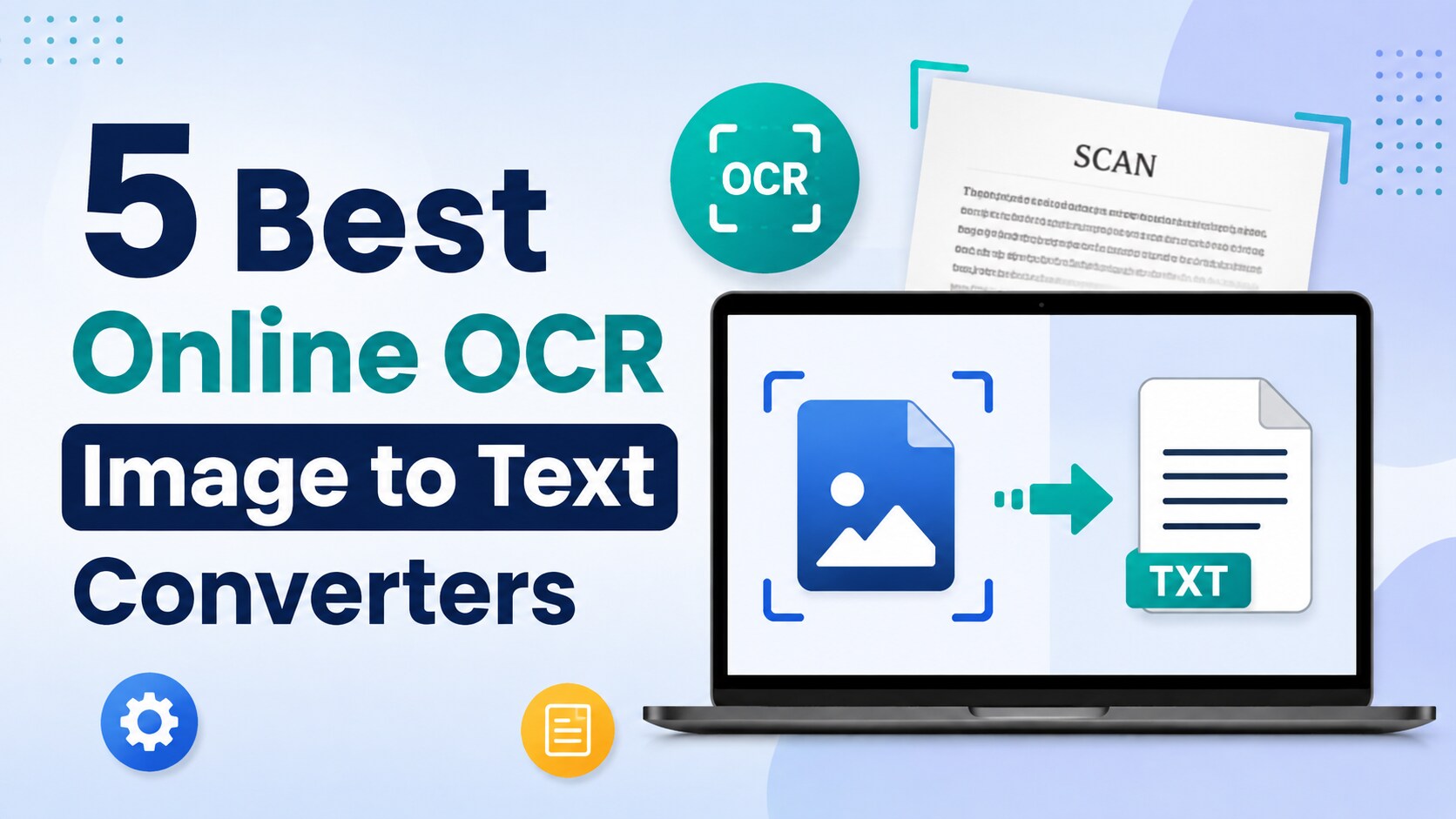
5 Best Online OCR Image to Text Converters
The best online OCR image to text converters are Imagestotext.io, Onlineocr.net, Nanonets.com, Imagetotext.info, and Imagetotextconverter.net. These tools use Optical Character Recognition (AI-based OCR) to extract editable, shareable text from images, scanned documents, and handwritten notes within seconds, with minimal grammar or spelling errors. Imagestotext.io ranks first for its free unlimited use, multilingual support, and batch processing, while the others offer strong alternatives depending on file size limits, supported languages, and output formats. Most of these tools work directly in a browser, require no installation, and don't store uploaded files, making them a fast and secure way to digitize text from any picture.
There was a time when people used to manually convert images into text for editing, sharing, or printing. It was a time-consuming and tiring task that left the extracted text with human errors, thus requiring editing, which again takes time. With the invention of Optical Character Recognition(OCR) technology, this tiring task has become the simplest and easiest.
OCR technology in the form of image-to-text converter tools enables the user to efficiently extract text from images in the blink of an eye, with zero grammar, spelling, or punctuation errors.
Why Do We Need It?
Undoubtedly, an OCR tool has revolutionized the way people used to perform picture to text conversions and provided the safest way to store confidential documents and data. Unlike human force, an AI tool will be available to the user’s aid around the clock, never get tired of converting pictures into text, and does not charge anything for constant service.
Google Lens
Google Lens is a convenient visual search and OCR tool that can recognize and extract text directly from images. You can upload a photo, scan text with your camera, select specific text, and copy it for use in other applications. Google Lens can also translate text, search selected content, and take actions based on information such as phone numbers, email addresses, and website links.
It is especially useful for students, professionals, and everyday users who need to quickly extract text from photos, screenshots, documents, signs, or handwritten content without installing dedicated OCR software.
Pros
- Easy to use
- Available through Google apps and supported browsers
- Extracts text directly from images
- Allows users to copy selected text
- Supports text translation
- Can search extracted text online
- Works with photos and screenshots
- Supports region-based text selection
- Useful for scanning documents and signs
- Can recognize phone numbers, email addresses, and website links
- Available on Android and iOS
- Useful for everyday image-to-text tasks
- No separate OCR website is required
Cons
- Requires an internet connection for many features
- OCR accuracy can vary depending on image quality
- Not designed primarily for large-scale batch document processing
- Advanced document formatting is limited
- Some features vary by device and platform
2. Onlineocr.net
Onlineocr.net is another widely-trusted image to text converter tool available online. Its capability to effortlessly convert images into text, provide the user with the choice of output file format, and multilingualism make it stand out as the second-best OCR tool. Additionally, the tool is free for unlimited usage, provides complete security to users’ data or documents, and unlike human help, it will be available for your assistance around the clock.
The picture to text converter is designed to handle large-sized images (up to 15MB) and perform a brief post-text extraction grammar check, eliminating the need for proofreading the extracted text. Its user-friendly interface, 3-step image to text conversion, web-based service, and the tool’s accessibility from smartphones, desktops, and laptops are a few other reasons for its popularity among professionals.
Pros
- Simple to use
- Free for unlimited usage
- Support 15MB image size
- Allow multilingual picture to text extraction
- Compatible with JPEG/JPG, BMP, PCX, PNG, GIF, ZIP formats
- Offers output text file format choice (docx, xlsx, or txt)
- Does not save user’s documents or data
- Offers “copy to clipboard” feature
- Web-based image to text converter
- Allows to convert images into text using email
Cons
- Limited languages allowed to copy text from images
- Does not support batch image processing
3. Image to Text Converter by Nanonets.com
Image to Text Converter by Nanonets.com is a well-reputed photo to text converter online tool. It features the most advanced OCR models to copy text from images including hand-written notes, and typed, scanned, or printed documents. The tool’s capability to handle larger images (up to 10 MB), multilinguistic image to text conversion, and simplest to use design are some of the key reasons for its utility for professionals.
Additionally, its free-of-cost use (for limited features), support for multiple image formats (PNG, JPG, and PDF), and post-text extraction grammar check add to the tool’s utility. It can be useful for students, educators, journalists, travel bloggers, journalists, and other professionals who need to convert images to text as a part of their routine.
Pros
- User-friendly interface
- Free for limited conversions of images to text
- Offers matchless accuracy (99.95%)
- Digital text is easy to share, edit, or reprint
- Support image size up to 10MB
- Compatible with PNG, JPG, and PDF image extensions
- Can be used as a converter cum translator tool
- Faster and the most efficient replacement for manual writing
- The extracted text will have no grammar, spelling, or punctuation errors
- Saves a massive time for users
- Will be available to suer’s aid 24/7 (with an active internet connection)
Cons
- Does not support multiple-image processing
4. Adobe Acrobat
Adobe Acrobat is a powerful document management and OCR solution that can convert scanned PDFs and image-based documents into searchable and editable text. Its OCR technology is particularly useful for professionals who regularly work with contracts, reports, forms, invoices, and other business documents.
With Adobe Acrobat, users can recognize text in scanned documents, edit the extracted content, search within scanned PDFs, and create more accessible digital documents. Its professional document tools also make it a suitable choice for organizations that need reliable PDF processing alongside OCR capabilities.
Pros
- Accurate OCR for scanned documents
- Converts scanned PDFs into searchable text
- Allows editing of recognized text
- Supports PDF and image-based documents
- Preserves document formatting effectively
- Makes scanned documents searchable
- Useful for professional and business workflows
- Supports document conversion and editing
- Provides tools for organizing digital documents
- Works across desktop and web platforms
- Suitable for handling professional documents
- Integrates OCR with broader PDF management features
Cons
- Many advanced features require a paid plan
- Can be more complex than basic online OCR tools
- Better suited to PDF workflows than simple image-to-text extraction
- Some features require an Adobe account
- Processing large or complex documents may require more system resources
5. Imagetotextconverter.net
Imagetotextconverter.net is a free OCR tool that can extract text from images. It is available online and is quite capable. With this tool, you can extract text from multiple images at once. The best thing about it is that you can extract text from images of printed/typed documents and handwritten ones.
Another feature of this tool is that it converts the extracted text to UNICODE. UNICODE, unlike ASCII, supports multiple languages. So, the image-to-text converter can recognize and extract text from other languages. This OCR tool is suitable for data entry operators, data analysts who need to gather data from images, and even students who simply want to digitize their notes. All in all, it is a super accessible and useful tool.
Pros
- Free to use
- No registration required
- Supports multiple image formats (PDF, PNG, JPG, WEBp etc.)
- Multiple input methods supported, including online importing through links
- Unlimited access, no paid upgrades required
- Quite Fast
- Highly accurate text extraction, even with blurred images (95%)
- Supports downloading the output in docx, pdf, and txt file formats
- One-button copying aids in quick sharing of the text
Cons
- Does not support SVG format
- Max image size is limited to 1 MB
Conclusion
The above-mentioned 05 best online OCR tools are the most accurate, reliable, and free for effortless, fastest, and 24/7 image to text extraction. Imagestotext.io is one of the leading, most versatile, and most accurate picture to text converters. Its technical and non-technical specialties make it an ideal tool for both professionals and non-professionals. Onlineocr.net is an accurate, fast, and reliable tool for text extraction from images. However, its limited features suit non-regular users and novices. Image to text converter by Nanonets.com is also a free, accurate, and efficient translator cum converter tool. It is also recommended for non-professional users. Long story short, whatever tool you choose (from the above-detailed pens), the accuracy and authenticity of the extracted text are certain and promised.
FAQ's
1.What is the best free OCR image to text converter?
Imagestotext.io is widely considered the best free OCR image to text converter because it offers unlimited free access to all its features without hidden charges. It supports batch processing of up to five images at once, recognizes multiple languages and fonts, and handles image sizes up to 10MB without losing accuracy. It also does not store uploaded documents, ensuring user privacy. Its combination of speed, accuracy, and zero cost makes it a strong choice for professionals, students, and casual users converting pictures into editable, shareable text.
2.How accurate is OCR text extraction from images?
Modern OCR tools powered by AI models achieve very high accuracy, often between 95% and 99.95%, depending on image quality. Nanonets.com claims up to 99.95% accuracy, while Imagetotextconverter.net delivers around 95% accuracy even with blurred images. Accuracy depends on factors like resolution, lighting, handwriting clarity, and font style. Clear, high-resolution, well-lit images with standard fonts produce the best results. Most tools also run a post-extraction grammar check, reducing spelling and punctuation errors so the output text needs little to no manual correction before use.
3.Can OCR tools extract text from handwritten notes?
Yes, several OCR tools including Imagestotext.io, Nanonets.com, and Imagetotextconverter.net can extract text from handwritten notes, not just typed or printed documents. These tools use advanced AI-based OCR models trained to recognize varied handwriting styles alongside standard fonts. Accuracy for handwriting is generally slightly lower than for typed text since handwriting varies widely between individuals, but the results remain usable for digitizing notes, forms, and journals. Students, researchers, and professionals often use this feature to convert physical handwritten records into searchable, editable digital text.
4.Is it safe to upload personal documents to online OCR tools?
Most reputable OCR converters, including Imagestotext.io and Onlineocr.net, state that they do not store or retain uploaded images or extracted text after processing, which makes them reasonably safe for personal use. However, since files pass through a third-party server during conversion, highly sensitive or confidential documents carry some inherent risk. It's best to review a tool's privacy policy before uploading, avoid sharing classified information, and prefer tools that explicitly confirm no data retention if privacy and document security are a primary concern.
5.Do OCR converters support multiple languages?
Yes, all five tools covered in this article support multilingual text extraction, though the number of supported languages varies. Imagetotext.info supports around 23 languages, while Imagestotext.io and Onlineocr.net offer broader multilingual recognition suited for global users. This makes OCR tools useful for translating printed or handwritten foreign-language documents into editable digital text. Language support quality can vary based on script complexity, so testing a tool with a sample image in your target language is recommended before relying on it for large-scale or professional translation and conversion projects.