Connect with us
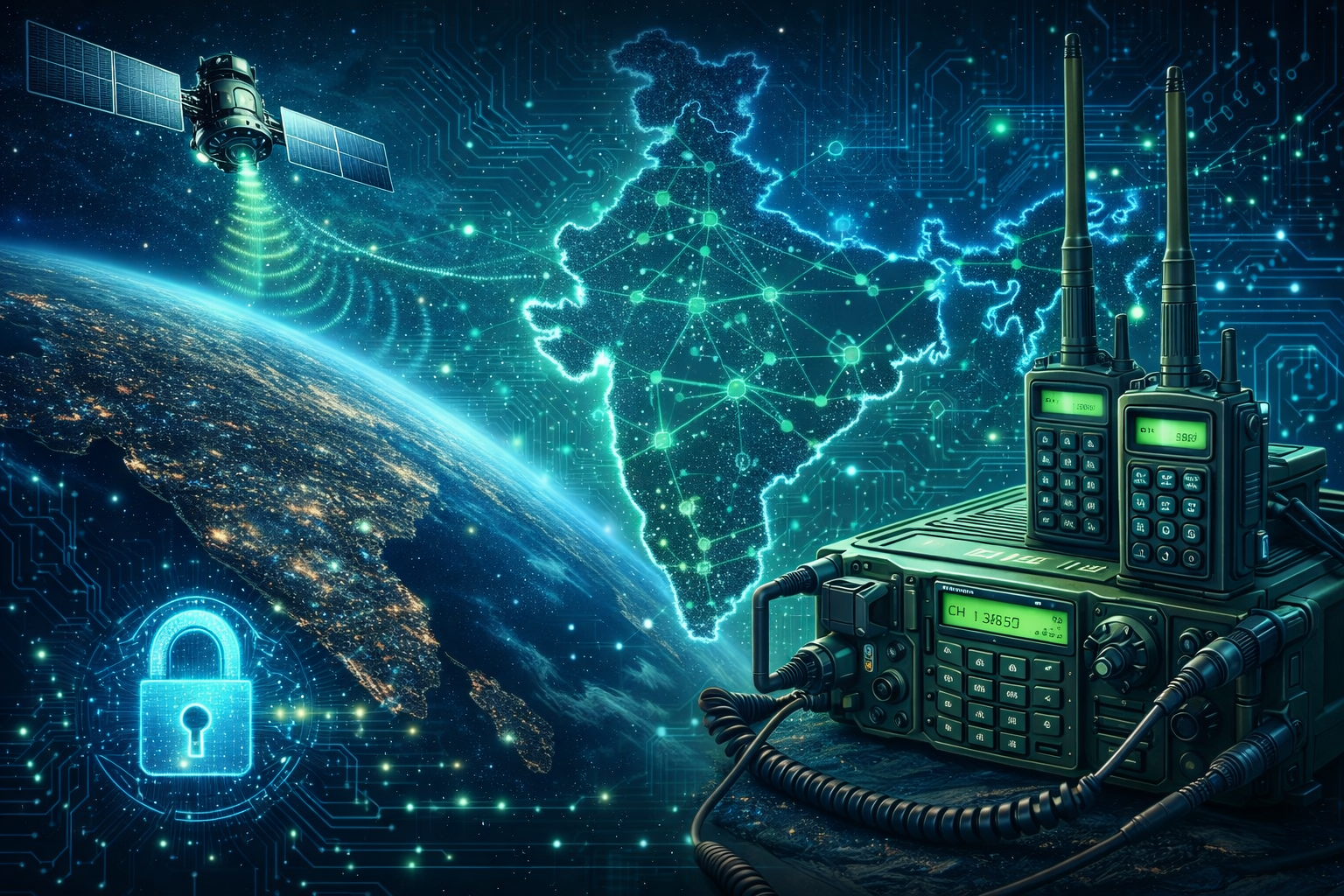
Everything You Need to Know About Military Communication Systems
Defence communication is the critical backbone of modern military operations. Fromsecure radio networks to satellite-enabled command centers, military forces depend entirely on advanced military communication infrastructure to coordinate operations across continents in real-time.
The global military communication market reached $47.5 billion in 2025 and is projected to grow at 7.8% annually through 2034,reflecting how essential these systems have become to national defense strategies.
Understanding military communication technology par ticularly military radiocommunication systems and military satellite technology is crucial for defenseprofessionals, procurement officers, and military strategists.
This guide covers the essential technologies, India's strategic capabilities, and the security protocols that keep military operations secure and resilient.
1. What Are Defense Satellites?
Defense satellites are advanced space-based systems used by nations to support military operations across multiple domains, including land, sea, air, and space.
They provide secure communication, real-time surveillance, navigation support, and strategic intelligence, making them a critical part of modern defense infrastructure.
Unlike commercial satellites designed for profit, defense satellites are engineer ed with military-grade specifications, hardened against cyber attacks, and designed to resist jamming and nuclear effects.
Defense satellites operate across various orbital altitudes. Geostationary satellites at 35,786 kilometers provide continuous coverage of fix ed regions.
Low Earth orbitsatellites at 200-2,000 kilometers offer low-latency communication for tactical operations. Each orbit type serves distinct military purposes.
Key functions of defense satellites include:
- Communications: Encrypted voice, video, and data links between commanders and deployed units
- Intelligence: High-resolution imagery for surveillance and target identification
- Early Warning: Detecting missile launches and nuclear detonations within seconds
- Navigation: GPS-guided weapons and precision targeting systems
- Command and Control: Real-time coordination across geographicallydispersed forces.
The U.S. Defense Support Program (DSP) satellites, positioned in high geostationar yorbits, detect missile launches through infrared sensors and provide criticalearly-warning time for defensive responses.
This space-based surveillance capability fundamentally changed military doctrine by enabling detection and response to existential threats.
2. Military Radio Communication: The Tactical Foundation
While satellites provide global reach, military radio communication systems form the tactical backbone enabling ground forces, aircraft, and ships to coordinate in real-time.
Modern military radio communication has evolved dramatically from legacy single-frequency systems toward software-defined radios (SDRs) that adapt to threats dynamically.
3. How Modern Military Radio Communication Works
Contemporary military radio communication systems operate across multiple frequency bands HF , VHF, and UHF with integrated encryption, frequency-hopping capability , and interoperability standards.
Software-defined radios represent the transformation: instead of hardware-locked systems, SDRs support rapid frequency switching, multi-band operability, and over-the-air software updates to counter emerging threats.
Core features of modern military radio communication:
- Encryption: AES-256 algorithms protecting against interception and signal analysis
- Frequency Hopping: Rapid frequency switching that defeats narrowband jamming attacks
- Low Probability of Intercept: Waveforms designed to evade adversary detection systems
- Interoperability: NATO STANAG standards enabling coalition operations
- Rugged design: Military-grade equipment functioning in extreme environments
The man-portable military communication systems market alone reached $9.56 billion in 2025, expanding at 13.05% annually , demonstrating the critical importance military organizations assign to tactical communication infrastructure.
4. Military Communication Satellites of India: Strategic Capability India
India has strategically developed a dedicated constellation of military communication satellites to achieve operational independence and network-centric warfare capability .
Rather than relying on foreign satellite operators, India's GSAT constellation provides secure, encrypted communications exclusively for Indian armed forces.
5. India's Active Military Satellite Fleet
GSAT-7 (Rukmini) is dedicated to Indian Navy operations, launched in 2013.
Operating in the L-band frequency , this satellite simultaneously supports communications for more than 50 naval ships and aircraft across the Arabian Sea and Bay of Bengal.
GSAT-7 removed India's dependence on foreign commercial systems like Inmarsat, enabling the Navy to maintain network-centric operations across 7,000 kilometers of coastline.
GSAT-7A (Angry Bird), launched in December 2018, is the first dedicated communication satellite for the Indian Air Force.
Operating in the Ku-band frequency with 10 switchable transponders, GSAT-7A provides:
- Real-time secure communication between ground radar stations and air bases
- Aircraft-to-aircraft coordination through airborne early warning systems
- Integration with unmanned aerial vehicle (UAV) networks
- Support for reconnaissance and surveillance operations
GSAT-6, deployed in 2015 and operating in the S-band, provides communication to armed forces in remote and border areas where terrestrial networks fail.
This satellite is essential for operations in the Himalayan frontier regions and island territories.
6. Next-Generation Satellites Expanding Capability
India recently signed a ₹3,100-crore contract for GSAT-7B, the first dedicated communication satellite for the Indian Army.
This advanced platform will integrate with the AkashTeer air defense system, transforming ground forces into a network-centric warfare-capable entity capable of real-time coordination with air and naval assets.
In November 2025, ISRO successfully launched CMS-03, India's heaviest communication satellite at 4,400 kilograms, providing multi-band communication services across India and neighboring ocean regions.
7. Why India Needs Military Communication Satellites
The Indian subcontinent spans 3.3 million square kilometers with diverse terrain ranging from deserts to mountains to coastal regions. Terrestrial networks cannot provide reliable coverage across this entire geography.
Military communication satellites overcome geographic barriers, enabling commanders in New Delhi to coordinate operations with units deployed in remote Himalayan locations or distant island territories.
Additionally , dedicated military satellites ensure operational independence India maintains exclusive control over military communication infrastructure, free from foreign interference or denial during crises.
8. Security: Protecting Military Communications
Modern military communication systems face constant cyber threats from nation-state adversaries and advanced persistent threats.
Military organizations implement multiple security layers to protect communications from interception, jamming, and cyber attacks.
9. Encryption and Security Protocols
Military communications employ AES-256 encryption far exceeding civilian commercial standards to make intercepted transmissions useless without proper decryption keys.
NATO's STANAG protocols establish comprehensive security
practices including:
- Advanced encryption algorithms resistant to computational attacks
- Authentication procedures verifying authorized users
- Data integrity mechanisms detecting tampering
- Regular updates addressing emerging cryptographic vulnerabilities Additional protocols include IPSec (Internet Protocol Security) for network-layer encryption and TLS (Transport Layer Security) for application-layer security, adapted specifically for military use with NSA Suite B cryptography.
10. Defense Against Jamming and Electronic Warfare
Adversaries employ sophisticated electronic warfare to degrade military communications.
Defense mechanisms include:
- Frequency hopping: Microsecond-level frequency switching making narrowband jamming ineffective
- Spread spectrum: Distributing signal power across wide frequency bands
- Adaptive antenna steering: Suppressing interfering signals while maintaining friendly communications
- Real-time threat detection: AI-powered systems identifying cyber threats as they emerge
11. Advantages of Military Radio Communication in Defence Operations
Military radio communication continues to be a trusted and essential tool for defence forces due to its reliability in critical situations.
Unlike internet-dependent systems, radio communication operates independently, making it suitable for hostile and remote environments
Key advantages include:
Works without internet or public networks
Reliable in remote and battlefield conditions
Faster real-time coordination during missions
Resistant to infrastructure failures
Essential for emergency and backup communication
These advantages make military radio communication a core component of modern defence communication systems, even as newer technologies emerge.
Conclusion
Defence communication is the backbone of modern military operations. India's GSAT constellation GSA T-7, GSAT-7A, GSAT-6, and upcoming GSAT-7B establishes the nation as a space-capable military power.
Combined with secure tactical radio systems and cybersecurity protocols, these capabilities enable network-centric operations with confidence.
For defense professionals, investing in resilient communication systems today ensures operational superiority tomorrow.
Troop Messenger embodies this evolution integrating satellite connectivity ,software-defined radios, and military-grade encryption into secure, user-friendly
platforms for real-time coordination.
FAQ: Common Questions About Military Communication
1: What advantage do military satellites provide over terrestrial networks?
A: Military satellites enable global coverage in remote and hostile environments. They enable beyond-line-of-sight (BLOS) communication, allowing coordination between units separated by hundreds of kilometers without relay infrastructure.
2: How do military radios prevent jamming?
A: Modern systems use frequency-hopping spread spectrum (FHSS) rapidly switching transmission frequencies unpredictably . Encrypted waveforms and spread-spectrum techniques reduce signal detectability , making jamming difficult.
3: Why do militaries use multiple satellite orbits?
A: Each orbit serves different needs. Geo stationary satellites offer capacity but high latency. Low Earth orbit satellites provide low-latency coverage with limited capacity Multi-orbit networks provide both flexibility and resilience.
4: What cybersecurity threats target military communications?
A: Nation-state attacks, signal interception, traffic analysis, and jamming. Defense: end-to-end encryption, multi-fact or authentication, intrusion detection, and information compartmentalization.
5: How do allied militaries ensure communication interoperability?
A: Standardized cybersecurity frameworks, interoperable encryption protocols, and compliance with international standards like STANAG enable secure coordinated operations.