Connect with us
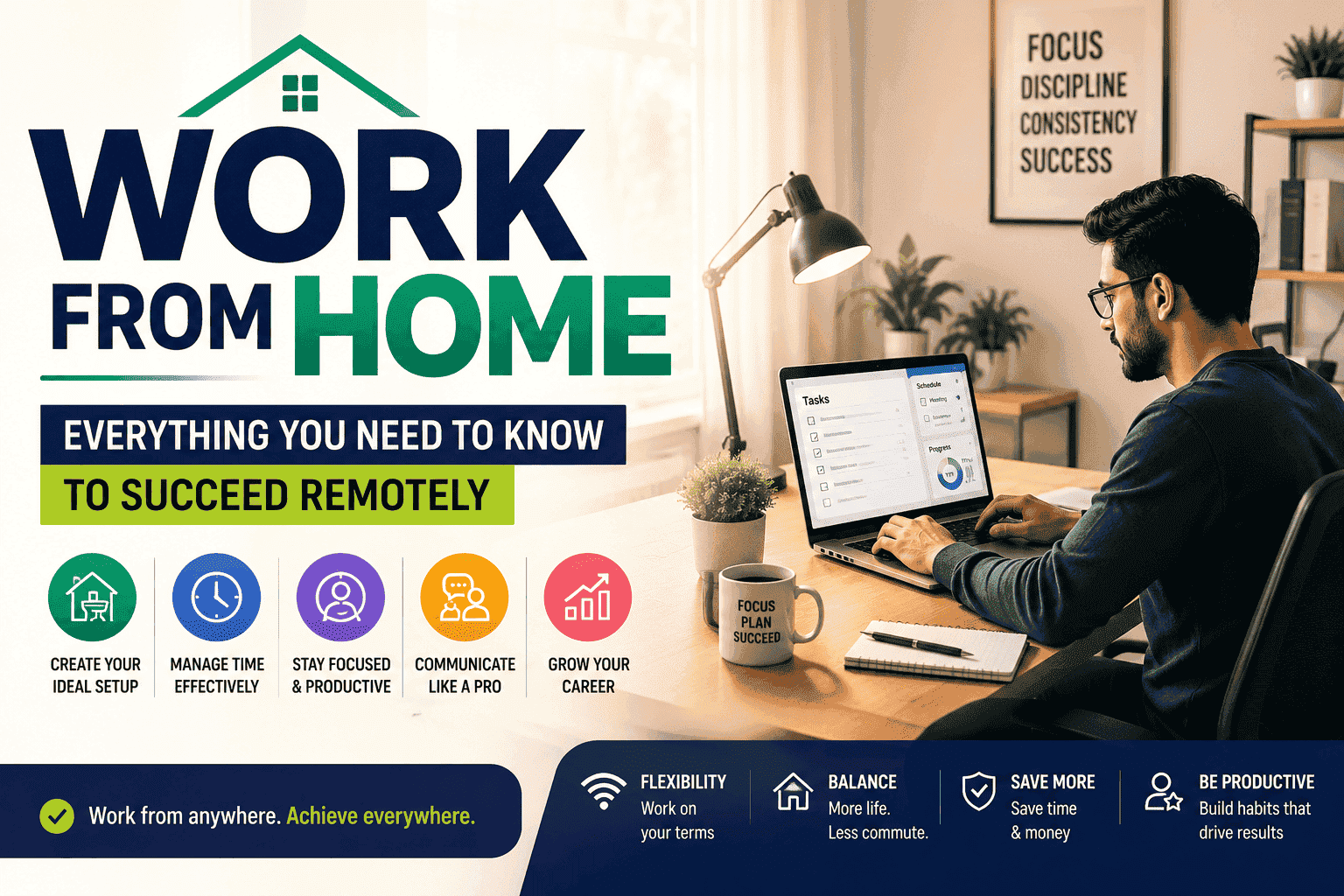
Work From Home — Everything You Need to Know to Work Remotely
Work from home has shifted from a temporary pandemic-era arrangement into a permanent fixture of the modern labor market, with millions of professionals now choosing remote or hybrid roles over traditional office work.
This guide covers exactly what you need:
- Work from home jobs — the most in-demand remote roles right now
- How to find legitimate opportunities — including Amazon work from home and part time options
- Daily habits and tools that actually make remote work productive
- How AI is changing work from home opportunities
- A step-by-step process to apply for work from home jobs successfully
What Is Work From Home and How Has It Changed Work
Work from home means performing your job duties remotely instead of commuting to a physical office, using internet-based tools to stay connected with colleagues and complete tasks. Approximately 34.3 million employed Americans teleworked or worked from home for pay as of April 2025, with the overall telework rate holding steady between 18% and 24% since late 2022.
The shift has proven far more durable than early skeptics expected. About 27% of paid full-time workdays in the United States are now worked from home, up dramatically from just 7% in 2019, while full work-from-home days alone account for 26% of paid workdays.
Work From Home Jobs — Most In-Demand Remote Roles
Remote-capable roles are concentrated heavily in knowledge work, with technology leading at 47% fully remote and finance and insurance following at 40%. Common in-demand work from home jobs span customer service, data entry, software development, digital marketing, virtual assistance, and content writing.
Remote job postings also attract significantly larger candidate pools than on-site listings — up to 340% larger — while seeing higher offer acceptance rates and faster hiring timelines. This makes remote roles especially competitive, so tailoring applications to highlight remote-specific skills like self-management and async communication genuinely helps candidates stand out.
Amazon Work From Home — Is It Legitimate and How to Apply
Amazon does offer legitimate work from home positions, including customer service, virtual call center roles, and various corporate remote positions. These openings are posted directly on Amazon's official careers page, and legitimate listings never ask candidates to pay upfront fees for training, equipment, or background checks.
To apply, search specifically for "remote" or "virtual" roles within Amazon's careers portal, since not every Amazon position is eligible for work from home. Be cautious of third-party job boards or unsolicited messages claiming to represent Amazon — verifying any opportunity directly through Amazon's own career site is the safest way to confirm legitimacy before sharing personal information.
Part Time Work From Home Jobs — Best Options for Flexible Workers
Part time work from home jobs are common in customer support, transcription, virtual tutoring, freelance writing, and social media management. These roles typically offer flexible scheduling, making them well suited to parents, students, or anyone balancing work with other responsibilities.
Married workers, parents, and women are statistically more likely to take on remote or part time remote arrangements, often because flexible work supports caregiving responsibilities alongside paid employment. Nearly 25% of employed women worked from home as of April 2025, compared to about 19% of employed men.
Best Remote Work Jobs From Home — Top Picks Across Industries
The strongest remote opportunities currently span technology, finance, healthcare administration, education, and creative services. Technology roles in particular benefit from a structural advantage — AI-related jobs are three times more likely to offer remote options compared to other job categories, reflecting how quickly tech-adjacent work has adapted to distributed teams.
Workers who work from home also earn meaningfully higher hourly wages on average compared to fully on-site employees, even before adjusting for occupation and education differences — a trend that continues to make remote-capable industries especially attractive to job seekers prioritizing both flexibility and compensation.
Work From Home Jobs No Degree Required
Several legitimate remote career paths do not require a bachelor's degree, including customer service representative roles, data entry positions, virtual assistant work, and entry-level technical support. That said, education remains a strong predictor of remote access overall — workers with a bachelor's degree telework at significantly higher rates than those with only a high school diploma.
For job seekers without a degree, building demonstrable skills through certifications, portfolio projects, or freelance work history can meaningfully improve competitiveness for these no-degree-required remote roles, since employers often weigh proven capability alongside formal education.
Work From Home Jobs for Female Professionals
Remote work has become a significant enabler of workforce participation for women, particularly those balancing caregiving responsibilities. Nearly one in four employed women in the U.S. currently work from home, a rate notably higher than their male counterparts.
Common remote roles attracting strong female participation include healthcare administration, education and tutoring, customer service, project coordination, and human resources support — fields where flexible scheduling directly supports the dual demands of professional and personal responsibilities.
Online Jobs Work From Home — Where to Find Them
Legitimate online work from home jobs can be found through established job boards, company career pages, and verified freelance platforms. Searching directly on trusted sites and filtering specifically for remote listings remains the most reliable approach, since legitimate employers rarely require upfront payments or guarantee unrealistic earnings.
When evaluating any online job posting, watch for warning signs like vague job descriptions, requests for personal financial information before an offer, or promises of unusually high pay for minimal work — all common indicators of job scams targeting remote job seekers specifically.
Remote Work From Home — How to Stay Productive Every Day
Productivity remains the most debated topic in remote work conversations, and the data genuinely supports both employees and employers when arrangements are structured well. Some research shows remote workers experiencing a measurable productivity increase, often attributed to fewer breaks, reduced sick days, and fewer in-office distractions.
That said, confidence in measuring remote productivity remains a real challenge for many organizations, with a notable share of leaders reporting they are not fully confident in how they track team output remotely. This makes individual habits and clear self-management even more important for remote employees who want to demonstrate consistent value.
Work From Home Tips — Daily Habits That Make the Difference
Successful remote workers consistently rely on a few core habits: maintaining a dedicated workspace separate from personal living areas, setting clear start and end times to prevent overwork, and batching communication into specific windows rather than reacting to every notification immediately.
Equally important is proactive, visible communication with managers and teammates, since remote work removes the natural visibility that comes from being physically present in an office. Sharing regular written updates on progress and blockers helps build the trust that remote employees often need to actively demonstrate rather than assume.
Work From Home Tools and Technology — Improving Productivity, Collaboration, and Communication
The right remote work tools do more than simply let employees message or video call from home — they directly shape how efficiently a distributed team operates day to day. When communication, file sharing, and project tracking are scattered across disconnected apps, employees lose time piecing together context that should already be visible in one place, which slows decisions and creates unnecessary back-and-forth between colleagues.
Strong collaboration tools solve this by keeping conversations, decisions, and shared files connected rather than fragmented, which reduces the time teams spend simply trying to figure out what already happened. This directly supports business outcomes that organizations care about most: faster decision-making, fewer redundant meetings, and stronger accountability across remote employees who are not physically visible to managers day to day.
Communication tools specifically play an outsized role in this equation. Teams using consolidated messaging platforms tend to send significantly fewer internal emails and reduce the operational drag caused by switching between multiple disconnected apps, which collectively costs businesses substantial amounts in redundant software licenses every year. For remote-first businesses, investing in the right communication and collaboration stack is not simply a convenience — it is a direct driver of efficiency, trust, and measurable output across distributed teams.
Work From Home and Artificial Intelligence — How AI Is Changing Remote Work
AI is reshaping remote work faster than almost any other workplace trend, with the majority of remote and hybrid workers across generations reporting that AI tools genuinely benefit their productivity. Younger workers in particular report the strongest gains, though older generations are also adopting AI-assisted workflows at meaningful rates.
AI-related jobs themselves are significantly more likely to offer remote options compared to other roles, reinforcing a feedback loop where the skills most in demand for remote work increasingly involve working alongside AI tools rather than being replaced by them. For remote job seekers, building basic AI literacy is quickly becoming as important as traditional remote-work skills like self-management and written communication.
How to Apply for Work From Home Jobs Step by Step
Start by identifying your target role and searching exclusively through verified job boards and direct company career pages rather than relying on unsolicited offers. Tailor your resume specifically to highlight remote-relevant skills, including self-management, written communication, and any prior remote work experience, even informal.
Prepare for virtual interviews by testing your equipment and internet connection in advance, and be ready to speak directly to how you stay productive and accountable without in-person supervision. Once an offer is extended, verify all details directly with the employer's official channels before sharing sensitive personal or financial information, since legitimate employers never require payment from candidates as a condition of employment.
Work From Home Challenges and How to Overcome Them
Common challenges include isolation, difficulty separating work from personal life, and unclear expectations around availability and output measurement. Many remote team leaders themselves report difficulty confidently measuring productivity across different roles, which means employees benefit from proactively documenting their own progress rather than waiting to be asked.
Addressing isolation requires intentional effort — scheduling regular check-ins with colleagues, participating in virtual team activities, and maintaining clear communication channels all help offset the lack of casual in-person interaction that office environments naturally provide.
Conclusion
Work from home has moved well beyond a temporary pandemic response into a lasting structural shift in how millions of people earn a living, with strong data supporting both its productivity benefits and its long-term staying power.
Quick summary:
- Work from home now represents roughly a quarter of all paid workdays in the U.S., up sharply from pre-pandemic levels
Legitimate remote jobs span every major industry, with technology and finance leading adoption - Daily habits like dedicated workspaces and proactive communication directly determine remote work success
- AI tools are increasingly central to remote productivity and to the types of jobs available remotely
- Caution remains essential when evaluating job postings, since remote work scams specifically target job seekers searching from home
The professionals who succeed most at remote work are not necessarily the most talented , they are the ones who build consistent habits, communicate proactively, and treat their home workspace with the same discipline as a traditional office.
Frequently Asked Questions (FAQs)
Q1. Is Amazon work from home legitimate?
Yes, Amazon does offer legitimate work from home positions, including customer service, virtual call center roles, and select corporate remote jobs. These openings are posted directly on Amazon's official careers page, and legitimate listings never require candidates to pay upfront fees for training, equipment, or background checks. To avoid scams, always apply through Amazon's verified careers portal rather than third-party job boards or unsolicited messages, and be cautious of any opportunity that promises guaranteed high pay for minimal effort, since these are common red flags in fake remote job listings.
Q2. What work from home jobs are available without a degree?
Several legitimate remote roles do not require a bachelor's degree, including customer service representative positions, data entry, virtual assistant work, and entry-level technical support. While education does correlate with higher remote work access overall, candidates without a degree can strengthen their competitiveness by building demonstrable skills through certifications, freelance project history, or relevant portfolio work. Employers in these roles often weigh proven capability and communication skills as heavily as formal education, making it possible to build a genuine remote career path without a traditional degree.
Q3. How can I stay productive while working from home?
Staying productive while working from home starts with maintaining a dedicated workspace separate from personal living areas and setting clear start and end times to prevent overwork. Successful remote workers also batch communication into specific windows rather than reacting to every notification immediately, which helps protect focused work time. Proactive, visible communication with managers and teammates is equally important, since remote work removes the natural visibility of an office environment, making regular written updates on progress and blockers essential for building trust with colleagues.
Q4. What tools do I need to work from home effectively?
Effective remote work depends on tools that keep communication, file sharing, and project updates connected rather than scattered across disconnected apps. The right collaboration and messaging tools reduce the time spent piecing together context, leading to faster decisions and fewer redundant meetings. Beyond basic video conferencing, remote workers benefit most from a consolidated communication platform that combines messaging, calls, and file sharing in one place, since switching between too many separate tools creates unnecessary friction and slows down day-to-day collaboration with teammates.
Q5. How is AI changing work from home opportunities?
AI is significantly reshaping remote work, with most remote and hybrid employees across all age groups reporting that AI tools genuinely improve their productivity. AI-related jobs are also three times more likely to offer remote options compared to other roles, creating a growing demand for remote workers who are comfortable using AI-assisted tools in their daily workflow. For job seekers, building basic AI literacy is quickly becoming as valuable as traditional remote work skills like self-management, written communication, and proactive collaboration with distributed teams.