Connect with us
Remote Work Trends 2026: Complete Report & Statistics
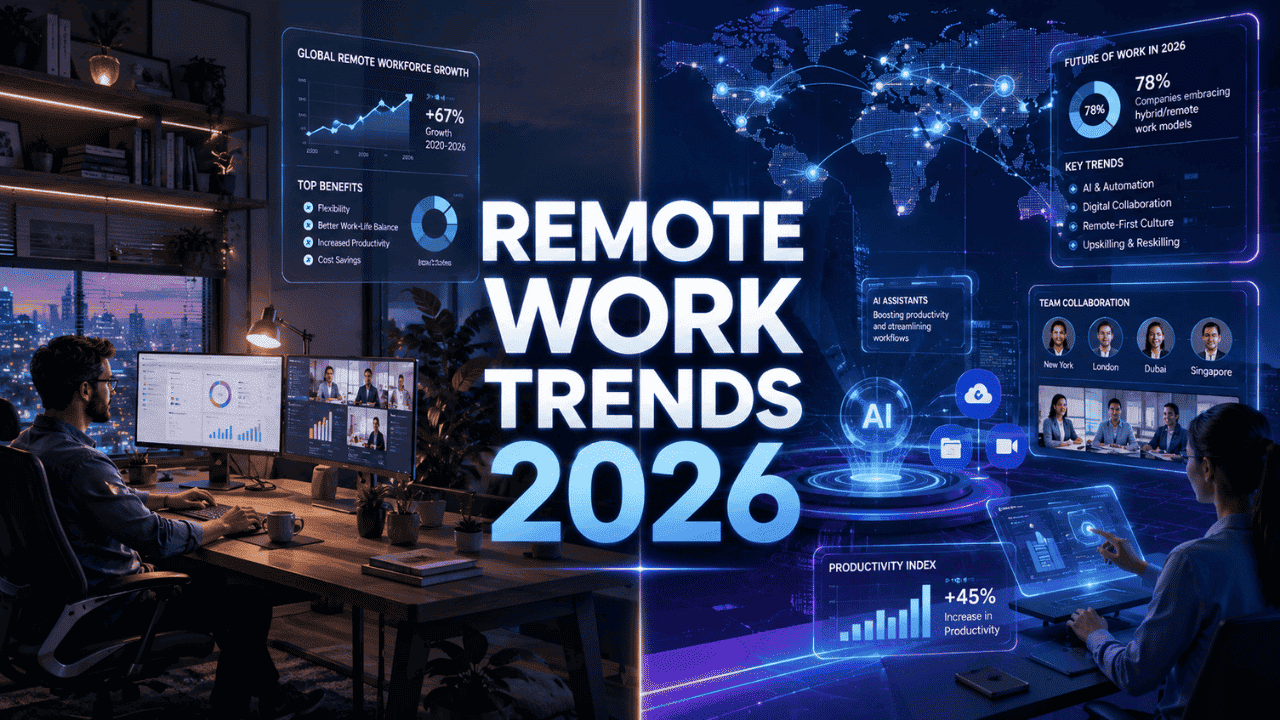
Hybrid work won. Not loudly, not with a press release, but the numbers settled it sometime in the last eighteen months. If you're trying to figure out where remote work actually stands in 2026, past the headlines about Amazon and JPMorgan dragging people back to desks, the data tells a more layered story than "remote is dying" or "remote is everything now." It's neither. It's something more specific, and a little messier, which is usually how real workplace shifts go.
This report pulls together the latest remote work trends 2026 has produced, across prevalence, productivity, pay, AI adoption, and what's coming next. Updated regularly, so the numbers here reflect Q1–Q2 2026 reporting, not 2022 pandemic-era stats that keep getting recycled.
Key Remote Work Statistics for 2026
If you only have two minutes, here's the shape of it:
- 23.4% of U.S. employees work remotely at least part of the time, more than 37 million people
- 26% of all paid U.S. workdays are now performed remotely
- 53% of remote-capable workers are hybrid, 27% fully remote, 20% fully on-site
- 61% of U.S. companies now have formal return-to-office policies
- Remote job postings grew 20% quarter-over-quarter in Q1 2026
- Remote employees earn roughly 12% more on average than on-site peers
- 86% of fully remote employees report burnout
None of those numbers cancel each other out, which is part of what makes this year confusing to write about. Growth and burnout. Mandates and resistance. Both true at once.
How Many People Work Remotely in 2026?
The headline figure, repeated everywhere this year, is that 23.4% of U.S. employees work remotely at least part of the time, putting the total above 37 million people. Separately, the Bureau of Labor Statistics' broader telework data puts the share of all paid workdays performed remotely at 26%.
What's notable isn't the raw percentage. It's that the line stopped moving. For three years running, analysts kept predicting a steady decline back toward 2019 levels. It hasn't happened. The number has flattened instead, sitting well above pre-pandemic norms and refusing to drop further despite some very public pressure campaigns.
Remote vs. Hybrid vs. Fully On-Site Breakdown
Among workers in remote-capable roles specifically, Gallup's 2026 data shows 53% are hybrid, 27% fully remote, and 20% fully on-site. That hybrid majority is the real story of this cycle, fully remote work isn't growing the way it did in 2021, but hybrid arrangements have become the default expectation for entire categories of knowledge work.
Remote Work by Industry
Job posting data shows real variation by field. Technology, marketing and creative, and legal roles post the highest share of hybrid and fully remote listings. Healthcare and administrative or customer support roles sit at the other end, staying overwhelmingly on-site by necessity. If you're job hunting and flexibility matters to you, the field you're in still does most of the work in determining your odds.
The Return-to-Office Pushback
This is where 2026 gets contentious. Roughly 61% of U.S. companies now have a formal RTO policy in place, and the reasons employers give are fairly consistent: collaboration, productivity, communication. Amazon, JPMorgan Chase, Dell, and the federal government have all pushed harder on in-office requirements, and that pressure trickles down, research suggests over half of businesses say major corporate RTO decisions shaped their own policy thinking.
Here's the part that doesn't get said enough: the mandates aren't actually working the way they're supposed to. Badge-swipe and cell-phone-tracking data show employees simply aren't showing up at the rate their employers are demanding. Remote work in early 2025 was still measurably higher than it had been back in October 2022, despite years of RTO announcements stacked on top of each other.
Why Employees Are Resisting
The resistance isn't abstract. Surveys show 76% of workers would quit if remote options were removed entirely, and among people actively job hunting, 85% cite remote work as their primary motivator. Among workers who believe RTO mandates are really about something else, the most common explanations are office-lease economics and a desire for tighter oversight, not collaboration. Whether that's fair to employers is a separate question. It's what a large share of employees believe, and belief shapes behavior regardless of whether the official explanation matches it.
Hybrid Work Is the New Default
If there's one phrase that captures 2026, it's this: hybrid stopped being a compromise and became the baseline. Roughly 52% of remote-capable employees now work a hybrid arrangement, according to Gallup, and that share has held steady rather than eroding the way some return-to-office advocates predicted.
What "Hybrid" Actually Means in 2026
The term covers a wider range of arrangements than it used to. Some companies mandate two fixed office days. Others let teams self-organize around three. A smaller group has moved toward "anchor weeks", concentrated in-person stretches a few times a quarter instead of weekly office days. None of this is standardized, and that lack of standardization is itself a trend worth naming: companies are still experimenting four years past the point most assumed this would be settled.
Ideal Hybrid Schedules According to Employees
When asked directly, most workers don't want fully remote and don't want fully on-site either. They want a say in which days they come in, and they want that flexibility protected rather than negotiated fresh every quarter. Trust comes up constantly in this research. Remote workers are roughly twice as likely as in-office workers to say their management actually trusts them, which says something uncomfortable about how a lot of offices are still run.
Remote Work and Productivity Trends 2026
This is the argument that should have been settled by now, and largely has been, even though the public conversation hasn't caught up.
A Bureau of Labor Statistics study across 61 industries found a measurable positive relationship between remote work adoption and total factor productivity growth, a one-point increase in remote work participation correlates with roughly a 0.08 to 0.09 point increase in productivity growth, holding even after controlling for pre-pandemic trends. Separately, 77% of remote employees self-report being more productive at home than in an office, and 71% of managers agree remote or hybrid arrangements help their teams perform, against just 11% who say it hurts.
What the Data Says About Output and Performance
Across multiple independent surveys, the productivity numbers cluster in a similar range: somewhere between 70% and 85% of remote workers report feeling more focused or more productive outside a traditional office. Fewer interruptions gets cited constantly as the reason. So does control over environment.
The Manager-vs-Data Disconnect
Here's the gap nobody talks about enough. Around 85% of leaders privately doubt that distributed teams are actually performing well, even while the productivity research consistently shows stable or improved output. That mismatch is driving a lot of the invasive monitoring software and blanket RTO mandates showing up this year, not data, but a feeling that something must be going wrong if you can't see it happening.
University research backs this up from the other direction: RTO mandates have been shown to hurt employee satisfaction without producing any measurable financial improvement. Planned return-to-office policies reduce actual work-from-home rates by less than half a percentage point, according to Stanford's tracking data. People find workarounds. They always do.
AI's Growing Role in Remote Work
The other defining thread of 2026 is how quickly AI tools have become infrastructure for distributed teams, not just a productivity add-on. Video collaboration platforms have effectively become the connective layer holding hybrid teams together, with usage data showing hundreds of millions of daily active users on tools like Zoom alone, a dramatic jump from single-digit millions before the pandemic.
AI Tools Reshaping Distributed Teams
Meeting equity has become a real design problem this year: making sure remote participants and in-room participants get equal airtime, equal visibility, equal influence on decisions. AI-assisted transcription, summarization, and async meeting tools are being adopted specifically to solve this, not as novelty features.
Skills Employers Want in 2026
The World Economic Forum projects that 39% of current worker skills will be transformed or made obsolete between 2026 and 2030, even as 170 million new jobs are expected to be created globally over that window. For remote and hybrid workers specifically, the skills gap is shifting fast, async communication, AI-tool fluency, and self-directed project management are showing up in job postings at a rate that didn't exist three years ago.
Remote Work, Travel, and Digital Nomad Trends 2026
One of the more durable side effects of remote work's normalization is how many people have started treating location as genuinely optional. Digital nomad numbers have crossed 40 million worldwide, with over 18 million from the U.S. alone, a jump of roughly 147% since 2019.
Workation and Remote-Work Travel Growth
Nearly four in ten remote workers say they'd work from another country entirely if their employer allowed it, and the share is only slightly lower among hybrid workers. This is pushing demand for longer-stay accommodations, coworking spaces in secondary cities, and travel products built specifically around "work from here for a month" rather than a typical one or two-week vacation.
Digital Nomad Visa and Policy Trends
Governments have noticed. More countries have introduced or expanded digital nomad visa programs this year, competing directly for the tax revenue and local spending that comes with hosting remote workers for extended stretches. Expect this trend to keep accelerating as the gap between "where people live" and "where people are employed" keeps widening.
Compensation: Do Remote Workers Earn More or Less?
The pay data this year is more favorable to remote workers than the conventional wisdom suggests. On average, remote employees earn about 12% more than on-site employees, and before adjusting for occupation, education, and experience, the raw wage gap is even larger, over 35% higher hourly pay.
Remote Pay Gap Data
That said, it's not uniform. Some tech workers report willingness to accept lower salaries, in some surveys as much as 25% lower, purely for the option of hybrid or fully remote work. Over half of in-person employees surveyed said they'd trade an average of 11% in salary for permanent remote or hybrid status. The honest read here: flexibility has a real, quantifiable price, and a meaningful share of the workforce is willing to pay it themselves rather than wait for employers to offer it.
What Workers Will Trade for Flexibility
Salary and remote work now rank as the top two priorities employees report when evaluating a job, ahead of most traditional benefits. Roughly 9% of U.S. workers said they'd accept a 20% pay cut specifically to work remotely, and another 21% would take a 10% cut. That's not a small or fringe group anymore.
Remote Work and Employee Wellbeing
The wellbeing data is where this report gets less tidy, and probably should.
Remote workers report feeling trusted more, stressed less, and in control of their schedules. Nearly 99% of professionals say remote or hybrid work is better for their mental health overall. But 86% of fully remote employees also report experiencing burnout, which on its face contradicts the trust-and-flexibility narrative until you look closer.
Burnout Among Fully Remote Workers
The pattern researchers keep flagging is boundary erosion. Flexibility without structure tends to bleed work into every part of the day, especially for people without a hard stop built into their schedule. Remote work removes the commute that used to function as a psychological off-switch for a lot of people, and most companies haven't replaced that with anything intentional.
Mental Health and Work-Life Balance Stats
About 65% of remote workers say managing stress is easier remotely, and over 80% say remote work improved their overall work-life balance. Both of those things are true at the same time as the burnout numbers. People can simultaneously prefer remote work and still struggle to switch off inside it.
The Four-Day Workweek and Other Emerging Models
A smaller but growing slice of companies are pairing hybrid arrangements with compressed schedules. Early pilots of four-day workweeks show productivity holding flat or improving, employee satisfaction rising, and resignation rates dropping measurably when companies shift from full-time office attendance to a hybrid, compressed model. These experiments still represent a minority of employers, but the direction of the data is consistent enough that more companies are watching closely rather than dismissing it as a gimmick.
What's Next: Remote Work Predictions Beyond 2026
Office Space and Real Estate Shifts
With more than half of remote-capable employees now working hybrid, a lot of commercial office space sits underused on any given day. Companies tracking actual occupancy data, rather than headcount on paper, are starting to right-size their real estate footprint, in some cases cutting costs by 25% or more without any measurable hit to employee experience.
Cybersecurity Risks for Distributed Teams
Distributed teams expand the attack surface, and the data reflects it. A large share of organizations reported a successful phishing or social engineering attack on remote workers in the past year. Projected cybersecurity spend tied specifically to remote infrastructure is expected to climb to roughly $15.8 billion by 2028, up sharply from current levels, with AI-driven security tools becoming a top budget priority for the year ahead.
Conclusion
Pull back far enough and 2026 isn't really a story about remote work winning or losing. It's a story about two groups operating on different timelines. Employers are still measuring this year against a pre-2020 baseline that probably isn't coming back, no matter how many RTO emails go out. Employees are measuring it against the version of work they got a taste of and aren't willing to give up without a fight.
The data backs the workforce more than it backs the mandates, at least so far. Productivity holds. Output holds. The trust gap is the thing that hasn't closed, and that's a leadership problem more than a remote work problem.
What happens from here probably gets decided company by company, not by any single trend line in this report.
FAQs
1. What are the biggest remote work trends in 2026?
Remote work in 2026 is defined by the rise of hybrid work, increased AI adoption, and flexible workplace policies. Around one in four employees now works remotely at least part of the time, while hybrid arrangements have become the preferred model for many organizations. Companies are also investing in collaboration tools, cybersecurity, and employee wellbeing as distributed teams become a permanent part of modern business operations.
2. Is remote work still growing in 2026?
Yes, although growth has stabilized rather than accelerated. Instead of expanding rapidly like it did during the pandemic, remote work has reached a sustainable level where hybrid work dominates. Organizations continue hiring remote talent for specialized roles, while many businesses combine office and remote work to improve flexibility, productivity, and employee satisfaction without fully abandoning physical workplaces.
3. Is hybrid work replacing fully remote work?
Hybrid work has become the preferred choice for many organizations because it balances flexibility with in-person collaboration. While fully remote positions remain popular, especially in technology and digital industries, employers increasingly adopt hybrid schedules to encourage teamwork and maintain company culture. Employees also value hybrid models because they provide flexibility without requiring a full-time office presence.
4. Does remote work improve productivity?
Multiple studies indicate that remote and hybrid employees often maintain or improve productivity compared to traditional office workers. Fewer workplace distractions, flexible schedules, and reduced commuting contribute to higher efficiency for many professionals. However, productivity also depends on effective communication, clear expectations, strong leadership, and access to reliable collaboration tools that support distributed teams.
5. Which industries offer the most remote jobs in 2026?
Technology, software development, digital marketing, finance, consulting, design, legal services, and customer support continue to offer the highest number of remote and hybrid opportunities. Industries requiring physical presence, such as healthcare, manufacturing, hospitality, and retail, remain largely on-site. The nature of the work continues to be the biggest factor influencing remote work availability.
6. How is AI changing remote work in 2026?
Artificial intelligence is transforming remote work by automating repetitive tasks, improving virtual collaboration, generating meeting summaries, assisting with project management, and enhancing productivity. AI-powered tools also help distributed teams communicate more effectively across different time zones. As businesses continue adopting AI, employees with AI-related skills are becoming increasingly valuable in remote and hybrid workplaces.
7. Will companies continue return-to-office policies in 2026?
Many organizations are maintaining return-to-office policies, but the overall trend favors hybrid work rather than full-time office attendance. Businesses continue experimenting with flexible schedules that balance collaboration and employee preferences. While some large corporations require more office presence, employee demand for flexibility remains strong, encouraging employers to adopt more balanced workplace strategies.